Podcast: Download (Duration: 47:29 — 54.6MB)
The Google SEO apocalypse is real. Google is drowning in AI-generated spam, has promoted Reddit, Quora and LinkedIn to dominate the top of the SERPs, and is running back-to-back updates that keep breaking rankings for legitimate publishers. A student in my mastermind saw an old blog post outranked by a random LinkedIn post from someone with no expertise, and one of Spencer Haws’s contest participants ranked 850 AI-written articles in 30 days.
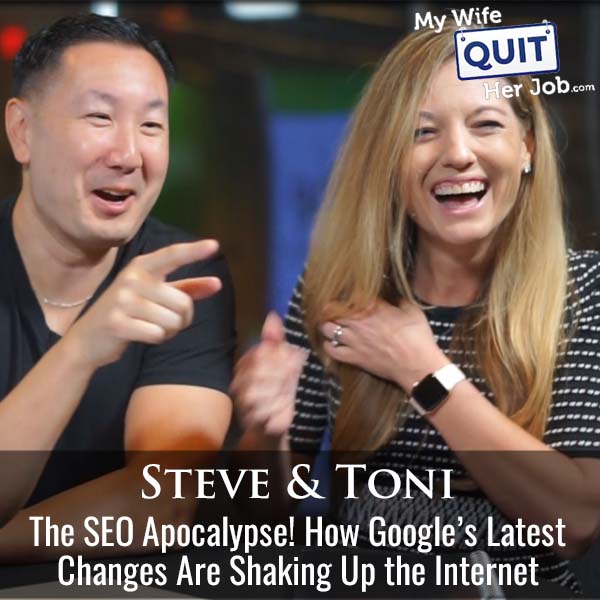
This is the first Profitable Audience segment on the show, where my co-host and business partner Toni Herrbach and I unpack what is happening to search, why AI content is temporarily winning, and how content creators should respond without chasing every fad.
Here is what changed, why it matters, and what to do about it.
Get My Free Mini Course On How To Start A Successful Ecommerce Store
If you are interested in starting an ecommerce business, I put together a comprehensive package of resources that will help you launch your own online store from complete scratch. Be sure to grab it before you leave!
Table of Contents
Key takeaways
- Google ran five updates late in 2023 back to back, and search results have been fluctuating wildly since. Reddit, Quora and LinkedIn now rank in a dedicated “forum and discussions” section, often above traditional publishers.
- In Spencer Haws’s 90-day Google vs AI content challenge, 74 people competed and the top five participants pulled 15,800 combined clicks in three months. The winner published 274 articles and used AI-generated outlines plus per-section AI drafts.
- One participant in the beverage niche published 850 AI articles in 30 days and hit 4,800 monthly visitors. It works, at least in the short term.
- Fake AI news is spreading fast. AI-generated sports channels on YouTube now make up roughly a third of my sports feed, and one falsely reported LeBron James was traded to the Warriors.
- Gen Z uses TikTok and Pinterest as search engines. Pinterest is quietly having a moment with 16 to 24 year olds.
- The response for legit publishers: fix the mobile experience, answer the question thoroughly with no fluff, add real first-hand experience, and stop chasing the latest trick.
Why is Google search getting worse in 2024?
Google search is getting worse because the volume of AI-generated spam has exploded and Google’s countermeasures have promoted community sites like Reddit and Quora that were never designed to answer product or medical queries authoritatively. Google’s public defense is that Reddit users are experienced at flagging spam, so the community effectively self-moderates. The problem is that a good spam filter is not the same as expertise, and a Reddit user with zero credentials can now sit at the top of the SERPs for a medical, financial or product query.
I have watched one of my long-ranking posts get outranked by a single LinkedIn post from a random person with information that was not even accurate. That is happening at scale. Google shipped five updates back to back at the end of 2023, and the results have been fluctuating ever since.
Toni’s point is the trust problem this creates. When you read something by Brene Brown, you know she has a doctorate in psychology, has done 30 years of research and has written multiple books. When the top result is a Reddit comment from an anonymous account, you have no way to evaluate the source, and Google has handed that source authority anyway.
Reddit, Quora and LinkedIn: how Google upgraded community content over blogs
Google upgraded Reddit, Quora and LinkedIn dramatically in 2023, and there is now a dedicated “forum and discussions” section in the SERPs where those results sit above most traditional publishers. Users started appending “reddit” to their searches to escape SEO-optimized affiliate content, and Google’s algorithm followed that behavior.
Quora ranks well and lets contributors link out, so operators are already gaming it. The pattern is simple: post a question years ago, wait for the thread to rank, then add a self-promotional comment with an affiliate link now.
Google reads the aged thread as authoritative and the modern affiliate insertion goes along for the ride.
LinkedIn is the newest twist. A friend of mine watched his blog post drop after an update, copied the same text word for word onto LinkedIn as a LinkedIn article, and the LinkedIn version now ranks number one for the same keyword.
He set up a 301 redirect from the original URL to the LinkedIn article and his affiliate links still earn. Building on rented land is risky, and I would not recommend that play, but it is a real signal about where Google is currently placing trust.
Spencer Haws’s Google vs AI content challenge: what 74 sites in 90 days revealed
Spencer Haws of Niche Pursuits ran a Google vs AI content challenge where 74 participants competed to see who could pull the most organic traffic to a new AI-generated site in 90 days. Prize was $2,500.
Results after three months: the top five participants achieved over 15,800 combined clicks, and the winner ended up with 274 articles ranking.
Verifying analytics for 74 people is a huge amount of work, and Spencer participated himself and only pulled 52 clicks in the first month.
The 850-article-in-30-days beverage site
One participant published 850 articles in one month in the beverage niche and hit 4,800 visitors in month one. That is roughly 30 articles a day.
No human can meaningfully edit 30 AI articles a day, so the assumption is these went out with minimal review. The tooling made it possible.
You feed an SEO-style prompt into ChatGPT (the AIPRM plugin builds a full content map from a single topic: article titles, keywords and descriptions in table form). Then you loop back through and generate each article from its row. Bulk publication follows.
The winner’s playbook: outline plus section-by-section generation, with real edits
The winner did substantial human editing on top of AI drafts and covered current events, specifically cricket matches. Cricket has a huge global audience, most of it outside the US, and correspondingly less English-language competition. That combination (news-cycle topic + underserved language market) is what let 274 articles pull the traffic they did.
The playbook I taught for AI content in Profitable Audience matches the winner’s method almost exactly. Use AI to generate the outline, loop through each section and generate the draft, then human-edit the result section by section.
My own AI-assisted article on Alibaba still ranks on the front page and gets steady traffic, and it was roughly 75% AI with real human editing on top.
Should content creators use AI to write articles?
Yes, but you have to fact-check everything and add real human judgment. This is the most common question I get on webinars now, and it was a question nobody asked before 2023. Bulk-publishing raw ChatGPT output straight to your site is the version of AI content I would never recommend, no matter how well it appears to work in a 90-day contest.
Two reasons the raw-output play breaks over time. First, current-events articles decay fast: if you write about a cricket match today, that page has almost zero long-term value, and the moment Google’s models tighten up, sites full of decaying pages drop hard.
Second, my strongest posts on My Wife Quit Her Job are 10-year-old posts written by hand. Longevity comes from articles that stay useful, and that requires editorial judgment machines still cannot supply.
The workable middle: use AI for outlines and first drafts, then have a real human fact-check every number, add first-hand experience where you have it, and break up walls of text with images and structure. If a piece of your business depends on the traffic, you cannot skip the editing step.
How AI-generated fake news is polluting YouTube, TikTok and dating apps
AI-generated fake news is now visible in almost every feed, and the quality is high enough that even experienced viewers get fooled. My YouTube feed is roughly a third AI-generated sports content.
A game happens, an AI writes the summary, someone drops in stock clips, and it publishes under a channel name that sounds real (“highlight deals” style).
I nearly texted Toni when one of these videos falsely claimed LeBron James had been traded to the Warriors. It looked real enough to trip a lifelong fan.
Toni sees the same pattern on TikTok. Her daughter learned a “cleaning hack” that involved mixing chemicals that could have caused an explosion in the bathroom, presented with the confident production quality of every other TikTok.
When TikTok’s authority-signaling editing collides with a viewer’s willingness to trust, the accuracy of the underlying claim stops mattering. This is why I no longer trust anything I see in a feed without a second source.
Dating apps have the same problem. People are running AI prompts through their message threads, and Facebook groups where women vet dates now show screenshots of the identical AI-generated message from three different guys.
Others upload fully AI-generated photos (no relation to the real person), effectively a next-level catfish. On a phone screen, at swipe speed, it is more than good enough to work.
Why Gen Z uses TikTok and Pinterest as their search engine
Gen Z uses TikTok and Pinterest as their primary search engines because both platforms present short, personality-driven answers that feel more human than a page of blue links. My daughters treat TikTok and Pinterest as their default. They would not go to Google to search for anything if they could avoid it.
The split between the two platforms is by category. TikTok gets the how-to and recipe queries (“how to make a 15-minute pasta dish”, “what is wrong with my heat press”).
Pinterest gets the aspirational and style queries (“what do I wear to Coachella”, “peach and teal bedroom ideas”). Pinterest’s fastest-growing demographic is 16 to 24 year olds.
I use TikTok as a search engine now too, mostly for restaurant recommendations and product problems. When my heat press threw an error code, Google surfaced affiliate roundups and YouTube surfaced 10-minute reviews. TikTok surfaced multiple people who had hit the exact same error, with fixes that got straight to the point in under a minute.
Why niche TikTok communities can beat Google for practical questions
The strength of TikTok as a search tool is the same as YouTube’s original strength: once you follow a specific creator you trust, the answer quality shoots up. Toni fell into “auto repair TikTok” and now follows five shops.
One is a mechanic with 40 years of experience whose son fronts the videos. When he ranks the worst three-row SUVs and Toni commented (she drives a Suburban), he replied in the comments with model-year specifics for what to look out for on hers.
That is a better answer than any affiliate roundup and it costs $0.
What content creators should actually do in 2024
Stand pat on your core strategy, fix your mobile experience, answer the query thoroughly with real first-hand experience, and stop chasing the latest ranking trick. That is my advice to the students in the class who got hit by the five updates at the end of 2023.
Chasing algorithm shifts in real time is how you burn out. The people who win over five years keep publishing durable content and improving the pieces they already have.
Fix mobile: break the walls of text
I ran an experiment on My Wife Quit Her Job and found that articles that look fine on desktop read as one continuous wall of text on mobile. Google’s models increasingly weight how long a user stays and what they do while they are there, and a wall of text on a phone is a bounce waiting to happen.
Going back through older posts to add more images and break paragraphs is a high-ROI edit right now.
NerdWallet is the reference example: the images resize cleanly on mobile, the aspect ratios adapt, and it is genuinely easy to scroll. If a huge finance site can be readable on a phone, so can yours.
Answer the question, then add first-hand experience
My current writing rule: answer the query thoroughly, cut the fluff, then add any real personal experience I have with the tool or product being reviewed after the answer. That last step is what AI cannot fake, and it is what the March 2024 patterns rewarded. The reviews that hold up are the ones where the writer has actually used the thing.
Build your name so Google recognizes you as an entity
Google has started weighting whether people search for you by name. I get close to a thousand searches a month for “my wife quit her job” and roughly the same for “Steve Chu”, and I believe that entity recognition is one reason my author bio now shows up as a knowledge-panel style card on the side of the SERPs.
Consistent presence across YouTube, TikTok, LinkedIn, X and Instagram feeds the same signal. You do not have to master every platform, but the volume of branded search Google sees for your name matters.
How to think about voice cloning and AI content production tools
Voice cloning has crossed the threshold where trained models on tools like ElevenLabs can produce audio that is roughly 90% indistinguishable from the original speaker. Andrew Youderian generated a fake apology from me to him using my podcast audio last year, and as someone who talks to me constantly, Toni scored it around 90 to 92% believable.
Two months earlier, a similar demo from Mike Jackness’s voice landed around 50%. The quality curve is steep.
For content creators, the honest use case is production time savings. I record every podcast intro from scratch (usually 20 to 40 minutes for a single episode) because voice levels drift.
If a trained clone can generate a fresh intro that matches the levels of the recorded episode, that is 20 minutes back every week. Same logic for repurposing YouTube transcripts into podcast episodes with small script swaps (“video” becomes “episode”).
Disclosure matters, but the workflow saves real hours.
Frequently asked questions
Is Google’s search quality actually getting worse in 2024?
Yes, for many product-review and how-to queries. Multiple SEO practitioners including Glenn Allsopp of Detailed have documented Reddit dominating product-review SERPs and low-quality AI content ranking alongside legitimate publishers. My blog and every member of my SEO mastermind have seen traffic hits, and users are visibly shifting some queries to ChatGPT, Perplexity, TikTok and Pinterest.
Does AI content still rank on Google in 2024?
Yes, in the short term. Spencer Haws’s 90-day contest showed the top five participants pulling over 15,800 combined clicks with primarily AI-generated content, and one beverage site published 850 articles in 30 days to hit 4,800 visitors. The open question is what happens to those sites at 12 months and 24 months as Google keeps updating.
Should I add Reddit or Quora to my content strategy?
You can, but treat it as diversification, not as a rented replacement for owned content. Reddit and Quora rank because Google trusts them right now, and if that policy changes in a future update, anyone who moved their business onto those platforms takes the hit. Own your site, use community platforms to reach people you cannot reach on Google, and keep the two separate in your head.
How is Gen Z using Pinterest as a search engine?
Gen Z uses Pinterest for aspirational and style queries: outfit ideas, decor inspiration, event planning, aesthetic references. TikTok handles how-to and quick-answer queries in the same audience, and Pinterest’s fastest-growing demographic is 16 to 24 year olds, which is why the platform is investing heavily in that segment.
What is the biggest change content creators need to make in 2024?
Two changes matter most. First, fix your mobile experience by breaking walls of text with images and paragraphs. Second, add real first-hand experience after directly answering the query, because that signal is what post-2023 Google is rewarding and it is the one thing AI cannot fake.