
Podcast: Download (Duration: 43:50 — 50.5MB)
The path onto QVC that actually worked for Kim Meckwood ran through a trade show. She booked a discounted booth in the Inventors Corner at the International Home and Housewares Show in Chicago, pitched to a panel that included QVC, HSN, and SkyMall, and collected business cards. A television appearance months later turned that contact into a contract.
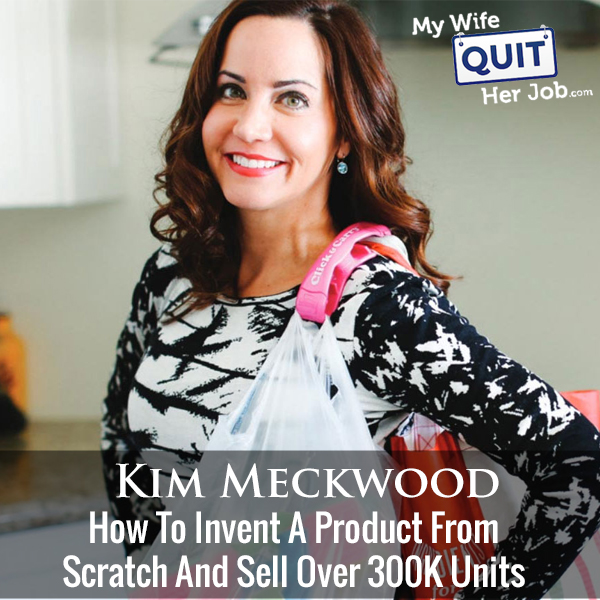
Kim is the founder of Click and Carry, a handle device that lets you sling up to 80 pounds of grocery bags over one shoulder, and she won the $50,000 grand prize on the Five Minute Pitch, my Shark Tank style show judged by me, Mike Jackness, Greg Mercer, and Scott Voelker. She has sold over 300,000 units.
Below is how she got from a dream to a steel mold in China, what QVC actually pays, the 401k decision she regrets, and what she would do differently starting today.
Get My Free Mini Course On How To Start A Successful Ecommerce Store
If you are interested in starting an ecommerce business, I put together a comprehensive package of resources that will help you launch your own online store from complete scratch. Be sure to grab it before you leave!
Table of Contents
Key takeaways
- Kim’s first QVC order was 13,600 units, and the product sold out in seven minutes on air.
- Her first steel mold in China cost $5,000, a modification cost another $3,000, and her current improved mold cost $25,000. The same mold in the US would run $65,000 to $85,000.
- She got in front of QVC through the Inventors Corner at the Home and Housewares Show, where the booth cost roughly $5,000 to $6,000 instead of full price.
- Retail and QVC both netted her about $1.40 per unit, because retailers require a 50% margin on a $7.99 to $9.99 item.
- She cashed out her 401k to fund a 60,000 unit reorder and paid roughly a 50% tax penalty on it.
- Total investment to get her first units to market was $10,000 to $15,000. Total invested over the life of the business is about a quarter million dollars.
- Her biggest regret is starting in retail instead of online, because online margins are significantly higher and testing is faster.
What is Click and Carry and how did Kim Meckwood invent it?
Click and Carry is a handle with two slots that hold as many bags as you can fit, rated at 40 pounds per side for 80 pounds total. You rotate the top to lock the bags in place, then either hold it with the gel grip or wear it over your shoulder to keep your hands free.
The idea came from a vivid dream. Kim dreamed of a Jetsons-style line of flying cars where one slot was missing, and a car zipped down into an X-shaped piece that closed and secured everything before the train took off.
She woke up realizing the shape was a way to secure things together while leaving room in the middle for a hand. She rounded it slightly so it would sit comfortably on one shoulder.
At the time Kim was in medical device sales for Medtronic, working in deep brain stimulation. She talked about the idea so much that one of her clients, a neurologist at USC, finally told her to stop talking and do something about it.
How Kim built her first product prototypes
Kim’s neurologist client introduced her to a neighbor studying entrepreneurial studies at the Pasadena design school, and Kim hired her to help with prototypes. The school had a 3D CAD printer, which was the whole point.
Each CAD print through the school cost about $175. Doing the same print commercially would have cost her closer to $1,000 per iteration.
That price difference is what let her iterate to a winning design at all. Once she had the prototype she wanted, she sent it off to have a mold made in China.
How much does it cost to make a plastic injection mold in China?
Kim’s first steel mold in China cost $5,000, and modifying it cost another $3,000, so her original tooling came to about $8,000. Her current, much better mold cost $25,000.
She found her first factory through a neighbor in her Los Angeles condo building who worked for Ty, the company behind Beanie Babies. He connected her with Ty’s factory, which made steel molds in addition to plush toys.
The same $25,000 mold would cost between $65,000 and $85,000 in the United States, and per-unit costs would be higher too. Kim would prefer to make Click and Carry an American-made product, and the math has not allowed it.
Why Kim’s first mold needed a redesign
The original mold had a straight-line slot for the locking mechanism, so the handle kept rotating out of position even with male and female parts meant to hold it. It did not do the job.
Kim redesigned the groove into a tooth shape, which fixed the problem and gave her a second patentable feature. She ended up with two patents from that one revision.
Molds are subtractive, so you can only remove material, never add it. She got lucky that the fix required taking material away rather than adding it.
Kim’s first production run and unit economics
Kim’s first production run was about 5,000 units at $2.09 each, rising to $2.17, with a landed cost close to $3 after importation and shipping. She sold at $7.99.
That is a thin margin for a plastic product people are reluctant to pay much for. Bootstrapping and selling directly meant she did not have to leave room for a retailer’s cut yet.
Her newer mold reduced material usage and cut her per-unit cost by 81 cents, roughly a 37% decrease. That change came years later.
Why swap meets and farmers markets did not work for Click and Carry
Swap meets and farmers markets failed as a sales channel because Click and Carry requires a demonstration. Kim worked local stores, farmers markets, and the Pasadena Rose Bowl swap meet, which draws around 50,000 visitors once a month.
Every sale she made came from physically showing someone how it works, on a mannequin or by putting it in their hands. Once a person felt it over their shoulder, they bought.
That is a one-to-one sales motion that does not scale. Recognizing that pushed her toward a website and toward channels where video could do the demonstrating.
How to get your product on QVC through the Inventors Corner
The route Kim used was the Inventors Corner at the International Home and Housewares Show in Chicago, where young companies get a discounted booth and pitch to a panel of major buyers. Her panel included QVC, HSN, SkyMall, and Lakeland UK.
The full trade show cost her close to $10,000 including travel, monitors, and video setup. The Inventors Corner booth itself was roughly $5,000 to $6,000.
She gathered every business card and followed up when she got home. QVC’s buyer never called her back.
How the Bethenny Frankel show led to Kim’s QVC contract
The QVC deal actually came through Bethenny Frankel’s talk show, months after Kim applied and heard nothing. Frankel ran a weekly segment called Bethenny In Your Business that helped a female entrepreneur, and Kim expected business advice and maybe a $5,000 to $10,000 stipend.
Frankel had sold her Skinnygirl Margarita franchise for a figure Kim puts around $100 million, so the advice alone seemed worth it. Instead the appearance produced a QVC contract.
Kim filmed the Bethenny episode in April, and that is when QVC told her they wanted to order. She calls it a Cinderella moment that changed the trajectory of the business.
How the QVC Sprouts program works for new products
QVC’s Sprouts program made an exception for Kim by giving her a guaranteed sale, which most sellers do not get. Normally you fund all the inventory yourself and only get paid as units sell.
Kim won gadget of the year that season, so QVC guaranteed the sale on an initial order of 13,600 units. She had roughly the remainder of her 5,000 unit run in stock at the time.
She filmed her segment in May and sold out in seven minutes. Manufacturing took about three months plus another month of ocean freight, so customers received their products in August.
Because she sold out, QVC added another 5,000 to 6,000 units to that initial order.
What QVC actually pays per unit
Kim sold sets of four for $25 on QVC and kept a little over $5 per set, which works out to roughly $1.40 per unit. QVC also withholds 5% against expected returns.
She fronted the entire production cost herself. Her money was tied up from April until roughly September 8, a month after the August 8 delivery.
Her factory ran late on that first order, so she had to air freight it into the United States to protect the timeline. That cost $13,000 instead of the roughly $5,000 ocean freight would have run.
Missing a delivery window sets a precedent with QVC that you do not want to set. She ate the difference.
Why Kim cashed out her 401k to fund a 60,000 unit order
After the first delivery QVC ordered 60,000 more units, which meant fronting roughly $130,000 before shipping. Kim did not know how to pitch investors yet, her father had recently passed away, and she was not going to ask her mother for the money.
So she cashed out her 401k. She expected a tax penalty of 20% to 30% and it came to about 50%.
The one break was timing. The tax bill did not arrive until about a year and a half later, so she had that window to operate and build.
Her framing is that sometimes you have to strike while the iron is hot. It is also the decision she describes as her big error.
How Kim got Click and Carry into retail stores by cold calling
Kim got into Ralphs, The Container Store, Lakeland UK, and a Japanese retailer entirely through cold outreach, using her QVC track record as credibility. She researched buyers on LinkedIn and went directly at them.
Her opener was a physical care package: samples in the mail plus photos of the product in use. That is what got her foot in the door, and buyers frequently called or emailed her for more information.
Once she had the meeting, she presented a short PowerPoint and played her QVC b-roll, a 53-second video showing every use case for Click and Carry. She also brought a printed version of the deck.
QVC is a strong credential with retail buyers because passing QVC’s quality approval process is difficult. Buyers know the product has already been vetted.
Her Ralphs buyer, Chris, is now one of her closest friends. They talk once or twice a week, and she plans to bring him on for operations if the business grows enough.
Retail margins vs QVC margins for a low-priced product
Retail margins were about the same as QVC, roughly $1.40 per unit, because retailers require at least a 50% margin on a $7.99 to $9.99 item. There is not much left on a product at that price point.
| Channel | Retail price | Kim’s net per unit | Cash flow |
|---|---|---|---|
| QVC | $25 for a set of four | ~$1.40 | Fronts all inventory, paid ~30 days after delivery, 5% returns holdback |
| Retail (Ralphs, Container Store) | $7.99 to $9.99 | ~$1.40 | Fronts all inventory, retailer takes 50% |
| Amazon direct | $11.99 single, $19.99 for two | Significantly higher | Fronts inventory, keeps the retail margin |
Retail also has a discovery problem for a product like this. Shoppers see it on a shelf and cannot tell whether it is a chip clip or a purse hook.
Kim’s fix in progress is a small looping video screen at the shelf, USB rechargeable with roughly six months of battery life, playing her b-roll so shoppers see the product in use. Funding those screens is one reason she is prioritizing higher-margin online sales.
How Kim priced Click and Carry
Kim’s original $7.99 price was arbitrary, and she now thinks $9.99 is closer to right. She receives feedback that even that is too low.
Her reasoning for staying low is that a brand new product is an impulse buy, and lowering the cost of entry helps adoption. My take is that anything under $20 is a no-brainer impulse purchase, so there is likely room above $9.99.
She has never run a pricing test. She is currently testing $11.99 for a single unit and $19.99 for a set of two on Amazon Prime, and moving online makes real testing fast and cheap.
Why Kim re-engineered Click and Carry after 4.7 stars on QVC
Kim rebuilt the product because hundreds of QVC reviews averaging 4.7 out of 5 kept surfacing the same complaint: it was difficult to open. One consistent negative across that many reviews is a design problem, not a customer problem.
She stepped back from QVC to re-engineer, and that is when she met a mentor named Mark, the inventor of the Perfect Pushup. He taught her how to pitch investors and introduced her to his factory.
That factory had produced over 10 million Perfect Pushup units with very little error. Kim switched to them, and her new mold produces far fewer defects while cutting 81 cents of material cost per unit.
Why Kim had to go back to a day job
Kim returned to a day job because funding inventory for QVC and Ralphs at the same time left her unable to cover her mortgage and, more importantly, her health insurance as a cancer survivor. The 401k tax bill landed in the same period.
She kept Click and Carry alive and kept selling throughout. The day job was survival for the business as much as for her.
She works nights, weekends, and early mornings on it, describing 12 to 15 hour days when she was full time on the product. Her stated goal is getting back to Click and Carry only.
Patents and copycats: protecting an invention
Kim holds two utility patents on Click and Carry and hired separate attorneys for patents and for trademark. It was expensive and she considers it the best money she spent.
There have been 16 grocery-carrying products since 1962. Hers was granted a utility patent because it is the only one that can be worn over the shoulder as well as carried in the hand.
The United States Patent and Trademark Office also profiled her in its Inventor’s Eye publication, in a segment called Spark of Genius. She views that as an extra layer of documented protection.
One competing product, a strap called Grocery Grips, markets itself as hands-free. Kim’s read is that it requires a hand to steady it and does not balance the weight evenly, so she has not filed anything.
What it costs to bring a physical product to market
Kim’s total to get her first units to market was $10,000 to $15,000, covering the $5,000 mold and roughly 5,000 units of production. She did it as inexpensively as she could.
Over the life of the business she has put in roughly a quarter of a million dollars. Most of that went to patents, multiple molds, shipping, production, marketing pieces, packaging, promotions, and annual license renewals.
She had no pre-orders and no validation before committing to the mold. Her decision rested on conviction that the product would eventually be as common as an umbrella.
What Kim would do differently starting over
Kim would start online instead of starting in retail. Instagram, Facebook, and YouTube did not exist as sales channels the way they do now, and she would use them for awareness before touching a shelf.
Her phrasing is that she started with the hard part first. The upside is that she now understands retail thoroughly and knows how to succeed in it.
She would still go back to the Home and Housewares Show, though she would no longer qualify for the Inventors Corner and would pay full booth price. For a housewares product she calls it the end-all be-all event.
Why Kim quit her job to build Click and Carry
Kim quit a job she genuinely loved after a breast cancer diagnosis reframed how she valued her time. She was diagnosed in February, completed surgeries by the end of March, and decided then to leave.
She was making good money at Medtronic in deep brain stimulation and had almost no free time. What actually made her happy was working on Click and Carry.
She saved through the end of that year and started full time in the new year. She is cancer-free, and QVC later featured her story in a Breast Cancer Awareness Month segment.
You can see the Click and Carry demonstration video at clickandcarry.com, and the product is available on Amazon Prime.
Frequently asked questions
How do you get a product on QVC?
Kim Meckwood reached QVC buyers by pitching at the Inventors Corner of the International Home and Housewares Show in Chicago, where a panel of retail and TV buyers evaluates new products. The contract itself came months later through an appearance on Bethenny Frankel’s talk show.
How much does QVC pay per unit?
Kim sold Click and Carry as a set of four for $25 on QVC and netted a little over $5 per set, roughly $1.40 per unit. QVC also holds back 5% of payment to cover expected returns.
Do you have to buy your own inventory for QVC?
Yes, in most cases. Kim fronted the full cost of all her QVC production runs and was paid roughly a month after delivery, though QVC’s Sprouts program gave her a guaranteed sale on her first order as that year’s gadget of the year winner.
How much does an injection mold cost in China?
Kim’s first steel mold cost $5,000 with a $3,000 modification, and her current improved mold cost $25,000. The equivalent mold quoted in the United States ran $65,000 to $85,000.
How much does it cost to bring an invention to market?
Kim spent $10,000 to $15,000 to get her first production units to market, covering tooling and an initial 5,000 unit run. She has invested roughly $250,000 total over the life of the business, mostly on patents, molds, shipping, production, and marketing.
Is a utility patent worth getting for a physical product?
Kim considers her two utility patents the best money she spent, hiring one attorney for patents and a separate one for trademark. The patent is what distinguishes Click and Carry from 16 prior grocery-carrying products, because hers is the only one that can be worn over the shoulder.
What is the Inventors Corner at the Home and Housewares Show?
The Inventors Corner is a discounted booth area at the International Home and Housewares Show reserved for new companies and new products. Booths ran roughly $5,000 to $6,000 for Kim, and it includes the chance to pitch a panel of major buyers.
Should you launch a new product in retail or online first?
Kim’s answer is online. Online margins are significantly higher than the roughly $1.40 per unit that both QVC and retail left her, pricing tests run faster, and video can demonstrate a product that shelves cannot explain.