Podcast: Download (Duration: 52:58 — 60.9MB)
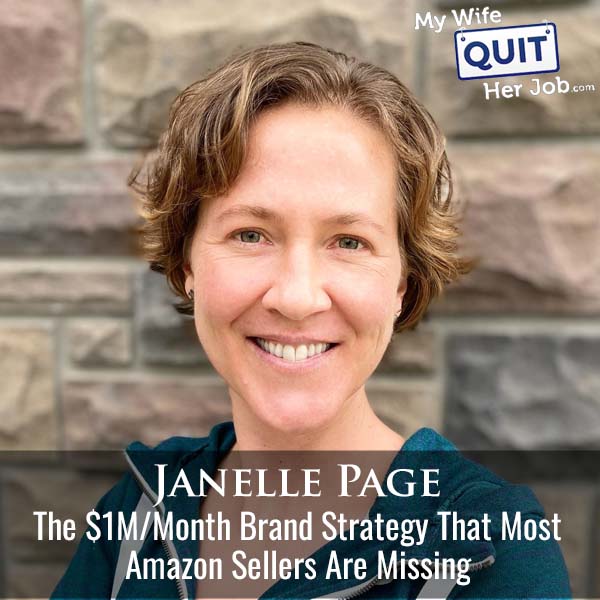
The way to turn an Amazon product into a real brand is to move your marketing off Amazon, build demand for your name (not your keyword), and give buyers a reason to search for you specifically. On this episode of the My Wife Quit Her Job podcast, I sat down with Janelle Page, a brand consultant who has driven over $475 million in ecommerce sales and helped Glamnetic scale from $80,000 a month to over $3 million a month by doing exactly that.
Janelle’s whole thesis is that Amazon is a closed, price-driven ecosystem. Whoever has the cheapest me-too product wins the keyword. The only defensible position is to create branded search demand off-platform, then defend your own name on Amazon where cost-per-click is a fraction of the category term.
Below is her framework: why keyword-first Amazon launches are dying, how to extract the founder story out of a “boring” product, the content approach that actually earns organic reach, and the way to structure a repeatable brand-content system without hiring an agency.
Get My Free Mini Course On How To Start A Successful Ecommerce Store
If you are interested in starting an ecommerce business, I put together a comprehensive package of resources that will help you launch your own online store from complete scratch. Be sure to grab it before you leave!
Table of Contents
Key takeaways
- Amazon is a closed, price-driven platform. If you cannot beat your own factory on price and you have no brand, there is no long-term margin left.
- Branded keyword defense on Amazon costs a fraction of category keywords. Creating “Glamnetic” search volume off-platform makes the on-platform ad game defensive, cheap, and durable.
- Every founder has a story worth telling. If you cannot find one in five minutes of interview, you are too close to the product. Ask a friend to interview you.
- Niche before you generalize. The CrossFit-only supplement strategy at Progenex won a whole category because they refused to be at every event.
- Video is required now. If you refuse to be on camera, at least show the product working. A demonstrable product is a brand-building product.
- Aggregators and PE groups will no longer buy pure Amazon-arbitrage businesses. If you plan to exit, brand is now the only asset they will pay for.
Why is the pure Amazon keyword-and-launch model breaking in 2026?
The pure Amazon keyword-and-launch model is breaking because Amazon is a closed, price-driven ecosystem where the total pool of category searches is fixed and every seller is fighting over the same slice. When your own factory can copy your product and sell it cheaper, you have no defensible position without a brand.
Janelle put it plainly on the episode: “There’s only so much keyword searches that exist there and everyone’s fighting over that pie.” Once a category gets saturated, cost-per-click on the head term rises, aggregators lose interest, and margin collapses.
Aggregators and PE groups used to buy those Amazon-only stores. They no longer will.
Janelle works with PE groups directly and confirms that pure category-arbitrage catalogs are “too high risk” for acquisition. They want brands with owned demand.
What does “get known, get found, get chosen” mean for an Amazon brand?
“Get known, get found, get chosen” is Janelle’s three-part frame for brand growth: known means people recognize your name before they search, found means the SEO/PPC surfaces you when they do, and chosen means the customer picks you over the identical-looking alternative on the shelf. Amazon sellers usually only invest in “found.” The other two are where brand equity actually lives.
The Glamnetic result illustrates the compounding. When customers off-platform started searching “Glamnetic” instead of “press-on nails,” Amazon’s ad game turned defensive. Defending your own branded term costs a fraction of a broad category term.
That is how Janelle’s team scaled Glamnetic from $80,000 a month to over $3 million a month on Amazon. The heavy lifting happened off Amazon.
How do I find my brand story if my product feels boring?
You find the brand story by having someone else interview you, because founders are too close to their own product to see what is interesting. Janelle claims she can pull a story out of any founder in five minutes, and the transcript backs it up with two examples: a pair of sisters selling lotions who did not think they had a story (they were immigrants whose mother’s herbal remedies had cured their rosacea back home), and a TV-mount installer with a PhD who spent two years tinkering with a better mount design after years of mounting the wrong ones for other people.
The pattern is always the same. The story sits in three places: your origin (why you started), the problem you personally lived with, and the tinkering years before the product existed. Those three questions crack open almost every founder.
If a friend interviews you and you still cannot find one, the product itself is probably a me-too and the honest fix is to pick a different hero product from your catalog.
How do I pick which product to build the brand around?
Pick the product that is most demonstrable on video, has an emotionally identifiable problem, and lets you niche down to a specific audience you can dominate. Janelle calls it “the tip of the spear.” You cannot build a brand around a shelf, a generic biotin bottle, or anything a viewer needs a paragraph of context to understand.
The Progenex CrossFit story is the canonical example. The supplement worked and tasted good, but they were showing up at the Arnold one weekend, a rock climbing convention the next, and a jujitsu event after that. Zero traction anywhere.
Then they went all-in on a new sport called CrossFit at a small event at the Cucamonga Ranch. They spoke the language (wads, boxes, Fran, Murph), locked down every top and rising CrossFit athlete under contract, and owned the category.
Millions of dollars later they were able to expand into surf, spearfishing, and yoga. They could not have started there.
Do I have to be on camera to build a brand today?
You do not personally have to be on camera. The product itself does. If you refuse to appear yourself, the minimum bar is video that shows the product solving a visible problem in three seconds, and you will need to work harder to compensate for the missing human trust signal.
Janelle referenced a cat-hair lint mitt ad on LinkedIn as the archetype. The video opens on the pain of a cat owner rolling a standard lint roller across a couch cushion, then shows the mitt sweeping the hair off in one pass.
Three seconds. Sale.
If your product cannot be shown solving a problem visually, Janelle’s honest read is that it is the wrong product to build a brand around. Pick a different hero from your catalog.
How do I come up with organic content ideas every single day?
Steal frameworks from other categories and personify them with your product. Janelle is launching a cat brand and her entire ongoing content plan is: find the best cat content on TikTok and Instagram, run user-submitted contests (America’s Funniest Home Videos for cats), and remake famous ad campaigns with cats in place of the original characters (the Bud Light “Bud Bowl” ads, restaged with cats and lickable cat treats).
The general rule she gave: study what already works in a completely different industry and port it into yours. She specifically calls out the Meta Ads Library as a research tool. Search “boring” categories like tech or insurance, then figure out which brand is telling the best story and adapt the structure.
The Glamnetic Thanksgiving Day post is a real example. Kansas City Chiefs vs. Dallas Cowboys game, press-on nails in each team’s colors, staged as a remake of the old Bud Bowl ads with the two teams’ helmets on the nails.
Her VA seeded it in Chiefs Facebook groups. It hit 3,000+ shares organically with zero ad spend.
How do I get past being “camera shy” or “not funny enough”?
The three fixes are: film yourself doing the actual work of the business (founder-journey content), pick a topic where the subject matter carries the video (pets, cooking, satisfying process), or go faceless with voiceover-and-hands video. Do not try to be a personality if you are not one. Let the topic do the work.
Janelle referenced Melissa on TikTok, who built her whole audience teaching people to fold towels and sheets. The video is folding laundry.
That is the entire content strategy. The subject matter carries it.
If you insist on being the on-camera face, gut-check first. Ask five friends to be brutally honest about whether you are actually entertaining on camera. Most people who think they are, are not.
What is the offer structure that turns brand content into product sales?
The offer structure is a single strong funnel around one hero product, with an ironclad guarantee, that solves an emotionally visible problem. Janelle’s biotin example: show the visceral pain (hair collecting in the shower drain), name the solution (biotin with clinical studies), and remove the risk (30-day money-back guarantee). One good funnel can make you millions.
The reason one funnel is enough is what happens after the first purchase. Once a customer is on your list, you can educate them into your other products.
Sold them biotin, now teach them magnesium helps sleep, restless legs, and brain function. Same customer, second and third order.
Amanda, an herbalist Janelle is working with, illustrates the education angle. Her product is a five-step kidney-recovery system for dogs.
The lead magnet is a free recipe book for raw dog meals, delivered via Facebook ads at under 25 cents a click. Step one of her system is switching the dog off processed food, so the funnel teaches the problem first and then sells the solution.
Should Amazon sellers keep selling on Amazon while they build the brand?
Yes, Amazon should stay in the mix as a channel. Janelle is platform-agnostic, and her job as a brand marketer is to create the demand and the desire so the customer can buy where they want (Amazon, DTC, or retail). The mistake is treating Amazon as a business model instead of a distribution channel.
The seller who builds branded demand off Amazon and defends their own name on Amazon gets the best of both. Cheap defensive PPC on branded terms, organic branded search from off-platform content, and a customer list you actually own for the DTC repeat purchase.
The seller who only ever does keyword research and category launches is on what Janelle called “the hamster wheel.” Three to six months of margin per product, then the factories catch up, then find the next product. That model is what aggregators used to buy and no longer will.
Frequently asked questions
Do I need to leave Amazon to build a brand?
No, you keep Amazon as a channel and build brand demand off it. Move your content, community, and paid ads to platforms where you can tell a real story (Meta, TikTok, YouTube, email), then use Amazon defensively by bidding on your own brand name where cost-per-click is a fraction of the category term.
How much cheaper is branded Amazon PPC versus category PPC?
Branded PPC is dramatically cheaper because you are the highest-relevance advertiser for your own name and competition on the term is minimal. Janelle described Glamnetic’s defense of “Glamnetic” as “much cheaper than press-on nails or magnetic lashes.” The exact multiple depends on your category, but branded terms routinely cost 3-10x less than head category terms.
What if my product is a generic me-too from the same factory as ten competitors?
You have two honest options: pick a different hero product from your catalog that has a demonstrable story, or accept that you are running the Amazon-arbitrage model and plan on a 3-6 month margin window per product. You cannot build a lasting brand on a me-too because your factory will always undercut you on price and you have no unique mechanism to defend.
How long does organic content take to work?
Realistically, up to a year of daily posting before you gain real traction, and your first six months of content will be mediocre while you learn what your audience responds to. Janelle was blunt on the episode: organic is slower and stickier than paid, and most founders do not have the patience for the ramp. If you need faster results, run paid ads on the same content while the organic library compounds.
Do aggregators still buy Amazon-only businesses?
Largely no. Janelle works directly with PE groups and aggregators and confirms they will not touch Amazon-arbitrage catalogs anymore because the model is too risky and the margins are compressing. They want brands with owned demand, a real customer list, and off-Amazon distribution, which is exactly the model this episode lays out.
What content format should an ecommerce founder start with?
Start with whichever removes your biggest personal barrier. If you can show your face, do short founder-journey clips of the actual daily work; if you cannot, do voiceover-and-hands video showing the product in use; if you have zero on-camera comfort, hire a UGC creator or brand ambassador. The specific format matters less than the consistency, so pick the format you will actually keep doing week after week.