Podcast: Download (Duration: 39:48 — 45.8MB)
Three big ecommerce shifts landed in the same week, and most sellers only heard about one of them. OpenAI quietly shelved its in-chat agentic checkout with Shopify and Etsy after adoption came in weak.
TikTok Shop rescinded its mandatory Fulfilled by TikTok rollout after a wave of merchant backlash. And the IEEPA tariff refunds people were counting on are tied up in a court fight with no refund mechanism attached.
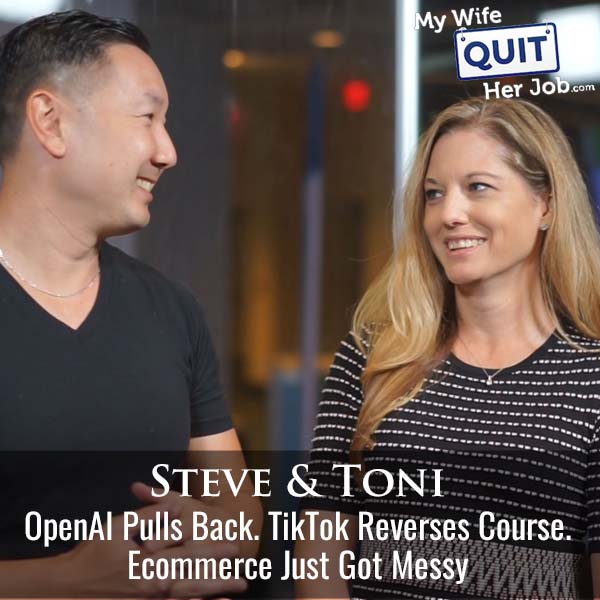
I broke all three down with my co-host Toni Anderson on episode 630 of the My Wife Quit Her Job Podcast. This post pulls the through-line so you can decide what to actually do this quarter about AI shopping agents, TikTok fulfillment, and China sourcing.
Below is exactly what changed, why it changed, and where the risk and opportunity sit for physical-product sellers right now.
Get My Free Mini Course On How To Start A Successful Ecommerce Store
If you are interested in starting an ecommerce business, I put together a comprehensive package of resources that will help you launch your own online store from complete scratch. Be sure to grab it before you leave!
Table of Contents
Key takeaways
- OpenAI quietly pulled its instant agentic checkout after only double-digit Shopify stores signed up. Product-feed complexity and split order pipelines killed adoption the same way it killed Facebook Shops.
- The real winner in AI commerce is not in-chat checkout. It is Google’s new agentic shopping protocol that lets AI agents buy on your existing storefront programmatically without needing a browser.
- TikTok Shop reversed its mandatory Fulfilled by TikTok requirement, but self-fulfilling sellers get shorter leashes on late-shipment strikes and lose the FBT badge that boosts visibility.
- The IEEPA tariffs got struck down, but the older Section 301 China tariffs are still in force, and Trump layered a fresh 15 percent tariff on top under a different rule.
- If you paid IEEPA tariffs under DDP terms, your Chinese supplier is the importer of record, so any refund goes to them, not you. To even be in line for a refund, register with US Customs and Border Protection now.
- Vietnam and India are now the strongest lower-tariff sourcing alternatives to China. Vietnamese factories are often owned by Chinese vendors sourcing raw materials from China, so unit prices can be lower than mainland pricing while sitting outside the 301 stack.
- Ecommerce just hit 16.6 percent of all US retail sales, an all-time high. In-store shopping keeps getting worse and one-click TV shopping on Prime Video is training buyers to buy from anywhere.
Why OpenAI pulled its agentic checkout for Shopify and Etsy
OpenAI shelved its instant agentic checkout inside ChatGPT because only double-digit Shopify stores actually signed up during the beta, and product-feed complexity made the experience miserable for merchants who did. The pitch was simple. A shopper types a query into ChatGPT, ChatGPT surfaces matching products, and the buyer completes the purchase inside ChatGPT without ever visiting the store’s site.
Sellers were expected to hand OpenAI their product feed, options, variants, shipping rules, and personalization inputs. Anyone selling configurable products or custom items knows how many edge cases live inside those fields.
I lived this in reverse with Facebook Shops years ago. Facebook forced its own checkout for anything with product options and personalization, my orders came in through a separate pipeline I had to reconcile by hand, and the whole experiment quietly died. OpenAI ran into the same wall in a fraction of the time.
Etsy got the same treatment and by all accounts also saw thin adoption. So OpenAI hit pause. This is not a permanent shutdown, and it will almost certainly ship again in a cleaner form once the shopping stack matures.
How AI shopping agents will actually buy from your store
The most likely winner in AI commerce is not an in-chat checkout at all. It is Google’s new agentic commerce protocol, which lets an AI agent authenticate, add items, and check out on your existing storefront programmatically instead of screen-scraping a browser. I am integrating it into my own store right now.
Today, when an AI agent fills out a form on your site through a browser, it takes a screenshot, fills a field, takes another screenshot to verify, and repeats for every field. That is why agent-driven checkouts feel slow and break constantly. A native protocol lets the agent talk to your store the way an app talks to an API, so an order goes from prompt to placed in seconds rather than minutes.
If this protocol becomes the standard, the winning setup is your own storefront, cleanly structured, with the agent hooks in place. You keep the customer relationship, the order data, and the email address, and the AI is just another sales channel routing buyers to you. That is a very different bet than optimizing for in-chat purchases inside ChatGPT.
What the TikTok Shop Fulfilled by TikTok reversal means for sellers
TikTok Shop rescinded its plan to force all sellers into Fulfilled by TikTok after heavy backlash, but self-fulfilling sellers are on a much shorter leash than before. Miss a shipment window, ship the wrong item, or let your seller score drop, and you can get suspended fast. The reason TikTok wanted everyone on FBT in the first place has not changed: a viral video can turn 100 orders a day into 1,000 orders a day overnight, and merchant fulfillment errors make TikTok look bad in front of an impulse buyer who does not know your brand.
Ian Page from Bullseye Sellers, an agency that specializes in TikTok Shop, is talking about this at Seller Summit 2026, and his read matches mine. Fulfilled by TikTok is technically optional, but the perks push everyone toward it in practice.
FBT sellers get an FBT badge, more visibility in the algorithm, and protection when a video goes viral. Self-fulfilling sellers get shorter grace periods on late shipments and no badge. The setup mirrors Seller Fulfilled Prime versus FBA on Amazon, and the outcome for most sellers will be the same: over time, the fulfillment-managed option wins because the platform quietly favors it.
What actually happened with the IEEPA tariffs and China Section 301
Only the IEEPA tariffs got struck down, the emergency tariffs Trump issued under the International Emergency Economic Powers Act. The older Section 301 China tariffs, which have been in force since Trump’s first administration, were untouched, and Trump layered on an additional 15 percent under a different rule right after the ruling.
So the total China tariff picture is: Section 301 tariffs still active, roughly 20 percent of the additional IEEPA tariffs on China vacated, and 15 percent added back through a separate mechanism that will probably also get challenged. Net-net, China imports are cheaper than they were at the peak but still meaningfully tariffed. The administration is buying time to move those IEEPA tariff levels onto the more legally durable Section 301 structure, which requires an official investigation and takes months.
Anyone waiting to place a China order hoping the whole tariff stack collapses is almost certainly going to be waiting a long time. Plan your sourcing on the assumption that China stays tariffed and any relief that comes will be partial.
How to actually get an IEEPA tariff refund from US Customs
Odds are you will not see an IEEPA tariff refund unless you are a large importer with lawyers on retainer, because the courts have ordered refunds without giving Customs a working refund mechanism. About 2,000 corporations have filed suit, a Supreme Court ruling ordered the refunds, and Customs has no clear process to actually pay them out.
Two things determine whether you are even in line. First, you need an active importer account with US Customs and Border Protection. Second, you need to have been the importer of record on the entries you paid tariffs on.
Here is the trap on that second point. If you shipped DDP (Delivered Duty Paid), your Chinese supplier was the importer of record, not you. Any refund on those entries flows back to your supplier in China, not to your business, even though you paid for the tariffs inside the landed cost.
If you plan to be in line for anything, set up a CBP account now, and going forward source EXW or FOB and act as your own importer.
Why Vietnam and India are the strongest lower-tariff sourcing alternatives
Vietnam and India are the strongest lower-tariff sourcing alternatives to China right now because they sit outside the Section 301 tariff stack, and Vietnam in particular is often just a China factory in a different country. Chinese vendors ship raw materials into Vietnam and, in many cases, own the Vietnamese factory doing the finishing work, so you get similar unit economics and shorter tariff exposure.
Jim Kennemer is speaking at Seller Summit 2026 on sourcing from Vietnam, and he is the person I am using right now on a live case study. What I am seeing on that project matches what he is seeing across his client base. Unit prices out of Vietnam are running slightly lower than China on comparable SKUs, and you pay only the newer 15 percent tariff instead of stacking on top of the Section 301 rates.
The tradeoffs are real. Communication and sourcing turnaround are slower than China, factory density is lower so you have fewer options per SKU, and MOQ negotiation is harder. For products where the tariff differential more than covers those frictions, Vietnam is worth a serious look this quarter.
Founder content is now the highest-trust ad format in ecommerce
Founder content beats influencer and AI-generated content in 2026 because buyer distrust of paid creators and AI avatars is at an all-time high, and platforms are actively rewarding real-human creator content over synthetic. New York just passed a law banning AI avatars in testimonials and ads, California is moving in the same direction, and TikTok is demonetizing accounts that lean on AI-generated video even when the content is animated rather than fake human.
The McDonald’s CEO burger-launch video that made national news is exactly why. The clip landed so poorly, calling the product a “burger product” and taking a tiny theatrical bite, that competing CEOs at A&W, Wendy’s, and every regional chain made parody response videos with their own products. The Wendy’s founder-style clip literally showed fresh burgers on the grill and threw in a frosty line because “our machines always work.”
The real lesson is that a founder standing next to their real product, in their real facility, talking about the actual thing they sell, is the trust format that is working right now. Polish does not matter. Meg’s hermit-crab supply account is a good small-scale example.
She literally packs snail poop on camera, her videos are gross, and they are getting engagement most six-figure DTC brands cannot buy because the content is unmistakably real.
Why ecommerce hit 16.6 percent of retail even as the economy tightens
Ecommerce is at 16.6 percent of US retail because in-store shopping is getting demonstrably worse and one-click TV shopping on Prime Video is training buyers to check out from anywhere, even when the underlying economy is tightening. Prime Video ad breaks now include a “buy now” overlay you can click straight through with your remote, and it is showing up in almost every ad slot rather than the occasional test placement it was six months ago.
Amazon has also moved the buy-now button directly above add-to-cart on many listings, which is generating accidental one-click orders (my wife triple-bought an item last week that way and had to chase Amazon support for refunds). Physical retail cannot compete with any of this. Home Depot lines are long, associates are scarce, returns are painful, and I now have Home Depot deliver anything I know the SKU for rather than making the trip.
At the same time, the tightening economy is real. Secondhand purchases are up 44 percent year over year, employer hours are getting cut in ecommerce-adjacent companies I know, and side-hustle income is looking a lot more like a survival lever than a lifestyle option. Restaurants still feel packed because roughly half of consumer spending now comes from the top 10 percent of earners, but the middle-income data does not look anything like the restaurant patios.
What Amazon’s crackdown on unsubstantiated listing claims means for you
Amazon has quietly started suspending listings with any claim it considers unsubstantiated, including “best” superlatives and any implied health benefits or symptom-relief language, even on listings that have been live for years. A one- or two-year-old listing running fine can get suspended overnight if the copy has language Amazon’s automated review now flags.
Do a preemptive audit of your listings before Amazon does it for you. Strip superlatives (“best,” “top-rated,” “#1”), remove any claim about relieving a condition or symptom unless you have real evidence in the listing, and rewrite bullets that lean on comparative claims about competitors.
The upside for legitimate brand sellers is thin. Every listing on Amazon is a rewrite of the top five listings above it, so the cleanup will hit knockoff sellers and real brands roughly equally. Owning your own store is the only structural way out of that cycle.
Frequently asked questions
Did OpenAI shut down agentic commerce for Shopify and Etsy for good?
No, OpenAI paused its in-chat agentic checkout after only double-digit Shopify stores signed up and Etsy adoption stayed thin. The product-feed and options complexity made the experience miserable for merchants, so OpenAI shelved the current version to work on it, similar to how Facebook Shops paused before rebuilding.
Is TikTok Shop still requiring Fulfilled by TikTok?
No, TikTok Shop rescinded the mandatory Fulfilled by TikTok requirement after seller backlash. Sellers can still self-fulfill, but they are on a shorter leash for late shipments, lose the FBT visibility badge, and are more likely to get suspended if a viral video triggers a fulfillment error.
Will I get a refund on the IEEPA tariffs I paid?
Probably not, unless you have an active CBP importer account and were the importer of record. Even large corporations with active lawsuits are stuck because the courts ordered refunds without giving US Customs a mechanism to actually pay them out. If you shipped DDP, any refund goes to your Chinese supplier as the importer of record, not to you.
Are the China tariffs actually gone?
No. Only the IEEPA tariffs got struck down. The older Section 301 China tariffs from Trump’s first administration are still in force, and Trump layered on a fresh 15 percent through a different rule after the ruling, which will likely be challenged too.
Where should I source instead of China right now?
Vietnam and India are the best lower-tariff alternatives because they sit outside the Section 301 stack. Vietnamese factories are often owned by Chinese vendors and use Chinese raw materials, so unit prices can match or beat China on comparable SKUs, with only the newer 15 percent tariff on top.
Why is founder content beating influencer content in 2026?
Buyer distrust of paid creators and AI-generated ads is at an all-time high, and platforms including TikTok are demonetizing AI-avatar and even AI-animated content. A founder on camera with their real product, in their real facility, is the trust format algorithms and buyers are both rewarding right now.
Is ecommerce still growing if the economy is slowing?
Yes, ecommerce just hit 16.6 percent of all US retail sales, an all-time high. In-store shopping keeps getting worse, one-click TV shopping on Prime Video is normalizing checkout from anywhere, and secondhand ecommerce (up 44 percent year over year) is absorbing a lot of the trade-down spending.