
Podcast: Download (Duration: 51:12 — 58.9MB)
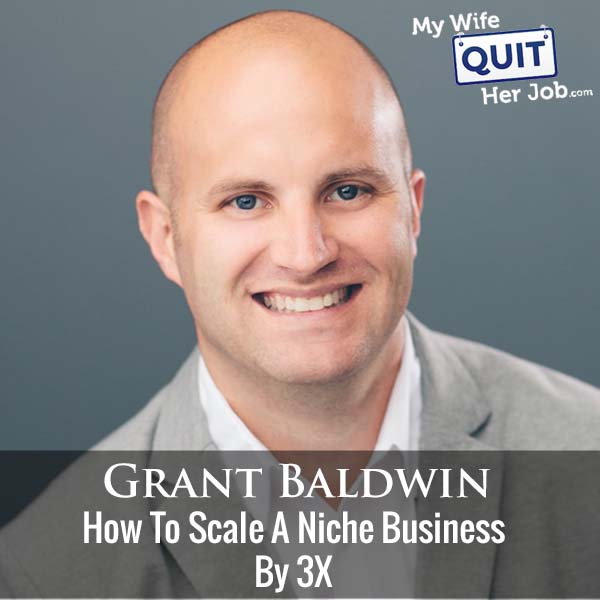
Getting paid to speak starts with narrowing rather than broadening. Grant Baldwin’s framework is to position yourself as a steakhouse rather than a buffet, picking one specific problem for one specific audience, because the more niche and focused you are, the easier it becomes to find gigs.
Grant runs The Speaker Lab, which teaches people how to get booked and paid to speak, and wrote The Successful Speaker. He is also the person who introduced me to webinars, a strategy that has made me millions over the years.
This episode covers his five-step SPEAK framework for booking gigs, and how he tripled the business using automated webinars, Facebook ads, and a phone-based enrollment team.
Get My Free Mini Course On How To Start A Successful Ecommerce Store
If you are interested in starting an ecommerce business, I put together a comprehensive package of resources that will help you launch your own online store from complete scratch. Be sure to grab it before you leave!
Table of Contents
Key takeaways
- Be a steakhouse, not a buffet. Speaking to everyone means speaking to nobody.
- The SPEAK framework: select a problem, prepare your talk, establish expertise, acquire gigs, know your worth.
- You need a website and a demo video before anyone will pay you to speak.
- Most bookings come from other speakers through referrals rather than cold outreach.
- Higher cost-per-lead converted better. $15 to $17 leads converted at 3% to 5% versus 1% at $5 to $7.
- Live chat on the checkout page alone converts people who are already holding their card.
- Free gigs are fine when you know why, since a single unpaid conference generated thousands in course sales.
- He took a full month offline and it became one of the business’s best stretches of the year.
What The Speaker Lab sells
Grant spent several years as a full-time speaker across the US, working with colleges, high schools, entrepreneurs, corporations, and associations.
Enough people asked how to do what he did that he started teaching it, and that became the core business.
The offering splits into two programs teaching largely the same material. A self-study program sold through automated and live webinars, and a group plus one-on-one coaching program sold over the phone.
The distinction is delivery. One is do-it-yourself, and the other puts coaches in the trenches with you and includes some done-for-you components.
Why speaking is a durable niche
My honest first reaction years ago was that the niche seemed too small, and it has become a seven figure business.
Grant’s argument is longevity. Public speaking has existed for a long time and will continue to, unlike a platform-specific skill that may be irrelevant in ten years.
The demand pattern resembles book writing. A large number of people aspire to it, and speaking is polarizing enough that the people who want it want it strongly.
His own starting point defines the customer. He had the potential but needed the plan, knowing he was a decent speaker and wanting more of it, with no idea how to find gigs, what to charge, or who hires speakers.
How Grant Baldwin tripled the business
The single biggest lever was adding the high-ticket group coaching program.
Demand existed already, with people asking for group or one-on-one coaching. Grant personally does no one-on-one work.
His constraint shaped the design. He is deliberate about not building a business around himself, and tells his team this is not the Grant show.
That means students should not join expecting significant access to him. The win he points to is students saying they worked with Eric or Rick and had a great experience, because those coaches were trained internally and have seen results themselves.
The self-study side provides the base. A $1,000 course sold through webinars, supported by Facebook ads and an email list of over 100,000 people.
Why selling by phone is harder than selling by webinar
Webinars scale without additional workload. Ten attendees or a thousand attendees changes almost nothing about how the webinar runs.
Phone calls have hard capacity limits, which creates a supply and demand balancing problem.
The scheduling window matters. Ideally someone books a call for the next day or two, while still interested and excited, rather than a week out.
That means sending enough traffic to fill three enrollment advisors’ calendars without pushing bookings so far out that interest cools. If an advisor has twelve open slots tomorrow and two bookings, that capacity is wasted.
The compensating advantage is human contact. A conversation about someone’s specific business and challenges lands differently than a webinar, even one where you call people out by name.
How the lead magnets funnel into two actions
Grant runs a variety of lead magnets including PDFs and a speaker fee calculator at myspeakerfee.com.
The calculator answers the question they hear most. It is a Typeform asking seven or eight questions and telling you what you should charge as a speaker.
Everything funnels to exactly two calls to action. Attend the automated webinar, or book a call.
That applies to every asset. Website buttons, podcast content, lead magnets, and the book all end at one of those two places.
How the automated and live webinar combination works
All Facebook ads point to the automated webinar, which runs daily. No ads go to the live webinar, partly for cleaner tracking.
Roughly once a month he runs a live webinar to the email list with substantially the same content.
The live one functions as a catch-all. If the automated webinar has a 50% show rate, half the registrants were interested and did not attend, and the monthly live session recaptures them.
People register for the automated webinar and then attend a live one weeks, months, or years later. Tracking shows attendees sitting through two, three, or four live webinars before buying.
Because no ad spend goes to the live webinar, those sales effectively recoup earlier ad costs.
Why higher cost per lead produced better results
Grant’s agency has driven cost per lead considerably higher while conversion improved.
Some weeks produced $5 to $7 registrants converting at about 1%.
Other weeks cost $15 to $17 per lead, two to three times as much, and converted at 3% to 5%.
The interpretation is lead quality. Fewer leads, better matched, with the dollars going to people who actually convert.
Total ad spend runs $25,000 to $35,000 a month, roughly a thousand dollars a day.
What webinar show rates look like now
Live webinar show rates run 24% to 41%, clustering in the high twenties.
That is meaningfully down from several years ago, when webinars were newer and less familiar to audiences.
Grant’s automated webinar runs about an hour plus Q&A, landing near an hour fifteen, with the offer and buy link appearing before the one hour mark.
The idea he is considering is a micro webinar. If you had to deliver a webinar in ten or fifteen minutes, cutting all the fat and getting straight to the offer, what would that do to show rates and conversion?
For reminders, registrants get email, SMS, and Facebook Messenger through ManyChat, since Messenger open rates are extremely high.
Why live chat only on the checkout page works
Grant added live chat to the checkout page alone rather than site-wide, using Crisp.
The volume is low. Perhaps one chat a week, since most people reaching checkout have no questions.
The people who do chat are holding their card and ready to decide. Their card is not working, they want to confirm a bonus applies, or they need one small clarification.
Clarifying that one thing pushes them over the edge. Ten conversations a month producing two, three, or five sales that would otherwise walk away frustrated pays for the tool many times over.
It integrates with Slack, so anyone on the team can handle the conversation, and the app shows which checkout page variant the person is on.
How the phone enrollment program is structured
Group coaching was $4,000 at the time of recording, moving to $5,000 days later.
Ads for calls target warm audiences preferentially. Some go straight to a booking page, which is hit or miss, and others route through a lead magnet or the fee calculator, then a piece of content, then the invitation to book.
Retargeting podcast listeners and repeat site visitors works better than cold traffic, where someone scrolls past an ad, books a call, and knows nothing about the company.
No-shows are the recurring problem, mirroring the webinar issue. People book while excited and flake two days later, or turn up purely to kick tires.
The three enrollment advisors work on straight commission, which removes fixed payroll cost while the ad spend remains a hard cost. Higher ticket prices create more margin to absorb that.
Why more people created more freedom
The team is 13 or 14 people, mostly contractors and mostly part-time, adding up to roughly eight full-time equivalents.
Grant held the same assumption most solo operators do, that more people means more headaches and less freedom.
His experience contradicted it. Getting the right people into the right roles produced more autonomy, not less, because most days there is a lot happening that he does not personally own.
The proof was a sabbatical. He took a complete month off, prepared with the team over several months in advance, with no Slack, no email, no meetings, and a single text about a missing login.
That four-week period was one of the year’s best stretches, and the debrief afterward found it had been business as usual.
His conclusion is that he did not want to build another job for himself, and that stepping away for that long requires genuinely solid people rather than only a part-time VA.
The tradeoff is real. Revenue tripled and so did costs, and he describes himself as doing less while making more.
Step 1: Select a problem to solve
This is where most speakers struggle, and it applies to any entrepreneur.
The instinct is reaching the broadest possible audience. Speakers say their message is for everybody, or that they can speak about leadership, sales, marketing, marriage, or parenting.
Grant’s response is that a message for everybody is a message for nobody, and claiming expertise in everything makes you look foolish.
The steakhouse framing is the fix. At a buffet, steak is one of a hundred mediocre options. At a steakhouse they do one thing extraordinarily well.
The counterintuitive part is that narrowing makes finding gigs easier rather than harder. The Speaker Lab’s own audience is interested in books, courses, coaching, and consulting, and Grant refuses to serve any of it. When someone suggested he start an author lab, the answer was no.
Step 2: Prepare your talk
Not all talks are created equal, and knowing your topic does not mean knowing how to build a talk around it.
The common position is having clarity on the audience and subject while staring at a blank screen.
This step covers constructing and delivering a talk: how to build it, how to handle nerves, whether to use slides, how to handle technology, and how to interact with an audience.
That applies whether you speak once or a hundred times, since either way you want to be professional.
Step 3: Establish yourself as the expert
Two marketing assets are non-negotiable if you want to get paid.
A website and a demo video.
Buyers need that proof and need to hear what you actually sound like before committing budget to you.
Step 4: Acquire paid speaking gigs
This is the step everyone wants to skip to, and skipping the earlier ones puts you back at square one.
Start by making sure everyone in your sphere of influence knows you speak and what you speak about. Family, friends, colleagues, and everyone else.
The objection is that none of those people book speakers, which is usually true and beside the point. They know someone who does, and you need to be on their radar when it comes up.
For active outreach, Google is effective and costs only time. Many events are already looking for speakers, which removes the hardest part of the sale.
The logic is that you are not convincing an organizer to hire a speaker, only showing why you are the right one. Someone teaching Facebook ads for physical products businesses does not need to convince Sellers Summit to book speakers, only to demonstrate fit for that audience.
The highest-yield channel is other speakers. Reviewing his first full-time year, Grant found most bookings came from referrals and word of mouth, from speakers passing along gigs they could not take.
Why speaking is a momentum business
Having the website, the video, the clear topic, and the defined audience does not make the phone ring.
Something has to start the momentum, and then it can build on itself.
The parallel is launching a product on Amazon. Simply listing it does nothing, and initial reviews and traction are what let it take on a life of its own.
Selling gets easier after a year on the market, and getting to that point requires deliberate early effort.
When speaking for free makes sense
Free is fine as long as you know why you are doing it.
The trap is doing it out of goodwill alone, because you like speaking and like helping people, while forgetting you are running a business.
The alternative framing is that a check is only one form of value. Leads, relationships, and customers for an existing product or service all count.
Grant’s example is FinCon, where he spoke without pay and covered his own travel. On paper he lost money, and he can trace thousands of dollars of course and coaching revenue to that event.
How to tell whether your positioning is working
Grant’s litmus test is asking friends, family, and colleagues to complete a sentence: you are the blank person.
The good answer is specific, like ecommerce and physical products.
The bad answer is vague. They think you do physical products, maybe some speaking, possibly a course, and they are not sure.
His view is that the durable advantage is focusing on one thing for a long time. Both of us have done substantially the same thing for a decade, which is what makes people default to you when the need arises.
Frequently asked questions
How do you get booked as a paid speaker?
Narrow to one specific problem for one specific audience, build a website and demo video, tell everyone in your network what you speak about, and search for events already hiring speakers in your niche.
What is the SPEAK framework?
Grant Baldwin’s five steps: select a problem to solve, prepare your talk, establish yourself as the expert, acquire paid speaking gigs, and know your worth.
Should you speak on many topics or one?
One. Be a steakhouse rather than a buffet, because claiming expertise across many subjects undermines credibility and makes you harder to book, not easier.
What do you need before charging for speaking?
A website and a demo video. Buyers need proof of what you speak about and evidence of how you deliver before committing budget.
Where do most speaking gigs come from?
Other speakers. Referrals and word of mouth from speakers passing along gigs they cannot take produced the majority of Grant Baldwin’s first-year bookings.
Should you speak for free?
Only when you know what you are getting instead of a fee. Grant Baldwin traced thousands of dollars of course sales to an unpaid conference talk he paid to attend.
Do cheaper Facebook leads convert better?
Not necessarily. Grant Baldwin’s $5 to $7 leads converted at about 1%, while $15 to $17 leads converted at 3% to 5%, so the more expensive leads produced better economics.
What are typical webinar show rates?
Roughly 24% to 41% for live webinars, clustering in the high twenties, which is down noticeably from several years ago as webinars became familiar.