
Podcast: Download (Duration: 55:17 — 63.6MB)
Going viral on TikTok comes down to three things: the energy you transmit through the screen, combining two subjects that do not normally go together so people comment, and content people can relate to personally. Kat Norton built over a million followers teaching Excel with dance videos filmed on an iPhone, then converted that audience into a course business reaching six figures in a single day.
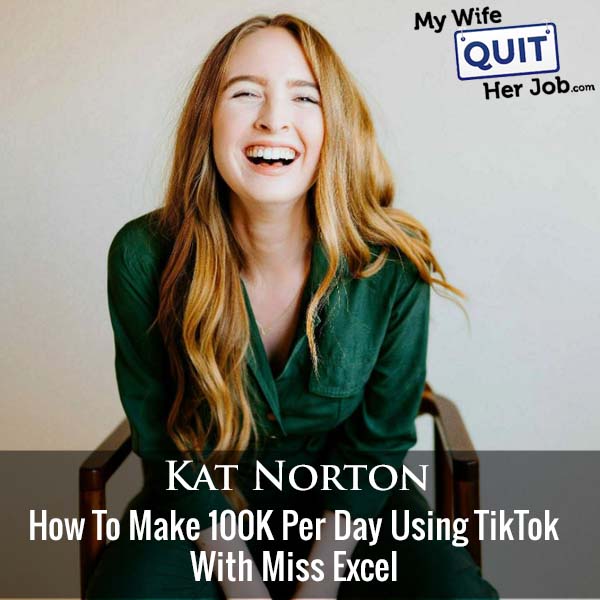
In this episode I sat down with Kat Norton, known as Miss Excel, who went from a corporate consulting job to quitting eighteen months later, running the entire operation herself with no staff and no professional equipment.
Below is the whole playbook: the virality formula, the cross-posting method that avoids watermarks, the webinar funnel producing six-figure days, course pricing and bundling, and the mindset work she credits for making any of it possible.
Get My Free Mini Course On How To Start A Successful Ecommerce Store
If you are interested in starting an ecommerce business, I put together a comprehensive package of resources that will help you launch your own online store from complete scratch. Be sure to grab it before you leave!
Table of Contents
Key takeaways
- Everything is filmed on an iPhone. No professional equipment, one person, no staff for the first two years.
- Energy overrides the algorithm. She does not post on days when her energy is off, and breaks most posting-frequency rules.
- Polarity drives comments. Combining Excel and dancing made people ask what they were watching, which fed the algorithm.
- Fourth video hit 100,000 views. Sixth brought a paying client. Three weeks in, a video hit 3.6 million.
- Webinars produce the six-figure days. 2,000 to 7,000 live attendees, 45 minutes of free teaching, then a 50% offer.
- Course bundle at $997, discounted to about $500 on webinars. Individual courses run $99 to $297.
- Only 2,000 of 100,000 TikTok followers moved to Instagram. Each platform has to be won separately.
- Each TikTok takes one to two hours to edit. Fifteen seconds, edited meticulously.
How Miss Excel started and scaled in 18 months
Kat was working at a consulting firm doing securitization reviews for banks, having built an internal Excel training program as a passion project. During the pandemic she stopped traveling for work, found herself back in her childhood bedroom, and started asking what she actually wanted to do.
A friend suggested putting Excel on TikTok. Her first reaction was refusal (27 years old with a corporate job), and the idea would not leave her alone for two days.
The timeline from there is remarkable. She watched a 40-minute YouTube tutorial on WeVideo, filmed ten videos in one afternoon, and started posting daily.
The fourth video hit 100,000 views. The sixth brought an inbound client, a CEO wanting G Suite training videos, which became her first side revenue within a week of starting.
Three weeks in, a video hit 3.6 million views in a day and took her past 100,000 followers. She sold her first course in November 2020, and by January 2021 the business was outearning her day job. She left corporate on February 1, 2021.
The three ingredients of a viral TikTok
The three things that make a TikTok go viral are energy, polarity, and relatability.
Energy is the one Kat emphasizes most. Content is an energy transmission, and viewers pick up subtle cues about whether you actually feel what you are projecting. She does not post on days when she is in a low or scarcity-minded state, because the audience senses it and faking enthusiasm reads worse than not posting.
Polarity means combining two things that do not normally go together, which sparks comments. Excel and dancing is inherently confusing, so people comment asking what they are watching, whether they love it or hate it. Comments are what push a video through the algorithm.
Relatability came later as she started building narratives, playing characters (the boss, the coworker, then you), switching outfits and doing transitions. When viewers recognize their own workplace in the scenario, they comment about it.
Underneath all three: the tip itself has to be genuinely good. The same handful of Excel tips go viral across every creator in the space.
Why energy matters more than the algorithm
Kat breaks most standard TikTok advice. She posts once or twice a week rather than daily, does not obsess over hashtags, and posts when she has something she is excited about.
Her framing: if posting daily energizes you, do it. If posting daily makes you anxious about what happens when you skip a day, that scarcity mindset is the opposite of the abundance you are trying to create, and it shows in the content.
This is quality over quantity in practice. Each fifteen-second TikTok takes her one to two hours to edit, working the timing meticulously.
How to cross-post between TikTok and Instagram Reels
Edit everything outside both apps and upload separately to each platform. Kat uses WeVideo, which avoids watermarks entirely and lets her add her own visual style rather than using the platforms’ built-in editors.
For music, start your song search on TikTok rather than Instagram. TikTok offers a shorter clip window from any given song, so a selection that works on TikTok will almost always be available on Instagram, and the reverse frequently fails.
Expect almost no audience transfer between platforms. When TikTok faced a potential ban, Kat moved to Instagram to hedge and only about 2,000 of her 100,000 TikTok followers followed her over. She had to go viral on Instagram separately, which she did as Reels launched.
The webinar funnel that produces six-figure days
The webinar funnel is what converts a TikTok audience into six-figure revenue days. Kat runs live “Excel parties” with 2,000 to 7,000 live attendees, teaches a full 45-minute class for free, then makes a 50% off offer with additional bonuses for people who buy during the session.
The promotion sequence is roughly seven to ten days out: a static post with the details, a fun Reel or TikTok, and pushes on LinkedIn and her email list. Everything routes through a Linktree in her bio, kept to three links maximum.
She runs two or three sessions per month, spaced a few days apart, and shows up live for every one. WebinarJam handles registration and the email automation.
The offer window is 24 hours after the replay. That structure, free teaching followed by a genuine discount for people who found it valuable, is what produced her largest revenue days.
Course pricing and bundling that works
Individual courses run $99 to $297, with the flagship Excel accelerator at $297. The complete Microsoft Office suite bundle is $997, and it is the top seller because the webinar discount brings it to roughly $500, or about the price of one and a half individual courses for eight courses.
Everything is one-time purchase with unlimited lifetime access rather than a membership. Buyers of the complete suite automatically receive new courses as they are added, which is what turns the bundle into the obvious choice.
Roughly 5,000 people out of a million-plus followers actually move through the email sequence, which is a useful reminder of how much audience it takes to support this revenue.
The email sequence behind the course sales
Two separate sequences run in parallel. The evergreen sequence starts with a free guide or mini course, then tells a five-email story about her background and why she cares about the material, with a discount code arriving in email four and a last-chance reminder in email five.
The webinar sequence is entirely separate: reminders leading up to the session, then the replay link and the 24-hour offer window.
The distinction matters. The evergreen sequence sells through story and relationship. The webinar sequence sells through demonstrated teaching value and urgency.
Why courses need emotion, not just information
Kat builds her courses on Jim Kwik’s learning formula: information plus emotion equals memory. Most courses deliver information alone, which is why so little of it sticks.
Her application is concrete. She teaches functions as a Wheel of Fortune-style game with a custom-designed theme, adds visual elements popping onto the screen, and edits every one of roughly a hundred videos per course herself because the editing is part of the teaching.
The goal in every video is sparking something: a laugh, or surprise at something genuinely useful. That emotional hook is what forms the memory, and she credits it for the courses performing as well as they do.
Why nobody can actually copy your content
People do steal Kat’s videos, reupload them to YouTube, and put their own name on them. Her assessment is that it does not really matter, because what sells is not the information.
Excel knowledge is a commodity, freely available everywhere. What people buy is the instructor: her teaching style, her energy, and whether they enjoy learning from her.
She has followers who do not use Excel at all and watch because the content makes them smile. That is not copyable, and it is the actual product.
The mindset work behind the business
Kat credits a specific sequence of inner work for making the business possible, having previously had an anxiety disorder and a public speaking disorder and hating any attention on herself.
Her three components:
- Dr. Joe Dispenza’s Breaking the Habit of Being Yourself, which grounds meditation and manifestation in science, which she needed as an analytical person before she could take any of it seriously.
- Lacey Phillips’ To Be Magnetic program, a structured method for identifying and reprogramming limiting beliefs using guided meditations and binaural audio to bring the subconscious forward.
- Kundalini yoga, as a meditation style that worked for her where conventional clear-your-mind meditation did not.
The example she gives of a limiting belief: in first grade she sang into a toy microphone and her parents told her she was great at many things and could not sing. Her child self encoded that as not being worthy of the stage, and her brain then found evidence confirming it for two decades.
Her framing on meditation generally: it is daily mental hygiene rather than an occasional treat, and finding a style that suits you matters more than following any particular method.
Masculine and feminine energy in creative work
Kat distinguishes between two working modes, which she calls masculine and feminine energy rather than male and female.
Masculine energy is execution: go, go, go, crank through the to-do list. Feminine energy is receptive and flowing, which is where creative ideas actually surface.
Her practical application is that she makes the most money on days she does not work. Time in nature, yoga, hiking, and then sitting down as the ideas arrive. The corporate habit of booking a 30-minute brainstorming block right after a run of meetings fails because you are in execution mode, not creative mode.
Frequently asked questions
How do you go viral on TikTok?
Three things: the energy you transmit (viewers detect whether you actually feel what you project), polarity from combining two subjects that do not normally go together so people comment, and relatability through characters and scenarios viewers recognize. Comments are what push videos through the algorithm.
Do you need professional equipment to succeed on TikTok?
No. Kat Norton built over a million followers filming everything on an iPhone. Video and audio quality on current phones is genuinely sufficient. She learned editing from a single 40-minute YouTube tutorial on WeVideo.
How do you post the same video on TikTok and Instagram Reels?
Edit outside both apps and upload separately to each, which avoids watermarks and lets you apply your own visual style. Search for music on TikTok first, since TikTok offers a narrower clip window and a selection that works there will usually be available on Instagram.
Do TikTok followers transfer to Instagram?
Almost never. When Kat moved to Instagram to hedge against a possible TikTok ban, only about 2,000 of her 100,000 TikTok followers came with her. She had to build the Instagram audience separately by going viral there too.
How do you make money from a TikTok audience?
Webinars convert best. Kat runs live sessions with 2,000 to 7,000 attendees, teaches a full 45-minute class free, then offers 50% off with additional bonuses for buying during the session. Those webinars produced her six-figure revenue days.
How should you price online courses?
Individual courses at $99 to $297, with a complete bundle at $997 discounted to roughly $500 during webinars. The bundle sells best because it costs about the same as one and a half individual courses. One-time purchase with lifetime access, with new courses added free for bundle buyers.
Does mindset work actually matter for building a business?
Kat credits it as the root of everything, having previously had an anxiety disorder and a public speaking disorder. Her sequence was Dr. Joe Dispenza’s book for the scientific grounding, Lacey Phillips’ To Be Magnetic for structured belief reprogramming, and Kundalini yoga as a meditation style that suited her.