Podcast: Download (Duration: 53:37 — 61.6MB)
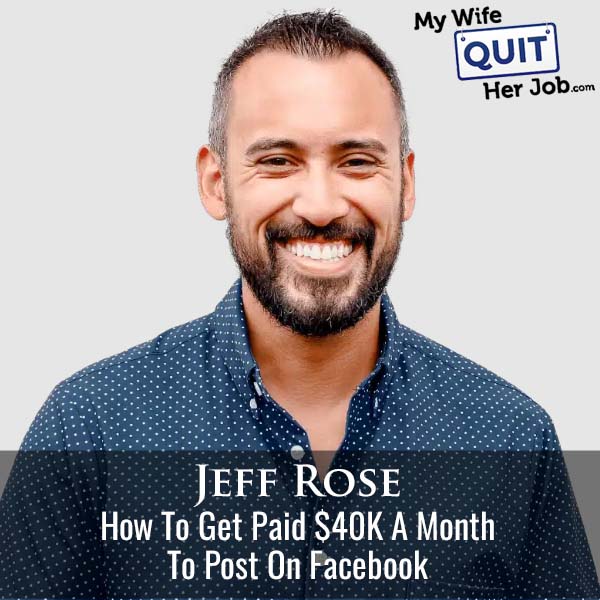
The fastest way to make money with Facebook monetization in 2026 is to post 20 to 24 image, text, and reel posts a day to a Facebook Page enrolled in Meta’s Content Monetization program, and to treat the page like the old blogs used to work: high volume, engagement-driven, evergreen recycling allowed. On this episode of the My Wife Quit Her Job podcast, I sat down with my longtime friend Jeff Rose of Good Financial Cents, who now makes almost $40,000 a month doing exactly that from a Page he barely touched two years ago.
Jeff’s ecommerce and blogging peers all watched their old blog revenue collapse when Google’s AI Overviews hit. His Good Financial Cents blog went from several hundred thousand dollars a month in display ads to about $180 in a recent month.
What replaced that income is a Facebook Page pushing screenshots, text posts, and short reels into Meta’s revamped Content Monetization program.
Below is the exact playbook Jeff walked me through: how the program pays, what content earns, how he sources 20 plus posts a day in about an hour, and how to think about the risk of leaning on Facebook as your main income.
Get My Free Mini Course On How To Start A Successful Ecommerce Store
If you are interested in starting an ecommerce business, I put together a comprehensive package of resources that will help you launch your own online store from complete scratch. Be sure to grab it before you leave!
Table of Contents
Key takeaways
- Meta’s Content Monetization program pays creators for images, text posts, reels, long-form videos, and stories on Facebook Pages. It is invite-only, and older Pages with existing followings get accepted much faster.
- Jeff Rose scaled from $137 in his first monetized month to about $40,000 a month by going from casual posting to 24 intentional posts per day. He is now on track for nearly $200,000 in 2026 from Facebook alone.
- Niche does not determine RPM the way it does on YouTube. Jeff has seen mom bloggers, thrifting Pages (roughly 300K followers earning $22K to $24K in a month), and dad-motivation Pages all pull five figures a month.
- Roughly 70% of Jeff’s content is screenshots of viral posts from X (Twitter), Reddit, and Threads, captioned with ChatGPT. He schedules everything with Post Planner and republishes evergreen posts because 95% of Facebook content is dead after 48 hours.
- The audience is older and higher-income, which is why the CPMs stayed strong. Facebook is skewing toward creators over 40 in a way TikTok and Instagram do not, which is part of why the program feels durable.
What is Facebook’s Content Monetization program?
Facebook’s Content Monetization program is Meta’s unified payout system that rewards creators on Facebook Pages for engagement across image posts, text posts, reels, long-form videos, and stories. It rolled up all the older Reels ad revenue, in-stream ad revenue, and performance bonus programs into one dashboard as of September 1, 2025.
Inside the program you can also earn from stars (viewer tips), subscriptions, and periodic performance bonuses on top of the base payout. Jeff told me he currently sees three separate bonuses stacked on his dashboard, including a 20% holiday bonus and a reach-based bonus that paid an extra $480 in a single week.
The program is invite-only. There is no “sign up” button; Meta invites Pages that meet its monetization policies, which include at least 30 days of consistent posting and content that follows community standards.
How does Jeff Rose earn $40,000 a month posting to Facebook?
Jeff Rose earns close to $40,000 a month by publishing about 24 pieces of engagement-optimized content per day to his Good Financial Cents Facebook Page and letting Meta’s Content Monetization program pay him per post based on reach and engagement. His mix is mostly screenshots he sources from Twitter, Reddit, and Threads, paired with ChatGPT-written captions and satirical commentary in his brand voice.
He started casually. In May 2024 he cross-posted an Instagram reel to Facebook and it hit several hundred thousand views.
The copyrighted music on that reel blocked the payout, though a screenshot of a viral DoorDash tweet a couple months later netted him $137 for two posts once his Page was accepted into the program.
The scale came when he went “all in” in April 2025. Month one after committing to a real posting cadence he made $10,000 to $15,000, then $20,000, then $30,000 for several consecutive months, and now sits near $40,000 a month. His follower count went from 25,000 to almost 400,000 in that stretch and just passed his YouTube subscriber count.
What kind of content actually earns money on Facebook in 2026?
The content that earns the most on Facebook monetization in 2026 is high-engagement content in almost any format: screenshotted viral tweets with fresh commentary, long-form written stories about founders and businesses, entertaining or satirical images, mom-blog style long posts, and short reels tied to trending topics. RPM is driven by engagement (likes, comments, shares, retention) rather than by niche.
Real examples Jeff has seen across the program:
- Thrifting Page with about 300,000 followers: roughly $22,000 to $24,000 in one month from Facebook alone.
- Mom-blog style long-form Pages: $10,000 to $20,000 a month writing 500 to 1,000 word posts with a single image.
- Political and dad-motivation Pages: five figures a month, driven purely by engagement and share velocity.
- Jeff’s Buc-ee’s business write-up (a long-form post about the gas station chain with a ChatGPT-generated image and rewritten commentary): over $3,000 from a single post.
- A one-sentence text post citing a stat about Americans drinking less alcohol: roughly $250 to $300 for that one post.
The counterintuitive part is that Jeff’s finance niche does not have an inflated RPM the way it does on YouTube. A short reel with a million views may only pay $30, while a text sentence with far fewer views can pay several hundred. Meta appears to be paying on total engagement value per format rather than on advertiser-driven CPMs.
How does Jeff source and schedule 24 posts a day?
Jeff sources and schedules 24 Facebook posts a day by screenshotting viral or on-brand posts from Twitter, Reddit, and Threads while he does other things (waiting to pick up his daughter from school, scrolling in downtime), then batching the caption writing in ChatGPT and pushing everything into Post Planner for automated scheduling. The whole workflow takes about an hour a day, and he does it solo with no VA.
His step-by-step:
- Screenshot 8 to 12 candidate posts during small pockets of downtime. Save them to his phone.
- Upload each screenshot to ChatGPT with a prompt asking for five caption variations and five first-comment variations, in his voice.
- Pick the caption that reads least like AI. Two- or three-sentence-in-a-row cadence is the tell, so he edits or reprompts to avoid it.
- Load the image + caption into Post Planner, drop it into a content bucket, and let the tool auto-schedule to preset time slots.
- Post about once an hour during waking hours, with 3 a.m. and 6 a.m. slots to catch early scrollers.
Roughly 90% of what he posts is new, and about 10% is recycled evergreen content. The recycling matters because only a small fraction of a Page’s followers see any given post, and 95% of Facebook posts are effectively dead after 48 hours.
Why is Facebook (not Instagram or TikTok) the best paid platform right now?
Facebook is the best paid platform right now because Meta’s Content Monetization program pays on more formats (including plain text and screenshots) than any competing platform, the audience skews older and higher-income, and Meta is actively spending to keep aging users engaged on a platform that kids abandoned.
Look at the alternatives. Instagram Reels bonuses got pulled, TikTok’s creator fund payouts have been famously stingy, and Threads paid nicely at launch and now pays essentially nothing.
Jeff has been talking to a Facebook Page agency that has been running this playbook for seven-plus years. He has also spoken with a political podcaster who has been earning from Facebook since 2019, and it remains that podcaster’s top revenue source, above sponsors and brand deals.
The audience skew is the durable part. My Facebook ads consistently outperform on older, wealthier segments, which lines up with why Jeff’s Good Financial Cents Page monetizes so well. Facebook is the platform of adults with money, and advertisers pay to reach them.
How do you get invited into the Facebook Content Monetization program?
You get invited into the Facebook Content Monetization program by running a Facebook Page that follows Meta’s monetization policies, posting consistently for at least 30 days, and generating real engagement that signals your Page is worth paying for. Legacy Pages that are five or more years old with a decent following tend to get invited fastest, sometimes just needing to click “accept” inside the professional dashboard.
There is no clean formula for newer Pages. Jeff has seen brand-new Pages get accepted quickly and other 20,000-follower Pages sit uninvited for months. The pattern that seems to work is consistent daily posting, real engagement (comments and shares, not just likes), and content that stays inside Meta’s community guidelines.
Check your professional dashboard first. If Content Monetization is already available to your Page, accepting the invite may be the only step you are missing.
Can you drive traffic to your website while running Facebook monetization?
You can drive traffic to your website from a monetized Facebook Page, but Meta will suppress reach on posts with outbound links, so most experienced Page operators keep the link in the first comment and cap external-link posts at roughly 30% of total content. The other 70% stays inside Facebook’s ecosystem where Meta pays you for engagement.
The classic example is the sports-rumor pattern. A Facebook post says “Crazy trade rumors” with a picture of a star player, and the article itself lives in a first-comment link on a page loaded with display ads.
The Page earns twice: once from Meta for the Facebook engagement, and once from ad impressions on the destination site.
For ecommerce and coaching businesses, this creates an interesting hybrid. A monetized Page pays you to build audience while you funnel a slice of that audience to your store or landing page. Many chat bots (ManyChat and similar) with keyword triggers (“comment STACK to get the checklist”) let you capture leads without penalizing reach with outbound links.
Is Facebook monetization sustainable, or is it going to disappear like TikTok’s creator fund?
Facebook monetization looks more sustainable than past creator-fund experiments because it is a unified program tied to Meta’s core ad business rather than a bolt-on marketing budget, it has been paying select creators consistently since at least 2019, and Meta needs it to keep older users producing content that competes with TikTok and YouTube. The risk is real but different from TikTok’s.
The honest read is that payouts will probably compress over time as more Pages enter the program, the way YouTube AdSense RPMs have shifted over 15 years. That is very different from a program getting killed outright. Jeff’s plan for 2026 is to lean into it hard now while payouts are strong, and to use the Facebook audience to rebuild traffic to his blog so he is not fully platform-dependent.
The right way to think about it is the same way any smart ecommerce operator thinks about a hot platform. Ride it while it is peaking, extract the revenue, and use the proceeds to build durable assets (an email list, a product, a site, a community) that outlast the platform.
How can an ecommerce brand use Facebook monetization?
An ecommerce brand can use Facebook monetization by turning its product photos, behind-the-scenes shots, and customer stories into a daily posting cadence that both earns from Meta and drives buyers to the store. The dream setup is a Page where Meta pays you to advertise your own products, effectively subsidizing your marketing.
Jeff pointed to a Facebook Page from a woman who sells politically themed cookies. She was earning $2,000 to $3,000 a month from Facebook while also selling out of inventory. Same content, two revenue streams.
For my own Bumblebee Linens business, the play is obvious once you see it. Handkerchiefs with funny captions are highly shareable meme material, we can produce dozens of image posts a week, and the same photo can be recycled a month later without wearing out. The barrier to entry is a well-behaved Facebook Page and a willingness to post volume.
What is the actual daily workflow you can copy?
The daily workflow you can copy is a 60-minute daily loop of source, caption, schedule, that produces 20 to 24 posts. Batching is what makes it sustainable solo.
- 15 to 20 minutes sourcing: screenshot 20 to 25 candidate posts from Twitter, Reddit, and Threads across the day.
- 20 to 25 minutes captioning: upload each screenshot to ChatGPT, request five caption + five first-comment variations, pick and edit the best.
- 10 to 15 minutes scheduling: drop each post into Post Planner (or Buffer) into a preset bucket that auto-schedules to a set time slot.
- 5 minutes review: skim analytics on yesterday’s top posts and flag any that are worth republishing in two weeks.
Once you have a couple of months of posts stored, republishing evergreen content covers a growing share of the schedule and drops the daily time even further. A VA can eventually take over the sourcing and scheduling entirely, leaving the operator to approve captions.
Frequently asked questions
How much can you realistically make from Facebook monetization?
Real earnings range from a few hundred dollars a month on smaller Pages to $40,000-plus a month on well-run Pages that post 20 or more times a day. Jeff Rose is on track for close to $200,000 in 2026 from Facebook alone, and he knows Pages doing similar or better numbers in niches from thrifting to political commentary. The floor is low and the ceiling is genuinely high.
Do you need a large existing following to earn from Facebook monetization?
You do not need a large existing following, though older Pages with several thousand engaged followers get invited into the program faster. New Pages can qualify after 30 days of consistent posting if the engagement is real. Follower count matters much less than engagement rate.
What niches earn the most on Facebook monetization?
Engagement drives earnings more than niche does on Facebook, which is why mom bloggers, thrifting Pages, dad-motivation Pages, and political commentary Pages all pull five figures a month. Finance and business Pages do well because the audience skews older and higher-income. Any topic that reliably gets comments and shares can monetize.
How many posts per day do you need to make real money on Facebook?
Serious earners post 20 to 50 times a day to overcome Facebook’s low organic reach, which typically shows any given post to less than 5% of a Page’s followers. Jeff Rose settled on 24 posts a day as the sweet spot he could sustain solo. Fewer posts still earn something, but the math gets much less compelling below about 10 a day.
Can you use AI to write Facebook posts and still earn?
You can absolutely use ChatGPT and similar tools to draft captions and commentary, and most active earners do. The trick is editing the output so it reads like a human and does not trigger the AI-slop cadence viewers now spot instantly. Facebook does not currently penalize AI-assisted text posts, though the community can flag obvious slop.
Can I schedule Facebook monetization posts with a third-party tool?
Yes. Post Planner, Buffer, and similar tools work with Facebook Pages and let you bulk-upload posts into buckets that auto-publish on a schedule. Jeff runs his entire operation through Post Planner, which is what makes 24 posts a day feasible for one person.