
Podcast: Download (Duration: 54:15 — 62.4MB)
To grow a YouTube channel fast, pick one specific niche, publish keyword-based videos to earn your first thousand subscribers through search, then pivot as quickly as possible to hour-plus long-form content that trains YouTube to serve you as “suggested” video after big channels in your topic. On top of that, A/B test every thumbnail (thumbnails drive roughly 70% of clicks), use uniform thumbnail templates so viewers recognize your channel, cap uploads at one video per day, and treat shorts as a top-of-funnel experiment, not a growth engine on their own.
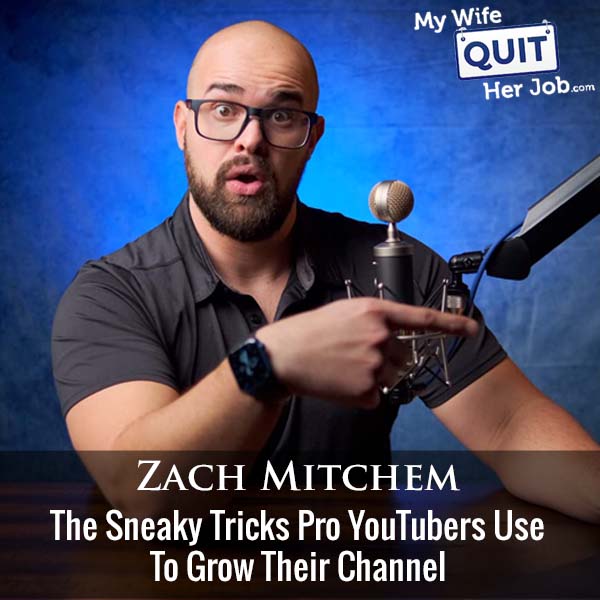
In this episode of the My Wife Quit Her Job podcast, I sat down with Zach Mitchem of We Are Video Makers, the YouTube strategist who helped me add 50,000 subscribers in about 2.5 months after it had taken me 2.5 years to hit my first 100,000. Zach also serves as Chief Social Media Officer for Seller Universe and consults for large creators including Evan Carmichael.
Below is the full playbook he walked me through, including the specific difference between search and suggested traffic, why hour-plus videos have quietly become the fastest way to grow a channel in 2026, and the click-through-rate targets to actually aim for.
Get My Free Mini Course On How To Start A Successful Ecommerce Store
If you are interested in starting an ecommerce business, I put together a comprehensive package of resources that will help you launch your own online store from complete scratch. Be sure to grab it before you leave!
Table of Contents
Key takeaways
- YouTube gets roughly 70% of its views from “suggested,” not from search. Search is a starter engine for the first 1,000 to 10,000 subscribers only.
- Long-form video (hour-plus, not eight-minute) is the strongest current growth format. Some clients are growing fastest on eight-hour videos.
- Post at most one video per day on any single channel. Posting more often knocks your own videos out of the browse shelf.
- Thumbnails drive about 70% of clicks and the title the other 30%. A/B test every single thumbnail, and always run tests to statistical significance in TubeBuddy, not for a fixed number of days.
- Aim for a 3% to 6% click-through rate. Above 6% usually means your reach is capped to existing subscribers; below 3% means the thumbnail or title needs work.
- Uniform thumbnail templates train YouTube to recommend more of your own videos after your other videos, which is the cheapest way to lift watch time.
- To find “suggested-friendly” topics, search YouTube for videos with more views than the channel has subscribers, then use a variation of that title.
- Tags almost never matter. Only spend real time on tags when a term is commonly misspelled or highly technical.
- Shorts are a different skillset and audience. They can drive top-of-funnel subscribers, but rarely convert to courses, email list, or long-video watch time.
How to get your first 10,000 YouTube subscribers
The fastest way to get your first 10,000 YouTube subscribers is to pick one narrow message, publish keyword-based videos that let YouTube “categorize” your channel, and be consistent enough to give the platform data to work with. The hard part is not the videos. The hard part is picking one lane and staying in it.
Small channels do not have enough watch data for YouTube to figure out who else would like their videos, so you have to signal it explicitly by keeping topics tight. If you publish e-commerce today, relationships tomorrow, and cooking on Wednesday, the algorithm has nothing to match your videos against.
Search-based content (“how to X”) is easier at zero subscribers because YouTube already knows the search intent. The catch is that search is a slow, capped growth engine. You want to graduate off pure search as quickly as possible.
The one-minute keyword research method
Zach’s shortcut for keyword research is to skip paid tools at first and just search YouTube for your target topic. Look for videos where the view count is higher than the channel’s subscriber count. That signal (more views than subscribers) is proof the video is being suggested and searched beyond that channel’s own base, which makes it a good topic to target with a similar title.
TubeBuddy and vidIQ both work as paid keyword tools. Zach uses TubeBuddy for its A/B testing features, but says the free version of vidIQ is enough for a starter channel.
How to get YouTube suggested traffic (the real growth engine)
You get YouTube suggested traffic by training the algorithm that people watch multiple videos on your channel back to back, and by making your videos look like natural next-video pairings with bigger channels in your niche. Suggested traffic is roughly 70% of all YouTube views, so this is where real growth happens.
There are two levers to pull.
1. Get suggested after your own videos
Use uniform thumbnail templates so a viewer instantly recognizes your video in the suggested sidebar. If someone likes your channel, a recognizable thumbnail is what makes them click the next one.
End every video with a specific “next” recommendation (“we solved X; now go watch this video on Y”). If viewers actually follow that CTA, YouTube learns that people binge your channel and will start suggesting more of your videos after your other videos.
Toilet-unclogging tutorials get one view per session. A hooked audience gets five.
2. Get suggested after other channels’ videos
Find a video on a bigger channel in your niche with more views than that channel has subscribers, then publish a video with a similar (near-copied) title on the same topic. YouTube links the two in its “test against each other” pool. Get suggested after that one big video and the algorithm starts putting you next to many similar ones.
Why hour-plus videos are the fastest YouTube growth format right now
Hour-plus videos are the fastest YouTube growth format right now because they generate far more watch time per view, train YouTube to serve you longer content everywhere, and let the algorithm play more ads per video. Zach says he would not have given this advice six months ago; the data has shifted.
Watch time is the metric YouTube cares about most. A two-minute video that gets a million views can never generate the total watch time of an hour-long video at the same view count.
The economics on AdSense follow the same curve. A one-million-view eight-minute video and a one-million-view eight-hour video are not in the same revenue league, and the eight-hour video wins by roughly 10x in Zach’s example.
The catch is patience. Give an hour-plus video 60 days before you evaluate it. It takes longer to find its audience than a snackable eight-minute video does.
But once it lands, the trust curve is different. Watching an hour with a creator builds real parasocial connection; watching two minutes builds nothing.
Zach cited Daniel Priestley’s rule of thumb (“seven hours of interaction, 11 touch points”) and long-form is how you rack up the hours.
The niche caveat matters. “How to fix a leaky faucet” is not an hour-long video, and forcing it to be one will hurt you. If you are in education, thought leadership, interviews, or podcasting, longer is better. If you are in product reviews or how-tos, keep it as long as needed and as short as possible.
Thumbnails: the highest-ROI investment on YouTube
Thumbnails are the highest-ROI investment on YouTube because they drive roughly 70% of the click decision, and click-through rate is the input that determines whether YouTube surfaces your video more or shelves it. Titles account for the other 30%.
What a good click-through rate looks like
Aim for a 3% to 6% click-through rate on average. Above 6% is usually a warning sign that YouTube is only showing your video to your existing subscribers and impressions are capped. Below 3% and something on the thumbnail-title-hook chain is broken.
As impressions scale, CTR naturally comes down (YouTube is testing you with new audiences), so 3% at 2 million impressions is better than 6% at 100,000.
Use a thumbnail template, not one-off designs
A template is a consistent visual system (position of the subject, zoomed face, three to five words, emphasized letters, color palette). Evan Carmichael’s channel is a common example: face right, close crop, short punchy text.
The template does two things at once. It makes viewers recognize your video in a crowded sidebar, and it lets YouTube link your videos together in its “same author” mental model.
The human vision system processes an image roughly 20x faster than words, which is why three-to-five-word thumbnails outperform text-heavy ones. Get the eye first, then the title.
A/B test every thumbnail, and update old ones
Create at least two thumbnails per video and A/B test in TubeBuddy. Run each test until statistical significance, not for a fixed number of days. For big channels, that can be two or three days; for small channels, it can be months.
Winning templates can double or triple click-through rates. When you find a template that beats your current one seven out of ten times, update your entire back catalog to the new template.
Old videos, new thumbnail is the single fastest way to resurrect a dead video. Evan Carmichael reportedly has four people whose full-time job is A/B testing and refreshing thumbnails across a 20,000-plus-video library.
How often to post on YouTube in 2026
Post at most one video per day on any single YouTube channel, ideally two to three high-quality videos per week. Zach’s data shows that going from one video per week to two can double AdSense revenue for many channels; going past one per day starts to hurt because new uploads kick your other videos off the browse shelf.
The reason for the cap is browse-shelf competition. When YouTube places one of your videos on a viewer’s home page, that placement is finite. Publish another video within 24 hours and YouTube may swap the new one in and pull the old one out.
On a short-heavy schedule, you risk knocking an hour-long video out of browse in favor of a 30-second one, which is a bad trade for total watch time.
Are YouTube shorts worth it? The honest answer
YouTube shorts are worth testing as a top-of-funnel experiment but are usually a vanity metric, not a growth engine, especially in education and thought-leadership niches. Some creators crush it with shorts. Most do not, and the audience that consumes a 30-second short is rarely the same audience that will sit through an hour-long video, hop on your email list, or buy a course.
The measurement discipline is worth stating. Do not judge shorts by view count alone. Look at whether subscribers going up correlates with a real bump in total watch time (hours), not just views.
If you gain 5,000 subscribers from shorts but watch-time hours barely move, those subscribers are not converting into engaged viewers.
Zach ran a surface-level look at Alex Hormozi’s top 30 videos: five hour-long videos accounted for 55% of the total watch time. His top five shorts generated roughly 7.5 million views but only about 6% of watch time. The takeaway: even for a channel doing everything right on shorts, one long video is worth many short ones for the business metrics that actually matter.
Should you put shorts on a separate channel?
If you have a big TikTok library you want to migrate over, put those shorts on a separate channel and post two to three per day there. That way you can experiment aggressively with shorts without kicking your main channel’s long videos out of the browse shelf.
Comparison: search-based vs suggested-based YouTube growth
| Dimension | Search-based growth | Suggested-based growth |
|---|---|---|
| Best for | 0 to 10,000 subscribers | 10,000 subscribers and above |
| Traffic ceiling | Limited by search volume | Effectively unlimited |
| Speed of growth | Slow but durable | Slower to start, then explosive |
| Speed of decline if you stop | Slow (Zach’s own dormant channel still gains subs) | Fast (algorithm forgets you) |
| Title strategy | Match exact search phrases | Copy variations of top big-channel titles |
| Share of total YouTube views | Roughly 30% | Roughly 70% |
| Ad revenue per view | Lower (shorter intent-driven videos) | Higher (longer watch time) |
How Evan Carmichael’s team operates at scale
Evan Carmichael’s team publishes roughly 20 videos per day across many channels, employs approximately 30 people, and dedicates about four full-time staff purely to A/B testing thumbnail templates. When a new template beats the current one seven out of ten times, the team goes back and updates every video in the affected library, because the compounding effect on click-through rate is worth the labor.
That is the shape of what “professional” YouTube looks like at the top. Most creators do not need 30 people, but they do need the underlying habit: keep testing thumbnails, keep updating old ones, and keep the video pipeline moving.
Frequently asked questions
What is the fastest way to grow a YouTube channel in 2026?
The fastest way to grow a YouTube channel in 2026 is to pick one narrow niche, publish long-form video (hour-plus for education/thought leadership), use uniform thumbnail templates, A/B test every thumbnail in TubeBuddy, and end each video with a specific “watch this next” recommendation so YouTube learns to serve you in suggested traffic.
How long should YouTube videos be for maximum growth?
For education, thought leadership, and podcast-style content, hour-plus videos are currently the strongest growth format. For how-tos, tutorials, and product reviews, keep videos as long as needed and as short as possible. Do not stretch a 10-minute video to 25 minutes just to hit a length target; do not compress a 25-minute video to 6 minutes just to hit a “short is better” myth.
Do YouTube tags actually matter?
YouTube tags almost never matter. The one exception is a commonly misspelled term or a highly technical term the algorithm might not recognize from the title, in which case adding it as a tag can help. Throw a few in, but do not spend real time on them.
What is a good YouTube click-through rate?
A good YouTube click-through rate is 3% to 6% for most channels. Above 6% usually means the video is only being served to your existing subscribers and reach is capped, while below 3% means the thumbnail, title, or opening hook needs work. Higher CTR is not always better; it must be evaluated against impressions.
Should I put shorts on my main YouTube channel or a separate one?
If you are experimenting with a few shorts per week alongside long-form video, keep them on your main channel. If you are going all-in on shorts and posting multiple times per day, create a separate channel so the shorts do not knock your long-form videos off the browse shelf. Never post more than one video per day on a single channel.
Does changing a YouTube thumbnail on an old video actually help?
Yes, changing the thumbnail on an old video is the fastest and easiest way to resurrect it. YouTube still tests your old videos in the background, and a new thumbnail with a higher click-through rate can push an old video back into suggested traffic. If it is a big channel with older videos, the lift can be significant.
Is YouTube AdSense enough revenue to build a business on?
Zach’s benchmark is that AdSense should pay for your team (editor, thumbnail designer, social manager) but not be your business’s main profit engine. Real profit comes from what YouTube drives to: courses, coaching, an email list, sponsorships, and brand deals. Steve’s own YouTube channel earned about $29,000 in a single month from AdSense alone in late 2022, and even that is a supporting stream, not the whole business.