
Podcast: Download (Duration: 51:22 — 59.1MB)
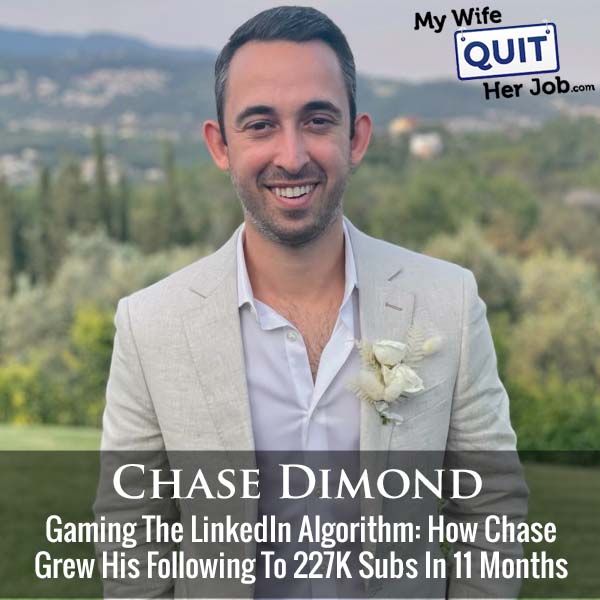
Chase Dimond, co-founder of Structured Agency, grew his LinkedIn following from 27,000 to 227,000 subscribers in 11 months and racked up 100 million organic content impressions, which he then converted into 30,000 to 50,000 email subscribers for his own newsletter. The playbook has three parts: good content, a lot of it (two to three posts per day), and heavy manual distribution (engage with every comment for 5 to 10 minutes after every post, plus a network of theme pages that reshare your work).
Chase shared the entire system on episode 484 of the My Wife Quit Her Job podcast. What follows is the specific tactical stack, including the post formats that outperform, the tools he uses to find his own best-performing posts, the profile-optimization moves that turn a viewer into an email subscriber, and the exact “wait an hour, then edit the link into the post” trick that keeps LinkedIn’s algorithm from suppressing your reach.
If you are a founder, marketer, coach, or agency owner considering LinkedIn as a growth channel, this is the current-2020s playbook that actually works.
Get My Free Mini Course On How To Start A Successful Ecommerce Store
If you are interested in starting an ecommerce business, I put together a comprehensive package of resources that will help you launch your own online store from complete scratch. Be sure to grab it before you leave!
Table of Contents
Key takeaways
- LinkedIn is Chase’s #1 organic platform, ahead of Twitter, Instagram, and Facebook. He grew from 27K to 227K followers in 11 months and hit 100M impressions, all organic.
- Roughly 90 percent of Chase’s newsletter growth (from 40K to 80-100K subscribers) came from LinkedIn and Twitter combined.
- The three-part LinkedIn formula: good content, high frequency (2 to 3 posts a day), and manual distribution (engage with every comment for 5 to 10 minutes after each post).
- Best-performing LinkedIn post formats: carousels (multi-slide PDFs), polls, and screenshot-of-a-tweet with the same tweet text as the description. LinkedIn’s algorithm rewards text-plus-image.
- The “delayed link” trick: post with no external link, wait an hour for engagement to build, then edit the post to add a PS with a link to your newsletter or lead magnet. LinkedIn (unlike Twitter) allows unlimited post edits.
- Optimize your profile like a landing page: headline with credibility numbers, a featured section with press coverage, and a link to a newsletter opt-in high in the profile.
- Chase’s best single-post lead-magnet conversion was 3,000 to 4,000 email subs from one post about 25 ChatGPT prompts (500,000 views).
- Chase pays a subscription of $500 a month for “engagement pods” (his own service). That kind of organized comment engagement is now a formal part of his LinkedIn stack.
- Chase runs a network of 6 LinkedIn theme pages (AI, copywriting, marketing, etc.) totaling ~175K additional followers, on top of his personal 227K.
Why is LinkedIn the highest-organic-reach platform right now?
LinkedIn is currently the highest-organic-reach platform because posts have a much longer half-life than Twitter, Facebook, or Instagram (sometimes 7+ days versus a few hours), and because the feed shows content well beyond your first-degree connections. Chase’s 200,000+ followers translated into 100 million impressions in 11 months, which is a reach rate no other platform matches organically at that follower size.
Two posts of Chase’s from a single day pulled 104,849 and 43,000 impressions respectively, totaling ~150,000 impressions in 24 hours. Facebook and Instagram organic simply cannot produce those numbers without paid boost.
The trade-off is that LinkedIn rewards engagement more heavily than any other platform, so the reach only shows up if you are willing to spend real time in the comments.
What are the three parts of Chase Dimond’s LinkedIn playbook?
The three parts of Chase Dimond’s LinkedIn playbook are good content, high frequency of good content, and manual distribution. Most creators focus on the first, some manage the second, and almost nobody does the third. Distribution is where the outsized growth actually comes from.
- Good content. Every post must answer “what’s in it for the reader?” Chase’s angle is teaching digestible, actionable email/copywriting tidbits in under 60 seconds of read time.
- Volume. Two to three posts per day, every day, timed to catch the North America morning window (roughly 7 to 9 a.m. PT) plus a lunch and afternoon post.
- Distribution. Stay in the comments for 5 to 10 minutes after every post and reply to every comment. Repost your top post 5 to 10 hours later for a “second life” bump. Enlist a network of peers and pages to seed the initial engagement.
What are the best-performing LinkedIn post formats in 2026?
The best-performing LinkedIn post formats are carousels (multi-slide PDFs), polls, and screenshot-of-a-tweet posts, in that order. Text-only posts underperform badly. LinkedIn’s algorithm consistently favors text plus a visual.
- Carousels. A PDF uploaded as a native LinkedIn document, presented as swipeable slides. Chase uses the free tool taplio.com/carousel to convert Twitter threads into LinkedIn carousels within 7 days of the thread going live.
- Polls. Get massive reach (100,000+ views) even with modest engagement, because voting counts as an interaction without requiring a comment. Chase’s polls on “HTML vs plain text emails” routinely pull 5,000 to 10,000 votes.
- Screenshot-of-tweet posts. Take a screenshot of one of your own tweets, upload it as the image, and paste the tweet’s text as the post description. LinkedIn treats it as text + image and rewards it.
- Native video. Chase is one of few consistently making video work on LinkedIn. His winning format: 20 to 40 second screen recordings of AI tools in action, no audio, no captions. Some hit 100K to 1M views.
How often should you post on LinkedIn?
The right posting cadence for growth on LinkedIn is two to three posts per day, spaced to catch global time zones. Chase posts one in the morning (7 to 9 a.m. PT, when US, EU, and late-Europe overlap), one at lunch (US/Canada window), and one in the afternoon (which extends into Australia’s wake-up).
The morning post is consistently his highest-reach post because it hits the most time zones simultaneously. Repurposing older content is not just acceptable, it is core to the strategy.
Chase’s daily content mix: one fully repurposed post (something popular from 6+ months ago, reposted as-is), one partial repurpose (recent content rewritten with a new hook, often with AI help), and one net-new post.
How does Chase Dimond convert LinkedIn reach into email subscribers?
Chase converts LinkedIn reach into email subscribers by treating his LinkedIn profile as a landing page and by adding delayed links to viral posts that route to gated lead magnets. Roughly 90 percent of his newsletter’s growth (from 40K to 80-100K) came from LinkedIn and Twitter combined, and his single best-converting post drove 3,000 to 4,000 email subs from one PDF carousel about ChatGPT prompts.
- Optimize the profile. Professional-but-fun profile photo, a banner headline stating credibility (“driven 150M+ in email revenue”), a name field with a keyword insertion (“Chase [Ecommerce Email Marketing Nerd] Dimond”), and a featured section with press coverage.
- Add a subscribe link near the top. A clickable “visit newsletter” button high on the profile.
- Turn on the LinkedIn Newsletter. LinkedIn auto-invites every new follower to subscribe, which is why Chase’s LinkedIn newsletter is now near 90,000 subscribers on top of his owned email list.
- Add the delayed link. Post with no link, wait an hour or two for engagement to build, then edit the post to add “PS: 85,000 email marketers and copywriters subscribe to my newsletter, click here to join for free.”
- Reverse-engineer lead magnets from viral content. When a carousel goes viral, ship a Google Doc version behind an email opt-in (“get this in text form so you can copy-paste”).
What is the “delayed link” trick and why does it work?
The delayed link trick is posting your LinkedIn content with no external URL, waiting an hour or two for engagement to build, then editing the post to add the link in a PS at the bottom. It works because LinkedIn (and Twitter, Instagram, most platforms) algorithmically suppress posts that contain outbound links at initial post time (they want to keep users on-platform).
By the time you edit the link in, the algorithm has already decided the post has strong engagement and continues distributing it, and you get the reach plus the click-through.
LinkedIn allows unlimited post edits at any time, which is why the tactic is uniquely powerful on that platform. Twitter only allows edits for Twitter Blue subscribers and only within 30 minutes.
What tools does Chase Dimond use to find his top-performing posts?
Chase uses three tools to find his top-performing posts for repurposing:
- Twitter Advanced Search (free). Filter by your own handle, a date range, and a minimum like or retweet threshold to surface your winners.
- Tweet Hunter. Paid tool, same-owner as Taplio, for surfacing and repurposing Twitter content.
- Taplio. Paid tool for surfacing and repurposing LinkedIn content, and for converting Twitter threads into LinkedIn PDF carousels via taplio.com/carousel.
The workflow is to filter last month or last quarter’s posts by likes/comments, then repost the top hits as-is or with a fresh hook.
Should ecommerce brand founders be on LinkedIn?
Ecommerce brand founders should be on LinkedIn if they want to recruit talent, attract investors, or eventually sell the business, but LinkedIn is not the right channel to directly sell physical products. The audience is founders, marketing directors, agency operators, consultants, and freelancers, not everyday consumers of a $40 apparel purchase.
Davey Fogarty (Calming Blankets, Ootii) is Chase’s example of a founder who invested heavily in personal brand across LinkedIn, YouTube, Twitter, and Instagram, specifically because it attracts inbound: businesses to buy, investors, hires, and partnership offers.
If your goal is exit, hire, or raise, LinkedIn is a top-two channel. If your goal is DTC sales, put that time into Instagram, TikTok, or paid channels.
How to structure a LinkedIn profile as a landing page
Structure a LinkedIn profile as a landing page by treating every visible field as conversion real estate: profile photo, banner, name, headline, featured section, and about section all work together to make one clear promise and one clear next action.
- Profile photo. Professional but human. Chase uses a wedding photo (dressed up, smiling, at an event).
- Banner image. A one-sentence credibility statement with a hard number (“driven $150M+ in email revenue”).
- Name field. Insert a keyword between first and last name for search (“Chase [Ecommerce Email Marketing Nerd] Dimond”).
- Headline. A crisp positioning line with authority proof (“top ecommerce email marketer, sent over a billion emails, $150M+ in email revenue”).
- Featured section. Third-party press (Business Insider profile, podcast appearances, big-brand case studies) plus your best evergreen post.
- Contact info + CTA button. A newsletter opt-in link high enough on the profile to be seen without scrolling.
How Chase ranks the major social platforms for creator growth
| Rank | Platform | Why |
|---|---|---|
| 1 | Email newsletter | Direct inbox access, no algorithm. Chase’s ~90K list is the most valuable asset. |
| 2 | Highest current organic reach, longest post half-life, strongest B2B audience. | |
| 3 | Twitter/X | Still the sharpest founder crowd, but volatile since 2023 algorithm changes. |
| 4 | Decent for personal brand, weaker organic than LinkedIn. | |
| 5 | Weakest of the four for organic creator reach. |
Threads is too early to rank; Chase is posting but not committing engagement time yet.
Frequently asked questions
How long does it take to grow a LinkedIn following?
Chase Dimond grew from 27,000 to 227,000 LinkedIn followers in 11 months by posting two to three times per day, using PDF carousels and screenshot-of-tweet formats, and manually engaging with every comment for 5 to 10 minutes after each post. For a creator starting from zero followers, expect to see the first 5,000 followers in three to six months at that posting cadence, assuming the content niche is one you can teach with authority.
What is the best time to post on LinkedIn?
The best time to post on LinkedIn for US-based creators with global audiences is 7 to 9 a.m. Pacific Time, because that window catches the West Coast morning, East Coast mid-morning, and late-afternoon Europe simultaneously. Chase’s morning post consistently outperforms his lunch and afternoon posts for that reason.
Do external links hurt LinkedIn reach?
Yes, external links in the body of a LinkedIn post hurt initial reach because LinkedIn’s algorithm suppresses posts that direct users off-platform. The workaround is to post without a link, wait an hour or two for the algorithm to distribute the post based on engagement, then edit the post to add the link as a “PS” at the bottom. LinkedIn allows unlimited edits, unlike Twitter.
What is a LinkedIn carousel and how do you make one?
A LinkedIn carousel is a multi-page PDF uploaded as a native document that readers swipe through slide by slide, similar to an Instagram carousel. To make one, format your content as a PDF (Chase uses the free tool taplio.com/carousel to auto-convert Twitter threads) and upload it as a “document” attachment when you post. LinkedIn treats it as a document post and shows a swipeable preview in-feed.
Is a LinkedIn newsletter worth setting up?
Yes, a LinkedIn newsletter is worth setting up because LinkedIn auto-invites every new follower to subscribe (which drives fast subscriber growth) and every issue publishes as both an email and an in-feed post. Chase’s LinkedIn newsletter has ~90,000 subscribers and pulls 21,000+ article views per issue, at zero incremental cost since he simply repurposes his owned-list newsletter content.
How much does it cost to run a LinkedIn engagement service?
Chase’s own LinkedIn engagement service (where his account and network of ~175K follower theme pages engage with your posts) costs $500 per month and is capped at 50 clients. The best-performing client grew from 4,000 to 20,000 followers in a few months, and typical growth is 25 to 100 percent month-over-month. It only fits creators whose audience is marketers, founders, copywriters, freelancers, or consultants (Chase’s own audience overlap).
Should I schedule LinkedIn posts or post live?
Chase deliberately does not schedule LinkedIn posts and instead posts live because most of his engagement lift comes from being present in the comments for 5 to 10 minutes after posting. Scheduling tools work fine for the actual publish action, but they do not solve the real bottleneck, which is real-time engagement with early commenters. If you must schedule, set a timer to be in the app when the post goes out.