
Podcast: Download (Duration: 39:03 — 45.0MB)
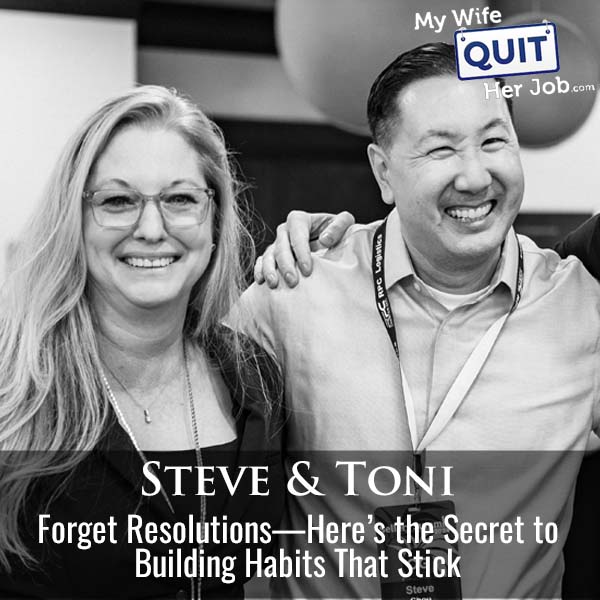
The reason most New Year’s resolutions fail by the second Friday in January is that they set outcomes you cannot directly control, and then quit as soon as the scale, the revenue, or the follower count refuses to move on the schedule you invented. On this episode of the My Wife Quit Her Job podcast, my co-host Toni Anderson and I talked through why we do not set resolutions at all, and what we do instead: build daily systems around actions we can control.
The core swap is simple. Replace “lose 10 pounds” with “hit 10,000 steps a day.” Replace “get 10,000 email subscribers” with “publish one YouTube video with a lead magnet every week.” Replace “hit $10K a month in ecommerce revenue” with “refresh Facebook ad creative once a week and revise one email flow per week.”
Below is the exact framework we use, plus the daily systems that have compounded over 15+ years of running a business and a media company, and one weird energy-management habit Toni started this year that made an immediate difference.
Get My Free Mini Course On How To Start A Successful Ecommerce Store
If you are interested in starting an ecommerce business, I put together a comprehensive package of resources that will help you launch your own online store from complete scratch. Be sure to grab it before you leave!
Table of Contents
Key takeaways
- Most resolutions fail because they set outcomes (“lose 10 pounds”) instead of actions (“walk 10,000 steps a day”). You cannot force outcomes, but you can execute actions.
- Systems beat goals because a system runs in the background whether you hit the goal or not. When you hit the goal with a resolution, most people stop the behavior and lose the result.
- Start smaller than you think. One good weekly email beats a promise to send two you never write. Three Facebook ad creatives a week beats a daily grind you abandon in February.
- Once a system is set up, AI collapses the effort dramatically. Steve automated hundreds of custom-print product launches at Bumblebee Linens with a single script that generates listings and pushes them to the site.
- Manage energy, not just time. Toni books one hotel night a month, entirely alone, to reset. Steve blocks a “do-nothing Friday” every week to think at 50,000 feet instead of putting out fires.
- Consistency beats intensity over years. Many bloggers and YouTubers who out-launched Steve in the early days have since quit. The people still standing are the ones who set up a repeatable process and stuck with it.
Why do most New Year’s resolutions fail?
Most New Year’s resolutions fail because they set outcome goals (“lose 10 pounds,” “get 10,000 subscribers,” “hit $10K a month”) that you cannot directly control, and then they set an arbitrary deadline that guarantees discouragement. When the scale barely budges by January 28, or the subscriber count stalls, or your revenue only climbs from $2,000 to $3,100 instead of the $10,000 you promised yourself, the whole system collapses.
The gym analogy is the cleanest version. Everyone shows up on January 5, five days a week, in a burst of willpower that no normal schedule can sustain. By January 31 most people have quit, when going three days a week (or even one) would have compounded into a real habit by summer.
Most people set goals without a strategy to reach them. The strategy is the whole game.
What is the difference between a goal and a system?
A goal is the outcome you want; a system is the repeatable set of actions you take every day or every week that eventually produces the outcome. A goal is “have 10,000 email subscribers.” A system is “publish one long-form YouTube video every week with a lead magnet embedded in the description.”
The goal can miss its deadline and the system still wins. Melissa, a student in our course, committed to releasing one long-form video every single week through all of 2024 and hit it. Whether her subscriber count landed at 5,000 or 15,000 mattered far less than the fact that she had a repeatable, unbreakable process by year end.
Systems remove the “should I do this today?” decision. Once a system is in place, doing it feels less like willpower and more like brushing your teeth.
How should you set business goals if not with resolutions?
Set business goals as weekly or daily process commitments tied to the actions that produce revenue, not to the revenue number itself. Instead of “hit $10,000 a month by June,” commit to “refresh three Facebook ad creatives a week and launch a new ad set every Monday.” Instead of “hit 10,000 subscribers by December,” commit to “publish one long-form YouTube video a week with a clear lead magnet.”
The reason process commitments work is that you can execute them regardless of whether the market cooperates on your timeline. You cannot make customers buy. You can make sure every abandoned cart triggers an email flow, every post-purchase order asks for a review, and every ad set gets refreshed on a schedule.
If you hit the underlying number, great. If you do not, the system is still running and compounding, and next month you tweak one variable at a time inside it rather than blowing up the whole plan.
How does AI let you build small systems faster in 2025?
AI collapses the setup cost of small business systems, which used to be the reason people avoided building them. At Bumblebee Linens, we launched hundreds of new custom-print products last year by building a script that generates the product image, auto-writes the title and description with AI, and pushes the finished listing to the website. Push one button, get one product live.
The pre-AI version of that same system took hours per product: Photoshop the image onto a mockup, write the copy by hand, upload manually. That is why nobody launched hundreds of new listings.
Same principle applies to email. AI drafts the subject line, the body, and the variants. You spend your time editing rather than staring at a blank cursor. Same for scripting YouTube videos, editing podcasts, and writing product listings.
What is the compound marketing effect and why does it matter?
The compound marketing effect is what happens when a small, consistent action produces a disproportionately large result over time, the same way small deposits produce huge investment returns over years. Melissa’s one video a week produced a full year of content and a real audience by December, when a “make 100 videos this month” resolution would have died in the first week.
The math is boring, which is why almost nobody does it. Three ad creatives a week is 156 a year. One email a week is 52 a year. One video a week is 52 a year. Any single one of those cadences compounds into a moat by year three.
The reason peers Steve started with in blogging and YouTube are no longer publishing is that they went hard for six months, hit a plateau, and quit. The 15+ years of consistent weekly emails he now sends look inevitable in hindsight and felt impossible on day one.
Why should you set up systems before you outsource?
Setting up a system before you outsource is what makes the outsourcing actually work, because a system is a documented process another person (or an AI) can follow. When you hand a task to a contractor with no system, you are handing over your ambiguity along with the task. When you hand over a system, you are handing over a checklist.
Toni’s Bumblebee Linens print workflow is the working example. Every custom order used to require manually pulling images off the website, laying them out on printing film without wasting expensive material, then hand-pressing. It was survivable for a small volume and impossible over the holidays.
The system now pulls every image directly from the site, lays them onto the film automatically, and prints. A small staff can now handle holiday-scale volume that would have crushed the manual workflow.
How do you manage energy so you can stay consistent?
Managing energy means blocking recurring windows where you deliberately do nothing productive, so that the rest of your week has enough capacity to execute your systems. Both Toni and Steve have found this necessary; the specifics look different, but the pattern is the same.
Toni books one hotel night a month, alone, in her own town. No family, no pets, no responsibilities, no coffee-shop background noise. Eighteen hours of complete quiet, then back to full-throttle execution the rest of the month.
Steve blocks a “do-nothing Friday” every week, usually spent thinking through what needs to get done, at 50,000 feet instead of in the weeds. Without it, every week becomes reactive firefighting and the important work never gets touched.
Small daily systems vs big yearly resolutions
| Common resolution | Why it fails | Better system to run instead |
|---|---|---|
| Lose 10 pounds | Outcome you cannot force; discouraging when scale barely moves | Walk 10,000 steps a day; strength-train two days a week |
| Hit $10K/month in ecommerce revenue | Depends on customers, ad platforms, seasonality | Refresh three ad creatives per week; revise one email flow per week |
| Get 10,000 email subscribers | You cannot make people subscribe on a schedule | Publish one long-form YouTube video per week with a lead magnet |
| Get 100 product reviews on Amazon | Depends on buyer behavior | Automated post-purchase email + text flow requesting the review with incentive |
| Work out five days a week | Too much on day one for most people; body rebels | Pick two anchor workouts you enjoy; add one at a time as capacity grows |
| Send two emails a week | Overwhelming from a standing start | Send one high-quality email a week for a year, then add the second |
Which ecommerce systems have the biggest compounding payoff?
The ecommerce systems with the biggest compounding payoff are the ones running in the background 24/7 while you sleep: post-purchase review requests, abandoned cart recovery, back-in-stock alerts, welcome email flows, and win-back flows for lapsed customers. Klaviyo (or your equivalent email tool) is where most of them live.
Toni recently set up both Google product reviews and Google Business reviews flows for her store. Product reviews needed an incentive (discount or gift card) to actually convert, because unincentivized asks produced almost nothing.
The reviews take months to accumulate. The system that produces them runs in minutes and then never stops running.
Frequently asked questions
Why do most people fail at New Year’s resolutions?
Most people fail because they set outcome goals they cannot directly control and give up when the outcome does not move on their arbitrary deadline. Studies commonly cite the second Friday in January as the point where the majority of resolutions collapse. Switching to daily or weekly action-based commitments dramatically improves follow-through.
What is a system in business and how is it different from a goal?
A system is a repeatable process (an email flow, a weekly publishing cadence, an automated review request) that produces a result whether or not you consciously push it. A goal is a target number or state. Systems beat goals because they run continuously and remove daily decision-making from the equation.
How do you build a habit that actually sticks?
Pick an action small enough that you cannot skip it without embarrassment, tie it to an existing routine, and repeat it for long enough that it becomes second nature. One weekly email is more sustainable than two daily posts. Once the smaller cadence feels automatic, add on top.
What is the compound marketing effect?
The compound marketing effect is the outsized long-term result of a small, consistent marketing action repeated over years. One long-form video a week for a year is 52 videos and a real content library. Three ad creatives a week is 156 tests. Each individual action feels small; the accumulated stack becomes a competitive moat.
How does AI help you set up business systems in 2025?
AI collapses the setup cost of business systems by handling the repetitive content pieces (product descriptions, email drafts, listing titles, video scripts) that used to require human hours per instance. A single script can generate hundreds of product listings; one prompt can produce a month of email variants; one workflow can auto-post video across every platform.
What are examples of good business systems for ecommerce?
Good ecommerce systems include automated post-purchase review requests, abandoned cart recovery flows, welcome email sequences, back-in-stock alerts, win-back flows for lapsed customers, and weekly ad creative refresh routines. Klaviyo and similar tools are typically where these live. Each one runs continuously in the background and compounds over months.