

Podcast: Download (Duration: 50:42 — 58.3MB)
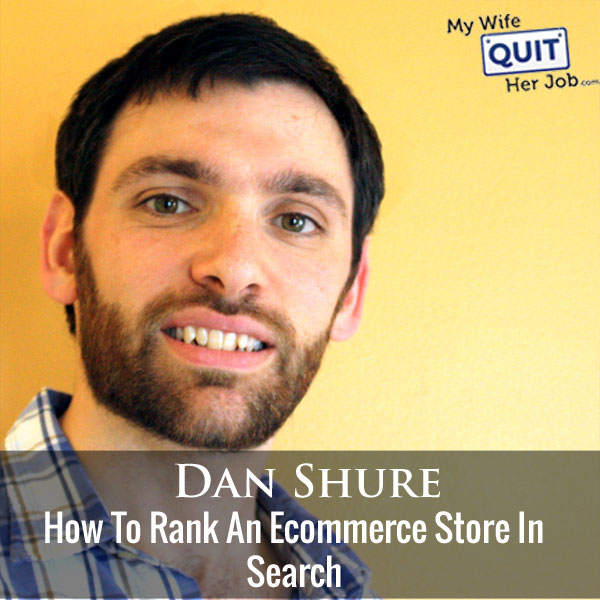
The biggest SEO mistake ecommerce stores make is not having a page for the topic people are searching. Dan Shure has worked with clients who sold more than a dozen fleece winter jackets without ever creating a fleece winter jacket category, losing a high-volume keyword they were positioned to own.
Dan runs a boutique SEO consultancy called Evolving SEO and has worked with Ring, Hint Water, Noah Kagan of Sumo, and Nathan Chan of Foundr, plus WGBH and Harvard Business Review. He also hosts the Experts on the Wire podcast.
Below is how he grew Sumo’s SEO traffic 20x in three months, how to judge whether you can rank for a topic, and the concrete fixes for category pages, product pages, and your homepage.
Get My Free Mini Course On How To Start A Successful Ecommerce Store
If you are interested in starting an ecommerce business, I put together a comprehensive package of resources that will help you launch your own online store from complete scratch. Be sure to grab it before you leave!
Table of Contents
Key takeaways
- Judge a topic by estimated traffic to the page currently ranking first, not by the search volume of one keyword.
- Dan evaluates competition on three factors: relevance gaps, domain authority of the current results, and content quality.
- Sumo’s 20x traffic growth in three months came from identifying 10 to 15 low-competition, high-traffic topics and executing seriously on the content.
- A precious metals client reached page one within a month on content alone, with zero backlink building.
- Add a purchase-intent phrase like “for sale” or “shop” to category titles and headings.
- Put every product category in your main menu dropdown, which creates an internal link from every page on the site.
- Google’s quality raters do not determine the algorithm. They are taste testers checking that it works.
- Meta description keywords are not a direct ranking factor, and they get bolded in results, which lifts click-through rate.
How Dan Shure got into SEO
Dan was a musician teaching piano lessons who built websites out of necessity in the early 2000s, for his band and his lessons. His family also ran businesses, including his father’s two sculpture companies, that needed sites.
The real motivation came in 2009 when he moved to a new location with no work, no money, and no piano students. SEO produced 50% or more of a fully booked studio within six months.
He discovered that design was not for him, since he is colorblind, and that he lacked patience for coding. What excited him was opening analytics and watching traffic arrive.
Listening to the SEO 101 podcast in 2010 was when he realized people did SEO full time. It has been his full-time work for roughly a decade since.
He is direct that client acquisition in SEO is entirely networking. He jokes that SEO is the worst channel for selling SEO, because anyone searching “SEO consultant in Massachusetts” tends not to be an ideal client.
A referral from Noah Kagan carries reputation and trust that a search result cannot. That mirrors how I get backlinks today, almost entirely through relationships rather than cold requests.
Why traffic potential beats search volume
Search volume for a single keyword tells you almost nothing about how much traffic a page on that topic will receive. Any page on the web can rank for thousands of keywords.
Search volume comes from the AdWords Keyword Planner, and every third-party tool pulls it from that API. It reports the 12-month average of searches for one exact phrase.
An article titled “overview of content marketing” might rank for content marketing, content marketing definition, what is content marketing, and the entire long tail around that topic. Volume on the head term captures none of that.
Even if you use it, you then have to guess your ranking position and click-through rate. Ranking first at roughly a 25% average click-through rate gets you an estimate for one keyword and ignores all the others.
How to estimate a topic’s real traffic potential
Find an article that already ranks first for the topic and put its URL into SEMrush or Ahrefs to see estimated monthly visits. That single number accounts for every keyword the page ranks for.
Dan’s example is the benefits of green tea, where Healthline holds the top ranking. Plugging Healthline’s article into SEMrush returns the full keyword database plus a click projection accounting for ads, maps, and review features in the results.
The estimates are not exact and they do not need to be. What matters is the relative comparison across every topic you are considering.
His method is a spreadsheet with topics as rows and estimated monthly visits as a column, sorted descending. Work from the top down.
The limitation is that this only works when an article already ranks well for the topic. If nobody has written specifically about your angle, you cannot get a clean estimate.
How to judge whether you can rank for a topic
Dan evaluates three things manually for every topic, searching hundreds of them in Google by hand rather than trusting a difficulty score from a tool.
| Factor | What you are looking for |
|---|---|
| Relevance | A gap where nobody has directly addressed the topic. Same logic as spotting a business opportunity. |
| Domain authority | Moz’s 1-100 estimate of site quality based on backlinks, visible via the MozBar plugin overlay. |
| Content quality | Whether you can genuinely create something better than what currently ranks. |
On domain authority, the calibration is against your own site. If you are at DA 40 and everything on page one sits at 80, 90, or 100, do not touch it unless you plan to build links aggressively.
Seeing a mix, a 39 and a 19 and a 45 among the high-authority sites, is a medium opportunity. It shows sites at your level can rank there.
The best case is a page of results with uniformly low domain authority and weak relevance. That is a wide-open window.
Quality is the third lever, and it matters most when the results are relevant and authoritative but the content is poor. You can outrank an established site by simply making something better, provided you get some initial traction and eyeballs on it.
Do humans decide Google rankings?
Google’s quality raters do not determine the algorithm. There are roughly 10,000 of them worldwide working from a 150-page guidelines document, and their job is checking that the algorithm does what it should.
Dan’s analogy is taste testers at a restaurant. They perform QA on results and they do not dictate rankings.
What does involve real people is user behavior data. If searchers click your result, bounce straight back to Google, click a second result, and stay there, Google will value the second result more highly as that pattern repeats.
What Google can measure about content quality algorithmically
Google analyzes readability, sentence structure, and reading level. Dan’s view is that if a tool like the Hemingway App can detect passive voice and run-on sentences, Google is likely evaluating similar signals.
The other major dimension is related entities. Google’s own example is that a Wikipedia-style page about New York City should probably mention the Empire State Building.
Dan applied this for a precious metals client selling silver coins. He had them run the silver coins Wikipedia page through Google’s Natural Language Cloud tool, which surfaces related topics and concepts, and account for those concepts on the category page.
That meant covering things like significant figures in the history of the coin or a famous mint, where it fit naturally into the page’s history section.
Should you put content on ecommerce category pages?
It depends entirely on the category. Dan added substantial content for the precious metals client because coins carry real history, the purchase is financial so buyers want trustworthy information, and every competitor ranking for those terms had content on their category pages.
Clothing is different. Someone searching women’s dresses is shopping for fashion and size rather than researching a topic, so heavy background content is less likely to serve them.
The test is your own product and customer. Silver coins are simultaneously a product and a subject people are genuinely interested in, and most products are not.
If it does make sense to explain the background of a product category, cover the important points about that category rather than padding for length.
Concrete fixes for ecommerce category pages
Google published UX playbooks for different site types, including retailers, that surfaced publicly. They were aimed at advertisers improving conversions, and anything Google publishes about user experience is at minimum indirectly relevant to SEO.
Dan’s reasoning is simple: anything good for CRO is good for SEO, because the more people like your site, the better the user metrics Google observes.
Put your price above the fold on category and product pages, visible without scrolling on both mobile and desktop.
Fix your photography. Dan sees a large number of ecommerce sites with mediocre product photos, and better photos produce better user metrics on the page.
Compress your images. Many stores upload images 3,000 pixels wide when they do not need to be, and a free tool like TinyPNG handles up to 20 JPEGs or PNGs at a time via drag and drop.
Name your categories properly and add purchase intent
Many stores publish the default CMS category name and stop there. Dan worked with a supplement client whose protein supplements page was titled simply “protein.”
Naming it “protein supplements” is the first correction. The second is adding a purchase-intent keyword: for sale, buy online, purchase, or shop.
“Shop Protein Supplements For Sale – Brand Name” in the title tag and the main page heading tells Google exactly what the page is and tells searchers they can buy the product on your site.
There are genuine purchase-intent searches to capture. If people search “shoes for sale” and the volume is there, targeting it is simply being more specific with your keywords.
It also lifts click-through rate, because the phrase signals to the searcher that your page sells the thing rather than writing about it.
Does the meta description matter for SEO?
Meta description keywords are not a direct ranking factor, and they still matter. Google has stated plainly that it does not use keywords in the meta description to rank a page.
What happens instead is that matching keywords get bolded in the search result when a user searches that term. Bolding draws clicks, better click-through rate improves your visibility, and that improves rankings.
So the value is real and indirect. Include a keyword or two, and write primarily for the click.
How to rank product pages
Build internal links to your important product and category URLs from your blog and content marketing. Internal linking is a strong ranking lever that most stores underuse.
Run your site through Moz or Screaming Frog SEO Spider to see how many internal links each category and product currently has. Important pages with few internal links are the obvious gaps.
Put your categories in your main menu. Dan is not a fan of mega menus unless you are genuinely the size of Target, and if you have 12 product categories behind a single “all products” link, add a dropdown linking each one.
That creates an internal link from every page on your site plus a direct click path from anywhere.
Write custom product descriptions
If you resell or distribute, write custom descriptions for at least your top 20 to 50 products. Google does not penalize duplicate content and it does assess how unique your content is and how much unique value it adds.
On length, Dan’s metaphor is code: if you can accomplish something in 200 lines instead of 1,000, you write 200. Be concise rather than wordy and do not stuff keywords, which is an old-school tactic.
Run descriptions through the Hemingway App to catch run-on sentences and passive voice.
Break up the information rather than writing dense blocks of text. Characteristics, data points, and measurements belong in bulleted lists, which is guidance straight from Google’s UX playbook.
The category that does not exist yet
The single biggest SEO mistake Dan sees is not having a page for the topic people search. A men’s clothing client sold over a dozen fleece winter jackets and had no fleece winter jacket category, despite meaningful search volume on the term.
Look at your existing categories and ask whether you can create subcategories. If you sell jackets, segment jackets.
Check volume quickly with the AdWords Keyword Tool or Keywords Everywhere, which displays search volume directly inside Google results.
This works well for us. We sell handkerchiefs and create separate category pages targeting specific handkerchief types using the same underlying products, and those pages end up ranking for a range of additional keywords.
What belongs on an ecommerce homepage
Your homepage should target your brand name, not a product keyword, unless you are effectively a single-product company. Ring Video Doorbell was a one-product company, so their homepage was the right page to rank for “video doorbell.”
That is good news, because it means you do not have to think about keyword targeting on the homepage at all.
What you do need is one clear call to action above the fold, alongside your value proposition.
Below that, showcase your best material and direct people where you want them. That can be categories, specific products, seasonal items or specials, and content like guides, blog posts, or videos that build the brand.
Trust signals throughout your store
Trust factors should be built into your entire site, not just the homepage. SSL is table stakes at this point.
Testimonials and highlighted reviews do real work, especially if you are not a recognized brand. A visitor landing on a store they have never heard of is actively scanning for signals that they are safe and that you can be trusted.
The Sumo case study: 20x traffic in three months
Dan grew Sumo’s SEO traffic 20x in three months, and it came from two things: topic selection and serious execution on the content.
He identified 10 to 15 topics where the competition was low relative to Sumo’s domain authority and content quality, and where the traffic potential was high. That research was the first half of the work.
The second half was execution, working directly with Sumo’s content marketer weekly for three months, passing drafts back and forth.
His view is that link building is not the only path. He points out that Quora is not building backlinks to its individual answers, and they rank constantly, because the domain has authority, the pages have internal links, and Google ranks the best available content.
The precious metals client he mentioned reached the top five for “Why Is Silver Valuable?” within a month, purely on page work with no backlink building at all.
Why most content fails
The mistake Dan sees repeatedly is treating content as a two-hour, 300-word task. That will not do anything.
Approach it expecting five, six, or seven rounds of edits. Think carefully about the title. Invest in the featured image at the top.
The other commonly missed element is the first sentence and introduction. Someone clicks your result, lands, and bounces, which helps nothing.
Dan’s framing is to treat each piece of the article as a device for keeping people scrolling.
Formulas that work for an article introduction
One approach is posing a question the reader will answer yes to in their head, which gets them psychologically committed. It gets cheesy quickly if overused.
For how-to and marketing content, the stronger formula has four beats: call out the reader directly, echo their struggle, name the emotion rather than just the intellectual problem, then show that the solution is below. Sometimes with a screenshot of the result.
Are you frustrated, confused, anxious? Then: here is the solution, keep reading.
Storytelling works in some contexts and badly in others. Dan had a health and nutrition client open with a long personal story about a sensitive medical topic, and nobody searching that topic wants that.
His comparison is a doctor. You want them professional and serious, not opening with jokes and anecdotes.
How to measure and improve content engagement
Use Hotjar for mouse tracking, heat mapping, and scroll depth. If 80% of visitors scroll only a short distance before leaving, your introduction is the problem, and the data tells you that directly.
Dan does not user-test content before publishing in most cases. He applies his own opinionated feedback, clients apply their editors’ judgment, and then they measure after launch.
Post-launch, he works from Google Search Console: impressions, position, and click-through rate. Content ranking well with poor click-through is the thing to fix.
How to identify a bad click-through rate
There is no absolute good click-through rate, so the comparison is relative. Dan exports Search Console data, sorts it, and identifies pages ranking comparably to others but converting impressions to clicks at a lower rate.
Before changing anything, search Google for that keyword yourself to understand the context. Two large featured answer boxes plus a map plus ads means nobody was going to click regardless.
Check your mobile share too, since mobile carries substantially lower click-through rates.
The obvious fixes are the title and description. Beyond those, rich results like star ratings or images can lift click-through for content types that support them, such as recipes.
How to write a title that ranks and gets clicked
Identify the top target keyword, meaning the highest-volume phrasing of the topic, and put only that in the title. For “Why Is Silver Valuable?” there are many variants, and one of them carries the most volume.
That leaves you with roughly two to four required words. Every other word in the title exists to earn clicks.
Adding more keyword variations rarely helps, because Google handles synonyms and phrase matching well. What you lose is room to make the title compelling.
For the click-earning portion, Dan uses a list of 400-plus power words that Sarah at Sumo created during his project there, categorized by what you are trying to convey, such as authority or completeness.
Content tricks that do not help SEO
Hiding article content behind a click-to-expand is not an SEO tactic and Dan is not a fan. Publishers may do it to track engagement, and there is no ranking reason for it.
Paginated slideshow articles that force click-next for ad revenue are the same. They lower your bounce rate artificially, and Google does not have your bounce rate.
What Google measures is how long someone stays on your content before returning to Google and what they do when they get back. Congratulating yourself on a low bounce rate from forced clicks is fooling yourself.
You can find Dan at EvolvingSEO.com, his podcast at EvolvingSEO.com/wire, on Twitter at @dan_shure, and on YouTube at Evolving SEO.
Frequently asked questions
How do you rank an ecommerce category page?
Name the category with the actual search term rather than a default CMS label, add a purchase-intent phrase like “for sale” or “shop” to the title and heading, build internal links to it from your content and main menu, and add relevant content where the category warrants it.
Should you use search volume or traffic potential to pick keywords?
Traffic potential. Search volume covers one exact phrase, while any page ranks for thousands of keywords, so plug the currently top-ranking article into SEMrush or Ahrefs and use its estimated monthly visits instead.
How do you know if a keyword is too competitive?
Compare the domain authority of the current page-one results against your own site. If everything ranks at DA 80 to 100 and you are at 40, skip it, and a mix of low and high authority results indicates a real opening.
Do Google’s quality raters affect rankings?
No. Roughly 10,000 quality raters worldwide check that the algorithm is producing good results, functioning as taste testers, and they do not determine or influence rankings directly.
Does the meta description affect SEO?
Not as a direct ranking factor. Keywords in your meta description get bolded when a user searches that term, which improves click-through rate, and better click-through improves your rankings indirectly.
Should you put content on category pages?
It depends on the product. Dan added substantial content for a precious metals client because coins carry real history and every ranking competitor had content, while a clothing shopper searching for dresses generally wants products rather than background.
Can you rank without building backlinks?
Yes, on a site with existing authority. Dan’s precious metals client reached the top five for a target keyword within a month using only on-page work, and Quora ranks constantly without building links to individual answers.
How long should a product description be?
As long as it needs to be and no longer. Be concise, avoid keyword stuffing, run it through the Hemingway App for run-on sentences and passive voice, and break specifications into bullet points rather than dense paragraphs.

