Podcast: Download (Duration: 49:22 — 56.8MB)
The seller who can deliver fastest gets to set the price, which is why relying entirely on FBA is a risk rather than an efficiency. Casey Gauss’s argument is that saving $2 per order means nothing if you cannot ship the order at all, so every Amazon seller needs at least one 3PL relationship alongside FBA.
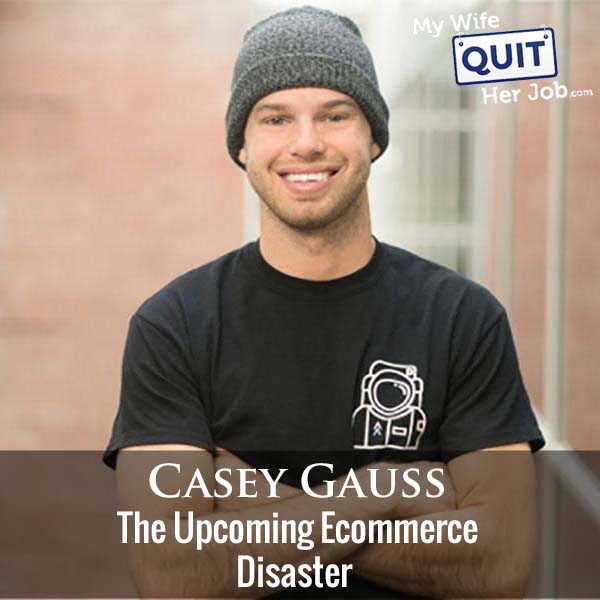
In this episode I spoke with Casey Gauss, founder of Viral Launch, which helped tens of thousands of sellers drive billions in Amazon sales. He recorded this in August 2020 while warning about the fulfillment crunch that was about to hit Q4.
Below is all of it: why fulfillment diversification matters, a workaround for keeping the Prime badge on FBM listings, how organic search collapsed as a share of Amazon sales, and what he learned losing control of the company he founded.
Get My Free Mini Course On How To Start A Successful Ecommerce Store
If you are interested in starting an ecommerce business, I put together a comprehensive package of resources that will help you launch your own online store from complete scratch. Be sure to grab it before you leave!
Table of Contents
Key takeaways
- Speed beats cost in fulfillment. Saving $2 an order is worthless if the order cannot ship.
- Every Amazon seller needs at least one 3PL alongside FBA, because both carry different risks.
- FBM listings can still appear in Prime-filtered search using a parent-child variation setup.
- Organic dropped from ~70% to ~30% of Amazon sales potential between 2016 and 2020.
- External traffic expands your ceiling. A $500K market becomes $750K or $1M for sellers driving outside traffic.
- Facebook has the attention to become the number two ecommerce player, which Shopify does not.
- Majority ownership does not mean control once investor protections are in the documents.
- Hiring senior people you assume know better than your own instincts is how founders lose companies.
Why fulfillment diversification protects your revenue
The seller who can deliver fastest gets to set the market price.
Casey’s framing is direct. A 3PL often costs more per order than FBA, and getting the product to the customer before a deadline is worth far more than the savings.
The arithmetic is unforgiving. Saving $2 per order across inventory you cannot ship produces nothing.
The prescription is at least one 3PL relationship in addition to FBA, so whichever channel is fastest at any given moment becomes the one optimized for sale.
Both options carry risk. Keeping everything in FBA means a category slowdown can strand you, and a 3PL warehouse can have its own outbreak or capacity failure.
His conclusion is that diversification is a risk management decision rather than a risk-free one, and concentration is the larger risk.
What happened to fulfillment capacity in 2020
Ecommerce demand rose 40% to 50% almost overnight while logistics infrastructure could not.
The early symptoms appeared in March and April 2020. Sellers had inventory sitting in FBA taking four to six weeks to reach customers, with no ability to pull it out.
That was ordinary spring shopping rather than holiday volume.
The carrier situation compounded it. Amazon relies heavily on USPS, UPS, FedEx, and regional carriers, and none had matching capacity increases.
By August, individual fulfillment centers were telling sellers they could neither ship nor receive and to request a different warehouse.
Casey’s read was that retail closures would push holiday shopping almost entirely online, into a system that was already failing in its slowest month.
The FBM workaround for keeping the Prime badge
A parent-child variation setup lets an FBM listing still surface when shoppers filter for Prime.
The structure is specific. Take your worst-selling variation, raise its price, and keep roughly five units in FBA.
Whether those units are actually fulfillable barely matters for the purpose.
The variations that actually sell run through FBM.
The result is that the Prime badge does not display on the well-selling variation in normal search results, and the listing still appears when someone filters for Prime.
Casey’s broader point is that fear of losing rankings should not stop sellers from using FBM when FBA cannot deliver.
Why organic Amazon rankings matter less than they used to
Organic search fell from roughly 70% of Amazon sales potential in 2016 to roughly 30% by 2020.
Casey’s reference point is a beauty brand he helped launch in June 2015 that did $36 million on Amazon alone by 2016, spending almost nothing on advertising.
That was possible because ranking was effectively everything at the time.
The composition shifted substantially. Advertising now represents something like 40% to 60% of the pie, and sponsored products are only part of that.
The rest sits in placements most sellers ignore. Editorials, new search sections appearing regularly, video, and live selling all take share from traditional organic results.
His criticism of the seller education space is that most content still teaches keyword research and sponsored ads while ignoring where the growth actually is.
How external traffic raises your market ceiling
Driving outside traffic expands the total addressable revenue for a product beyond what Amazon demand alone supports.
Casey’s example uses a vitamin C serum market that Amazon-native demand would cap at roughly $500,000 a month for one product.
Sellers who also run Facebook, Shopify, Walmart, and their own brand push that same product to $750,000 or $1 million.
That puts them in a fundamentally different competition than sellers optimizing only for rank and sponsored ads.
Both directions work. Running ads to your own site produces a halo effect on Amazon because some buyers prefer to check out there, and Amazon’s attribution program lets you run ads directly to listings.
Why Facebook is positioned to become the number two ecommerce platform
Attention is the asset that determines who can compete with Amazon, and Facebook has more of it than anyone.
Casey made this prediction publicly roughly two and a half years before Facebook announced Shops.
The user numbers support it. Nearly three billion monthly active users across Facebook, over a billion on Instagram, and roughly 800 million on Facebook Marketplace, which he notes almost nobody discusses as an ecommerce marketplace.
Marketplace behaves largely like peer-to-peer resale, and new products can be listed. Facebook was paying merchants roughly $5 per order at one point to encourage new product listings.
Shops changes the mechanics. Checking out inside Facebook or Instagram requires entering payment details once rather than trusting each individual store, which raises conversion and therefore lowers effective ad cost.
The strategic risk for sellers is the lever Facebook holds. They could make ads pointing to Shopify more expensive on user experience grounds, and ads pointing to Facebook Shops cheaper.
Why Shopify is unlikely to become a marketplace
Shopify lacks the one asset that makes a marketplace work.
Casey’s assessment is that Shopify has no consumer-side attention, which is precisely what Amazon provides its sellers.
Building that would require enormous traffic acquisition spending, on top of fulfillment infrastructure they are also behind on.
Their existing advantage is that many merchants already use the platform, and he does not see how that translates into a uniform marketplace experience.
Google is the more interesting candidate. Attention, world-class technology, and effectively unlimited capital, and Casey is surprised they have not made a more compelling seller offer.
My own experience supports part of that. Most of my store’s sales come from Google shopping, and those customers have substantially longer lifetime value than the ones I acquire from Facebook.
The reason I still send that traffic to my own site is what Google cannot offer. An email address, an SMS number, a pixel, and everything else that comes with owning the customer relationship.
Why Casey Gauss lost control of the company he founded
He still owns the majority of Viral Launch and has no involvement in it.
Investor protections in the funding documents are what separated ownership from control. Some were normal and some less so, and he did not have his own lawyer reviewing them.
He retains veto rights over selling the company and raising money, and little say over most operating decisions.
His self-diagnosis is a lack of confidence in his own instincts. In his early twenties with the business working, he assumed people with longer resumes would know substantially more than he did.
The timeline is stark. The month after bringing in a senior executive was the last profitable month the company had.
That executive then helped bring in investors he believed were looking after his interests.
When the investors wanted to take a direction he thought would damage the company, customers, and employees, he resigned rather than be associated with it.
What he would do differently
Casey would have appreciated what was already working rather than assuming the unknown was better.
His framing of the mistake is a fallacy: believing that what you do not know is probably far better than what you have.
He would focus on growing profitably, on the reasoning that it aligns incentives with customers far more closely than growth-at-any-cost does.
He would not have brought in senior executives who broke the culture.
The investment he would have made instead is in the young team members already performing, rather than assuming outsiders knew better.
His view on taking money is not that it is always wrong. Expectation setting is what determines the outcome, and telling investors you have doubled every nine months sets a very different expectation than telling them you run profitably and want a balance sheet cushion.
What roll-up acquirers look for in an Amazon brand
Casey now works at Thrasio, which acquires Amazon brands and takes over operations entirely.
Their stated average is 175% growth post-acquisition, and he cites eight figure brands doubled within 30 days.
The ideal target is best-in-class within its niche. More reviews than competitors, solid rankings across the board, or outselling the category leaders.
Any strategic advantage counts, even in a small niche, as long as the brand outperforms its competitors on some dimension.
The criteria are broader than that in practice. They have acquired single products from an account and accounts with thousands of listings.
They had acquired roughly 70 brands over two years at the time of this conversation, against a market of roughly 30,000 million-dollar-plus sellers.
Frequently asked questions
Should you use FBA or a 3PL?
Both. Casey Gauss argues every Amazon seller needs at least one 3PL alongside FBA, because the fastest fulfillment option changes and the seller who delivers fastest sets the price. Saving $2 an order is worthless if you cannot ship.
Can FBM listings still show up in Prime search?
Yes, with a parent-child variation. Keep roughly five units of your worst-selling variation in FBA at a raised price, and run the variations that actually sell through FBM. The listing still appears when shoppers filter for Prime.
Does ranking organically on Amazon still matter?
Less than it did. Organic fell from roughly 70% of sales potential in 2016 to roughly 30% by 2020, with advertising taking 40% to 60% and the remainder spread across editorials, video, and newer placements.
Does driving external traffic to Amazon help?
It raises your ceiling. A product market that Amazon-native demand caps at $500,000 monthly can reach $750,000 or $1 million for a seller also running Facebook, their own site, and other channels.
Should you send ads to Amazon or your own site?
Both work, for different reasons. Ads to your own site produce a halo effect because some buyers prefer checking out on Amazon anyway, and your own site is where you capture email, SMS, and pixel data.
Could Facebook compete with Amazon in ecommerce?
Casey argues yes, because attention is the deciding asset. Nearly three billion monthly users, over a billion on Instagram, and roughly 800 million on Marketplace, plus Shops enabling checkout without trusting individual stores.
Does majority ownership mean you control your company?
No. Casey still owns the majority of Viral Launch with no involvement in it. Investor protections written into funding documents separated ownership from operating control, and he had no personal lawyer reviewing them.
What do Amazon roll-up companies look for?
Best-in-class position within a niche, whether that means more reviews, strong rankings, or outselling category leaders. Any strategic advantage counts, and the criteria in practice are broad enough to include single products.