
Podcast: Download (Duration: 51:03 — 58.7MB)
The single most important rule in SMS marketing is that having someone’s phone number does not give you permission to text them. Penalties run $500 to $1,500 per message with automatic class action status in the US, which makes uploading an existing customer list one of the most expensive mistakes an ecommerce store can make.
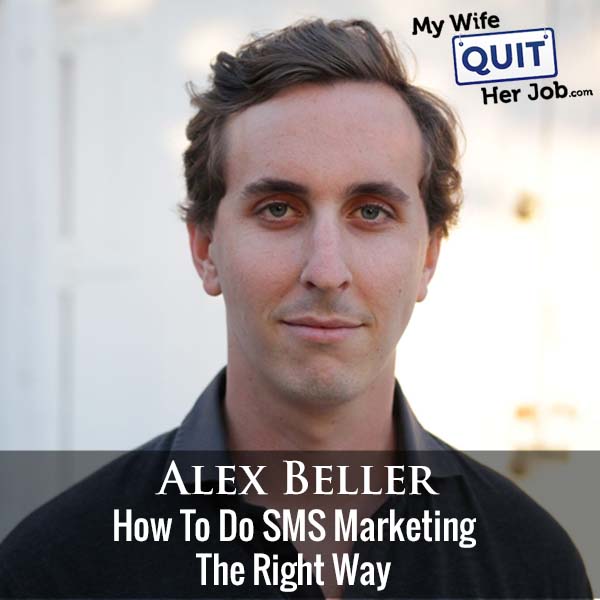
In this episode I spoke with Alex Beller, co-founder of Postscript, the SMS provider I use for my own store. He spent six years in ecommerce before starting the company, which went through Y Combinator and launched in September 2018.
Below is the whole channel: what makes SMS different from email, how to structure welcome and abandoned cart flows, how often to broadcast, the metrics to expect, and every legitimate way to build a list.
Get My Free Mini Course On How To Start A Successful Ecommerce Store
If you are interested in starting an ecommerce business, I put together a comprehensive package of resources that will help you launch your own online store from complete scratch. Be sure to grab it before you leave!
Table of Contents
Key takeaways
- You cannot text numbers you already have. Penalties run $500 to $1,500 per message.
- Texts cost roughly one cent each, which is why targeting matters more than it does in email.
- Lead with email and follow with SMS on flows, since email is far cheaper.
- Staggered omnichannel timing lifted revenue 15% to 20% over either channel alone.
- Average campaign unsubscribe rate is 0.7%, and welcome and abandoned cart flows run higher.
- Once a week is palatable and three times a week is not. Automations have no real cap.
- Keyword opt-ins convert better than form fills. Checkout-only collection will not scale.
- People will cap the number of brands they allow, which creates a first mover advantage.
Why SMS became a viable marketing channel
Mobile traffic kept growing as a share of ecommerce while email performance plateaued.
Alex and his co-founder watched that pattern for years at an ecommerce platform company and asked what the mobile-first retention channel would be.
Email was not declining, and it was a mature and heavily used channel already.
The specific problem came from a friend running a Shopify business who complained he had no easy way to text his customers.
Their launch criteria were pragmatic. Something sellable to businesses, with organic distribution through an app store, and a first customer within 90 days.
The channel has moved from skepticism to early adoption in the years since, with best practices only now becoming established.
How customers actually respond to marketing texts
Response rates run high and the responses are noisy, because people treat texts casually.
Brands see a wide spectrum on any campaign. Genuine enthusiasm, confusion about who is texting, and unsubscribes all arrive together.
The variation between brands is the more useful signal. Sentiment analysis shows dramatically happier responses for brands approaching the channel with customer interest first and a personal voice.
Alex’s example is a self-care brand that has sent Starbucks gift cards to its list twice, and is currently running a book club with 40 or 50 subscribers over text.
The contrast is with the email-first instinct of sending a 10% off code four times a week to everyone, which does not work over SMS.
Why SMS requires more restraint than email
People will subscribe to a limited number of brands by text, unlike the hundreds of email lists most of us carry.
Alex’s estimate is somewhere between five and fifteen brands, and where that caps is still unknown.
That creates a first mover advantage. Brands building lists now and taking care of subscribers will hold an advantage over those who arrive later.
The cost math reinforces it. A text costs roughly one cent against a fraction of that for email, so each message needs a higher revenue per subscriber to justify itself.
Restraint has a compounding benefit. A cautious approach keeps costs down and unsubscribes low, which means the list builds faster over time.
How to combine SMS with email and Messenger
Run all three channels with staggered timing rather than choosing between them.
A/B tests on post-purchase upsells show the pattern clearly. Email alone and SMS alone each underperform the two staggered by 15% to 20% in revenue.
The reason is exposure across contexts. Alex’s analogy is being more likely to watch something after seeing a billboard, an ad, and a friend’s recommendation, spread across time rather than arriving at once.
Your lists are also not identical. A store that collected email for years and started SMS recently will have people on one list and not the other.
On flows, lead with the cheaper channel. Send the email first and fire the text only if the recipient did not open, click, or buy.
Cancellation logic matters when running three channels. If the email goes out, the text follows a day later, and Messenger a day after that, each should cancel on purchase completion.
How often to send SMS campaigns
Automated flows have no real cap and broadcasts need a relevance test.
Alex recommends going hard on automations. Welcome series, abandoned carts, post-purchase upsells, support check-ins, and shipping notifications are all timely enough that subscribers welcome them.
Broadcasts are the opposite. The question to ask is whether this week’s marketing calendar contains something genuinely worth a text, rather than what your fixed frequency should be.
A great piece of content, a substantial promotion, and a product drop in the same week might justify three texts. Another 10% off coupon justifies none.
His threshold is roughly once a week as palatable and three times a week as excessive.
The risk beyond unsubscribes is sentiment. Someone who keeps buying can still come to find your brand annoying, which is easier to trigger over text than email.
How to structure an SMS welcome series
Tackle one topic per message, because subscribers read every text rather than one in five.
Postscript’s templates run three messages spread over about ten days. One on day one, one on day four, and one a week after that.
They split by customer history. New subscribers who have never purchased get a different flow from returning customers signing up for SMS for the first time.
A typical sequence covers context setting for how the brand will use SMS, then hero product features, then social proof through customer reviews, then a call to action with an incentive.
Length varies by price point. A low-priced consumable might warrant two weeks, and a several-hundred-dollar purchase can justify a series running months.
Alex considers welcome series underused generally. The subscriber is halfway warm and has not purchased, which makes it the right moment to overcome objections and build connection.
How to segment SMS broadcasts
Segment on purchase behavior and on engagement recency.
Purchase-based segmentation is the strongest. If product X pairs well with product Y, build a segment of people who bought X and not Y and send them something specific about Y.
New versions work the same way. A product launch sent to buyers of last year’s version is highly relevant by definition.
Engagement segmentation matters for older lists. A brand running SMS for years can segment to people who clicked in the last six months and hold back the rest.
There is no deliverability penalty for sending to unengaged subscribers, unlike email. A message sent is a message delivered, so the only real cost is unsubscribes.
What metrics to expect from SMS
Alex shared the aggregate benchmarks across Postscript’s customer base.
| Metric | Typical range |
|---|---|
| Delivery rate | Effectively all sent messages |
| Click rate | 7% to 40%+ depending on the message |
| Campaign unsubscribe rate | 0.7% average |
| Welcome and abandoned cart unsubscribes | 2% to 3% cumulative |
| Cost per message | Roughly one cent |
Welcome and abandoned cart flows run higher on unsubscribes because they are often the first message a subscriber receives, frequently after signing up for a discount code they then leave with.
Unsubscribe rates also vary by category. Beauty and food and drink run lower, and home goods runs highest at around 1% for campaigns.
The compliance rule that matters most
Having someone’s phone number does not give you permission to text them.
The requirement is explicit opt-in to SMS marketing specifically. They sent the first text, checked a box at checkout, or entered their number knowing it meant SMS marketing.
Exporting numbers from your email platform or Shopify and sending to them is not permitted, regardless of whether those people are customers.
The penalties are severe. $500 to $1,500 per message, with automatic class action status in the US, and an industry of lawyers who find accidental recipients and file suits.
The scale is real. Alex describes a very large brand that collected retail checkout phone numbers in 2010, was sued for $100 million, and settled for $10 million.
Postscript deliberately does not allow self-serve list uploads for this reason, routing them through a compliance review instead.
How to convert existing customers into SMS subscribers
You cannot text them, and you can almost certainly email them.
Alex recommends a short email series promoting the SMS list, since anyone whose phone number you have almost certainly gave you an email address too.
Some brands run this monthly or quarterly. Others include a passive call to action at the bottom of every email inviting people to text a keyword to join a VIP list.
Paid works too. Those email addresses can build a targeted audience for ads promoting SMS signup.
Every way to build an SMS list
Checkout collection alone will not scale, because the opt-in box cannot be pre-checked.
Pop-ups are essential. Either split by device with email on desktop and SMS on mobile, or run a two-screen pop-up collecting both.
Alex is blunt about brands refusing pop-ups. Without them, the list is unlikely to reach meaningful scale.
Keyword opt-ins convert better than form fills, since typing a short word beats entering a phone number.
The creative approaches are where growth is happening now:
- Package inserts with a keyword call to action, including for retail customers
- Instagram profile and story calls to action, plus one-click swipe-up opt-ins
- Facebook lead ads, which can pre-fill a number Facebook already has
- Site-wide banners offering something in exchange for a keyword text
- Influencer keyword promotion, which produced tens of thousands of signups for one brand after a screen-recorded text exchange went viral
Back-in-stock alerts and waitlists over SMS are still largely unexplored and likely next.
Why SMS works as a two-way support channel
The reply is what makes SMS behave differently from every other marketing channel.
Alex describes it as live chat the customer carries everywhere.
Many Postscript customers route SMS replies into their help desk, handling order questions and issues through the same thread as marketing.
My own post-purchase message invites people to reply with questions about their order, and we genuinely get replies, which sometimes turn into natural upsells.
Alex expects the channel to continue moving this direction, becoming more two-way and less broadcast-oriented.
What happens to SMS as more brands adopt it
Alex expects a long run, with norms tightening rather than the channel collapsing.
His comparison is email rather than Messenger or WhatsApp. SMS is an open protocol that no single company controls, which is what gave email a twenty-year run.
The behavior he expects to disappear is blasting an entire list twice a week, which some brands and platforms still recommend.
Inbox filtering is already starting. Phones now separate unknown senders or explicitly mark spam, which is why Postscript is building contact cards that let subscribers save a brand as a contact.
That is the same principle as an email safe sender list, applied before the filtering becomes strict.
Frequently asked questions
Can you text customers whose phone numbers you already have?
No. They must have explicitly opted into SMS marketing. Penalties run $500 to $1,500 per message with automatic class action status in the US, and one large brand settled a related suit for $10 million.
How often should you send marketing texts?
Automated flows have no real cap since they are timely by nature. For broadcasts, roughly once a week is palatable and three times a week is excessive. The test is whether you have something genuinely worth a text.
Should you send email or SMS first?
Lead with email on flows, since it costs a fraction of a text. Fire the SMS only if the recipient did not open, click, or buy. Staggering both channels lifts revenue 15% to 20% over either alone.
What is a normal SMS unsubscribe rate?
Roughly 0.7% for campaigns on average. Welcome series and abandoned cart flows run higher at 2% to 3% cumulative, since those are often the first message someone receives after grabbing a discount code.
How do you structure an SMS welcome series?
One topic per message, since subscribers read every text. Postscript’s template runs three messages over about ten days: context setting, product features, social proof, then a call to action with an incentive.
How do you build an SMS list?
Pop-ups are essential, since checkout opt-in boxes cannot be pre-checked. Keyword opt-ins convert better than form fills, and package inserts, Instagram stories, and Facebook lead ads all work well.
How do you get existing customers onto your SMS list?
Email them. Anyone whose phone number you have almost certainly gave you an email address, so run a short series promoting the SMS list or include a passive keyword call to action in every email.
How much does SMS marketing cost per message?
Roughly one cent, which is substantially more than email. That cost is why targeting and restraint matter more here, and why leading with email on automated flows makes financial sense.