
Podcast: Download (Duration: 46:21 — 53.3MB)
To launch a brand new product category, validate it in public before you spend real money, expect roughly a year and five to ten prototype rounds to get a manufacturable design, and start with a small first production run you can sell through in one season. Greg Meade and his partners invented CrossNet, a four-square volleyball hybrid, on a $40,000 investment and now sell it in Dick’s, Walmart, Academy Sports, and Sam’s Club.
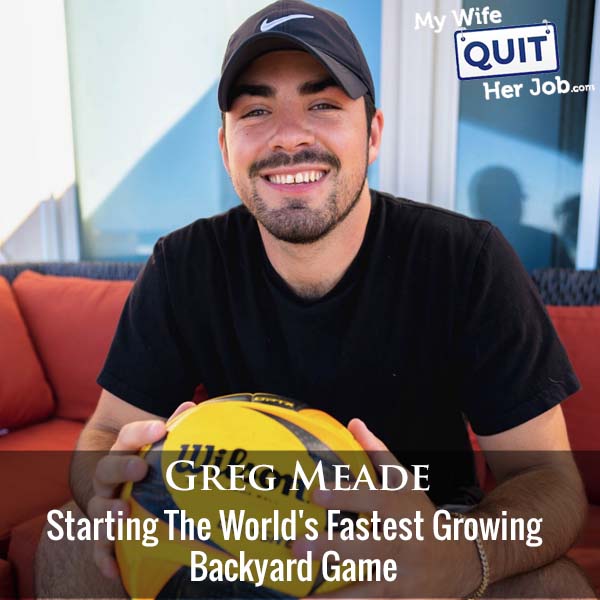
In this episode I sat down with Greg Meade, founder of CrossNet, to walk through inventing a product that did not exist: how they picked the idea, the beach test that proved it worked, the Alibaba sourcing process for a complex physical product, the underground Twitter marketing that funded the early days, and how they got into national retail through LinkedIn.
Below is the full playbook: prototyping timeline and cost, the free public validation method, first order sizing, wholesale outreach, PO financing, patent enforcement, and why the education problem is the hardest part of a new category.
Get My Free Mini Course On How To Start A Successful Ecommerce Store
If you are interested in starting an ecommerce business, I put together a comprehensive package of resources that will help you launch your own online store from complete scratch. Be sure to grab it before you leave!
Table of Contents
Key takeaways
- Validated by playing in public before spending. Forty teenagers lined up to play at a Rhode Island beach, which was the go signal.
- A year and 5-10 prototype rounds. Complex physical products take that long even when you have an engineer co-founder.
- $40,000 total from three founders. Reinvested 100% of proceeds into inventory and marketing for years.
- First order was 300 units. That covered one summer season.
- Twitter retweets at $10-20 per 100,000 impressions. Bought from meme pages, not through Twitter’s ad platform.
- LinkedIn cold outreach got them into national retail. Connect first, wait a few days, then message.
- Volleyball influencers were the wrong audience. Families buying for their kids are the actual market.
- Education is the hardest part of a new category. QR codes, rule books, and video, and it still takes years.
How to come up with a genuinely new product idea
The CrossNet idea came from a deliberate brainstorming session rather than a flash of inspiration. Greg and his engineer co-founder Mike sat watching ESPN all day, wrote down roughly 50 product ideas, and crossed them off until two remained: a wall charger speaker and a four-square volleyball game.
They chose the game because both had grown up playing sports together, which meant they understood the space and would enjoy the work.
The prototype came the next day. They bought two volleyball nets at Walmart and tied them together against a shed and a tree with tape. Janky, and enough to play on and refine the rules.
The rules came together the same day by borrowing from what already existed: four-square elimination and rotation, volleyball scoring at 11, win by two.
The free public validation method that works
Validate a physical product by taking a prototype somewhere public and seeing whether strangers ask to play with it. Greg’s crew brought their prototype to a Rhode Island beach intending to play a few games themselves.
They never got to play. Roughly 40 teenagers lined up to use it instead.
That was the moment they knew, and it happened before the $40,000 inventory commitment. It still happens: setting up at a popular spot reliably draws people asking to join or take photos.
This kind of validation costs nothing and produces far better information than surveys, because it measures behavior rather than stated intent.
How to get a complex physical product manufactured
Getting a complex physical product manufactured means searching Alibaba for factories that make the closest existing thing, messaging every one of them with CAD drawings, and putting the ones who say yes into competition on price and quality.
The CrossNet process: search “volleyball net manufacturer,” message every factory, send CAD blueprints, and ask directly whether they can build it. Some said no, some said yes, and the yeses got compared.
Have the CAD drawings ready before you approach anyone. A serious technical drawing changes how factories respond, and it is what makes a genuine yes-or-no answer possible.
Expect five to ten prototype rounds and roughly a year to a design you are happy with. Products with multiple materials and moving parts fail one component at a time: the poles work but the net is wrong, then the net is right but the poles broke.
Plan on factory visits. Greg’s co-founder went twice before COVID and considered ongoing visits normal for quality control.
How much capital it takes to launch a physical product
Three founders put in roughly $40,000 total, which covered the first production run and initial marketing, then reinvested every dollar of proceeds back into inventory and marketing for years.
The first order was 300 units, which sold through over about four months of summer. That is a reasonable first-run size: enough to prove the market and small enough to survive if it moves slowly.
No equity was ever sold. The business stayed founder-financed through several years of growth, eventually adding PO financing rather than investors.
The underground Twitter strategy that drove early sales
CrossNet’s early sales came from buying retweets from meme pages at $10 to $20 per 100,000 impressions, which is dramatically cheaper than any official ad platform.
The mechanics: find meme or niche pages with large followings, DM them asking for rates, and pay them to retweet your content. This runs entirely outside Twitter’s advertising system.
The content that worked was a UGC video of people playing, captioned “four square meets volleyball,” with a purchase link underneath.
Two caveats. This tactic was far more effective around 2017 than it is now, since many of the large parody and meme accounts were removed in a platform purge.
It also works best for lower-priced impulse purchases. At CrossNet’s $150 price point, Twitter stopped producing sales.
Why the viral video came from someone else’s page
CrossNet’s biggest early traffic spike came from a random Facebook user reposting a video of Olympic athletes playing, which hit 10 million views. The founders woke up to a flood of orders and initially could not identify the source.
They eventually found the video, and they still run ads against that same footage years later because it continues to convert.
The upstream cause was giving product to four Olympic athletes who had reached out asking for a set. The direct return on that was modest. The second-order effect, someone else repackaging their content, was enormous and unplannable.
How to get into national retail stores through LinkedIn
CrossNet got into Dick’s, Walmart, Academy Sports, and Sam’s Club primarily through LinkedIn cold outreach, and they still close wholesale deals that way.
The exact process: search the retailer’s name on LinkedIn, filter to people, connect with the relevant buyers without messaging, wait a few days so it does not read as desperate, then send a short message introducing the product and offering to get it into their hands.
Selling a genuinely new product into retail is easier than selling another entry in a crowded category. Dick’s needs innovative games. Whole Foods does not need another beverage.
How wholesale terms and PO financing actually work
Retailers buy on purchase orders with net 60 or net 90 payment terms, which means you manufacture and ship inventory and wait up to three months to get paid. Large retailers set those terms and there is little room to negotiate.
That creates a serious cash flow problem, since you are floating manufacturing costs on large orders. CrossNet funded POs from personal money for four years before finally taking PO financing, which Greg considers a mistake in hindsight.
PO financing works by having a lender front the inventory cost against a confirmed purchase order. Borrow $100,000, repay roughly $125,000. Most lenders require you to show the PO, particularly on large orders.
Why volleyball influencers were the wrong audience
CrossNet spent a year putting up to ten volleyball athletes on monthly retainers producing excellent content, then realized the content was aimed at the wrong buyer.
The actual customer is a parent in Nebraska buying for an eight-year-old who wants to tap the ball around the yard with friends. That buyer does not recognize professional volleyball players and does not need spiking footage.
The pivot was back to core roots: content showing families playing together. The volleyball community took two to three years to win over and represents a small fraction of sales.
The lesson generalizes. Impressive niche-authority content is not the same as content that speaks to who actually buys.
The influencer gifting mistake that cost real money
Sending product to anyone who asks is expensive and mostly wasteful. CrossNet lost real money DMing athletes on Instagram offering free nets for content.
The current process only sends product to people who reach out first and have a genuine conversation with the team. Creators who deliver content the brand likes then move onto a retainer.
The filter that matters is whether someone genuinely wants your product or is simply collecting free things.
Why education is the hardest part of a new category
The hardest problem in launching a new product category is teaching people what it is and how to use it, and there is no fast solution.
CrossNet’s approach layers everything available: a rule book in the box, assembly instructions, QR codes linking to gameplay video, and eventually QR codes on the net itself so strangers encountering it in public can learn the rules.
The goal Greg articulates is a ten-year horizon: a parent or kid walking past a CrossNet knowing the rules the way they know soccer or basketball. That level of cultural familiarity is what a new category has to earn.
Getting people to physically play it is what converts them. The volleyball community ignored it at a beach tournament for two full days, then played on day three when the founders left to swim, and became advocates.
How to protect a new product category from copycats
CrossNet holds a patent, and enforcement requires an ongoing legal budget and active pursuit. Copycats appear in major retailers, which Greg treats as confirmation the product works.
His framing on the knockoffs: even someone buying a copy at Target is still playing CrossNet, which grows the category. The brand’s job is establishing itself as the foundation of the category rather than eliminating every imitation.
The practical defense alongside legal action is product line expansion: CrossNet Doubles for two-on-two, the H2O pool model, and versions for pickleball and soccer.
Frequently asked questions
How do you validate a physical product idea before spending money?
Take a prototype somewhere public and see whether strangers ask to use it. CrossNet’s founders brought their duct-taped prototype to a beach and 40 teenagers lined up to play. That behavioral signal cost nothing and beat any survey.
How long does it take to develop a physical product?
About a year and five to ten prototype rounds for a product with multiple materials and moving parts, even with an engineer co-founder. Components fail one at a time: the poles work but the net is wrong, then the net is right and the poles broke.
How much money do you need to launch a physical product?
CrossNet launched on roughly $40,000 from three founders, covering a 300-unit first production run plus initial marketing, then reinvested all proceeds into inventory for years. A first run sized to one selling season is a reasonable target.
How do you get your product into national retail stores?
LinkedIn cold outreach works. Search the retailer on LinkedIn, connect with buyers without messaging, wait a few days, then send a short introduction offering to get the product into their hands. A genuinely new product is easier to pitch than another entry in a crowded category.
What are net 60 and net 90 payment terms?
Retailers place purchase orders and pay 60 or 90 days after delivery, meaning you finance manufacturing and wait months for payment. PO financing solves the cash flow gap: a lender fronts the inventory cost against a confirmed PO, typically charging around 25% (borrow $100,000, repay $125,000).
Should you use influencers in your product’s niche community?
Not necessarily. CrossNet retained up to ten volleyball athletes producing excellent content before realizing their actual buyer is a parent who does not recognize professional volleyball players. Match content to who buys, not to who has the most credibility in the category.
How do you teach customers how to use a brand new product?
Layer every available channel: printed rule book, assembly instructions, QR codes linking to gameplay video, and QR codes on the product itself for strangers who encounter it in public. Expect it to take years. Getting people to physically try it is what converts them.