Podcast: Download (Duration: 51:13 — 58.9MB)
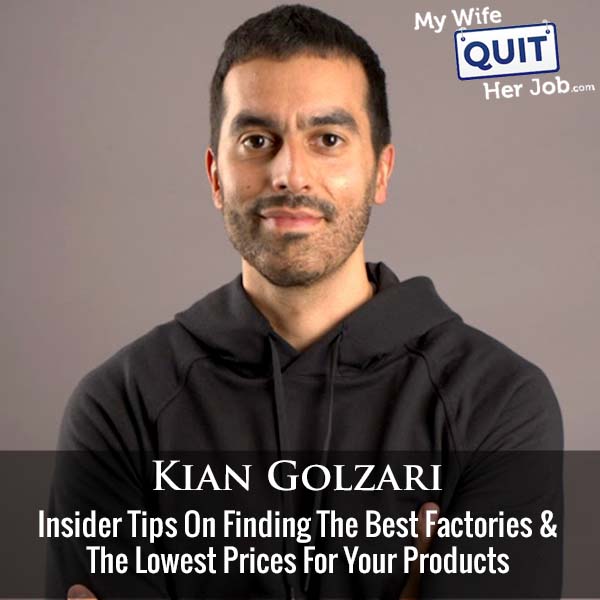
To source products from China like a pro, search Alibaba by manufacturer (not product), filter for Verified suppliers with Trade Assurance and ISO 9001 / BSCI certifications, use the first word of each factory’s name to identify the region that specializes in your product (Wenzhou for eyewear, Shenzhen for electronics, Xiamen for backpacks), and open every relationship with a leverage-rich pitch that tells the supplier why partnering with you is worth their best price. That is the playbook Kian Golzari has used across 500+ Chinese factories to source products for the NBA, the Olympics, the UN, and Kobe Bryant.
In this episode of the My Wife Quit Her Job podcast, I talked with Kian, one of the world’s most experienced product sourcers, founder of the sourcing service TitanSourcing.com, and creator of the YouTube channel Sourcing with Kian. Kian grew up around Chinese manufacturing (his father’s UK outdoor brand Highlander went into China 35 years ago), moved to Ningbo in 2010, and has personally sourced over 2,500 products.
Below is the full playbook: how to vet a factory on Alibaba, how to write a supplier pitch that gets a real reply, how to negotiate prices using the RMB exchange rate, how to protect your product without a bulletproof NDA, and how to structure mold-cost deals so you can switch suppliers later.
Get My Free Mini Course On How To Start A Successful Ecommerce Store
If you are interested in starting an ecommerce business, I put together a comprehensive package of resources that will help you launch your own online store from complete scratch. Be sure to grab it before you leave!
Table of Contents
Key takeaways
- Search Alibaba by manufacturer, never by product. Filter for Verified suppliers + Trade Assurance + relevant certifications (ISO 9001, ISO 14001, BSCI, SEDEX) before you ever look at price.
- The first word in a Chinese factory’s name is its city. Scan the manufacturer list for the most repeated city (e.g. Wenzhou for glasses, Shenzhen for electronics) and prioritize factories in that region.
- Verify factory age using the “years established” field inside the profile, not the “years on Alibaba” tag. A 25-year-old rockstar factory can show “1 year” on Alibaba because they only recently listed.
- Prices on Alibaba are placeholders. Never accept the listed price. Send a spec sheet with your exact materials, dimensions, and Pantone colors and get a real quote back.
- Small factories (25-50 workers) are the best fit for a low-MOQ custom project. Large factories (500+ workers) become worthwhile once your monthly order size is at their scale.
- The exchange-rate hack: pull the USD/RMB chart on XE.com and quantify how much extra profit the factory has captured since your last PO. That is your negotiation number, and it should be asked for at the time of payment, not weeks earlier.
- Real product protection is a mold + a patent + an exclusivity agreement, not an NNN. Kian only signs NNNs for genuinely innovative products; for everything else, relationship and a mold-with-embossed-logo do the work.
Step 1: Search Alibaba by manufacturer, not by product
The right way to start on Alibaba is to open the manufacturer search (not the product search), type your product, and filter before you look at a single price. Sorting by price on the product tab is what leads to the “blue-light glasses for $1.80 that look identical to blue-light glasses for $7.90” trap, and the $1.80 factory is almost always the wrong one.
Filter for three things up front: Verified Supplier (a third party has validated their factory info), Trade Assurance (Alibaba refunds you if the order doesn’t match the spec), and factory or product certifications relevant to your category.
Only once those filters are applied do you start reading profiles. Price is the last variable, and it is a variable you negotiate later, not a variable you sort by.
Step 2: Understand the factory and product certifications that matter
The certifications you should recognize on an Alibaba profile fall into two buckets: factory-level (audits of the facility itself) and product-level (compliance for a specific SKU or category).
| Certification | What it means | Why you care |
|---|---|---|
| ISO 9001 | Quality management system audit | The factory has documented quality control processes. Signals maturity. |
| ISO 14001 | Environmental management standard | The factory has been audited on environmental practices. Required by many Western retailers. |
| BSCI (Business Social Compliance Initiative) | Labor and social compliance audit | Third-party verification that labor practices meet minimum standards. |
| SEDEX / SMETA | Ethical trade audit | Common alternative to BSCI. Required by many EU and UK retailers. |
| Product-level (CPSIA, CE, Prop 65, etc.) | Category-specific compliance | Product must pass for sale in the target market. Ask factory for test reports. |
Absence of these certifications does not automatically mean the factory is bad; it can mean they never applied because they don’t sell to big-brand retailers. But presence of them is a strong positive signal, and if you plan to sell into Walmart, Target, or Disney later, you will need them anyway.
Step 3: Use the factory name to identify the right region
Chinese factory names almost always start with their city (Wenzhou Optics, Shenzhen Electronics, Xiamen Backpack Co). Scroll your filtered manufacturer list and note which city name repeats the most. That is the region that specializes in your product because of raw-material access, skilled labor, and supply-chain density.
A rough cheat sheet of what tends to concentrate where:
- Shenzhen and the Pearl River Delta: electronics, consumer tech, hardware
- Wenzhou: eyewear, shoes, lighters, small metal goods
- Yiwu: small commodities, gifts, accessories
- Ningbo and Hangzhou: home goods, textiles, sporting goods
- Xiamen: bags, backpacks
- Fuzhou: shoes, footwear
- Guangzhou: apparel, leather goods
Kian’s rule: if the region you find on Alibaba matches this specialization map, you are in the right pool. If it doesn’t, keep digging.
Step 4: Verify factory age using “years established”, not “years on Alibaba”
The number next to a factory name on Alibaba is “years on Alibaba,” not “years in business.” Great old factories that only sold at the Canton Fair may show “1 year” on their Alibaba tag even though they have been operating for 25 years.
To see the real age, click into the factory profile and open the “Company Information” section. The “Year Established” field (with a blue verified tick) is the true founding date. Kian’s cutoff: at least 5 years established, because that is enough time to have exported to enough countries and developed real production experience.
Also check the machinery list in the profile. A footwear factory with five in-house flex-test machines is a factory that can pre-test 10,000 walking cycles before your shipment leaves, which is a very different quality operation from one that outsources every test.
Step 5: Right-size the factory to your order
Match factory size to your order size. A 500-worker factory will treat a 300-unit custom order as an annoyance and either quote a price that discourages you or deliver it poorly. A 25-50 worker factory will treat that same 300-unit order as a chance to win a new customer.
The corollary is a mistake Kian sees constantly: sellers outgrow their factory and never renegotiate. If your monthly order has grown from 300 units to 2,000 units, the smaller factory is now under-resourced for your volume, and a mid-size factory would give you better price, better lead time, and better production techniques.
Every 12-18 months, re-shop your top three specs. Send the same tech pack to three top-five factories and see what comes back. Do not switch on price alone; sample first, and use the quote as leverage with your existing factory.
Step 6: Write a supplier pitch that gets a real reply
The average Alibaba supplier receives 50-100 inquiries a week, and 90% of them are one-line “what’s your MOQ and price?” messages that get a canned reply and go straight to the bottom of the pile. To get to the top, your first message must qualify you as a real customer worth investing in.
The elements of a winning first message
- Who you are (company name and brand history, even if small)
- What you’ve built before (Amazon SKUs, Shopify revenue, influencer relationships)
- Why you chose them specifically (their certifications, their trade-show presence, their machinery, their region specialization)
- The exact spec sheet: materials, dimensions, Pantone colors, packaging, testing requirements
- Your intent to visit the factory in person once travel allows
The mention of an in-person visit is Kian’s honesty enforcement mechanism. A factory that thinks you are actually going to walk in will not inflate its worker count from 100 to 500 to impress you.
If you have no prior brands, lean on domain expertise: “I’ve been a yoga instructor for 14 years, I run a studio, and I’ve been giving customer feedback on this exact product category for years.” Product expertise plus a real spec sheet reads as a qualified buyer, regardless of company size.
How to negotiate lower prices using the XE.com exchange-rate hack
Kian’s favorite one-move price hack: pull the USD/RMB chart on XE.com and calculate how much extra profit your factory has captured since your last PO because of exchange-rate movement. That number is your requested discount.
At the time of the recording, the dollar had moved from ~6.3 RMB in April to ~7.2-7.3 RMB in November, roughly a 12-13% swing in the factory’s favor. A $100K PO in April was worth ~630K RMB to them; the same PO in November was worth ~720K RMB. That is $12-13K of extra profit they captured without lifting a finger.
Bring that chart and ask for a matching discount. Even after they push back with “raw materials went up,” you’ll typically settle at 5-6% off, which is a meaningful margin lift on the same purchase.
Timing rule: negotiate at the moment of payment, not weeks before
Always negotiate at the moment you actually have to wire the deposit or final balance. If you agree on a discount 30 days ahead of production, the factory has 30 days to invent reasons why the discount shrunk (power outages, raw material spikes, currency reversal). Locking the deal into the invoice at payment time removes those escape hatches.
How to validate a factory-claimed price increase
When your factory pushes a price increase, validate it with three or four other factories in the same region on the same raw material. If they all confirm the same increase, the ask is legitimate and you accept it. If none of them mention the increase, you push back and let your factory know you are getting different data from their peers.
The same drill works for labor cost increases. Every province in China has different labor dynamics, so ask factories in the same province specifically. Kian’s rule is simple: never accept a price increase you have not independently validated.
How to protect your product without a bulletproof NDA
Real product protection sits in three layers, not in an NNN contract. NNN agreements (“non-disclosure, non-use, non-circumvention”) are worth the paper they are printed on only if you are willing to hire a Chinese lawyer and sue over a $10,000 order, which almost no one does.
The three real layers of protection
- Mold. Any custom-tooled part requires a $500-$50,000 mold. That mold cost is a barrier to entry for copycats.
- Patent. A design patent (~$4,000) or utility patent (~$15,000) is the only legal protection with real teeth. Only worth it for genuinely innovative products.
- Exclusivity agreement. Ask your supplier for market or regional exclusivity, tied to a volume commitment. Start with 6 months of US exclusivity at a specific unit target.
Kian’s soft-power move for products that don’t warrant a patent: tell the factory you have a patent (even if you don’t). They almost never verify, and the belief that a patent exists discourages them from developing it for someone else.
The “logo in the mold” defensive trick
When you invest in a custom mold, insist your logo is embossed (raised) into the mold, not debossed (recessed). Debossed logos can be filled in and re-used for competitors; embossed logos physically prevent the same mold from producing an unbranded copy.
That single spec detail turns your mold into a piece of defensive IP. If the factory ever tries to sell your product to another buyer, your logo shows up on every unit, and the copy is unsellable without new tooling.
How to structure a mold-cost deal so you can switch suppliers later
If you pay the mold cost outright, switching factories later means eating the mold cost twice. Kian’s preferred structure is to pay the mold upfront and get it refunded via order volume, so you can walk if the relationship sours.
Kian’s mold refund ladder
- 25% of the mold cost refunded after 5,000 units ordered
- 50% refunded after 10,000 units
- 100% refunded after 20,000 units
The refund isn’t actually a wire back. It’s a credit against your next PO invoice. Once the ladder is complete, the mold is effectively free, and if you ever want to move production elsewhere, you can, because you have zero sunk cost in the tooling with the current factory.
An alternative first ask: propose a 50/50 mold split with the supplier (“I’ll pay $5K, you pay $5K”). A confident factory will often say yes, and you have instantly cut your mold cost in half.
How to find good factories outside of Alibaba
Alibaba is Kian’s starting point, but not his only one. Two other high-value sources when Alibaba’s pool is thin or you need suppliers your competitors don’t already know about:
- ImportYeti.com. Search a market-leader competitor and see their real US import records: which factories they use, HS codes, shipment volumes, and cadence. Many of these factories are not on Alibaba.
- Industry trade-show exhibitor lists. Every category has a major trade show (Outdoor Retailer for outdoor gear, Interbike for cycling, etc.). Pull the exhibitor list from the show’s website, filter for Chinese company names, and contact them directly.
Both methods surface suppliers your competitors on Alibaba have not seen, which is where genuine sourcing advantages come from.
Are Chinese factory workers being treated unfairly?
Kian’s direct answer from 500+ factory visits: he has seen roughly one factory with real labor concerns. The stereotype of Chinese manufacturing as sweatshop labor is largely outdated in 2023.
The economics have shifted. As China’s middle class grew, service-industry jobs (Starbucks, KFC, retail, restaurants) opened up in coastal cities and became the more attractive option for young workers. Factories moved inland and had to raise wages to compete, and today a Chinese factory worker often earns more than a Chinese Starbucks barista.
To verify labor conditions on a specific factory, ask for BSCI or SEDEX audit reports (labor-focused compliance audits) and confirm the audit address matches the factory’s Alibaba profile address. Both requirements matter; a mismatched address means the certificate belongs to a different facility.
Frequently asked questions
Do I need to speak Chinese to source from China?
No. Chinese factory sales assistants are trained in English, and factory bosses who don’t speak English typically communicate through them. A Chinese translator or agent is not required to run first contact through order placement.
What certifications should a Chinese factory have?
At a minimum, look for ISO 9001 (quality management) and either BSCI or SEDEX (labor and social compliance). ISO 14001 (environmental) is a plus. For product-level compliance, the factory should hold or be able to obtain the test reports required for your target market (CPSIA for US children’s products, CE for EU electronics, Prop 65 for California).
How do I use Alibaba’s factory profile to spot a middleman or trading company?
Compare the claimed machine count against the shipment volumes and worker count. A “factory” that ships 250,000 sewn units per order but only lists 25 sewing machines is outsourcing to smaller factories. Ask directly if they subcontract; honest suppliers will confirm.
How can I get a lower price on Alibaba?
Use the XE.com USD/RMB exchange-rate move since your last PO to quantify the factory’s currency gain, then ask for a matching discount at the time of your next payment. Also validate any factory-claimed price increases with 3-4 other suppliers in the same region before accepting.
What is an NNN agreement and is it worth signing?
An NNN is a non-disclosure, non-use, non-circumvention agreement. Kian only signs NNNs for genuinely innovative products because enforcement in China is impractical for a small ecommerce brand. Real protection comes from molds, patents, and exclusivity agreements, plus a strong relationship with the factory.
Should I use a small factory or a large factory for my first order?
For a low-volume custom first order (a few hundred to a few thousand units), a small factory (25-50 workers) is a better fit because they want new customers and are more flexible on MOQs and custom specs. Move to a larger factory once your monthly volume matches their production scale.
How do I switch factories if my mold is stuck at the old one?
Structure your mold deal so the cost is refunded via order volume (25% back at 5K units, 50% at 10K, 100% at 20K). Once refunded, the mold is effectively free, and moving production elsewhere costs nothing but new tooling at the new factory. Also emboss your logo into the mold so it cannot be re-used for competitors.
What are the best alternatives to Alibaba for finding Chinese suppliers?
The two strongest alternatives are ImportYeti.com (search competitor US import records for their real factories) and industry trade-show exhibitor lists (filter for Chinese companies and contact them directly). Both surface factories your competitors on Alibaba do not already know about.