
Podcast: Download (Duration: 51:34 — 71.1MB)
The fastest way to tell a real factory from a trading company on Alibaba is to look at the product categories they list. A genuine factory works from a specific set of raw materials, so a supplier offering watches, backpacks, and sunglasses on the same page is almost certainly a middleman rather than a manufacturer.
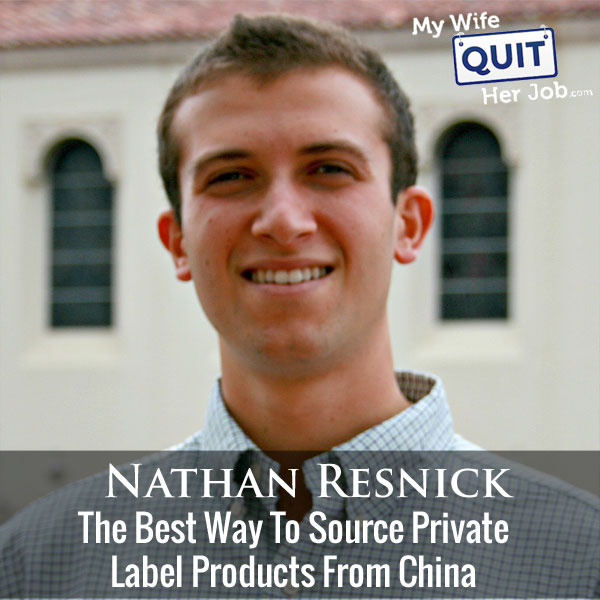
Nathan Resnick founded Sourcify, which connects companies to pre-vetted factories, after running two ecommerce brands of his own. His first product, a leather watch strap with no holes that fastens like a zip tie, took five months to go from idea to finished product and funded its production run through Kickstarter.
This episode covers how to vet a supplier before you commit, the questions that get a factory to actually reply, why 85% to 90% of listings on open databases are not factories, sourcing outside China, and how his team produced a custom suit sample in ten days.
Get My Free Mini Course On How To Start A Successful Ecommerce Store
If you are interested in starting an ecommerce business, I put together a comprehensive package of resources that will help you launch your own online store from complete scratch. Be sure to grab it before you leave!
Table of Contents
Key takeaways
- Roughly 85% to 90% of companies on open sourcing databases are trading companies or export agents rather than actual factories.
- Spot a trading company by its product range. Real factories work from specific raw materials and cannot credibly produce across unrelated categories.
- Fewer than 1% of Alibaba inbound inquiries convert into a production run, which is why factories ignore generic messages.
- Lead with proof of buyer intent: your store, your sales history, your LinkedIn. Skip the interrogation on first contact.
- Request the business license and verify it against the Chinese provincial registry.
- Buy samples from two or three factories at once when speed matters, and compare execution before committing.
- Chinese factory labor runs roughly $400 to $600 a month versus $180 to $200 in Pakistan, and Chinese plants are far more automated.
- Contracts with overseas factories are weak protection. The relationship and your brand are what actually defend you.
How do you tell a real factory from a trading company?
Look at the product categories a supplier lists, because a genuine factory is built around specific raw materials and cannot credibly make everything. A supplier offering watches, backpacks, and sunglasses on one page is a trading company.
The exception is worth knowing. An apparel or cut-and-sew manufacturer can legitimately produce across several clothing categories, since the underlying materials and machinery are shared.
Some trading companies say so in their name, and some factories run a trading arm alongside production. Neither fact removes the need to check.
The definitive test is the business license. Request it, and if you read Mandarin or have someone who does, verify the registration against the province’s own website to see how the company is registered, or whether it is registered at all.
What is the difference between a factory, a trading company, and a sourcing agent?
Factories actually produce goods. Trading companies, sourcing agents, and export agents all add a margin on top of the factory’s unit cost, and what they provide in exchange is a liaison with English-speaking sales staff.
That value is real in specific situations. Plenty of factories have no English-speaking representative, so a trading company can bridge the gap on mold creation and design work.
Small order quantities are the other case for using one. A trading company will accept volumes a factory would refuse, and you will not be the smallest account they handle.
Why do factories ignore your Alibaba messages?
Fewer than 1% of inbound Alibaba inquiries turn into a production run, so factories spend significant time and money filtering leads and treat generic messages as noise. Yours looks like the other ten they received that day.
The lead quality problem runs both ways. Open databases and trade shows are the two main channels feeding most factories, and both deliver low-quality inquiries in volume.
Trade shows have their own version of this. Everyone collects business cards in a notebook, and how a rep remembers you depends heavily on your energy at the booth. Arriving sluggish at the end of a long day at the Canton Fair does not help.
How do you write a supplier inquiry that gets a reply?
Lead with evidence that you are a real buyer. Link your online store, show your growth, and include a LinkedIn profile so they can verify you exist.
Note that Facebook is blocked in China, so it is useless as a credibility signal. LinkedIn works.
Do not open with a list of demands. Ask a few key questions about who they produce for, their main markets, and their minimum order quantities, and leave the rest for later.
Keep the structure simple and numbered. English proficiency among sales reps varies widely, and a clear numbered list gets a usable answer where a dense paragraph does not.
What questions should you ask to vet a factory?
Ask for past clients, main markets, main product categories, business licenses, and certifications such as ISO. Those five establish whether the company is what it claims to be.
Request multiple contact methods rather than one. Email, WeChat, and Skype all serve different purposes, and relying on a single channel is fragile. Note that WhatsApp is blocked in China, so WeChat is the practical default.
Try to reach past the sales rep. Getting to a manager or the factory owner changes the quality of the relationship, and owners are often more receptive than sellers expect.
The red flags are the inverse. Communication that keeps dropping off, a language barrier too wide to work through, a registration that shows a trading company, or a product range spanning unrelated categories.
The only real validation is repeated production. Working with a factory several times and confirming that quality and communication hold up over time is what proves them out.
Are trade shows worth it for finding suppliers?
Trade shows are valuable because meeting face to face makes it far easier to tell a factory from a trading company, and because business in Asia runs on relationships. A conversation at a booth reveals things a message thread will not.
Visiting the factory itself deepens that further. Tours typically run two to three hours, which reflects a deliberate relationship-building process rather than an inspection.
That investment has commercial consequences. Factories that see you putting in effort become more willing to work with lower minimum order quantities, and this applies to large plants as well as small ones.
Should you source outside China?
Labor costs are the reason larger companies are moving, with a Chinese factory worker earning roughly $400 to $600 a month against $180 to $200 in Pakistan. Sourcify works with factories in Thailand, India, Pakistan, and Mexico.
Automation is the tradeoff. Chinese factories are considerably more systematized, while production in India and Pakistan tends to be labor-driven with far less automation.
That difference matters most at volume and on consistency. Producing 100,000 shirts to an identical stitch is more reliable in an automated Chinese plant than in a manual operation.
Finding these factories is harder because no equivalent of Alibaba exists for most of these countries. Trade shows have international sections, and Sourcify hires freelance factory managers in-country to build the relationships directly.
The economics can still favor them. Nathan has found minimum order quantities and costs on athletic apparel in Pakistan coming in below China.
How fast can you get a custom product sample made?
Ten days, if your factory relationships already exist. Nathan’s team saw Conor McGregor’s pinstriped suit at a press conference, decided to reproduce it, and had suits, ties, and wallets in hand ten days later, with the ties and wallets arriving in six.
The original clothing supplier had quoted 16 to 20 weeks for the same job.
Speed came entirely from existing relationships. Sourcify already worked with suit factories, so it was a matter of messaging three or four of them rather than starting a search.
Everything else happened remotely. Fabric options came over WeChat and email, and they picked a match from photographs without handling the material.
How do you spec a custom product remotely?
Get professionally measured and send those measurements to the factory. Nathan went to a custom tailor in San Diego the day after the press conference, had every measurement taken, and sent them to China.
The hardest element was the lettering. Each letter had to be spaced to the exact millimeter, so they printed different spacings on paper and compared them until the proportions were right.
Production ran through two facilities. A printing factory handled the fabric, then the suit factory cut and sewed to specification.
A good factory asks you the questions you forgot. If they handle a product category regularly they know the material options, the zipper types, and the details you have not considered, and they will raise them unprompted.
Should you order samples from more than one factory?
Order from two or three simultaneously when speed matters, because it converts a sequential process into a parallel one. Nathan bought two suit samples at roughly $100 each including shipping.
The comparison paid off. One factory spaced the lettering too large and the other got it right, which they only discovered by running both at once.
They paid for samples before the specs were even final. That only works with factories you already trust, and it is what compressed the timeline.
What did the Conor McGregor suit case study actually prove?
The site did $23,000 in its first week at roughly $400 a suit, against a unit cost of $30 to $40. Most of that traffic came from major media coverage rather than paid advertising.
It ended abruptly. The marketing partner used a Conor McGregor image and name, and a cease and desist arrived within a week of launch, so they refunded every order and took the site down.
Two structural decisions are worth noting. They collected payment upfront through Stripe and planned to produce only after knowing the size mix, and they used WooCommerce rather than Shopify because Shopify removes stores over intellectual property complaints.
The broader lesson is about speed. Nathan also worked with the original creator of a bag that went viral, whose market share collapsed because competitors copied it before he could scale.
How much does it cost to make a custom mold?
Molds can start in the low thousands of dollars or less, particularly if you modify an existing mold rather than commissioning one from scratch. That modification path is far cheaper and faster.
You will generally need CAD drawings for a custom mold. Freelancers on Upwork produce these at reasonable rates, which is how Nathan got his first watch strap designed with no product background at all.
Start by finding a factory that already makes something similar. Their existing tooling and experience shorten everything that follows.
How do you design a product without a design background?
Take a feature that works on one product and apply it somewhere it has not been used. Nathan’s watch strap borrowed the zip-tie mechanism from belt buckles.
You do not need an original invention. Look at what you like across existing products and combine those elements into something better in your category.
Material trends open the same door. The move toward bamboo, cork, and wood spawned wooden watches, then wooden speakers and hats, all from the same observation applied to new categories.
Can you stop a factory from copying your product?
Contracts offer weak protection, because enforcing one in China requires money and time most sellers do not have. Nathan puts contracts in place and does not rely on them.
The realistic defense is your brand. Until someone physically handles your product, what sells it is the brand you built, and that is not something a factory can copy.
The TRX resistance strap case shows the cost of the alternative. That founder reportedly spent around $5 million on a legal battle, and not even against the factories directly, but against a trading company selling knockoffs on Amazon.
He won, and what the win actually delivered was the removal of competing listings from Amazon. Working through the ecommerce platforms to take down infringing stores is usually the more efficient route than litigation.
Customs and Border Protection can also help block imports that infringe a registered trademark, which is worth setting up if you have the registration.
Are Chinese factories selling directly on Amazon?
Yes, and it is one of the biggest shifts in Asian manufacturing. Factories can search what their products sell for online, see that the brand captures most of the margin, and conclude they should sell direct.
Two things limit them. Most factories are poor at building brands and making products people want, and many do not understand import logistics or want to invest in learning.
That is exactly why branding matters more now. Generic products are being listed directly by the people who make them, and the only durable protection is a brand customers choose deliberately.
Should you sell on multiple channels at once?
Master one channel before adding another. Nathan sees entrepreneurs planning simultaneous launches on Amazon, Shopify, and eBay before they can scale a single one.
The tooling makes multichannel feel accessible, which is part of the trap. Being able to list everywhere is not the same as being able to grow anywhere.
Depth beats breadth early. Crush one channel, grow on it, and expand from a position where you already know what works.
Frequently asked questions
How do you tell if an Alibaba supplier is a real factory?
Check their product categories, since real factories work from specific raw materials and cannot credibly produce watches, backpacks, and sunglasses at once. Then request their business license and verify it against the Chinese provincial registry.
What percentage of Alibaba suppliers are actual factories?
Roughly 10% to 15%. Nathan estimates 85% to 90% of companies on open sourcing databases are trading companies, sourcing agents, or export agents.
Why do Chinese factories not respond to my messages?
Because fewer than 1% of their Alibaba inquiries become production runs, so they filter aggressively. Show proof you are a real buyer with your store, your sales history, and a LinkedIn profile.
Is it worth using a trading company?
Yes when your order quantities are small or the factory has no English-speaking staff. You pay a margin above the factory’s unit cost in exchange for a liaison and access to lower minimums.
How much does a custom mold cost?
From a few thousand dollars or less, especially if you modify an existing mold rather than commission a new one. You will usually need CAD drawings, which freelancers produce affordably.
Should you order samples from multiple factories?
Yes when speed matters. Ordering two or three at once turns a sequential process into a parallel one and lets you compare execution before committing to a production run.
Is it cheaper to manufacture outside China?
Labor is cheaper, with Pakistani factory wages around $180 to $200 a month versus $400 to $600 in China. Chinese factories are far more automated, which matters for consistency at volume.
How do you protect your product design from being copied?
Contracts are weak protection since enforcement in China is expensive and slow. Build a brand customers choose deliberately, and use ecommerce platform takedowns and customs trademark recordation against infringers.