
Podcast: Download (Duration: 13:46 — 16.1MB)
To start a dropshipping business the legit way, you pick a niche you actually understand, land a real US-based wholesale supplier who will ship on your behalf, put up a professional-looking store on a cheap platform, drive free traffic through SEO and social media, and then private label your best-selling products under your own brand. That is the sustainable path. It is not the AliExpress arbitrage or Amazon-to-eBay stuff you see hyped on YouTube and TikTok, which almost always ends in banned accounts and unhappy customers.
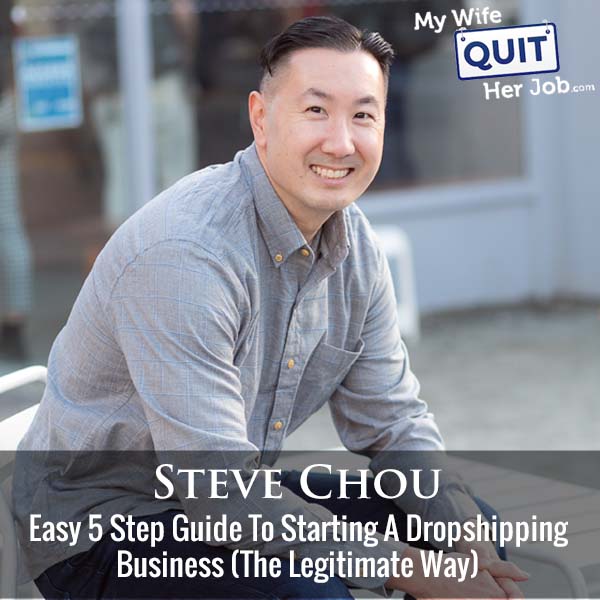
This is a solo Family First Friday episode of the My Wife Quit Her Job podcast, and I want to walk you through the exact 5-step playbook I would follow if I were starting a dropshipping store from zero today, on a shoestring budget.
Here is the full framework: what dropshipping actually is, the models to avoid, how to pick a niche and products, how to find a real supplier, how to vet that supplier, how to drive free traffic without ad money, and how to transition into private label so you can grow past the 10 to 30 percent margins that dropshipping caps you at.
Get My Free Mini Course On How To Start A Successful Ecommerce Store
If you are interested in starting an ecommerce business, I put together a comprehensive package of resources that will help you launch your own online store from complete scratch. Be sure to grab it before you leave!
Table of Contents
Key takeaways
- Legit dropshipping means selling other companies’ products through a real US wholesale supplier who ships on your behalf. AliExpress arbitrage, Amazon-to-eBay flipping, and any marketplace-to-marketplace model is not legit and will get you banned.
- Dropshipping margins are 10 to 30 percent, so you cannot afford paid ads and you need an average order value of at least $50 (ideally $100+) for the math to work.
- Directories like Worldwide Brands and SaleHoo are a last resort. Every legit supplier in a directory is being contacted by hundreds of other sellers, so the winning products are already saturated.
- The best way to land a real dropship supplier is to call the manufacturer of a product you want to sell, ask for their list of wholesale distributors, then contact those distributors directly. The second best way is to attend a wholesale trade show in person.
- Before you contact any supplier, have a real-looking website up. Suppliers will vet you, and a domain plus a WooCommerce store with a mock product catalog is table stakes.
- Because you cannot afford paid ads, all your traffic has to come from SEO and social media. Pick one channel that matches your product’s visual profile and audience, then grind on it daily.
- The dropship store is Step 0. As soon as you spot your winners, private label those exact products under your own brand to jump from 10 to 30 percent margins to 66 percent or better.
What is dropshipping and how does it actually work?
Dropshipping is an ecommerce model where your online store never carries inventory. When a customer places an order on your site, you turn around and buy that product from a wholesale supplier at your cost, and the supplier ships it directly to your customer under your brand.
You pocket the difference between the retail price you charged and the wholesale price you paid. There are no upfront inventory costs, no warehouse, no packing, and no shipping labels on your end.
The reason dropshipping is attractive to first-time sellers is capital. You can literally start with just a domain, a cheap store platform, and a supplier agreement, so total startup cost can be under $100.
Dropshipping business models to avoid at all costs
The dropshipping models to avoid are AliExpress dropshipping, dropshipping direct from China, and any marketplace-to-marketplace flipping (Amazon to eBay, Walmart to Amazon, and so on). Every one of these will hurt your customers, your bank account, or your seller account.
AliExpress and direct-from-China dropshipping have brutal shipping times (often two to four weeks) and unpredictable quality control. That translates into refund requests, chargebacks, and terrible reviews within your first 90 days.
Marketplace-to-marketplace dropshipping is explicitly against Amazon’s and eBay’s rules. Both platforms only allow dropshipping from actual wholesale distributors, and both actively catch and ban sellers who route orders through another retailer.
If a “guru” is teaching one of these models as a fast path to income, walk away. The end state is always a suspended account or a chargeback pile.
Step 1: Pick a dropshipping niche you already know
Pick a dropshipping niche you already know and love, because your product selection will be limited to what your suppliers actually carry, and content marketing is a lot easier when you understand the customer. If you love fishing, dropship fishing supplies. If you run a beauty salon, dropship beauty products.
Domain knowledge shortens every future decision.
A few niche rules that separate stores that grow from stores that stall:
- Higher price point. Aim for an average order value of $50 minimum, $100+ preferred. Think barbecue grills, fire pits, standing desks, saltwater aquarium gear, not $8 phone cases.
- Cross-sell friendly. The niche should have lots of related products. Sell a barbecue grill, then upsell tongs, aprons, a thermometer, wood chips. Repeat business is where dropshipping actually gets profitable.
- Timeless products. Avoid categories that go obsolete every 12 months, like iPhone cases and consumer electronics accessories. Product churn means constant catalog updates and lost SEO equity.
- An identifiable audience. If your niche has active blogs, Facebook groups, and subreddits, marketing gets 10x easier because your customers already gather in one place.
- Content-able. You need to write blog posts, film TikToks, or post Instagram photos. If you cannot picture producing 50 pieces of content about the niche, pick a different niche.
Step 2: Find a real US wholesale dropship supplier
The best way to find a real US wholesale dropship supplier is to call the manufacturer of a product you want to sell and ask them for a list of their authorized wholesale distributors. Then contact those distributors directly and ask if they will dropship on your behalf. It sounds old-fashioned because it is, and that is exactly why it works.
Most dropship suppliers carry a wide catalog from many manufacturers, so landing one good distributor often opens hundreds of SKUs at once. Setup varies. Some distributors will only dropship for retailers with a brick-and-mortar store, and some require you to buy a small opening order at wholesale to prove you can move product before they turn on dropshipping.
Directories like Worldwide Brands and SaleHoo are a last resort. Any supplier listed in a directory is already being contacted by hundreds of sellers, so you are jumping into a saturated pool with the same products as everyone else.
If cold-calling manufacturers is not landing suppliers, the next best move is attending a wholesale trade show. Head to WholesaleCentral.com for the trade show calendar. There is a wholesale show for practically every product category in the US, most are free with a business license, and meeting brands face-to-face at a booth converts to dropship agreements at a rate email never will.
Step 3: Build a real store before you contact suppliers
Build a real-looking store before you contact any supplier, because every legit distributor will look up your website to decide whether taking you on is worth the setup cost on their end. A domain name and a live storefront with a mock product catalog is the minimum bar.
Suppliers will ask about your ecommerce experience, your marketing plan, and your projected volume. If they land on a Shopify default theme with no products, you get ignored.
I recommend WooCommerce for a first store because you can be up and running with hosting and a domain for around $3 a month, and you own everything you build. Once you land a supplier, swap the mock catalog for their real SKUs.
Step 4: Vet the dropship supplier with a test order
Vet the dropship supplier by placing a test order to your own address before you send them a single paying customer, because every dropshipping business lives or dies on the supplier’s execution. Trust has to be earned with a real transaction.
When your test order arrives, evaluate five things:
- Ship speed. Orders should ship within one to two business days. Slower than that and your reviews will suffer.
- Packaging quality. Is the product in a proper box with real packing? Is the shipping label plain and unbranded, so it does not scream “different company”? Is the product likely to arrive undamaged?
- Customer service response time. Message them a mock question. If they take a week to reply, that is what your customers will experience.
- Tracking and invoicing. Do they automatically send tracking and a clean invoice? You will need both to keep your customers informed.
- Return handling. Ask how defective merchandise is handled. Do they refund? Do they replace? Returns come back to you, not to them, so you need the policy in writing.
Questions to ask every supplier before you sign:
- What is your wholesale pricing, and are there volume discounts as I scale?
- What is your per-order dropship fee? (Most dropshippers charge one.)
- What is your standard ship time?
- What is your return policy on defective and non-defective merchandise?
- Do you offer EDI (Electronic Data Interchange)? EDI syncs their inventory into your store in real time, which is the single biggest customer service win you can get, because you never oversell an out-of-stock item.
Step 5: Drive traffic with SEO and social media, not paid ads
Drive traffic with SEO and social media, not paid ads, because dropshipping margins of 10 to 30 percent cannot support Facebook or Google Ads costs at any real scale. Free traffic is your only lane, and free traffic is a grind.
Pick one primary channel that matches your product. Visual products like fashion, wedding, home decor, and jewelry win on Instagram and Pinterest. Products aimed at an older demographic still work on Facebook.
TikTok gives brand new accounts massive reach without a subscriber base, which is why it is currently the highest-leverage free channel for new stores. B2B brands live on Twitter/X and LinkedIn.
Consistency beats cleverness. My friends who grew Instagram stores post one to two times a day. My student Angela, who runs zerojewelry.com, posts six to seven times a day on Instagram and once a day on TikTok.
Emma McFerrin built the eyelash brand Glamnetic (later valued at nine figures) by DMing every follower who engaged with her early posts.
In parallel, invest in SEO. Grab a keyword tool like Ahrefs or Ubersuggest so you can see what customers actually search for and how hard each keyword is to rank for. Then publish a series of buyer-intent blog posts targeting those keywords (“best barbecue grill under $500,” “how to season a cast iron grill grate,” etc.).
Whichever channel you pick, go deep on that one channel before adding the next. Splitting energy across four platforms at the same time is why most new stores die of exhaustion at month six.
And from day one, collect emails and SMS phone numbers on every visit and every order. Email and SMS give you a free re-engagement channel that does not depend on any algorithm, and repeat-purchase customers are where dropshipping margins finally start looking healthy.
The real endgame: private label your winners
The real endgame of a dropshipping store is not dropshipping. It is using the store to discover which products your customers actually want, then private labeling those exact winners under your own brand. That is how you jump from 10 to 30 percent margins to 66 percent or higher, which is the margin profile you need to build a seven-figure ecommerce business.
Watch your sales data for three to six months. The moment a SKU is consistently outselling everything else in the store, contact the manufacturer directly and place a private-label order under your own brand.
You keep the traffic engine, the customer list, and the SEO equity you built with the dropship store. You swap the low-margin third-party SKU for a high-margin owned SKU. Now the same 1,000 monthly orders make three to five times the profit.
How much does it cost to start a legit dropshipping business?
You can realistically start a legit dropshipping business for under $100 in cash outlay: about $10 to $15 for a domain, roughly $3 to $10 a month for shared hosting if you use WooCommerce (or $29 a month for Shopify), and free themes or a low-cost template. Add a business license (typically $50 to $100 depending on state), which most wholesale suppliers will require.
Beyond that, budget for a keyword research tool ($30 to $99 a month) once you are ready to start ranking content. Everything else (SEO writing, social posting, supplier outreach) is your own time.
Frequently asked questions
Is dropshipping still profitable in 2026?
Legit dropshipping is still profitable in 2026, but only as a low-risk way to learn ecommerce and identify winning products before you commit capital to inventory. Long-term margins of 10 to 30 percent make it hard to scale on its own, which is why the successful path is to transition winners to private label as soon as sales patterns are clear.
What is the difference between dropshipping and private label?
Dropshipping means selling another company’s finished products under their brand and having them ship every order for you. Private label means manufacturing your own branded products (often the same physical item with your logo), holding inventory, and shipping yourself. Private label carries 60 to 70 percent gross margins versus 10 to 30 percent for dropshipping, but requires real capital and warehousing.
Do I need a business license to start dropshipping?
Yes, you need a business license and a resale certificate to buy from legitimate US wholesale suppliers, because suppliers will not sell to you at wholesale prices without one. Getting a business license typically costs $50 to $100 depending on your state and can be done online in an afternoon.
What is the best platform to build a dropshipping store on?
The two best platforms for a dropshipping store are WooCommerce and Shopify. WooCommerce is the cheapest option (as low as $3 to $10 a month) and you own everything, but it requires some setup. Shopify is more expensive ($29+ a month) and takes a percentage of sales, but it is faster to launch and requires zero technical work.
How long does it take to make your first dropshipping sale?
Most legit dropshipping stores make their first sale within 30 to 90 days of launch, assuming the founder is posting consistent content on one social platform and publishing SEO articles. Stores that rely on paid ads sometimes see sales in week one, but almost never at a profit given the 10 to 30 percent margin ceiling.
Can you dropship on Amazon or eBay?
You can only dropship on Amazon and eBay from real wholesale distributors, not from other marketplaces or from AliExpress. Both platforms actively catch and permanently suspend sellers who route orders through another retailer, so marketplace-to-marketplace dropshipping is a fast way to lose your seller account.
Why do most dropshipping businesses fail?
Most dropshipping businesses fail for three reasons: they chase saturated products they found in a directory, they cannot afford paid ads at 10 to 30 percent margins, and they never transition winners into private label so they stay stuck at low margins forever. The ones that succeed pick a niche they know, land direct-from-manufacturer suppliers, grind on free traffic, and move to private label the moment they spot repeat winners.