

Podcast: Download (Duration: 47:23 — 54.5MB)
The most reliable productivity system for a busy entrepreneur is a three-part stack: assign each weekday to one specific business area (theme days) so you never context-switch mid-day, keep a separate menial-task list for the 15 to 35 minute gaps between meetings so those windows are actually productive, and protect at least one fully open day per week for real creative or deep work. That combination is what lets my podcast co-host Toni Herrbach run four businesses, raise seven kids, and still shut down at 3 p.m. on Fridays.
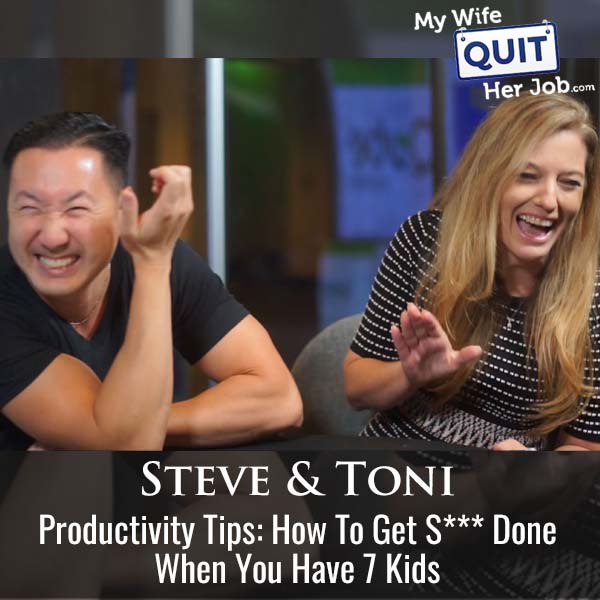
This is a Profitable Audience episode of the My Wife Quit Her Job podcast, where Toni and I compare how we actually schedule our work weeks and where I get her to break down the 46-day morning routine (no phone, treadmill walk, 5-minute meditation, delayed breakfast) that has fully killed the brain fog she was fighting for months.
Below is the full playbook: the theme-day schedule, the menial-task buffer trick, why “being busy” can be a coping mechanism, and the exact new morning routine that made Toni feel like a different person in six weeks.
Get My Free Mini Course On How To Start A Successful Ecommerce Store
If you are interested in starting an ecommerce business, I put together a comprehensive package of resources that will help you launch your own online store from complete scratch. Be sure to grab it before you leave!
Table of Contents
Key takeaways
- Theme days beat mixed days. Toni gives every weekday to one business (Monday = client, Tuesday = deep work, Wednesday = course and podcast, Friday = shut down by 3 p.m.). Steve does the same.
- Every entrepreneur needs at least one fully open day per week as a buffer, because “the fridge broke” or “the kid needs a ride” will destroy any calendar that is 100 percent booked.
- Keep a separate menial-task list (small admin, contract updates, email templates, Speaker follow-ups) for 15 to 35 minute gaps. Trying to do creative work in those windows produces almost nothing.
- Toni’s rule: never try to film a video in less than 60 minutes. Small mistakes in a rushed window kill the whole session.
- Chronically being busy on purpose can be a coping mechanism (a way to avoid processing emotions), not just proof of ambition. Real seasons of overload are different.
- Bestseller-list book launches cause a real emotional-crash pattern after the launch is over. Plan for a slow recovery period, not a snap-back to full output.
- Toni’s morning routine at 46 days in: no phone on waking, 30 to 45 minute treadmill walk with an intentional podcast, 5 minutes outside in the sun, 5-minute guided meditation, no breakfast until 10:30 or 11. Result: measurably better blood work and no more 2 p.m. crashes.
Why every entrepreneur needs at least one open day per week
The single biggest productivity mistake busy entrepreneurs make is booking their calendar to capacity, because unplanned emergencies are guaranteed and a fully-booked calendar has no room to absorb them. A screw in your tire, a broken fridge, a sick kid, or a car repair each take 3 to 5 hours out of your day. On a packed calendar those hours have to steal time from real work; on a calendar with one open day, they just fill the buffer.
The book Margin by Richard Swenson makes this case in full: forward progress needs slack, not maximum utilization. If you have zero white space on your calendar, every glitch in the matrix costs you compounding productivity, not just the raw hours lost.
There is a second cost most people underestimate. A surprise interruption also shifts your mindset for hours afterward. A 30-minute tire-shop visit at 8 a.m. can put you in a low-grade irritation state that reduces your output for the rest of the morning, so the “real” cost is often 4 to 5 hours, not 30 minutes.
How theme days let you run multiple businesses without burning out
Theme days mean assigning each weekday to one specific business area or one specific type of work, so you never context-switch inside a day. This is the single biggest structural change that separates entrepreneurs who run 3 to 5 income streams cleanly from entrepreneurs who feel constantly scattered across all of them.
Toni’s week runs like this: Monday is her main client (she already has a team meeting on their calendar, so the whole day is theirs), Tuesday is head-down deep work (no meetings, phone off), Wednesday is course and podcast day (office hours, podcast recording, course email replies), Thursday and Friday flex between the other businesses, with Friday shutting down at 3 p.m.
My week runs on the same principle with different themes. Monday is my biggest production day (2 YouTube videos, 2 podcasts prepped for editing, blog posts).
Wednesday is podcast recording plus office hours. Thursday is Bumblebee Linens day, and Friday is deliberately empty for family time.
Why Tuesday (the “no meetings” day) is the most valuable slot in the week
Tuesday is the day Toni does 15 client emails, writes YouTube scripts, and knocks out anything that requires unbroken concentration. Her rule: no calls, no scheduled anything, phone effectively off. Kids know not to expect a text back, and she stays in flow state for essentially the whole day.
Deep work needs a full uninterrupted window because a single meeting bleeds the entire day. After any live call, most people need 30 to 60 minutes of “un-meeting” decompression before real creative work is possible again, so a day with even one meeting is not really a deep-work day.
The menial-task list: how to make 30-minute gaps productive
Keep a separate menial-task list (small admin work, contract updates, email templates, quick data entry, no-thinking-required tasks) for the 15 to 35 minute gaps between appointments, because trying to do creative work in those windows produces almost nothing. Toni realized this after years of trying to write emails or film videos in short pockets and consistently failing.
A live example she shared from the day before we recorded: she had a 35-minute window in her car between appointments, tried to draft marketing emails, felt terrible about the output, and switched to updating Sellers Summit speaker contracts and templates instead. She finished all of it with 10 minutes to spare, because those were true no-brainer tasks she had done dozens of times.
The mental model is that not all work uses the same fuel. Creative work (scripts, videos, emails, strategy) needs a long runway.
Menial work (data entry, contract admin, template edits) can be shoved into any spare pocket without penalty. Sort your to-do list by fuel type, not just by priority.
The 60-minute minimum for filming any video
Toni’s other hard rule: never try to film a video in under 60 minutes. In a 15-minute window, one small mistake becomes the deal-killer because there is no time to re-film. In a 60-minute window, a mistake is just a retake.
The same rule applies to any creative task with a real re-do cost (podcasts, sales scripts, launch copy). Match the window to the task, and stop forcing high-cost tasks into low-time windows.
Is being busy actually a coping mechanism?
Chronic, always-on busyness (not seasonal overload) can be a coping mechanism, because filling every hour leaves no time to process emotions or sit with uncomfortable feelings. Toni surfaced this in the episode after hearing it several times from different sources: “being productive” gets a free pass in a way that binge-watching or drinking does not. The underlying pattern is often the same avoidance.
The test she suggests: ask yourself why you are always busy. If the answer is “because there is a natural season of overload right now” (young kids, first year in a new job, launching a book), that is legitimate. If the answer is “I just cannot sit with nothing to do,” that is worth examining.
There is a caveat: parents of young children are not doing this. That season is objectively hard and there is no fixing it with a productivity system. The coping-mechanism version of busyness is the one where the constraints are not real and you are still packing the calendar to the top.
Book launches: expect an emotional crash
Launching a book with the intent of hitting a bestseller list produces a predictable emotional crash after the launch ends, because of the sheer volume of relationship-based work required to get there. My Wall Street Journal bestseller launch was the hardest 3 months I have ever worked. I did nothing for the rest of that year beyond keeping the lights on, and I am still paying for that recovery period the year after.
If you are planning a book launch, budget a recovery period of at least 3 to 6 months of maintenance-only work afterward. Do not commit to new sponsors, new podcast slots, or new projects during that window. The crash is normal.
Toni’s 46-day morning routine that killed the brain fog
Toni’s new morning routine is a strict 6-step sequence with no phone contact until step 5, and after 46 days it has measurably fixed her brain fog and improved her blood work. She started it because she was hitting foggy, low-energy afternoons that had her staring at her computer and considering going to bed at 2 p.m., which is not her normal state.
Here is the exact sequence she follows every morning:
- Wake up, turn off alarm, and do not touch the phone. No email, no text, no social. This one change was the biggest lever.
- Put on the workout clothes she leaves on her treadmill the night before, get on the treadmill, and open the curtains for morning sunlight.
- Walk on the treadmill for 30 to 45 minutes at roughly 4 mph (a fast walk, not a run), while listening to an intentional podcast (health, marketing, motivation). No true crime, no music.
- Get off the treadmill and sit outside for 5 minutes in the sun (or by a window if it is cloudy or raining). This resets circadian rhythm.
- Do a 5-minute guided morning meditation (Toni uses the top result for “5 minute morning meditation” on YouTube). This is the step she was most skeptical about and now considers essential.
- Shower, then start work. Do not eat breakfast until roughly 10:30 or 11 a.m., using the extended overnight fast as the first natural break in the workday.
The results after 46 days: her to-do list clears every day, big projects are getting knocked off, she is sometimes done for the day by 4 p.m., her caffeine intake has dropped, and lab work improved without any dietary changes or dropping alcohol. The whole change is upstream of the workday itself.
Why “no phone before bed” is the second lever
The evening companion to the morning routine is no phone in the 30 to 60 minutes before sleep, replaced with a 5-minute evening meditation on hectic days. This is the standard advice that almost nobody follows, and the reason it works is the same reason the morning meditation works: it forces the mind to stop cycling on the next three days of tasks.
Even 5 minutes of a genuinely quiet mind (no phone, no planning, no scrolling) is enough to break the loop and let you fall asleep faster. Combined with the morning routine, it is what enables the “no crashes at 2 p.m.” result Toni now gets consistently.
A weekly template you can copy today
Here is the productivity stack from this episode compressed into a template you can use as a starting point.
- Assign each weekday to one specific business area or type of work (theme days). Never mix.
- Protect at least one fully open day per week as a buffer for emergencies and unplanned deep work.
- Pick one weekday that is your no-meetings day, and defend it (phone off, no calls, no scheduled anything).
- Maintain a menial-task list separate from your creative-work list, and use it for every 15 to 35 minute gap.
- Never attempt any creative task with a re-do cost (video, sales copy, strategy) in a window under 60 minutes.
- Do not touch your phone for the first 60 to 90 minutes after waking, and end the day with 30 to 60 phone-free minutes before bed.
- Add a walk (20 to 45 minutes) plus 5 minutes of outdoor sunlight to your morning. Delay breakfast to roughly 10:30 to 11 a.m.
- Do a 5-minute guided meditation morning and evening. Yes, even if you are certain meditation is not for you.
Frequently asked questions
How do busy entrepreneurs manage their time with kids at home?
Busy entrepreneurs with kids typically use theme days (assigning each weekday to one type of work) and protect at least one fully open buffer day per week for the emergencies that come with kids. Trying to run a packed 5-day calendar with children guarantees that a sick day or school pickup will destroy the week; a calendar with slack absorbs it.
What is a theme day and how does it work?
A theme day is a weekday assigned to one specific project, business, or type of work, so you never context-switch inside a day. For example, Monday might be one client, Tuesday might be deep-work only with no meetings, and Wednesday might be course creation plus podcast recording. Theme days remove the mental cost of jumping between unrelated projects.
How do you stay productive between meetings?
Keep a separate menial-task list (small admin, template updates, contract follow-ups, no-thinking-required work) for the 15 to 35 minute gaps between meetings. Trying to do creative work in those windows produces frustration and almost no output, but no-brainer admin tasks fit perfectly.
Does a morning routine actually improve productivity?
Yes. Toni’s 46-day morning routine (no phone on waking, 30 to 45 minute walk with an intentional podcast, 5 minutes of outdoor sunlight, 5-minute meditation, delayed breakfast) removed her brain fog and improved her lab work with no other diet or lifestyle changes. The specific tactics matter less than the pattern of no phone plus movement plus sunlight plus stillness.
Is being always busy a sign of avoidance?
Chronic, always-on busyness can be a coping mechanism for avoiding uncomfortable emotions, in the same way binge-watching or drinking can be. The test is whether you can sit quietly with no task and be comfortable; if not, some of your busyness may be filling that space rather than serving your business.
Can you really shut down at 3 p.m. on Fridays as an entrepreneur?
Yes, if you protect a specific weekday for deep work and use theme days for the rest, you can compress a full week’s output into 4 focused days and end early on Fridays. Toni does this every week, and Steve’s ideal week ends by mid-afternoon Friday for family time. It requires ruthless calendar defense, not fewer projects.
How long should a book-launch recovery period be?
Plan for at least 3 to 6 months of maintenance-only work after a major book launch. The pattern of sponsor commitments, podcast tours, and public-facing hustle creates a real emotional crash on the other side, and layering new projects on top of it slows the recovery further.

