
Podcast: Download (Duration: 39:28 — 45.4MB)
An item now counts as handmade on Etsy only when it is based on the seller’s own original design. Etsy quietly deleted the seven words in its rules that also allowed “a templated design or pattern,” so print on demand shirts built from clip art and purchased templates no longer qualify.
Etsy never announced the change. Listings first lost visibility, then got removed, and repeat violators are being banned for life, while AI-generated designs are allowed only with disclosure and a “Designed by seller” label.
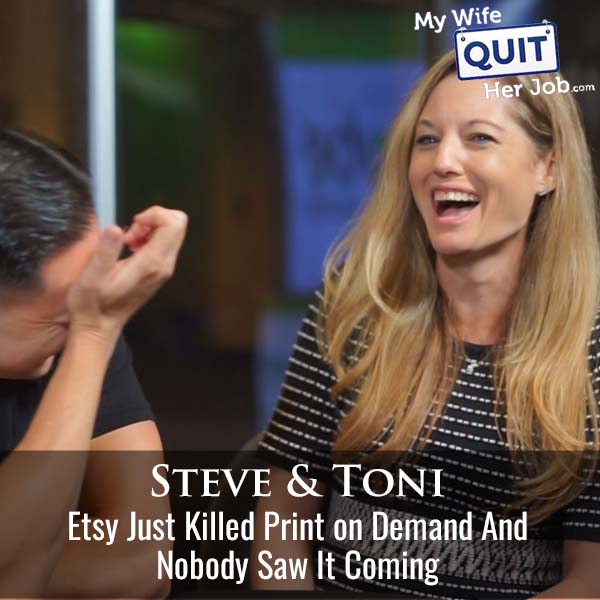
In this episode, my co-host Toni Herrbach and I argue about it. I think Etsy made the right call, Toni thinks the rules make no sense, and along the way she reveals that her own ecommerce business started with a “handmade” Etsy necklace that was nothing of the sort.
Get My Free Mini Course On How To Start A Successful Ecommerce Store
If you are interested in starting an ecommerce business, I put together a comprehensive package of resources that will help you launch your own online store from complete scratch. Be sure to grab it before you leave!
Table of Contents
Key takeaways
- Etsy removed “templated design or pattern” from its handmade rules. Items now have to be based on the seller’s original design.
- Enforcement came before any announcement. Listings disappeared from search, then got delisted, and repeat violators are banned for life.
- AI designs are allowed only with disclosure. They also carry a “Designed by seller” label in place of “Made by seller.”
- The lines are confusing. Stitching someone else’s embroidery design is out, while paying someone to digitize your own image is fine.
- Shoppers say they want handmade until they see the price. In my store, customers chose machine-made over a 50% premium for hand-rolled edges.
- Serious handmade sellers are building their own channels, including TikTok, their own Shopify store, and in-person sales.
What Etsy changed in its handmade policy
Etsy changed its handmade policy by removing the words that allowed templated designs and patterns. The old rule let you sell an item “based on a seller’s original design or use a templated design or pattern,” and the new rule stops after “based on a seller’s original design.”
The change started last year, and Etsy did not announce it. Sellers using templates first noticed their listings were no longer visible, and then Etsy started delisting them.
When sellers switched to AI-generated designs, Etsy delisted those too. It later added a rule that AI-generated items must be clearly disclosed, along with a new “Designed by seller” designation that replaces “Made by seller” for those items.
I made a YouTube video about the change because I estimate about 90% of print on demand is someone putting an image or a bunch of clip art on a T-shirt. Etsy was getting flooded with exactly that.
What counts as handmade on Etsy now: real examples
Under the new rule, an item counts as handmade on Etsy when the design itself comes from the seller, even if a machine or a contractor helps produce it. Here is how Toni and I read the policy for the examples we discussed, so check Etsy’s current rules before you list.
| Item | How it fits the new rule |
|---|---|
| T-shirt printed with purchased clip art or a template | Out, because the design is not the seller’s own |
| Bib stitched with someone else’s embroidery design | Out, for the same reason |
| Your own image, digitized by a hired contractor, then machine embroidered | Allowed, because the design started with you |
| Pre-made candles with your own scent and a decorative label | Allowed, as I understand it |
| AI-generated design on a product | Allowed with AI disclosure and a “Designed by seller” label |
Our own business used to sell on Etsy a long, long time ago. If we still did, stitching a purchased embroidery design onto a bib would now break the rules, and stitching an image we paid someone to digitize would be fine, which Toni and I agree makes very little sense.
Why Etsy is cracking down on templated and AI designs
Etsy is cracking down because it is losing money and has lost its identity as the handmade marketplace. A few years ago it opened the floodgates to Chinese sellers, and sales went up for a while.
Then the site became a junkyard of knockoff, factory-made listings that undercut real handmade sellers. One description I saw called it “a cesspool of AI slop,” because the same design ends up on thousands of identical shirts.
Being a public company makes this harder, because Etsy has to show profits and growth every quarter. With AI listings flooding in on top of the factory goods, Etsy lost a significant number of sellers last year.
Part of the blame goes to YouTube. I follow some channels with over a million subscribers that pitch AI print on demand as a gold mine, and they never show their income reports or their own stores.
Why I think Etsy’s handmade rule is the right move
I think the handmade rule is the right move because Etsy only works if it has a clear identity, and that identity is supposed to be handmade. If I owned Etsy and did not have to answer to public shareholders, I would keep it strictly handmade.
Toni and I agree on one thing: very few people make real money from print on demand without an audience. The clip art shirt sellers getting delisted were never building a durable business on Etsy anyway.
Why Toni thinks Etsy’s handmade rules go too far
Toni thinks the rules go too far because “template” and “pattern” cover a lot of legitimate handmade work. If she sews a dress from a pattern, she is still physically making it, and Etsy’s wording blurs that line.
Her favorite example is the popular world map where you mark the places you have traveled with pins. She would rather the seller use a template of the world than invent their own version of Africa.
Toni’s view is that Etsy let things get out of control, overcorrected, and will eventually have to find the middle. In her words, Etsy went too far with some of this and not far enough with the rest.
Where to draw the line on handmade
Nobody has a clean answer for where handmade ends, and that is the real problem with the policy. Photographers like Ansel Adams sold prints, and nobody made photographers disclose Photoshop edits when that software arrived.
A sewing machine replaced hand stitching, and my embroidery machine sews a design without anyone touching it. If you get truly granular, handmade means someone weaving the fabric on a loom first, and nobody wants to wait for that.
How Etsy’s AI enforcement is banning legitimate sellers
Etsy is enforcing the handmade policy with AI, and that creates a guilty-until-proven-innocent system. Listings get delisted first, and sellers who keep violating the policy get banned for life.
I have been reading the Etsy forums on Reddit, and plenty of people say they were banned unfairly. Meanwhile, many listings that clearly break the rules are still up.
Toni and I both know legitimate sellers on every platform who have been suspended or had inventory quarantined. Enforcement like this catches some bad actors, and it also takes down real businesses selling quality products.
How a “handmade” Etsy necklace launched Toni’s ecommerce business
Toni’s ecommerce business started with a necklace her future business partner bought on Etsy about 12 years ago. Her partner had read a post I wrote about getting product ideas from Etsy, a post I later took down after it drew a wave of hate.
The partner, an essential oil distributor at the time, showed Toni the necklace and said they could sell it. Only about two Etsy sellers carried it, and nobody was selling it on Amazon.
Toni had been browsing Alibaba for about a year by then, and she recognized the necklace immediately. It was a metal piece that was clearly not handmade, and that realization launched her business.
So Etsy’s handmade problem is far from new. Toni noticed it 12 years ago.
Handmade vs machine-made prices: what shoppers actually choose
Most shoppers say they want handmade or American-made products and then choose the cheaper option once they see the price. I see this in my own handkerchief store all the time.
A customer recently wanted a handkerchief with hand-rolled edges, where someone literally rolls the edges by hand. When we told them it cost about 50% more, they said to just send the machine-made version.
We also get customers who refuse to buy anything made in China. Our made-in-USA handkerchiefs cost about three times as much, and one woman I spent about ten minutes on the phone with told me to send the Chinese ones once she saw the prices.
| Example | Handmade or US-made price | Cheaper alternative |
|---|---|---|
| Handkerchief edges | About 50% more for hand-rolled | Machine-rolled |
| Made-in-USA handkerchiefs | About three times the price | Imported |
| A paper product from Toni’s client | About $8 to $9 landed cost printed in the US | Under $1 printed in Asia |
| Leather laptop bag | $400 to $500 handmade on Etsy | About $45 at TJ Maxx or Ross |
| Fabric purse on Etsy | About $100 handmade | $5 to $10, likely factory-made |
Toni follows leather workers on TikTok who make bags by hand and sell them on Etsy for $400 to $500. After the tools, materials, and hours, those makers probably earn about $22 an hour.
Why shoppers distrust AI-made products on Etsy
Shoppers distrust AI-made products on Etsy because they expect anything sold there to have been touched by a human. Many commenters on my YouTube video said they would never buy something on Etsy labeled as AI-made.
Toni and I are both heavy AI users, so we are clearly outside the mainstream on this. I recall a survey showing roughly 60 to 70% of people are against AI, and fears about jobs and safety keep fueling that.
Toni sees a back-to-handmade movement growing alongside AI, including more people homesteading. One seller I follow sold almost a million dollars of old-school landline phones that connect to your cell phone over Bluetooth.
Is AI-assisted work still your own work?
Toni argues that AI help should not automatically make work “AI-made.” She recently had the Claude Chrome extension proofread an email she wrote herself, and it made four grammar fixes, which is no different from what a human editor used to do.
I think about it like the old story of the mechanic who fixes a car in two minutes and charges $1,000. The two minutes rest on a lifetime of learning, and shoppers forget that when a product involved AI.
If you came up with a funny saying for a niche shirt and used AI only for the font and layout, the idea is still yours. The stigma is real anyway, so sellers should expect an AI label to lower what buyers will pay.
How Toni would fix Etsy’s marketplace
Toni would fix Etsy by stopping duplicate designs and letting shoppers filter by where and how products are made. Twenty people selling the same T-shirt design is the clearest sign of the problem.
Her bigger idea is origin categories, such as made in the USA, made in Europe, or made in Asia, each with a minimum percentage requirement. An AI-assisted category could sit alongside them.
She uses Lippy Clip as the example, a brand her friend started on Etsy. Its fabric was bought in the US and the products were assembled in the US, with only the metal clip imported from China, so it would land at roughly 85% US-made.
Where handmade sellers are selling instead of Etsy
Handmade sellers are moving to TikTok, their own Shopify stores, and in-person sales paid through Cash App, Zelle, or Venmo. Toni sees this on local TikTok, where a neighbor sells baked goods, insulated lunch bags, and scrunchies through videos and a twice-weekly stand.
Lippy Clip followed the same path. It started on Etsy with products made by people in Toni’s town, then expanded to Shopify and eventually Amazon.
When I looked, I could not find Etsy sellers doing seven figures, and most top out in the high six figures. If you can build an Etsy shop to that level, starting your own store is arguably easier, and nobody can delist you there.
Frequently asked questions
Can you still sell print on demand on Etsy?
You can still sell print on demand on Etsy when the design is your own original work. Print on demand items made from purchased clip art, templates, or design packs no longer meet Etsy’s handmade rule.
Do you have to disclose AI-generated designs on Etsy?
Etsy requires sellers to clearly disclose when an item’s design was generated with AI. Those items carry a “Designed by seller” label in place of “Made by seller.”
Why are Etsy sellers getting banned?
Etsy sellers are getting banned for using templated designs and undisclosed AI designs after Etsy quietly tightened its handmade rule. Etsy uses AI to flag listings, delists them first, and bans repeat violators for life, which has caught some legitimate sellers too.
Can you sell machine embroidery on Etsy?
Machine embroidery is allowed on Etsy when the design is yours, even if you pay someone to digitize it for your machine. Stitching someone else’s embroidery design onto a product does not qualify.
Will customers pay more for handmade products?
Customers often say they want handmade products and then choose the cheaper option at checkout. In my store, a customer passed on hand-rolled handkerchief edges once they learned the price was about 50% higher.
Is Etsy still a handmade marketplace?
Etsy is trying to become a true handmade marketplace again after factory-made and AI-generated listings flooded the site and buried real handmade sellers. Its tighter rule now requires every item to be based on the seller’s own original design.