
Podcast: Download (Duration: 47:07 — 54.2MB)
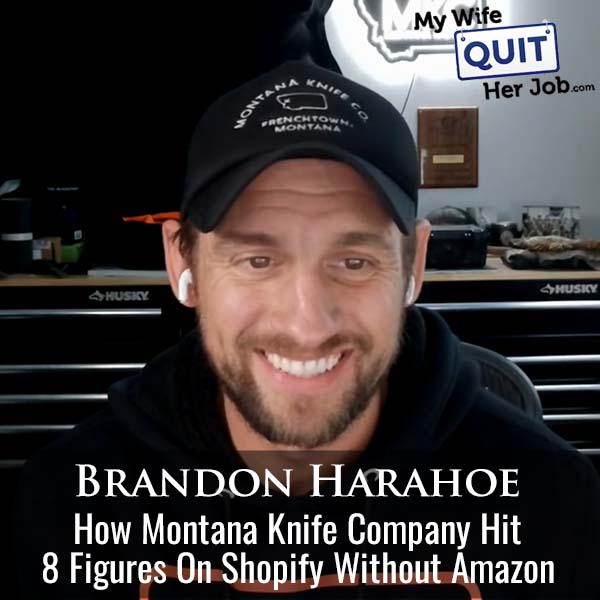
Montana Knife Company scaled to eight figures on Shopify by pairing a legendary craftsman with a weekly drop model, an obsessively-built email list, day-one SEO investment, and a decision to stay 100 percent direct-to-consumer without Amazon or wholesale. In podcast episode 615, I sat down with Brandon Harahoe, co-founder and VP, to walk through the exact playbook they used from launch in December 2020 to a 51,000 square foot manufacturing facility in Montana.
The bigger story is that Montana Knife Company (MKC) built its brand while unable to run paid ads for the first three or four years, because ad platforms flagged hunting knives as weapons. That constraint forced them to build organic email, organic social, and organic search from day one, and those channels are still doing most of the heavy lifting even now that paid ads finally work.
Below is Brandon’s full breakdown of the drop model, the email strategy, the SEO-plus-YouTube system, and how a made-in-USA hunting knife brand out-competed 100-year-old incumbents in five years.
Get My Free Mini Course On How To Start A Successful Ecommerce Store
If you are interested in starting an ecommerce business, I put together a comprehensive package of resources that will help you launch your own online store from complete scratch. Be sure to grab it before you leave!
Table of Contents
Key takeaways
- Montana Knife Company launched in December 2020 with 150 knives, sold out in 14 minutes, and never took a pre-order because they refused to ship a knife they had not already made.
- Josh Smith became the youngest master bladesmith in history at 19, which anchored the brand’s craft credibility from day one.
- Every knife ships the next day. Roughly 99 percent of orders since launch have hit that standard.
- Email was the primary channel for the first two years because paid ads were blocked as “weapons” content across Meta and Google.
- SEO was the first outside hire, before anyone drew a salary. MKC now outranks 100-year-old incumbent knife brands.
- They run about 100 drops per year (weekly Thursday knife drops, Saturday in-stock drops, and two apparel drops per week).
- Wholesale is under 0.5 percent of revenue. They have turned down Cabela’s-scale wholesale contracts to protect D2C capacity.
- Return rates are so low that reducing them further became a company metric was replaced by growing the top of the funnel.
The Montana Knife Company backstory: from $15,000 daggers to sub-$500 hunting knives
The Montana Knife Company backstory starts with Josh Smith, who began making knives at 11 and became the youngest ever certified master bladesmith at 19, a record no one has broken in two decades. Before MKC, Josh made $3,000-to-$30,000 custom knives for collectors, including replicas commissioned for sheiks in Abu Dhabi and Dubai after being flown to London archives to study historical swords. The show Forged in Fire is based on the same certification process that Josh went through; he appeared on seasons one and two.
The problem with $15,000 collectible knives was that buyers did not use them. Josh’s stated mission was to distill everything he knew into one hunting knife every hunter could actually use in the field. The brand tagline captured it: “Used, abused, and passed down.”
Josh’s mom trademarked “Montana Knife Company” and registered the URL in 2000. When Brandon joined 20 years later, he had to track down the domain from a small Montana web agency to link it to Shopify.
Why Made in USA works for a knife brand (and where the tradeoffs are)
Made in USA works for a knife brand because it aligns with an audience (hunters, outdoorsmen) that already values American craftsmanship, and it survives supply-chain shocks like the 2020 lockdowns. The tradeoff is real: Chinese, Pakistani, and Taiwanese knife factories have 30 to 40 years of manufacturing refinement, and their labor costs run roughly 4x lower with steel costs 15 to 40 percent lower. Brandon is direct that many of those overseas knives are legitimately good products.
MKC bet on Made in USA anyway for three reasons: personal alignment with American manufacturing, supply-chain control after watching COVID break the industry, and a market gap. The knife category had spent a decade racing to the bottom (making $20 blister-pack knives designed to be thrown out and replaced), and no one was building a premium heirloom Made-in-USA option.
The bet worked because “things men pass down” is a shrinking category. Watches, firearms, wallets, and knives are essentially the last consumer objects that get handed to the next generation. Nobody wants your iPhone 13.
How Montana Knife Company got its first sales without Amazon
Montana Knife Company got its first sales by pre-loading Instagram with landscape photography for three months while the first batch was being made, then leaning on personal networks for the initial buyers. Brandon had 10-plus years of photography experience and dumped a large catalog of Montana landscape imagery onto the account to grow followers before there was a single knife to sell.
The first drop on December 18, 2020 was 150 knives (the Speed Goat model). They sold out in 14 minutes. There was no next batch ready because the factory was Josh’s garage and they had to order more raw steel.
The bootstrapping loop was brutal but simple: sell, use the revenue to buy more steel, wait for manufacturing, sell again. That loop is why the “drop model” exists at all.
The drop model is the honest output of a company that refused to sell what it could not ship the next day, and it stuck as the operating rhythm even after cash flow stabilized.
The weekly drop model that runs the business
The weekly drop model at Montana Knife Company means the website only ever lists what can ship the next day, with roughly 100 drops per year across knives and apparel. Every Thursday night is a knife drop, every Saturday is an in-stock drop, and there are two apparel drops each week (Tuesday and Friday).
The rule is inviolable: they only launch on the website what the shop can physically ship the next day. As many knives as the manufacturing team completes that week is exactly what goes live on Thursday.
That constraint made pre-orders impossible from day one. Other knife-industry CEOs told Brandon he was insane for refusing to take pre-orders, because a pre-order database can be used to secure cheaper bank financing. MKC declined every time because they did not want to take money for a knife that might get lost between heat treat and blade grind.
Same models, rotating drops, six colors
Same models, rotating drops, and only six colors is the MKC branding rule that separates them from most drop-based knife brands. Most competitors run drops as “30 fully custom knives, all different, this is the only time you get this.” MKC does the opposite: about 28 core models that rotate through weekly drops in a fixed six-color palette.
The reference is Rolex, not custom knife culture. The Blackfoot is the Submariner and the Stonewall is the Daytona. When you see an MKC knife hanging on a hunting pack across a campground, the branding is immediately recognizable, which is impossible to pull off with unlimited customization.
Four to five times a year they layer in an event drop like “Blaze Friday” (an orange knife drop event). Those are the only times you get non-standard colorways.
Why email was the entire growth channel for the first two years
Email was the entire growth channel for Montana Knife Company’s first two years because paid ads were blocked. Meta, Google, and other platforms flagged hunting knives as weapons content, and Brandon spent hours on calls with Google Ethics and Meta trying to get exceptions. They only figured out paid ads at around year three.
Before founding MKC, Brandon ran his own agency specializing in Klaviyo-plus-Shopify email builds for large accounts. He came into MKC with an obsessive focus on list quality, telling Josh directly, “I don’t care if your grandma buys a knife, she has to do it through the Shopify site and I want her email.”
The list-building tactic was the drop itself. There was no email discount, no lead-magnet ebook. Customers wanted the knives so badly (after watching them sell out) that giving up an email and SMS number on a first visit was the cost of admission.
That is worth pausing on. In an industry where every ecommerce brand offers 10 percent off for an email, MKC built a huge engaged list by making the product the incentive.
The SEO strategy that beat 100-year-old knife brands
The SEO strategy that let Montana Knife Company outrank century-old incumbent knife brands was to hire an SEO contractor as the first outside expense (before either founder paid themselves a salary) and to publish one or two blog posts per week covering every knife, steel, blade grind, and handle in the category. Brandon partnered with a contractor named Joel from Flux on day one because he saw incumbents were “sleeping behind the wheel” on organic search.
The pillar-and-cluster approach was intentional: exhaustive coverage of the knife taxonomy so any search intent in the space landed on MKC content. Five years in, they are outranking companies with a 100-year head start.
Every blog is paired with a video that lives on YouTube (originally as the SEO-friendly video companion to the written post). That coupling is what turned the YouTube channel into a real growth engine.
How Montana Knife Company uses YouTube as middle-funnel content
Montana Knife Company uses YouTube as middle-funnel content by pairing informational blog-companion videos (“how to sharpen a knife like a master bladesmith,” “how to field dress a deer”) with a weekly behind-the-scenes shop vlog. The informational content pulls new viewers in through search and recommendations. The vlog turns those viewers into subscribers because the shop crew is a group of on-camera personalities who feel like people you would want to have a beer with.
YouTube is now one of the top four or five converting sources on MKC’s post-purchase exit survey. Paid YouTube ads work particularly well because the organic content is strong enough that viewers subscribe after seeing an ad, not just click through.
The pattern generalizes: paid ads convert better when they feed into a channel worth subscribing to.
Instagram, TikTok, and Twitter: how MKC chose its social channels
Montana Knife Company chose its social channels by matching format to team strength rather than trying to cover every platform. Brandon has personally posted on Instagram every single day for five years without missing a day, and most days he posts two or three times because the current algorithm rewards frequency.
Instagram is the anchor because one of the co-founders was strong on camera and Brandon is a photographer. TikTok Shop is not a priority because the price point (a $1,300 chef set) makes creator seeding a big gamble. Twitter is essentially abandoned because nobody on the team is a natural copywriter, and they refuse to fake it.
The rule Brandon repeats to other founders: pick the platform your team can execute on daily, and drop the ones you can’t.
Why Montana Knife Company said no to Amazon (for now)
Montana Knife Company said no to Amazon because they have not had the manufacturing capacity to serve both their D2C funnel and a wholesale channel at the same time. They have already hired an Amazon-native marketer (three years ago) and poached a COO who ran packaging and fulfillment at Amazon Spokane, so the operational chops are in place. They are just waiting for capacity.
The economic logic mirrors their wholesale stance. Big-box retailers (Cabela’s-scale) knock on the door regularly asking for 60,000 knives for a given year. Every unit committed to wholesale is a unit not available for the D2C drop calendar, so the answer stays “not yet.”
They will eventually enter wholesale and Amazon because older buyers do want to hold a knife in a physical store before purchasing. That is a real audience they are currently missing. It is a “later” problem, not a “never” problem.
The Blaze Friday model: run Black Friday every quarter
The Blaze Friday model at Montana Knife Company means running a Black Friday-scale event every quarter instead of concentrating all the effort into November. Brandon looked at his Q4 workload after 18 Black Friday cycles in D2C ecommerce and realized MKC’s customers were not buying in November because it was Black Friday. They were buying because the team was pouring quarters of energy into the launch.
Now they do the exact same playbook (two-month lead-up, Facebook ads, email captures, product-launch treatment) around a Blaze Friday orange-knife event in August, and around similar events in Q1 and Q3. The Blaze Friday drop is Blaze orange colorway knives, which sold out at scale.
The framing shift is what matters. Any product restock at MKC is treated like a product launch, and any product launch is treated like a brand relaunch. That level of effort is the moat.
The one habit Brandon says beats AI and paid ads
The one habit Brandon says beats AI and paid ads is a founder or marketer who is genuinely excited about the brand every day. He is direct about the pattern: most marketers he talks to do not care about the company, they care about their end-of-quarter bonus. That energy leaks into the content.
If the person making the content is not excited, why would the customer be? That is his stated hack for 2025, 2026, and 2027.
MKC leans into it operationally too: Josh and Brandon are both directly reachable in Instagram DMs, they run a Facebook fan group of 6,000-to-7,000 collectors as an ongoing product-design channel, and they publish weekly vlogs from inside the shop. Every one of those signals human ownership rather than a boardroom optimizing for margin.
Frequently asked questions
What is Montana Knife Company’s business model?
Montana Knife Company operates a 100 percent direct-to-consumer model on Shopify with a weekly drop calendar (roughly 100 drops per year), no Amazon presence, and less than 0.5 percent of revenue from wholesale. Every knife is made in Montana by the company’s own 65-person manufacturing team, and every order ships the next day.
How did Montana Knife Company scale without Amazon?
Montana Knife Company scaled without Amazon by building an obsessively curated email list, publishing SEO-optimized blog and video content weekly from day one, and running a weekly drop model that generated persistent scarcity and repeat traffic to Shopify. They also ran zero paid ads for the first three years because ad platforms blocked hunting knife content as “weapons,” which forced them to master organic channels first.
How much does a Montana Knife Company knife cost?
Montana Knife Company knives sit in the premium field-use hunting knife tier, roughly 10 to 50 times cheaper than Josh Smith’s pre-MKC custom knives (which ran $1,500 to $30,000) and priced above mass-market imports. The exact price varies by model; check the current drop calendar on the Montana Knife Company website for live pricing.
Is Montana Knife Company on Amazon?
Montana Knife Company is not on Amazon as of episode 615. The team has hired the operational talent to launch on Amazon when the timing is right, including a COO poached from Amazon’s Spokane fulfillment operation, but they are prioritizing D2C manufacturing capacity until the new 51,000-square-foot facility is running.
Who owns Montana Knife Company?
Montana Knife Company was co-founded by Josh Smith, the youngest ever certified master bladesmith, and Brandon Harahoe, who came in from ecommerce and marketing to build the brand’s marketing engine and back-end systems. Josh runs product and craft. Brandon runs marketing, ecommerce, and brand.
What is the drop model in ecommerce?
A drop model in ecommerce is a release cadence where a brand launches a limited quantity of a product at a scheduled time, ships whatever sells within a short window, and does not restock until the next scheduled drop. Montana Knife Company runs roughly 100 drops per year and only launches what its factory can ship the next day, which is a stricter version of the model than most streetwear and sneaker brands that pioneered it.
How can a Made in USA brand compete with cheaper overseas manufacturers?
A Made in USA brand can compete with cheaper overseas manufacturers by targeting a category where craftsmanship and heirloom quality are the buying decision, not price per unit, and by building a founder-led brand that competitors relying on marketing alone cannot match. Montana Knife Company acknowledges overseas knives are often technically good products, so their moat is craft heritage (Josh Smith’s master bladesmith credentials), transparent US manufacturing shown weekly on video, and a direct-to-consumer relationship that removes retail margin.