
Podcast: Download (Duration: 56:18 — 64.7MB)
The dominant theme of Sellers Summit 2019 was sellers actively diversifying away from Amazon. In my keynote I shared that over 40% of top Amazon sellers are now based in China and that roughly one in three clothing listings is counterfeit, and that anxiety shaped nearly every conversation at the event.
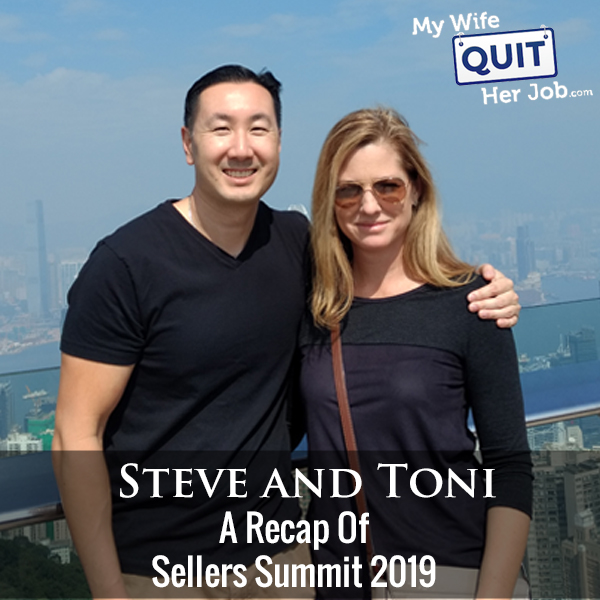
Toni Anderson is my partner in crime for Sellers Summit and this is her sixth appearance on the podcast. We ran through the survey results, the mastermind format, and every session from our fourth annual event.
Below is what worked, what changed, and the key takeaway from each talk.
Get My Free Mini Course On How To Start A Successful Ecommerce Store
If you are interested in starting an ecommerce business, I put together a comprehensive package of resources that will help you launch your own online store from complete scratch. Be sure to grab it before you leave!
Table of Contents
Key takeaways
- 77% of Sellers Summit 2019 attendees sell full time, and roughly 81% have been selling for over a year.
- Six mastermind groups ran this year, four of them restricted to sellers doing $1 million or more in revenue.
- Roughly 60% of Toni’s mastermind group sells entirely off Amazon, a sharp change from prior years.
- Amazon grew only about 16% in Q1 2019, while the share of Chinese sellers on the platform jumped from about 25% to 40%.
- SEO was the top traffic source for nearly every merchant in Andrew Youderian’s Ecommerce Fuel community survey.
- Profit, not revenue, was the recurring message. Your best-selling product is often not your most profitable one.
- Sellers Summit 2020 is May 6-8 at the Westin in Fort Lauderdale, and 2019 tickets sold out by mid-February.
What attendees said about Sellers Summit 2019
The survey feedback centered on one thing: the event stays deliberately small. Attendees say the intimate format is why they learn more, because relationships built at the event continue all year and conversations keep going after each session ends.
Toni and I have not changed the original formula. Catered lunch every day so everyone eats together, cocktail parties every night, and dinner signup sheets so nobody eats alone.
The attendee quality was noticeably higher this year. 77% sell full time rather than as a side hustle, and around 81% have been selling for more than a year.
What made it satisfying was seeing returning attendees whose businesses had grown three to five times in a single year. Chris Nelson, one of our four-year attendees, went from a couple thousand dollars a month to seven figures, his own building, and 13 or 14 employees.
Recognizing repeat attendees
We gave Sellers Summit OG t-shirts to the 12 to 15 people who have attended all four years. Three-year attendees, a group of roughly 50 to 60 people, got special stickers on their badges.
That first year those people took a real risk. Toni had run events before and neither of us had run an ecommerce event together, and they paid us anyway.
How the Sellers Summit mastermind works
The Sellers Summit mastermind is a screened, full-day session where attendees must prove at least $250,000 or $1 million in revenue depending on the tier. We lock ourselves in a catered room and spend the entire day working on each other’s businesses.
Every participant takes a hot seat, describes what is working in their business, and brings one question for the group. Everyone else then works that problem with them.
We ran six mastermind groups in 2019, nearly half the attendees, and expanded to four groups dedicated to sellers at $1 million or more. It is the most rewarding part of the conference for me, largely because of how openly people share both problems and wins.
The post-event feedback Toni receives is consistently a request for more mastermind days. Groups continue their relationships outside the event.
The shift away from Amazon in the mastermind
The biggest change this year was how many mastermind participants sell entirely off Amazon. Roughly 60% of Toni’s group had never sold a product on Amazon at all.
That changed the conversation. Instead of only Amazon tactics, groups spent significant time on content, email, and Facebook ads.
The driver is competitive pressure. Amazon has gotten more cutthroat, piracy is rampant, and sellers are working urgently to build audiences they own.
The roundtable sessions for regular attendees
Roundtables give every attendee a shorter version of the mastermind experience. Speakers, former speakers, and sponsors each lead a small table discussion for an hour to 75 minutes.
Discussions go deeper on session topics or cover subjects the agenda missed. Toni ran one on content marketing this year covering how to start a blog, what content to create, and how to distribute it.
I skipped a breakout session for the first time this year because writing the keynote consumes most of my preparation, and ran a roundtable on SEO and conversion optimization instead. Andrew Youderian’s annual Ecommerce Fuel merchant survey showed SEO as the top traffic source for nearly everyone in his community.
Conversion optimization matters just as much, because plenty of sellers drive traffic to sites that are not ready to convert it. Then they blame the ad platform.
Why every Sellers Summit speaker stays the whole event
Every speaker at Sellers Summit stays for the full event and mingles with attendees. In a group this size you will see each of them multiple times a day.
We have turned down big-name speakers who show up, present, and leave. That is a legitimate way to run a speaking career and it is incompatible with how this event works.
The cocktail parties every night exist for the same reason. My own method is getting a speaker to the bar, buying them a couple of drinks, staying sober myself, and asking them to reveal everything.
Session recaps from Sellers Summit 2019
Every talk was curated around one theme from my keynote: building a brand that is hard to copy, anchored in a community of loyal customers.
Dana Jaunzemis on finding your profit heroes
Dana Jaunzemis taught how to identify your most profitable products, which frequently are not your best sellers. Her whole framework is logic and math applied to product-level profitability.
She asked the room how many people update their listings regularly, and fewer than half raised a hand. Her process is to find the profit heroes and then optimize those specific listings rather than chasing every opportunity.
The ecommerce community obsesses over revenue, which is a vanity metric. What matters is how much money you keep.
Ed Ruffin on scaling Amazon advertising
Ed Ruffin walked through how his Amazon PPC strategy evolved and presented a newer method that outperforms the traditional approaches circulating online. His talk was eye-opening enough that I asked him to convert my own account.
Ed and the Seller Labs team are rebuilding my campaigns on the new structure. We are documenting the numbers as a case study.
Michael Paulson on finding suppliers
Michael Paulson of Jungle Scout presented a new strategy for finding suppliers, substituting for Greg Mercer this year. The method is simple enough that anyone can execute it.
He closed with a live game where the audience answered questions about importing and cost of goods, with results appearing on screen in real time. It exposed how much people think they know about their own product costs.
Ilana Wechsler on the Google Display Network
Ilana Wechsler showed how to leverage the Google Display Network, which has a much larger reach than Facebook and which very few sellers use. Her talk scored among the highest in the attendee survey.
Her key point is that the creative you already run on Facebook works on the Google Display Network with comparable efficiency. That makes expanding reach far cheaper than building from scratch.
Mike Jackness on extracting maximum customer value
Mike Jackness mapped the entire customer journey from cold visitor to repeat buyer. He covered nurturing a cold visitor into a warm one, converting the first purchase, and then driving repeat purchases indefinitely.
Nathan Resnick on legally avoiding tariffs
Nathan Resnick shared a fully legal strategy for reducing tariff exposure by routing goods through Mexico. The timing was ideal, landing the week after tariffs jumped to 25%.
Several attendees asked him about black hat approaches during Q&A and he declined to engage. His position, and mine, is that a legal method exists so there is no reason to risk penalties that are extremely steep if you get caught.
Nathan lived in China as an exchange student, speaks the language fluently, and has built products there. He is remarkably knowledgeable for someone in his mid-twenties.
Brad Moss on high-powered Amazon sales analysis
Brad Moss, the former head of Seller Central, broke down how he analyzes an Amazon business to maximize sales. He covered which levers you actually control and how to read your numbers to decide which inputs to adjust.
It is a dense, detailed talk that I plan to rewatch repeatedly.
The email deliverability session
The email deliverability talk covered how to stay out of spam folders as inbox filtering gets more aggressive. It compared strategies across different email service providers.
The practical material covered what to do with undelivered emails and with dormant subscribers who have stopped opening. There are steps worth taking before you purge those addresses entirely.
Toni and I have had our own Sellers Summit emails fail to reach Hotmail addresses, so this one hit close to home.
Scott Voelker on building an audience first
Scott Voelker presented a four-part framework for building a future-proof brand, and his core argument is to build an audience before deciding what product to sell. That sequence is the right approach in ecommerce today.
This was the first time I had actually seen Scott speak live, despite him speaking at Sellers Summit every year. His energy on stage matches his energy online.
Brett Curry on Google Shopping ads
Brett Curry delivered a step-by-step walkthrough of setting up Google Shopping campaigns, revised from a more advanced version he gave the previous year. Google Shopping clicks are relatively inexpensive compared to Facebook, with the caveat that they do not scale the same way.
Last year I asked him for an advanced talk because that was what I personally wanted. It turned out most attendees were not running Google Shopping at all, so this year’s basics version scored much better.
Bill D’Alessandro on scaling past solopreneurship
Bill D’Alessandro talked about building a team and moving beyond running everything yourself. His personal story is achieving the four-hour workweek and then finding it unsatisfying despite the money and the free time.
This resonated with me because I have been close to a solopreneur for years and started feeling the same way recently. Bill and I had debated this exact question at Ecommerce Fuel before he built the talk.
Toni’s nephews run our AV team and are in their early twenties, and this was their favorite session of the event. Attendees were still discussing it walking out of the room.
Ezra Firestone on Facebook chatbots
Ezra Firestone gave a primer on Facebook chatbots, which most attendees had not used. He is an outstanding speaker and the session was both funny and genuinely instructive.
His mic and shirt came apart mid-talk, so I walked on stage, buttoned his shirt, fixed the mic, and he never broke stride.
The email segmentation session
Alexandra from Klaviyo covered email segmentation at a level of granularity most sellers never reach. Toni considers herself strong on email and spent the session texting people in the room with ideas she was not implementing.
The example that landed was segmenting on product color. If a customer consistently buys gold jewelry, you send them an email where every element including the buy button is gold-toned.
Most sellers segment on order value, products purchased, or purchase frequency. This went considerably deeper.
Trent on scalable Amazon wholesale
Trent covered wholesale on Amazon end to end, from getting started through negotiating contracts and handling other sellers on your listings. The negotiation material included near-scripts for approaching suppliers and closing deals.
Amazon wholesale carries lower monetary risk than private label and requires less capital to start. It was a well-attended session, which suggests attendees are looking at diversifying their model.
Casey Gauss on ranking products on Amazon
Casey Gauss of Viral Launch covered getting a product onto Amazon and ranking it without giving away enormous quantities of inventory. He fit roughly 80 slides into his session.
His material is built on Viral Launch’s data across their entire seller base, which he compiles into implementable strategies. The slides carry most of the data, so they are worth studying closely.
Molly Pittman on Facebook ads
Molly Pittman showed Facebook ad examples that are working now, and the format has changed dramatically in a single year. Facebook has restructured to favor engagement as the platform saturated and as the company absorbed criticism over data handling.
This was a must-watch session.
The IP theft, tariffs, and sourcing panel
I moderated a panel on freight, tariffs, product sourcing, and protecting intellectual property, with most audience questions landing on IP theft. The clearest takeaway was that patents are not the best way to protect a product, for several reasons.
Stephen Weigler laid out alternative protections that cost considerably less. Pam and Nathan Resnick handled the tariff and freight forwarding questions.
Greg was on the panel for practical operating knowledge, since he still sells roughly six figures a month. While others covered IP and freight, he described what he actually does day to day.
Craig’s closing keynote on purposeful business
Craig closed the event with a talk on building a business with a purpose beyond profit. He is one of the best storytellers our AV crew had ever heard.
A lot of us start businesses to make money without considering a higher purpose. Companies like TOMS earn genuine loyalty because they contribute to their communities.
The tie-in Toni highlighted is that a larger purpose also gives employees a reason to stay. After two and a half days of tactics, having a bigger goal is what helps you filter the noise and decide what your business should actually do.
The 5 Minute Pitch live finale
Sellers Summit closed with a bonus session: the live finale of 5 Minute Pitch, the Shark Tank style show I run with Mike Jackness, Scott Voelker, and Greg Mercer. Five companies pitched the Sellers Summit audience live.
The audience voted the field down to a final two, and a panel of seven judges selected the winner. We handed over a $50,000 check on stage.
The room filled and the doors were locked at 4:55 because everything was being recorded. Toni missed it entirely, and so did Craig for a while.
I was genuinely nervous for the contestants after becoming attached to them over the season.
What changed at Sellers Summit in 2019
Two things changed beyond the expanded masterminds. We had noticeably more female attendees and more female speakers, which the women in the room were visibly happy about.
The other change was the topic mix. Sessions on email, Facebook, Google Shopping, and brand building drew heavier interest than in prior years, tracking with sellers looking to reduce Amazon dependence.
Why Sellers Summit stays small
Sellers Summit will not get bigger. The single most common reason attendees return is the small size, and Toni holds the line on ticket sales even when I ask for extras.
I had to post in our own Facebook group in March asking to buy a ticket, because Toni would not sell me one. Tickets for 2019 sold out by mid-February.
The price rises over time and never goes on sale. There is no Black Friday discount and no held-back inventory.
Sellers Summit 2020 runs May 6 to 8 at the Westin in Fort Lauderdale, the same hotel we have used before, right on the beach with a direct walkway to the ocean. All sessions are on one level, which resolves the elevator complaints from Miami.
You can find event details at SellersSummit.com.
Frequently asked questions
What is Sellers Summit?
Sellers Summit is an annual ecommerce conference focused on strategies for selling physical products online, deliberately kept small so attendees can build real relationships with speakers and each other. 2019 was the fourth year.
How does the Sellers Summit mastermind work?
Attendees must prove at least $250,000 or $1 million in annual revenue depending on the tier, then spend a full day in a small group working on each other’s businesses. Each participant takes a hot seat, shares what is working, and brings one problem for the group to solve.
What percentage of Amazon top sellers are based in China?
Over 40% as of the 2019 keynote, up from roughly 25% the previous year. Amazon’s own growth slowed to about 16% in Q1 2019.
Why are Amazon sellers moving off the platform?
Rising competition from overseas sellers, rampant counterfeiting, and platform dependency risk. Roughly one in three clothing listings on Amazon was counterfeit at the time of the 2019 event.
Is your best-selling product your most profitable one?
Often not. Dana Jaunzemis’ session focused on identifying profit heroes, the products that generate the most actual profit, which frequently differ from the products generating the most revenue.
Can you use Facebook ad creative on the Google Display Network?
Yes. Ilana Wechsler’s session showed that creative running on Facebook performs with comparable efficiency on the Google Display Network, which reaches a larger audience.
Is Amazon wholesale less risky than private label?
Financially, yes. Wholesale requires less upfront capital and carries lower monetary risk than developing and stocking your own private label product, though it involves substantial supplier negotiation.
Where is Sellers Summit 2020?
The Westin in Fort Lauderdale, May 6 to 8, with all sessions on a single floor. Tickets are available at SellersSummit.com and prices increase over time with no sales or discounts.