Podcast: Download (Duration: 55:03 — 63.3MB)
Selling products on TikTok works through two separate systems: organic videos that build brand awareness and occasionally go viral, and TikTok ads that produce predictable revenue. Parth Kukreja’s fourth organic video generated $50,000 in two days with no link in the bio, and his CPCs on TikTok ads run about half what he pays on Facebook.
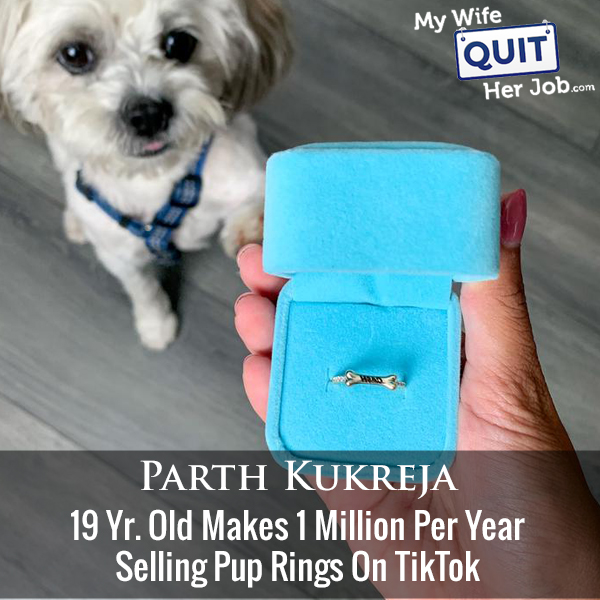
In this episode I sat down with Parth Kukreja, who built Pup Ring, a personalized pet jewelry brand, to seven figures at 19 while attending college. He failed seven businesses before this one.
Below is his full playbook: how he acquired the product, the organic TikTok approach, the ad funnel structure, the on-site survey that fixed his conversion rate, and why virality cannot be a revenue plan.
Get My Free Mini Course On How To Start A Successful Ecommerce Store
If you are interested in starting an ecommerce business, I put together a comprehensive package of resources that will help you launch your own online store from complete scratch. Be sure to grab it before you leave!
Table of Contents
Key takeaways
- One organic video produced $50,000 in two days. No link anywhere, people searched the brand name.
- TikTok CPCs run about half of Facebook’s. He stopped Facebook ads entirely for four to five months.
- Virality cannot be a revenue plan. Reposting a 4-million-view video produced nothing.
- Older demographics forgave weak creative. The 45-plus audience converted on a video he thought was terrible.
- A Hotjar survey at 20 seconds fixed conversions. Ask what is stopping the purchase, then answer it.
- Bottom-of-funnel ads answer objections like sizing and shipping rather than reintroducing the product.
- A banned TikTok ad account kills your organic reach if the accounts are linked.
- Overseas metal molds cost about $70. Nine sizes made the tooling nearly free.
How Parth acquired the Pup Ring product
He inherited a validated dropshipping product from a client who was abandoning it, including $30,000 of purchase data.
He was working as a web developer when a client hired him to build a store. The client concluded he could not solve his supply problems out of China and walked away from the product.
Parth had seen the numbers while building the site and thought it was a winner. He asked whether he could take it over, and the client agreed and handed over the data.
That data is what made the launch fast. He loaded $30,000 of purchase history into Facebook as a lookalike audience seed and ran ads inside a week.
The results were not immediately profitable. Campaigns broke even for most of the early period with maybe a single day in the red, which is an unusually short learning curve attributable entirely to starting with real customer data.
How to move a dropshipped product to domestic manufacturing
Take the product blueprint, get the design files, and have a domestic manufacturer produce a mold with your improvements built in.
Parth pulled the design files from the AliExpress supplier and brought them to a manufacturer already making similar products. He adjusted the mold so the engraving would be larger and more legible, which was the main complaint about the original.
Overseas metal molds cost roughly $70 across nine sizes, which makes the tooling investment nearly irrelevant. This is dramatically cheaper than plastic injection molds, which run into the tens of thousands.
The tradeoff is production time. These are clay molds poured individually, which breaks the molds and makes each ring slightly different, so lead time runs 30 days from start to finish. Engraving in-house takes hours.
His joke about the transition turned out to be literally true: order 500 arrived before order 1. The first customer waited 40 days through the China supply chain and disliked the company, while the 500th received a ring in about two weeks under the domestic system.
How the first viral TikTok generated $50,000
Their fourth video hit roughly a million views and produced $50,000 in two days with no link in the bio and no Instagram connection.
Viewers typed “Pup Ring” into a search engine, found the brand as the first result, and bought.
The mechanism is worth understanding. Social platforms suppress content that pushes traffic off-platform, so posting URLs works against you. Content people genuinely want to see gets distributed, and interested buyers will find you on their own.
The video itself was almost nothing. It was titled around having heard TikTok makes small businesses go viral, and showed product photography of the ring with minimal editing.
The context makes it more striking. They had just done $60,000 in revenue in December 2020 for only $5,000 in profit, and were preparing to sell the business for $4,000, less than they paid for the $5,000 engraving machine.
How to approach organic TikTok for a business
Post about three times a week, aim for one or two deliberately viral attempts a month, and treat the rest as brand building.
The mindset barrier comes first. Most ecommerce operators work from a basement or dorm and never need to be visible, and TikTok requires putting yourself on camera as the owner and explaining what you sell.
Content research is the practical method. Follow other business accounts, identify which of their posts got the most views, and work out why that post spread rather than copying the post itself.
His example is a cookie company promoting a cookie drop, framing a routine product sale as a limited release. The framing was the transferable part.
The tonal shift they made over time: early videos tested whatever might stick, and current videos follow trends and build brand rather than selling. Customers do not want to feel sold to.
What makes a TikTok video go viral
The hook determines everything, followed by showing the product in an interesting light and closing with a call to action.
TikTok distributes in tiers. A video goes to 100 to 1,000 people first, and if engagement holds it moves to progressively larger audiences until it lands on the For You page broadly.
Parth’s honest position is that virality cannot be engineered reliably. They reposted a video that had done 4 million views and it went nowhere.
My experience matches. I have had videos watched 50% through that went nowhere and videos watched 20% through that went completely viral, which makes the pattern look close to random.
The Instagram comparison is useful. Videos that go viral there get reposted 10 to 15 times, and the useful exercise is diagnosing why the original spread rather than reposting it.
How TikTok ads compare to Facebook ads
TikTok CPCs run roughly half of Facebook’s, which is why Parth stopped running Facebook ads entirely for four to five months.
The mechanics are familiar. Lookalike audiences, retargeting, and a top-of-funnel and bottom-of-funnel structure all work the same way as Facebook. Reporting offers fewer metrics because the platform is newer.
The strategic difference is emphasis. Parth puts less weight on audience configuration and more on creative volume, because content quality drives returns more than targeting does now.
Timing helped. Post-iOS 14 Facebook costs made the gap wider than it would otherwise be.
How to structure TikTok ads by funnel stage
Top-of-funnel prospects new audiences with attention-grabbing creative, and bottom-of-funnel excludes everyone who has not already engaged.
Bottom-of-funnel audiences are built from people who clicked the product, viewed the page, added to cart, or initiated checkout. Everyone who has not viewed the product gets excluded.
The creative differs by intent. Top-of-funnel earns attention. Bottom-of-funnel answers the specific reason someone did not buy.
For Pup Ring those objections are sizing and shipping. A sizing ad explains how to measure and covers the 60-day warranty for a bad engraving or wrong size, with a lifetime warranty option available.
With a single product, repurchase campaigns happen through email rather than ads.
How to find out why visitors are not buying
Trigger a small Hotjar survey about 20 seconds into a product page visit asking what is stopping the purchase today, with four preset options and a fifth open choice.
Set the timing against your actual data. Pup Ring’s average product page session runs 30 to 40 seconds, so the survey fires at 20.
Keep it unobtrusive. It slides in from the right taking 20% to 30% of the screen and can be dismissed. Parth reserves full overlays for email capture only.
The value is in pairing responses with session recordings. If someone says shipping is too slow, you can watch how far they scrolled. If shipping information sits at 75% down the page and they left at 50%, the information exists and the placement is wrong.
Only run this on product pages. That is where purchase intent lives, and it is why he measures conversion rate on product page traffic rather than site-wide.
The changes it produced: updated customer photos, and a personalization field that renders the customer’s name in the actual engraving font instead of a generic one, since people wanted to see the result before committing.
Why virality cannot be your revenue plan
Ads produce predictable revenue and virality does not, which is why Parth builds forecasts on ad performance and treats viral hits as upside.
Their early mistake was including virality as a line item in profit and loss projections. It cannot be modeled.
The relationship is complementary rather than competitive. A viral video drives an influx of organic traffic and simultaneously lowers your CPMs, so the ad system performs better while it lasts.
How to solve the creative production problem
Outsource creative volume to a UGC service rather than shooting it yourself, since testing weekly requires more content than a two-person team can produce.
Pup Ring uses Influee. They specify what they need, the service recruits content creators, and Parth approves or rejects submissions with licensing included for ad use.
Creative was their explicit bottleneck. Their first Facebook ad, a retro-music video zooming between two ring images that both founders considered terrible, ran for eight months because it resonated with the 45 to 65 demographic.
That is the demographic lesson worth carrying: older audiences tolerate dated creative, and the younger audiences on TikTok require far more volume and testing.
The TikTok ad account risk to know about
If your ad account gets disabled while linked to your organic account, your organic reach stops working, similar to being shadowbanned.
Pup Ring was banned four times without any policy violation, most likely flagged because the product is personalized. Each appeal was approved.
Getting a dedicated TikTok rep resolved it. Their rep reviews flags before the account shuts down, and the bans stopped.
The tradeoff on separating accounts is real. An unlinked ad account protects organic reach and gives up the ability to grow the organic account through ads. Parth’s media buyer took an account from 100 to 30,000 followers in a month using linked ads.
What Parth would tell someone starting out
Persistence over everything. Pup Ring is his eighth business, and the seven before it failed.
His parents told him to stop and go to college. He kept going, and he credits them for both the pushback and for eventually helping move the engraving machine into their basement once they saw the vision.
One thing he explicitly warns against: he maxed out a $1,500 Discover card to fund early ads because he had no capital. He recommends nobody repeat that, and suggests keeping a job for income while building.
Frequently asked questions
How do you sell products on TikTok?
Run two systems in parallel: organic videos posted about three times a week for brand building and occasional virality, plus TikTok ads for predictable revenue. Parth’s fourth organic video produced $50,000 in two days, and his ad CPCs run roughly half of Facebook’s.
Do you need a link in your TikTok bio to get sales?
No. Pup Ring’s first viral video had no link and no Instagram connection. Viewers searched the brand name, found the site as the top result, and bought. Platforms suppress content that pushes traffic off-platform, so making people want to find you works better.
Are TikTok ads cheaper than Facebook ads?
Cost per click on TikTok ran about half of Facebook’s for Pup Ring, enough that they stopped Facebook entirely for four to five months. The ad mechanics are similar, with lookalikes and retargeting, though TikTok reports fewer metrics as a newer platform.
Can you make a TikTok video go viral on purpose?
Not reliably. Pup Ring reposted a video that had earned 4 million views and it went nowhere. A strong hook improves your odds, and virality should be treated as upside rather than modeled in revenue forecasts.
How do you find out why people are not buying?
Trigger a small survey about 20 seconds into a product page visit asking what is stopping the purchase, with a few preset options. Pair the answers with session recordings, since the information is often already on the page but positioned below where visitors scroll.
What should bottom-of-funnel ads say?
They should answer the specific objection keeping someone from buying rather than reintroducing the product. For Pup Ring that means sizing explanations and warranty terms, or shipping speed. Exclude anyone who has not already viewed the product.
Should you link your TikTok ad account to your organic account?
It carries real risk. A disabled ad account suppresses the linked organic account’s reach much like a shadowban, and Pup Ring was banned four times without violating policy. Linking does let you grow the organic account through ads, so the tradeoff depends on which channel you rely on.