
Podcast: Download (Duration: 58:02 — 66.7MB)
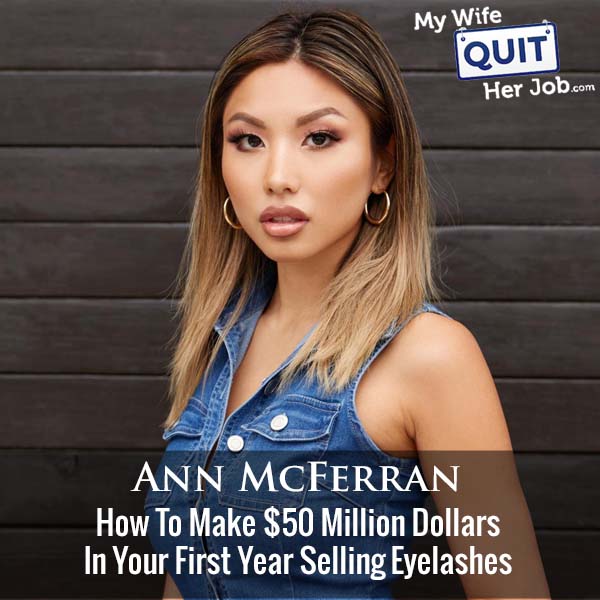
Ann McFerran built Glamnetic, her magnetic-eyelash brand, from $0 to more than $50 million in revenue in a single year by fixing a category that already existed but did not work. She launched from her Koreatown back house in July 2019 with a $300 first purchase order (100 lashes at roughly $3 each, in 5 styles), and by Black Friday five months later she was doing seven figures a month. On episode 442 of the My Wife Quit Her Job podcast, Ann walked through the full playbook: how she sourced the product, how she generated her first sales by DMing followers, how she scaled with Facebook ads, and how she is adapting now that iOS ad tracking is broken.
I have wanted to record this interview for a while, since my wife has spent an embarrassing amount of our money on eyelashes over the years. This post pulls the operating playbook out of that conversation and adds the numbers, tools, and category context that make it useful for anyone trying to start a beauty or consumer-product brand from scratch.
Get My Free Mini Course On How To Start A Successful Ecommerce Store
If you are interested in starting an ecommerce business, I put together a comprehensive package of resources that will help you launch your own online store from complete scratch. Be sure to grab it before you leave!
Table of Contents
Key takeaways
- Ann launched Glamnetic in July 2019 out of her Koreatown back house and crossed $50M in revenue inside her first 12 months.
- First purchase order: 100 lashes across 5 styles at roughly $3 each landed cost, sold at $30 retail. The whole first order was a few hundred dollars.
- The product innovation was two-fold: (1) 5 to 6 magnets per lash instead of the industry-standard 2 to 3, and (2) a liquid magnetic eyeliner replacing the sandwich-style magnets that customers could not apply.
- First sales came entirely from Ann personally DMing every new Instagram follower with a custom Shopify discount code, up to 8 hours a day.
- She scaled with talking-head Facebook ads shot on her phone in her bedroom, hiring a Facebook ads freelancer from Upwork as her first paid hire.
- Revenue doubled every month after launch. Seven-figure months hit by Black Friday 2019; the March 2020 stimulus checks added another 3x tailwind on top of that.
- Since the iOS 14.5 privacy update, Glamnetic has shifted heavily into retail (Ulta, Sephora) and into organic TikTok, because paid social alone no longer produces reliable ROAS.
What Glamnetic sells and why the category needed a fix
Glamnetic sells magnetic false eyelashes and, more recently, press-on nails, sold direct-to-consumer at glamnetic.com and through retail at Ulta and Sephora. The magnetic-lash category existed before Ann entered it in 2019, but every product on the market had one of two problems: sandwich-style magnetic lashes were nearly impossible for a normal person to apply, and traditional strip lashes required lash glue that stings, damages your natural lashes, and takes practice.
Ann had worn lashes daily since she was 16 and had spent years teaching friends to apply them. She saw an obvious market gap: an easy-to-apply strip lash that did not use glue. When she tried the existing magnetic options, “I literally could not get them on for the life of me,” she said on the show.
The Glamnetic breakthrough was two innovations packaged together. First, she asked factories to glue 5 to 6 magnets onto each strip instead of the industry-standard 2 to 3, so the lash would grip better. Second, she paired the lashes with a liquid magnetic eyeliner (rather than the sandwich-style two-layer magnets others were using), which turned application into a two-step process any customer could execute at home.
How Ann sourced her first magnetic eyelashes on Alibaba
Ann sourced her first magnetic lashes by Googling “magnetic lash suppliers,” landing on Alibaba, and messaging factories at random until she found two who could hand-glue 5 magnets onto a full glam-style strip. The process took over a year, running part-time at night on WhatsApp while she was still painting full-time as an artist.
None of the factories she initially found could do exactly what she wanted. The workaround was to identify suppliers who could do magnetic lashes and suppliers who could do full glam strip lashes, then ask specific factories to combine both methods. Because Ann is a trained artist, she sent hand-drawn design references along with the specs, which made the sourcing conversation much clearer.
Sample outcomes across roughly 100 rounds of samples:
- Most factories sent back samples with glue that was not fully dry, magnets falling off, or wonky spacing.
- Two factories produced high-quality prototypes, and she moved forward with both.
- The liquid magnetic eyeliner (the “why now” innovation that made the product usable) took another separate sourcing loop with different suppliers.
Her first purchase order economics
Ann’s first purchase order was tiny by industry standards, on purpose. She self-funded the entire company (no outside capital), so she wanted to prove sell-through before writing bigger checks.
| Metric | Value |
|---|---|
| Units in first PO | 100 lashes, 5 styles (all names started with L) |
| Landed cost per unit | ~$3 |
| Retail price | $30 (in line with premium hand-made lash comps) |
| Initial revenue goal | $10,000/month |
| Actual result, month 1 | Surpassed the $10K target |
The 3PL detail is worth noting: Ann never fulfilled from her bedroom. She used a third-party warehouse (later ShipMonk, brought in via business partner Kevin Gold) from day one, because “they have a better shipping rate than if you were to ship yourself. So what’s the point?”
How Ann generated her first Glamnetic sales through Instagram DMs
Ann generated Glamnetic’s first sales by personally DMing every new Instagram follower with a warm intro and a custom Shopify discount code named after them. She sat on Instagram for roughly eight hours a day for weeks doing nothing else, and it was enough to sell through the entire first inventory batch.
The seed audience came from a beauty meme account she had grown before the brand existed. When Glamnetic launched, she converted the meme account into a beauty-brand account and had a few thousand followers to start conversations with.
The DM script that worked
Ann’s script was not a hard-sell. It was a research conversation that ended in a warm offer. Loose structure:
- Say hi, thank them for following, ask if they had heard of magnetic lashes.
- Listen to what they said. Most replied “yes, tried them, could not get them on.”
- Ask if they would like to try Glamnetic. Generate a Shopify discount code with their personal name (e.g. SARAH20) for 20 percent off.
- Send follow-up voice memos so the interaction felt human, not scripted.
Two side effects showed up quickly. Customer feedback drove real product improvements (they added pre-trimmed lashes because DM conversations kept surfacing “I did not realize I could trim these”). And her hit rate was high enough to sustain the entire first inventory batch on DMs alone.
I ran a similar hustle in the early days of Bumblebee Linens: if a customer abandoned their cart, I would call them by phone within 15 minutes. Once I had them on the line, my close rate was roughly 90 percent. Ann’s DM version scales the same principle for a modern beauty brand.
How Glamnetic scaled from DMs to $50 million with Facebook ads
Glamnetic scaled from a DM-driven trickle to $50M in year one by running founder-led talking-head Facebook and Instagram ads shot on Ann’s phone, hired out to a freelance ads buyer from Upwork. The ads worked because Ann was the demo, the founder, and the target customer all in one, and because the visual before-and-after transformation was inherently thumb-stopping.
The creative was intentionally low-fi. Ann filmed straight into her phone camera, no music, no editing polish, with an opening like “Hi, I’m Ann, I’m the founder and CEO of Glamnetic, do you struggle with lashes?”
Then she demoed application on herself in a single continuous shot.
Her hiring order (the exact sequence)
Ann’s hiring order in year one is a useful blueprint for any founder scaling a physical-product brand. She hired for revenue-blocking bottlenecks, in this order:
- Facebook ads freelancer from Upwork (first paid role, contractor).
- Video editor, also from Upwork, once ad creative was the bottleneck.
- UCLA interns to help her scale DM sales, on rotating schedules.
- Customer service reps, because handling every complaint personally was crushing her emotionally.
- First full-time W-2 employee, Mia (found via friend referral) as an in-house design/CX generalist, right before Black Friday 2019.
Three earlier full-time hires from Craigslist quit within a few days, in part because the “office” was a Koreatown back house. The referral hire (Mia) stuck, which is a useful signal for any early-stage founder: warm referrals beat cold job posts at the “we work out of my bedroom” stage.
Revenue curve, month by month
| Period | Milestone |
|---|---|
| July 2019 | Launch; first month exceeds $10K revenue goal. |
| Aug 2019 – Oct 2019 | Revenue roughly doubles month over month, primarily from Facebook/Instagram ads plus DMs. |
| November 2019 (Black Friday) | First seven-figure month. |
| Jan – Mar 2020 | Ongoing seven-figure months. |
| Post-March 2020 stimulus | ~3x additional tailwind across the whole DTC beauty category; full-year revenue crosses $50M. |
Ann is honest that the March 2020 stimulus check hitting shortly after their scale-up gave every DTC beauty brand a ~3x lift. Glamnetic’s product-market fit and ad creative are what let them capture their share of it.
How Glamnetic is adapting after the iOS 14.5 privacy update
Since Apple’s iOS 14.5 App Tracking Transparency update in April 2021, Glamnetic has cut its dependence on paid social and rebuilt around retail placement and organic TikTok. Ann was blunt on the show: “You can expect to lose money now running ads.” The math that worked in 2019 (buy a customer for $15, sell $30 lashes, profit) has flipped for many DTC brands, and Ann believes most under-capitalized brands will not survive.
Their post-iOS strategy has three pillars.
Pillar 1: retail placement in Ulta and Sephora
Glamnetic lashes are now stocked in every Ulta and every Sephora, and Glamnetic press-on nails are in Ulta. Retail is “much more intensive logistically” but delivers guaranteed revenue that ad-driven DTC no longer provides. Ulta reached out to them, not the other way around, after Glamnetic went viral organically.
Pillar 2: organic TikTok content, driven by the founder
Ann has pulled organic social back in-house and is filming and editing TikToks herself, because outsourcing the “clever creator” role kept failing. Her recent series has strangers running over Glamnetic press-on nails with their cars (Tesla and others) to prove durability. Founder-created organic is what surfaces beauty brands to retail buyers today, so this pillar feeds Pillar 1.
Pillar 3: extending customer LTV to justify break-even acquisition
If you now lose money on the first purchase, your only escape is to lift lifetime value. Ann’s version of this is product-line expansion: from lashes to liquid liner to press-on nails, so an acquired customer has more categories to repurchase into. Most customers do not become brand-loyal until purchase 3 or 4, so your job is to survive economically long enough to reach that repeat.
What Ann would tell anyone starting a beauty brand today
Ann’s core advice for anyone starting a beauty or consumer-product brand today is to be 100 percent obsessed with the specific product before you start, because the paid-ads era that carried Glamnetic in 2019 is over. If you cannot go viral organically on TikTok or Reels, or you do not have a real product edge, you will not survive the current CAC environment.
Her honest sequence, in her words:
- Only start if you cannot stop thinking about the specific product. Passion is what carries you through the first 18 months of sprint pace.
- Time your entry to a downturn if you can. Cheaper labor, cheaper attention, less competition for shelf space.
- Master organic short-form video before you touch paid ads. Retailers scout TikTok now, so a viral organic post can produce Ulta and Sephora inbound leads directly.
- Use a 3PL from day one, even at 100 units. Their shipping rates beat what you can negotiate solo, and packing boxes is not a founder job.
- Hire for the specific bottleneck that is currently blocking revenue, not for “the org chart.”
Frequently asked questions
Who is Ann McFerran and what is Glamnetic?
Ann McFerran is the founder and CEO of Glamnetic, a magnetic-eyelash and press-on-nail brand she launched from her Koreatown back house in July 2019. Glamnetic crossed $50 million in revenue in its first 12 months and is now stocked in Ulta and Sephora. Before starting Glamnetic, Ann was a UCLA-trained psychobiology graduate who worked as a professional painter selling pet-portrait commissions.
How much did it cost to start Glamnetic?
Ann self-funded Glamnetic and started with a first purchase order of roughly 100 lashes at about $3 landed cost each, totaling a few hundred dollars in inventory. The magnetic eyeliner and packaging brought total launch costs into the low four figures. She took no outside capital.
What makes Glamnetic magnetic lashes different from other magnetic lashes?
Glamnetic magnetic lashes use 5 to 6 magnets per lash instead of the industry-standard 2 to 3, paired with a liquid magnetic eyeliner instead of the earlier “sandwich” designs where two lash strips clamped around your natural lash. Both changes made the lashes easier to apply and dramatically improved hold.
How did Glamnetic get its first customers?
Glamnetic got its first customers when Ann personally DM’d every Instagram follower with a warm conversation and a custom Shopify discount code named after them. She spent up to 8 hours a day in DMs during launch, and the strategy alone sold through her entire first inventory batch of ~100 lashes across 5 styles.
What Facebook ads worked for Glamnetic?
Founder-led talking-head videos shot on Ann’s iPhone in her bedroom, with no music and minimal editing, drove Glamnetic’s scaling on Facebook and Instagram from 2019 into early 2021. Ann introduced herself as the founder, demoed application in one shot, and let the visual transformation do the selling. She hired the media buyer from Upwork.
Is it still possible to build a $50M brand on Facebook ads?
It is much harder since Apple’s iOS 14.5 privacy update in April 2021 broke pixel-based attribution and drove paid-social CACs up sharply. Ann said on the show that most DTC brands can now expect to lose money on paid ads and must recover margin through repeat purchases, retail distribution, and organic short-form video. Glamnetic itself has shifted toward Ulta, Sephora, and TikTok.
What 3PL does Glamnetic use?
Glamnetic uses ShipMonk, brought in by Ann’s business partner Kevin Gold shortly after launch. Ann’s advice to new founders is to use a 3PL from day one, even with 100 units of inventory, because the shipping rates beat what a solo founder can negotiate and packing boxes is not a founder-value-add task.