Podcast: Download (Duration: 55:12 — 63.5MB)
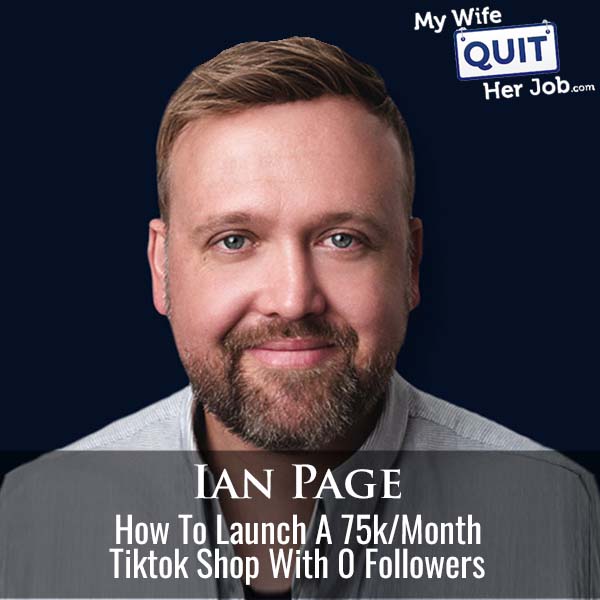
The way to launch a TikTok Shop and grow it to $75,000 a month with zero followers is to skip the “go viral” fantasy entirely, jumpstart your first sales with a paid shopper network, then flood the affiliate program with product samples and run GMV Max ads on almost every video that comes back. On this episode of the My Wife Quit Her Job podcast, I sat down with Ian Page, founder of Bullseye Sellers, who has taken this exact system from $0 to $75K/month for one client and scaled 38 shops on the platform.
TikTok Shop is now on a run rate of over $50 billion in GMV this year and converts about 4.5x higher than traditional social media, which is why sellers are pouring in. The catch is that TikTok caps your affiliate outreach at 2,000 creators a week until you cross a $2,000 GMV threshold, and your first shop score is a doom loop where zero sales means zero creator responses which means zero reviews. Ian’s team has built a repeatable escape hatch that gets clients to profit in about six months.
Below is the full playbook: how much you need in the bank before you start, which products qualify, how the paid-shopper cold start works, and why running $5 ads on unproven videos beats hunting for the next viral hit.
Get My Free Mini Course On How To Start A Successful Ecommerce Store
If you are interested in starting an ecommerce business, I put together a comprehensive package of resources that will help you launch your own online store from complete scratch. Be sure to grab it before you leave!
Table of Contents
Key takeaways
- TikTok Shop has a cold-start “catch 22.” With zero sales you can only invite 2,000 creators a week, and none of them will respond because you have no reviews. Ian’s fix is a paid shopper network that buys full-price units to cross the $2,000 GMV threshold in the first 30 days.
- Do not attempt TikTok Shop until you are a seven-figure Amazon seller, or you have outside capital. Ian budgets $6K to $7K a month for six months if you self-manage, and $10K to $12K a month if you hire an agency. That money is at risk.
- The $75K/month sales figure is not the point. That client averages 5 to 8 million monthly impressions, and 50 to 70 percent of buyers with intent leave TikTok to buy the same product on Amazon. The Amazon halo is the real prize.
- Brand-focused products win. If your box, listing and shop all look like a coherent brand, buyers who leave TikTok can find you on Amazon. Generic products lose the sale to a competitor.
- Stop chasing viral. Send 200 samples a week, expect 160 videos back, and put $5 to $10 in GMV Max ads on every video that clears a low quality bar. TikTok’s ad AI finds the buyer for you.
- Affiliate commission is 15 to 20 percent for organic videos and negotiable down to about 5 percent for paid Spark ads. This is how you fit an ad budget into the P&L.
What is TikTok Shop and why does it convert so well?
TikTok Shop is TikTok’s native in-app marketplace where creators can tag products in videos and viewers check out without leaving the app, and it is growing so fast because the buyer sees the product in use before they know they are shopping. TikTok is projecting over $50 billion in GMV this year, and Ian says the platform converts about 4.5x higher than traditional social media because the buying moment is impulse, not intent.
That impulse is the fundamental difference from Amazon. On Amazon, someone is already searching for what you sell, and you win or lose against the two competitors on either side of your listing. On TikTok, there are no competitors in the frame. The only thing that exists at the moment of purchase is your video and the buyer.
The impulse also explains why brand loyalty on TikTok is weaker than on Amazon. Ian’s take is that a TikTok buyer might remember your brand three months later if they need something related, but they are unlikely to hunt you down the way an Amazon customer would. That is fine if your product is a one-time buy, and it matters a lot if your growth model depends on repeat orders.
How much does it cost to launch a TikTok Shop?
Ian’s rule of thumb is $6,000 to $7,000 a month for six months if you run it yourself, and $10,000 to $12,000 a month if you hire an agency. That is $36,000 to $72,000 you should be prepared to lose, similar to a Meta ads test budget. If you cannot afford to burn that cash, you will bail the first time you see a 1.2 ROAS and never make it to profitability.
The cost splits three ways: samples sent to affiliates, ad spend on videos those affiliates make, and agency retainer if you use one. Bullseye’s retainer is $4K a month, which means the remaining $6K in the $10K package goes to product samples and ads. Sampling is the single biggest variable and the reason a bootstrapped seller usually fails.
Ian will not take a client under seven figures on Amazon unless they have outside capital, and the reason is simple. A quarter-million-a-year seller does not have the margin to seed hundreds of samples a month, absorb 15 to 20 percent affiliate commissions, and still keep enough inventory to stay in stock on Amazon. Trying to be a “master of none” across Amazon, TikTok, Meta and Google is how sellers go broke.
Which products actually work on TikTok Shop?
The products that work on TikTok Shop are branded, ideally consumable, and easy for a shopper to find on Amazon after they see the video. Ian filters every prospect on those three criteria before he agrees to take them on. Everything else is a stretch.
The brand test is the strictest one. A generic charger with an unbranded box is a Swiss cheese product on TikTok, because 60 to 70 percent of viewers with buying intent will leave the app to search Amazon, and if they cannot identify your listing they will buy a competitor. A branded box, branded packaging, and a coherent shop of related SKUs all pass the test. A random assortment of unrelated products does not.
High-LTV consumables are the strongest category because you can afford the cost stack. Supplements, skincare, haircare and other repeat-order products let you absorb the 15 to 20 percent affiliate commission and TikTok fees knowing that a first sale will drive one or two follow-on orders at a much better margin. That is how Ian’s biggest client, an eczema skincare brand, went from banned to $75K/month.
One-time buys can still work if the ROAS math is strong on the first sale. Ian’s bath toy client had a viral video in April with a $1.50 cost per order on a $12 product. They sold out on Amazon and did not care about repeat purchases because every single sale was already profitable.
What products should you avoid on TikTok Shop?
Weight loss, catch-all medical claims, and any category the FTC watches closely are the fastest way to get your shop taken down. Affiliates make wild claims, TikTok assigns strikes to both the creator and the shop, and you end up wearing violations you did not personally commit.
The workaround is to educate affiliates before you send samples, giving them a written list of the exact phrases they can and cannot say. Ian’s supplement clients use phrases like “here are signs you may have parasites” instead of “guaranteed to kill parasites,” and for weight loss they talk about pant sizes and dress fit instead of pounds. Anything vague enough to imply the outcome without promising it.
How the TikTok Shop cold start actually works
TikTok caps a brand new shop at outreach to 2,000 creators a week and blocks any outreach at all until you make your first sale. Those first 2,000 creators will ghost you because you have no reviews and no sales history, so most new shops sit at $0 for weeks and eventually give up. Ian calls this the definition of a catch-22.
The escape route is a paid shopper network. Bullseye’s sister company Sella Co pre-buys a couple hundred units of your product at full retail price and ships them to real shoppers, who then leave reviews. That gets you past the $2,000 GMV threshold in the first 30 days, unlocks the tier above (which triples your weekly outreach limit), and gives new affiliates the social proof they need to say yes.
This is the old Amazon review-jumpstart playbook that Amazon spent years killing, and TikTok’s corporate team openly encourages it. Ian says he is now getting inbound leads from TikTok employees inside the internal Lark channel asking him to walk other sellers through the cold start solution. TikTok wants sellers to succeed early because their whole model depends on it.
The TikTok Shop outreach thresholds you need to know
- $0 in sales: Zero outreach allowed. You cannot invite any affiliates until you have at least one sale.
- $1 to $2,000 in sales: 2,000 creators per week. Most of them ghost you.
- $2,000 to $50,000 in sales: About 7,000 creators per week (over 3x the entry tier).
- $50,000 and above: Unlimited outreach.
The whole cold-start strategy exists to get you from the first bucket to the third as fast as possible. Everything after that is just running the same affiliate and ads playbook at scale.
Why sending 200 samples a week beats chasing one viral video
Ian’s team sends about 200 product samples per week per client, gets about 160 videos back (an 80 percent post rate), and puts $5 to $10 in GMV Max ads on almost every video that clears a low quality bar. The bar is “mentions the brand name, covers the features and benefits, and identifies a problem the product solves.” That is it.
The reason this works and the “only run ads on the best videos” strategy fails is that TikTok’s ad AI is a couple of years ahead of Amazon’s at matching a creator’s video to the right buyer. Ian’s team tested the intuitive approach first (wait for organic performance, then boost the winners) and had almost nothing to run ads on. Switching to “put a little money on everything” turned the same sample budget into consistent sales.
Jay Hunter, the CRO of Mary Ruth Organics, told Ian on a webinar that Mary Ruth’s went from $0 in January 2024 to a projected $70 million on TikTok Shop in 16 months by ratcheting up sampling and getting less picky about who they sent to. Jay’s only threshold is an 80 percent post rate. He does not care about the affiliate’s follower count or GMV history.
Why the “just be everywhere” strategy wins on TikTok
The reason the sample-everything, boost-everything approach works is that TikTok buyers need to see your product roughly 8 to 10 times before they buy. If you fund 160 videos a week with small ad spend, your brand appears everywhere in your target avatar’s feed, and by the tenth impression they convert. It is the Alex Hormozi “just be everywhere” playbook applied to a paid social feed.
You cannot do this on Amazon because the platform only serves your ad to a shopper who is already searching. On TikTok, you can manufacture the feed. That is the whole reason TikTok Shop exists as a category unto itself.
How the halo effect on Amazon works
For Ian’s biggest client, $75K a month on TikTok Shop drives 5 to 8 million monthly impressions, and their Amazon listing for the same product is now doing 3x the revenue it did before TikTok. About 50 to 70 percent of TikTok viewers with buying intent will leave the app and buy on Amazon instead, because prime delivery is more convenient than checking out on TikTok.
Bullseye ran a shopper survey to quantify where the buyers actually end up:
- Amazon: 62 percent of intent buyers
- TikTok Shop checkout: about 27 percent
- Brand website: 11 percent
That is why the profit math on TikTok itself does not have to be beautiful. Ian’s eczema client makes about $10,000 a month on $75,000 in TikTok revenue (a thin contribution margin), and the real return is a tripled Amazon listing and a 25 percent DTC lift. If you evaluate TikTok Shop as a standalone P&L you will kill it before the halo shows up.
The corollary is that if you do not have an Amazon listing to catch the spillover, TikTok Shop by itself is a much weaker business. This is the opposite of the usual “diversify off Amazon” pitch. TikTok Shop makes your Amazon business better; it rarely replaces it.
How the paid GMV Max ad model works with affiliate commission
Affiliates get 15 to 20 percent commission on organic videos they post, which is high for physical product. To fund a paid ad budget, Ian negotiates the commission down to about 5 percent in exchange for a Spark code, which authorizes the shop to run ads on the affiliate’s content.
The math looks like this on a single video:
- Organic post: 15 to 20 percent commission, no ad spend, revenue driven only by whatever organic reach TikTok gives it.
- Paid Spark ad: 5 percent commission plus $5 to $10 initial ad budget, revenue driven by GMV Max targeting to the right avatar.
Because you only pay per click and TikTok’s cost per click often runs $1.25 to $1.50 (versus about $0.75 on Amazon), a few conversions on a paid video cover the ad spend and the commission and still leave contribution margin. The AI is what makes this cheap, because it finds the right shopper for the video even when the video has terrible organic reach.
Why chasing viral videos is the wrong strategy
Chasing viral is the wrong strategy on TikTok Shop because you cannot manufacture virality, and the videos that do go viral tend to be entertainment (a funny dog clip), not product explanations. Ian has run 38 client shops and can count on one hand the number of videos that have actually gone viral. Most of his real revenue is from ordinary videos running $5 GMV Max ads.
Jay Hunter’s guidance to Ian was blunter: if you try to reverse-engineer a viral formula and force affiliates to copy it, you will end up with worse performing videos. The magic is in the specific angle the creator invents. Give them a product brief with the do’s and don’ts and let them run.
The one thing that does matter is the six-second watch time threshold. If viewers drop off before six seconds, TikTok will not push the video further, so a hook in the first three seconds is the one instruction Ian gives every creator. “My name is Joe, let me tell you about…” is too slow. Start on the payoff.
How long until a TikTok Shop is profitable?
The expected time to profit on a TikTok Shop with a competent operator is six months, and self-managed sellers often take eight or more. That six-month window assumes you have the capital to keep sampling, keep running small GMV Max budgets on every video, and stay in stock while the affiliate flywheel warms up.
The reason so many shops fail is the same reason most YouTube channels fail. Sellers ship 100 samples, get back a few weak videos, spend $500 on ads, see no sales, and quit. Anyone who has run a content platform for a year knows the first three months look like nothing is working. TikTok Shop is the same shape as that.
Once you cross $50K a month, outreach limits go away and the model becomes self-sustaining. The affiliate flywheel starts feeding itself, top creators come to you asking for samples, and Spark codes stack up faster than you can spend on ads.
Frequently asked questions
How much does it cost to launch a TikTok Shop?
Plan on $6,000 to $7,000 a month for six months if you self-manage, or $10,000 to $12,000 a month if you hire an agency. That covers product samples, ad spend, and (with an agency) the retainer. Treat it like a Meta ads test budget: money you can lose.
How long does it take to make money on TikTok Shop?
With a competent operator, expect roughly six months to reach profitability. Self-managed sellers often need eight months or longer. The first 30 days are about crossing the $2,000 GMV threshold so TikTok unlocks more affiliate outreach.
Do you need followers to sell on TikTok Shop?
No. Sales on TikTok Shop are driven by affiliate creators making videos with your product, not by your own follower count. Ian’s largest client started at zero followers and is now doing $75,000 a month.
What is the TikTok Shop cold start problem?
The cold start problem is that TikTok blocks affiliate outreach until you make a sale, then caps outreach at 2,000 creators a week until you cross $2,000 in sales. New shops with no reviews cannot get creators to accept samples, so most stall out. The fix is to buy your first sales through a paid shopper network to cross the threshold and generate reviews.
What products sell best on TikTok Shop?
Branded, high-LTV consumables sell best: supplements, skincare, haircare and similar repeat-order categories. The branding requirement matters because 50 to 70 percent of buyers leave TikTok to buy on Amazon, and they need to be able to identify your listing.
What is the average affiliate commission on TikTok Shop?
Organic affiliate commissions are 15 to 20 percent of sale price. That drops to about 5 percent for videos where the shop runs paid Spark ads using the affiliate’s content, which is how brands fit an ad budget into the P&L.
How much of a TikTok Shop’s value is the Amazon halo effect?
For Ian’s eczema skincare client, TikTok Shop drives about $10,000 a month in direct profit on $75K in sales, and roughly 3x growth on the Amazon listing plus a 25 percent lift on DTC. About 62 percent of buyers with intent leave TikTok to check out on Amazon, so the halo is usually the larger prize.
Can you get banned from TikTok Shop for what an affiliate says?
Yes. If an affiliate makes a false claim, both the creator and the shop receive a strike under TikTok’s 24-point system. Ian says the fix is to educate affiliates in advance with a written list of allowed and prohibited phrases, particularly for supplements, weight loss, and other FTC-regulated categories.
I Need Your Help
If you enjoyed listening to this podcast, then please support me with a review on Apple Podcasts. It's easy and takes 1 minute! Just click here to head to Apple Podcasts and leave an honest rating and review of the podcast. Every review helps!




Ready To Get Serious About Starting An Online Business?
If you are really considering starting your own online business, then you have to check out my free mini course on How To Create A Niche Online Store In 5 Easy Steps.
In this 6 day mini course, I reveal the steps that my wife and I took to earn 100 thousand dollars in the span of just a year. Best of all, it's absolutely free!