
Podcast: Download (Duration: 47:45 — 54.9MB)
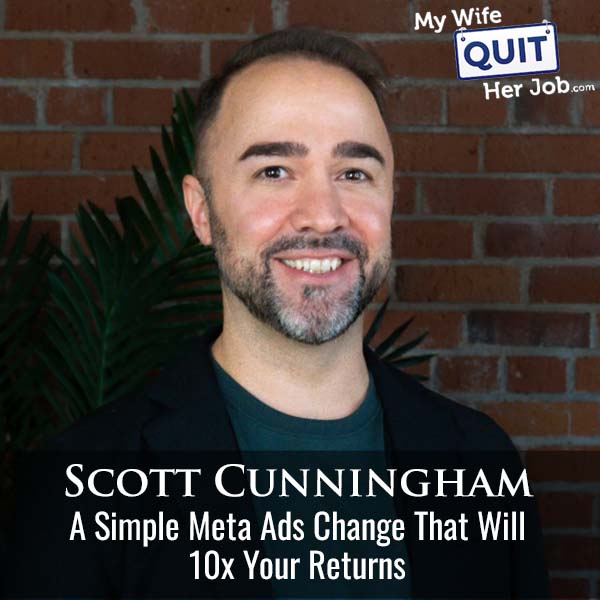
The Meta ads change that is quietly 10x-ing returns for Shopify stores right now is to swap short punchy ad copy for a long-form story ad built on a five-part master story: a category-of-one headline, an origin story, a differentiation stack, a testimonial stack, and a risk-reversing offer. On this episode of the My Wife Quit Her Job podcast, I sat down with Scott Cunningham of Merchant Mastery, who runs both a Shopify agency (Socialite) and a coaching community, and who has been quietly running this playbook since he adapted Eugene Schwartz’s 1966 book Breakthrough Advertising for the Meta ads era.
The specific tactic that made me record this episode is Scott’s long-form Meta ad. Ten of his community members in the past week alone reported their best-ever ad performance running the exact same five-part written story as a Facebook ad, paired with a still image or a founder video. The playbook is a wholesale rejection of the short “scroll-stopping” ad copy Meta agencies have preached for the last five years.
Below is the exact framework Scott walked me through: the four desire buckets that produce a category-of-one headline, the five parts of a master story, the ad structure that works after Meta’s September Andromeda update killed interest targeting, and the way he validates the whole system on $60 a day.
Get My Free Mini Course On How To Start A Successful Ecommerce Store
If you are interested in starting an ecommerce business, I put together a comprehensive package of resources that will help you launch your own online store from complete scratch. Be sure to grab it before you leave!
Table of Contents
Key takeaways
- Meta’s September 2025 Andromeda update killed interest audiences. All targeting now happens through the creative and copy, which is exactly why long-form story ads suddenly out-perform short punchy ones: they give Meta more signal about who to serve the ad to.
- Scott’s five-part “master story” ad framework is: category-of-one headline, five-part origin story, differentiation stack, testimonial stack, and offer. All five parts run inside a single long Facebook ad.
- Every strong headline starts by identifying the buyer’s most prominent desire, drawn from four buckets: mass instinct (permanent), innovation problem (permanent), trend (changing), and mass education (changing). The framework comes from Eugene Schwartz’s 1966 book Breakthrough Advertising.
- Every Shopify seller has an origin story, even the ones who insist they don’t. Scott’s client at American Vinegar Works swore he had no story, then revealed he found an 1800s fermentation method in a French library and rebuilt it with the University of Massachusetts.
- The launch structure is a $60/day break-even test with two ad copies and three creatives each (owner video, UGC, static), all in a single ad set post-Andromeda, with organic social layered on only after ads validate the message.
What is Scott Cunningham’s Story Selling Formula for Meta ads?
The Story Selling Formula is a five-part narrative structure that runs as a single long-form Meta ad and gives Facebook enough signal to auto-target the right buyers post-Andromeda. The five parts are: a category-of-one headline that names the buyer’s top desire, a founder origin story, a head-to-head differentiation stack against alternatives, a testimonial stack that answers common objections, and an offer that removes purchase risk.
Scott built the formula by combining Eugene Schwartz’s 1966 direct-response classic Breakthrough Advertising with what he sees working across the Shopify brands his Socialite agency runs ads for. It is deliberately old-school. Long, direct, benefit-first, and structured to hold attention rather than shock it.
The reason it works in 2026 has less to do with copywriting theory and more to do with Meta’s algorithm change. Interest audiences are gone, and the ad copy itself is now the targeting layer.
A 400-word story ad tells Meta exactly who this product is for, what problem it solves, and which readers stop and read; a five-word “Buy Now!” ad tells Meta almost nothing.
Why did Meta’s Andromeda update kill short-form ads and reward long-form?
Meta’s Andromeda update rolled out in September 2025 and removed the ability to target by interest audiences, which forced the algorithm to infer audience fit from the ad creative and copy instead. Short punchy ads no longer give the algorithm enough information to find your buyer, so campaigns that used to run on tight interest stacks now underperform.
Long-form ads give Meta a rich text signal about the buyer profile, the problem, and the product category. The algorithm reads that signal, matches it to on-platform behavior, and delivers the ad to lookalikes of the users who actually read to the end. The ad copy is now doing double duty as both persuasion and targeting.
The new post-Andromeda structure Scott’s agency uses is a single ad set that consolidates all creatives (no more separate interest / open / lookalike ad sets), driven by a rich long-form primary text with three creative variants per copy variant. This is a significant departure from the “one ad set per audience” playbook that dominated 2020 to 2024.
How do you find the “most prominent desire” that anchors your ad?
The most prominent desire is the single buyer motivation with the highest intensity, staying power, and audience scope, chosen from four brainstormed buckets: mass instincts (permanent human drives like family, wealth, health), innovation problems (unsolved specific problems like eczema or migraines), trends (short-lived opportunities like COVID face masks or K-pop merchandise), and mass education (the current level of consumer awareness in your category).
The four-bucket exercise for Scott’s Palmerus Puzzles client (double-sided wooden puzzles handmade in Calgary) played out like this:
- Mass instinct: family connection, hobby, shared memories, screen-free time.
- Innovation problem: traditional puzzles lose pieces, get soggy, collect dust after one build, and lose novelty.
- Trend: renewed interest in tactile hobbies as an antidote to screen time.
- Mass education: growing awareness that puzzles improve memory formation and reduce screen fatigue.
Once the list is built, you grade every desire on intensity (how urgent is it?), staying power (will people keep buying to satisfy it?), and scope (what share of your customers share it?). The highest-scoring desire becomes the anchor for your category-of-one headline.
What is a category-of-one headline, and how do you test it?
A category-of-one headline is an opening line for your ad that positions your product as the best possible answer to the buyer’s most prominent desire, in language a competitor could never plausibly copy. Scott’s test is simple: if any competitor could say the same thing, the headline is not category-of-one and needs to be rewritten.
Weak headline: “Premium wooden puzzles for adults.” Any puzzle brand can claim it.
Category-of-one headline: “The double-sided poplar-wood puzzle designed to hang on your wall as artwork when you’re done.” Only Palmerus can plausibly say that.
The headline sits at the top of the primary text of the Facebook ad, above the origin story. It is the piece of copy Meta serves first, and it decides whether a scrolling user stops long enough to read the story. Everything else in the master story is downstream of getting this line right.
How do you write your origin story if you think you don’t have one?
Every Shopify seller with product validation has an origin story; they usually just do not recognize it as remarkable, because they are too close to their own decision to sell. Scott’s rule is that something led you to this specific product, and documenting that something is the origin story. His five-part origin-story framework is: struggle, journey, spider bite (the moment of revelation), revelation, impact.
The American Vinegar Works example illustrates how invisible a great origin story can feel to its owner. When Scott’s team asked Rodrigo, “What led you to selling vinegar?”, he shrugged and said grocery vinegar felt bland. Then out came the full story: while traveling in France he found an 1800s fermentation manual in a library, consulted the University of Massachusetts to reverse-engineer the process, and built a facility to ferment vinegar in oak barrels for nine days a batch.
Rodrigo genuinely did not think that was remarkable. His Meta ads were running at a 0.5 ROAS before Scott’s team added the origin story. Once the story appeared in the primary text, the ads became profitable, because the story is exactly the signal a buyer needs to prefer a $20 bottle of vinegar over a $4 grocery bottle.
What are the five parts of Scott’s master story ad?
The five parts of Scott’s master story ad are the sequence a single long-form Facebook ad walks a buyer through, top to bottom, inside the primary text field. Each part has a specific job and a specific length target.
- 1. Category-of-one headline. One or two sentences. Names the buyer’s top desire and positions your product as the uniquely best answer.
- 2. Origin story. Two to four short paragraphs. Uses the five-part struggle / journey / spider bite / revelation / impact structure so the reader trusts you did the work they would not do themselves.
- 3. Differentiation stack. A short list or two of “they do X, we do Y” comparisons across features, materials, sourcing, or customer support. This is the section that fends off direct competitors.
- 4. Testimonial stack. Two or three real customer quotes that each answer a common objection (price, trust, quality, longevity). Objection handling by proof, not by argument.
- 5. Offer. One to two sentences. Reduces purchase risk (guarantee, free shipping, no-questions returns) or adds an incentive (bundle, first-order discount, gift with purchase). Ends with a specific call to action.
Total length is typically 300 to 500 words inside the primary text. Yes, that is longer than what Facebook has told agencies to write for years. That length is the point.
What ad campaign structure works post-Andromeda?
The post-Andromeda ad campaign structure Scott’s agency runs is a single CBO campaign with a single ad set, containing two long-form copy variants tested against three creative variants each, for a total of six ads on the “ice” at once. The old three-ad-set split (interest / open / lookalike) is gone; everything consolidates into one ad set because interest targeting is gone.
Scott’s hockey-analogy launch plan:
- Build a bench of 5 ads. Draft five different long-form story ads based on the master story exercise, each with a different angle on the primary desire.
- Put 2 on the ice. Pick the two you would bet the business on and launch those first.
- Pair each copy with 3 creatives: a founder video, a UGC video, and a static image or infographic. That is 6 ads live simultaneously.
- Start at $60/day. Goal is to break even in the first week. Break-even validates the message and lets you scale.
- Scale after 10K/month. Once you’re consistently hitting five-figure monthly revenue from ads, layer on organic social and email retention.
The scale-up rule matters. Organic social is a great retention and vetting channel once ads have proven the message, and it is a very slow validation channel if you use it first. Scott’s rule of thumb is that pure-organic Shopify growth typically takes four years of daily posting to hit meaningful revenue, versus roughly 30 to 90 days on paid.
Can beginners use AI to write the master story?
Beginners can use AI to draft the master story if they use a custom GPT trained specifically on the framework rather than a blank ChatGPT prompt. Scott built a proprietary tool called Story Selling AI (available at merchantmastery.io) that interviews the merchant through the four desire buckets, the origin story, the differentiation stack, the testimonials, and the offer, then produces drafts of each section using 40+ pages of internal templates and examples.
The critical rule is that AI cannot invent your category-of-one headline. Generic ChatGPT pulls language from the entire public web, which by definition is what your competitors already say; a true “breakthrough” headline in Schwartz’s sense has to say something no one else has said. AI is a brainstorming partner for the raw material and a first-draft writer for the connective tissue, and you supply the specifics of your product, story, and customer.
Scott’s practical workflow is to answer the tool’s interview questions with your own words, review the draft output, and then edit it into a voice that reads like you. Most merchants who try to short-cut the interview step end up with copy that sounds like every other ecommerce brand.
What does the ad look like paired with creative?
The winning creative pairing for a long-form story ad is a still image or short founder video that stops the scroll while the long-form text holds attention. The creative’s only job is to buy the primary text a chance to be read. The text does the actual selling.
Scott’s three creative variants per copy:
- Founder video (from-the-owner). The founder on camera talking about the origin moment or the product’s key differentiator. Works because it visibly attaches a real person to the story in the copy.
- UGC video. A customer using or reacting to the product. Works as ambient testimonial support to the testimonial-stack section of the copy.
- Static image or infographic. Product on a clean background, or a simple comparison graphic. Works because it does not compete with the copy for attention; the reader’s eye lands on the text quickly.
Rotate which creative wins by testing all three against both copy variants for the first two weeks, then let Meta’s optimizer concentrate spend on the best-performing pairs.
When should a Shopify seller add SMS to the mix?
Shopify sellers should add SMS to their Klaviyo (or equivalent) flows as soon as they have a working ads engine and a growing email list, because SMS has higher open and click-through rates than email and doubles the recovery rate on abandoned checkouts. Scott’s agency Socialite is a Klaviyo Platinum Diamond partner, and their standard build sends an email first, then follows up with an SMS to anyone who did not open the email within a set window.
The list-building step matters more than the tool choice. Get SMS opt-in at checkout and in your welcome flow from day one; the compounding value of a bigger opted-in SMS list is much larger than the incremental performance difference between platforms.
Skip SMS entirely until you are past the validation stage. On $60/day of ads with no clear message-market fit, SMS adds cost and complexity without meaningful upside. Once you are hitting $10K to $50K a month and have a solid email flow, SMS is the highest-ROI add-on channel.
Frequently asked questions
Do long-form Meta ads still work if my product is a low-priced impulse buy?
Long-form story ads still work for lower-priced products, though the emphasis shifts. On sub-$30 items you can shorten the origin story and lean harder on the differentiation stack and testimonial stack, because the buyer decides fast. The core reason long-form beats short-form (Meta needs targeting signal from the copy post-Andromeda) applies regardless of price point.
How much should I spend testing a new Meta ad campaign?
Scott’s baseline test budget is $60 a day with a goal of breaking even within the first week, run against a single ad set with two copy variants and three creatives each. That is enough spend to give Meta learning signal without burning cash before you know whether the message works. Scale up only after you hit break-even at that budget.
Is the Story Selling Formula only for Shopify stores, or does it work for Amazon sellers too?
The framework works for any DTC ad channel, though the ad itself has to live outside Amazon, because Amazon does not run long-form primary-text ads. Amazon sellers use the same master story to rewrite their product listing bullets, A+ content, brand story page, and external Meta ads that funnel to Amazon. The underlying desire-and-story mechanics are the same.
Where does the “Breakthrough Advertising” book fit in, and do I need to read it?
Eugene Schwartz’s Breakthrough Advertising (1966) is the source material for the four-desire framework and much of Scott’s story architecture. The book is out of print and typically costs $200 to $1,000 secondhand, so most operators use derivative frameworks like Scott’s rather than the original. Reading it helps if you write a lot of copy, though the ROI on Scott’s Story Selling course or AI tool is faster for most merchants.
How long before I know whether my new story ad is working?
You should see a clear signal within the first 5 to 7 days at $60 a day of spend, which is roughly $300 to $420 total. If cost-per-purchase is trending toward your break-even number by day 7, the message is working and you can scale. If you are well above break-even by day 7 with no downward trend, kill the ad and rotate in a copy variant from your bench of 5.
Do I still need organic social if my ads are profitable?
You still need organic social as a trust-and-retention layer once your ads are working, because a decent share of ad-clicks vet your brand by clicking through to your Instagram or TikTok profile. An empty or stale social presence kills conversions from otherwise qualified traffic. It does not have to lead sales; it has to prove you are a real, active brand.