
Podcast: Download (Duration: 38:35 — 44.4MB)
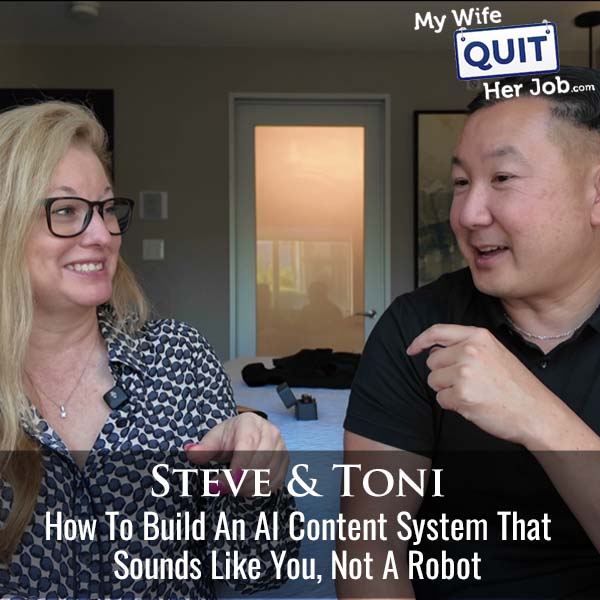
In this episode, my co-host Toni and I sit down to rework our Profitable Audience course and unpack the exact system I use to make AI write in my voice instead of the generic cadence everyone recognizes within three sentences. The short answer: you feed the model your existing content, hand-edit every draft, and then iterate with the model on why you changed what you changed. Do that consistently and you can publish a blog post a day, a YouTube video a week, and daily posts on LinkedIn, X, Threads, and TikTok without sounding like a robot.
We also cover why standalone blogging no longer works, how Google’s new agentic shopping cart cuts your website out of the buying journey, why consistency beats every other content variable, and the specific reason most creators using AI right now are actively hurting their brand.
Here is the full breakdown of our AI content workflow, the platform changes forcing it, and the case studies from our course that prove consistency plus voice training is the whole game.
Get My Free Mini Course On How To Start A Successful Ecommerce Store
If you are interested in starting an ecommerce business, I put together a comprehensive package of resources that will help you launch your own online store from complete scratch. Be sure to grab it before you leave!
Table of Contents
Key takeaways
- Standalone blogging is no longer a viable business model because Google’s AI Overviews and social platforms keep users off external sites.
- Google’s new agentic shopping cart lets buyers check out inside Google, so your store gets the order but never the visit.
- The way to make AI sound like you is to draft with AI, hand-edit every output, then feed your edits back so the model learns your voice over time.
- Voice-first prompting (talking to Claude or ChatGPT through the mic) produces more natural drafts than typing prompts.
- Consistency beats platform choice, personality, or production value. Every successful creator we know posts on a fixed cadence for 12 to 24 months before hockey-sticking.
- Automating the pieces you dislike (idea capture, first drafts, cross-platform repurposing) is what makes daily publishing survivable.
Why blogging alone no longer works as a business model in 2026
Standalone blogging stopped working because Google’s AI Overviews now answer most queries directly on the search results page and social platforms actively suppress outbound links. The old blog monetization loop of ranking a post, capturing a click, and earning on an affiliate link or display ad has been broken by both ends of the funnel at once.
Traffic to independent publishers has been declining year over year as AI-generated answers keep readers on Google, and every social platform from LinkedIn to TikTok downranks posts that send users off-platform. If you are still trying to build a business on blog traffic alone, the ceiling is falling on you every quarter.
That does not mean written content is dead. It means written content only pays off now when it feeds a bigger system, like a YouTube channel, a podcast, an email list, or a product catalog.
Blogging as one channel inside a multi-channel content play still works. Blogging as the whole business does not.
How Google’s agentic shopping cart changes ecommerce traffic
Google’s agentic shopping cart, announced at Google I/O, lets shoppers add a product to a universal Google-hosted cart, then has Google’s agent shop around the web for the best price, suggest upsells from other stores, and complete checkout inside Google itself. The order lands in your Shopify (or other) backend, but the customer never visits your website.
This is directionally similar to what already happens with the Shop app, live shopping on CommentSold, or Amazon-fulfilled orders. The buyer transacts with a middle layer, and the store owner only sees the order line item in the admin dashboard.
For content creators and store owners this has one immediate implication: you cannot rely on the product page to do the persuasion anymore. The persuasion has to happen upstream in content the buyer consumes before they open Google, which puts even more weight on YouTube, podcasts, email, and social presence as the actual conversion machine.
Why AI-written content sounds like a robot (and why readers now spot it in three sentences)
AI-written content sounds like a robot because every large language model has a default cadence, a default sentence rhythm, and a default vocabulary that stays constant regardless of what topic you feed it. I can spot AI in a newsletter within three sentences, and once I know it is AI, I stop reading.
The tell is the pattern, not any single word or phrase. Parallel structures, smooth transitions, tidy three-item lists, balanced sentence lengths.
Human writing is lumpier, has asides, uses specific numbers, and drops in real names of real people and places.
Toni is seeing the same tell in her curriculum-industry clients: their competitors’ newsletters increasingly open with a line like “just so you know, this is really me writing, not AI” because founders realize their audience is starting to bounce the second the AI cadence kicks in. That is a leading indicator. Within a year, “written by a human” will be a real trust signal in most content categories.
The AI content workflow that actually sounds like you
The workflow that produces AI content in your voice has four repeating steps: give the model your existing writing as reference, ask it to draft, hand-edit every draft, and then tell the model what you changed and why. You never publish a raw AI output. You always publish the edited version, and every edit becomes future training data for the model.
Here is the specific loop I run inside Claude for every piece of content:
- Load reference files. I keep a set of files with my past blog posts, YouTube scripts, and social posts that Claude can pull from. These teach the model my sentence rhythm, my recurring examples, and the way I open and close sections.
- Prompt for a draft with a hard requirement. Every section must include either a personal story or a real-life example. This alone kills 80% of the generic-AI feel.
- Hand-edit the draft. I rewrite openings, break up any paragraph that sounds too smooth, and swap generic examples for specifics from my own business.
- Feed the edits back. I paste my edited version next to Claude’s version and ask: “Compare these two. What did I change? Update your writing guidelines so next time you draft closer to my version.” Over weeks and months, the drafts get closer to publishable on the first pass.
Today my first drafts are about 85% of the way there. A year ago they were maybe 40%. The gap closes only because I keep feeding my edits back, which most people never do.
Why voice-first prompting produces better drafts
Talking to Claude through the mic produces better drafts than typing prompts because you can dump three minutes of unstructured thought, personal stories, and context in the time it would take to type two paragraphs. I now do almost all my prompting by voice, and the extra context translates directly into a draft that needs less editing.
The workflow is the same as text prompting. You just speak the prompt, speak the personal story you want woven in, and let the model do the structural work.
Jeff Rose was talking about dictating blog posts more than a decade ago and I dismissed it at the time. He was right and I was wrong.
Why “read it out loud before you film” catches AI in the script
Reading a script out loud before filming catches AI cadence you cannot spot when reading silently. I have had scripts that seemed fine on the page and then sounded completely robotic the moment I said them into the camera, which is much harder to fix in post than to catch in the writing stage.
If a sentence feels awkward in your mouth, it will feel awkward in the viewer’s ear. Rewrite it before the camera turns on.
Why consistency beats every other content variable
Consistency beats platform choice, personality, production value, and even quality because the algorithms on every platform reward accounts that publish on a predictable cadence and because your own skill compounds through reps. Every creator we know who has broken through spent 12 to 24 months publishing before the traffic curve went vertical.
Financial Tortoise (Tae Kim) showed a YouTube chart at a conference of his first 18 months, which was a flat line at basically zero, followed by a slow bump, a bigger bump, then hockey stick. That shape is the norm, not the exception. If you quit at month 12 you never see the inflection.
Kevin, one of our course members, ground through 18 to 20 months on YouTube while wanting to quit multiple times, and is now on track for a five-figure monthly income and has launched paid courses on the back of that audience. David Crabill, our very first course member, has been consistent on his forager site’s podcast and email list for years and has had opportunity after opportunity open up because of that consistency.
How Brenda built a TikTok following from zero in six weeks
Brenda, who owns My Bobette (a haircutting tool for a specific hair type), started posting a TikTok every single day about six weeks ago with zero existing audience. Her first video got two or three views, most of them from other course members cheering her on. A video I saw of hers this week had 42 likes.
She had no personal brand, no email list, and no existing content library to lean on. The only variable she changed was showing up daily. That single input is what is moving the numbers.
How Christina made her first sale with zero ad spend
Christina launched a pet product recently with a tight budget after spending most of her capital on product development, samples, and inventory. Instead of buying ads she has been posting daily on TikTok (and reposting to the other platforms) with her and her pets in the videos. She rarely mentions the product directly in her content.
She just made her first sale and it came organically from the content, not from paid traffic. The lesson is not that ads do not work. The lesson is that a founder with a photogenic product, a natural on-camera presence, and daily posting can absolutely build a business without an ad budget.
How to make daily content survivable with AI and automation
Daily content becomes survivable when you automate every step that is not the actual creative work: idea capture, first drafts, cross-platform repurposing, and scheduling. The reason most creators fail on consistency is the friction of each individual post, not the strategy itself.
My weekly output right now is a blog post a day, a YouTube video a week, and daily posts on LinkedIn, X, Threads, and TikTok. That would have been impossible for me even 12 months ago. The unlock was building a system where one long-form piece of content (usually a video or a podcast) becomes the seed for everything else, and AI handles the reformatting to each platform.
For Toni’s team, the friction point was collecting personal stories from her business partner Liz to use in YouTube scripts. The fix was a simple voice-to-ChatGPT automation where Liz just talks into her phone whenever a story comes to mind. That single friction removal is what turned a six-month stuck project into a shipping one.
What we are cutting from the Profitable Audience course
We are cutting most of the old blogging-as-a-business lessons and pushing them to an archive, because the way to make money from blogging alone has changed enough that those specific tactics no longer apply. The foundational SEO principles are still valid. The old workflows around ranking posts to earn affiliate clicks are not the highest-leverage use of a creator’s time in 2026.
The course now centers on AI-assisted content creation across every platform, voice training loops, and the specific automations that make daily publishing sustainable. Everything from the last seven years stays accessible for members who want the history, but the primary path through the course is rebuilt around what actually moves the needle today.
Frequently asked questions
How do you make AI-generated content sound like you and not like a robot?
You make AI sound like you by giving it your existing writing as reference, drafting with it, hand-editing every output, then feeding your edits back and asking the model to update its guidelines based on the diff. Repeat that loop over weeks and the drafts get progressively closer to your natural voice.
Is blogging still worth it in 2026?
Blogging as a standalone business model is no longer worth it because AI Overviews and social platforms have collapsed the traffic and monetization loop. Blogging as one channel inside a broader content play (YouTube, podcast, email, ecommerce store) is still valuable, especially for SEO and for feeding a mailing list.
What is Google’s agentic shopping cart and how does it affect ecommerce stores?
Google’s agentic shopping cart, announced at Google I/O, lets shoppers add products to a universal cart, has Google’s AI find the best price and upsells across the web, and processes checkout inside Google itself. Your Shopify or other store fulfills the order but the customer never visits your site, which shifts the persuasion work upstream to content the buyer sees before they ever open Google.
How long does it take to see traction from consistent content creation?
Most successful creators we work with post consistently for 12 to 24 months before their traffic curve goes vertical. The first year is usually a near-flat line, followed by a slow bump, a bigger bump, then the hockey stick. Quitting before month 12 is why most people never see the inflection.
How much content can one person realistically publish with AI assistance?
With a well-tuned AI workflow one person can publish a blog post a day, a long-form video a week, and daily posts on four or five social platforms. The key is treating each long-form piece as a seed and using AI to reformat it for every downstream channel, rather than creating each post from scratch.
Should I use voice or typing when prompting AI to write for me?
Voice prompting produces better drafts because you can share three minutes of unstructured thought, personal stories, and context in the time it takes to type two paragraphs. The richer the input, the less editing the output needs.
What is the single biggest mistake creators make with AI content?
The single biggest mistake is publishing raw AI output without editing and without feeding edits back to the model. Readers now recognize the default AI cadence within three sentences, and once they clock it they stop reading, which trains platform algorithms to suppress your content too.