
Podcast: Download (Duration: 55:52 — 64.2MB)
The moment to move to a 3PL is when you would otherwise have to sign a warehouse lease, and for most sellers that happens around 25 orders a day shipping outside of Amazon. When you evaluate quotes, ask for one all-in price to get a package to your customer, because the pick fee everyone negotiates over is roughly $2 of a $10 total and the carrier charge is the other $8.
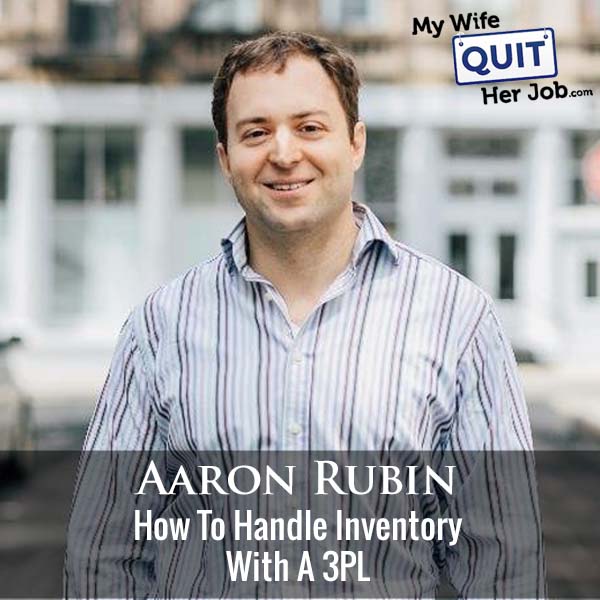
In this episode I spoke with Aaron Rubin, founder of ShipHero, a warehouse management software company that also runs its own fulfillment operation. Aaron started an online store at 19, grew it past $7 million in top line revenue, survived a near-total collapse during the financial crisis, and had a 3PL go bankrupt on him.
Below is the whole picture: when a 3PL beats in-house, when FBA beats both, how the shipping pricing trap works, what storage actually costs, and what warehouse software fixes that spreadsheets cannot.
Get My Free Mini Course On How To Start A Successful Ecommerce Store
If you are interested in starting an ecommerce business, I put together a comprehensive package of resources that will help you launch your own online store from complete scratch. Be sure to grab it before you leave!
Table of Contents
Key takeaways
- Move to a 3PL when you would need a lease. Roughly 25 non-Amazon orders a day is the threshold.
- Use FBA for Amazon sales. It is cheaper than a 3PL for Amazon-channel orders.
- Get one all-in per-package price. A 3PL that will not quote one is hiding something.
- 3PLs receive carrier kickbacks on shipping, and the amount is opaque to you.
- Custom and small should stay in-house. Custom and large is fine for a 3PL.
- Fix receiving before picking. Garbage in, garbage out.
- Barcode scanning exposes performance gaps. Aaron’s best packer did double the work for $2 an hour more.
- Multiple warehouses beat one location because cross-country shipping is slow or expensive.
When to use a 3PL instead of running your own warehouse
Switch to a 3PL at the point where staying in-house would require signing a warehouse lease.
Aaron’s rule is about physical space rather than revenue. If you have a garage or a basement and the time to pack orders yourself, keep doing that.
The moment that space runs out is the decision point. Signing a lease commits you to a fixed cost for years, and a 3PL keeps that cost variable.
His own experience is the argument for flexibility. When his business halved during the financial crisis, he was locked into a lease he could no longer fill and still had to pay the bill.
How many orders a day justifies a 3PL
Roughly 25 orders a day shipping through your own channels, or about 500 orders a month, is the bottom end where a 3PL starts to make sense.
Below that volume the hassle outweighs the savings. You are managing a vendor relationship to handle a handful of packages.
The order count that matters excludes Amazon. FBA handles those separately, so the number to watch is what ships from your own store.
3PL versus Amazon FBA: which is cheaper
For orders sold on Amazon, FBA is cheaper than a third party warehouse and you should use it as much as you can.
The economics flip for your own store. Using Amazon to fulfill Shopify orders is expensive, both on storage and on the per-shipment cost.
That is why most sellers with both channels run both systems. FBA covers the Amazon orders, and a 3PL or in-house operation covers everything else.
The 3PL shipping pricing trap
Merchants negotiate hard on the pick and pack fee and ignore the carrier charge, which is four times larger.
Aaron’s round numbers make it concrete. Of a $10 package, roughly $2 goes to the 3PL and roughly $8 goes to a carrier like UPS.
The result is that people pick a 3PL that saves 15 cents on picking while costing dramatically more on shipping.
The kickback structure is the reason this stays hidden. 3PLs receive rebates from carriers based on your spend, the amount is variable, and you cannot see it.
Why carrier pricing is impossible to estimate yourself
Published carrier rate cards are genuinely too complex to model, even for people who do it professionally.
The variables stack up. Residential surcharges, delivery area surcharges, and fuel surcharges all layer on top of the base rate, and you cannot know in advance what share of your orders will trigger each one.
Zones are the part that breaks intuition. Zones run one through eight, and roughly 10 times as many packages land in zone eight as zone one, because the concentric rings get larger as they move outward.
Aaron’s conclusion is that the math effectively requires algorithms rather than a spreadsheet, which is well outside what most merchants can do.
What to ask a 3PL before signing
Ask for one number: the total cost to get your product to your customer.
Reject the itemized breakdown at the quoting stage. You want the all-in figure, ideally with no zone variation, or an honest average per shipment if zones are unavoidable.
A refusal is diagnostic. If a 3PL cannot give you that number, the number is probably not good, because a competitive one would be happy to share it.
Beyond price, check public reviews. The Shopify app store, Trustpilot, and G2 all carry 3PL reviews the provider cannot delete, and communities like eCommerceFuel have direct experience threads.
What 3PL storage and pick fees actually cost
Aaron’s own fulfillment operation gives a useful reference point for what flat-rate 3PL pricing looks like.
Storage is free for the first 60 days, so anything that turns within two months carries no storage cost at all. After that it runs about $5 a month for a bin of 4.4 cubic feet and about $30 a month for a pallet.
Inserts count as picks. Orders with one or two items include the insert free, and additional picks run about 25 cents each.
Custom boxes carry no extra handling fee, though the merchant supplies the boxes themselves.
What product types work for a 3PL
Product size and margin barely matter, because every product has to sit in some warehouse regardless.
The real filter is customization combined with volume. A 3PL will happily handle custom notes, gift wrapping, or embroidery when you ship a thousand orders a day, because it is worth training a station for it.
At 10 orders a day nobody will train a picker on your specific handling requirements. Small and highly custom is the case that stays in-house.
Large and custom works fine at a 3PL. Standard products of any size are almost always a good fit.
How to protect yourself if a 3PL fails
Choose a 3PL running software that other 3PLs also use, so switching does not mean rebuilding your systems.
Aaron built ShipHero specifically because his own 3PL went bankrupt. Both his company and Everlast sued the operator, the operator declared bankruptcy to escape the lawsuits, and someone else bought the shell.
The network approach solves the switching cost. Hundreds of warehouses run his software, so a merchant can move between them without changing systems.
You also do not have to move existing inventory. Send new stock to the new warehouse and let the old one run out, which removes the hardest part of a migration.
That is how his largest clients operate. Universal Music Group simply adds a facility and quietly stops sending volume to one they are unhappy with.
What good warehouse software actually does
Barcode scanning at every step eliminates picking errors and shows you exactly who is performing.
Without scanning you make mistakes constantly and you have no visibility into who makes them. Eyeballing effort is unreliable and gives you nothing defensible to act on.
Aaron’s numbers from his own warehouse are the case for it. His top performer did twice the work of his lowest performer while earning about $2 an hour more, and he only discovered that after installing software.
The staffing consequence is the real payoff. Hard data makes personnel decisions straightforward instead of guesswork, and it lets you keep the people who are genuinely good.
Why receiving matters more than picking
Start with receiving rather than picking, because inaccurate intake makes everything downstream impossible to fix.
The mechanism is simple. If items are not verified and barcoded as they arrive, your inventory counts are wrong, so no amount of picking discipline can produce accurate orders.
Get receiving right for a couple of months and picking accuracy follows almost automatically. Once the data upstream is correct, the rest is easy.
Aaron also tracks sellable and non-sellable stock in separate bins. Damaged or stained inventory stays counted, and the system never offers it to a picker or reports it as available to Shopify.
Why one warehouse location costs you money
Shipping from a single location means cross-country orders are either slow or expensive, and you cannot get both.
Aaron ships from New York, and orders going to California illustrate the problem directly. Nothing gets there fast and cheap from a single origin.
Multiple warehouses are what fix it, which is a capability most merchants only get through a 3PL. Splitting inventory across regions shortens the average zone.
Two carrier options worth knowing for light items: USPS first class works well under a pound, and FedEx One Rate is inexpensive if the product fits the flat envelope.
What Aaron Rubin learned from nearly losing his business
He lost control of his first company’s finances because he trusted quarterly summaries from an accountant he had no relationship with.
The setup was the problem. His co-founder handled the books, and the outside accountant was the co-founder’s friend, so Aaron saw a P&L once or twice a year and nothing deeper.
When the financial crisis hit, three things landed at once. Revenue dropped as karate school enrollment fell, an Amex limit went from $50,000 to $500, and a bank called a $170,000 credit line with 60 days to repay.
The books turned out to be wrong. Profits he believed were around half a million dollars were dramatically lower, and there was more debt and less cash than the financials showed.
His lesson is to look at the numbers yourself. He asked for direct QuickBooks access, was refused, and did not push hard enough, which cost him roughly six months of runway.
The resolution was brutal. He took on all the personally guaranteed debt, his father mortgaged a paid-off house to fund the payoff, and Aaron spent years doing every $12-an-hour job himself to get back to zero.
How a flash sale site solved a cash flow problem
Selling one deal a day let him run a real business with essentially no cash in the bank.
The mechanism is inventory concentration. Stocking 500 SKUs requires capital for all of them, and selling a single deal a day requires only about a week of stock for one product.
He bought decent quantities of popular products for a good price, often on a credit card or 30-day terms, so the cash cycle worked in his favor.
The logistics got easier too, since storing and shipping one product at a time removes most of the picking complexity.
The idea came from Backcountry’s Steep and Cheap. He could not afford to attend IRCE, so he bought the conference DVDs and heard how that flash sale site grew into a large share of their revenue.
Frequently asked questions
When should you switch to a 3PL?
When you would otherwise have to sign a warehouse lease. If a garage or basement still holds your inventory and you have time to pack orders, stay in-house. Roughly 25 orders a day outside of Amazon, or about 500 a month, is the practical threshold.
Is a 3PL cheaper than Amazon FBA?
For Amazon sales, no. Use FBA as much as possible for orders sold on Amazon. Amazon becomes expensive when you use it to fulfill orders from your own Shopify store, which is where a 3PL wins.
What should you ask a 3PL for pricing?
Ask for one all-in price to get a package to your customer, ideally with no zone variation or an honest average. Refuse the itemized breakdown of pick fees plus carrier charges, since the itemization is what hides the real cost.
Why do 3PL shipping costs get inflated?
3PLs receive kickbacks from carriers based on your shipping spend, and the amount is variable and invisible to you. Merchants negotiate over the roughly $2 pick fee while the roughly $8 carrier charge on the same package goes unexamined.
What products are a bad fit for a 3PL?
Small, highly customized products at low volume. A 3PL will not train staff on your specific handling requirements for 10 orders a day, though at a thousand a day plenty will. Standard products of any size work well.
How do you avoid getting stuck with a bad 3PL?
Pick one running warehouse software that other 3PLs also use, so you can move without changing systems. You can also send new inventory to the new warehouse and let the old one run out, which avoids physically relocating stock.
What does warehouse software do that spreadsheets cannot?
Barcode scanning at receiving and picking eliminates mistakes and produces per-employee performance data. Aaron discovered his top packer did twice the work of his lowest for about $2 more an hour, which was invisible before scanning.
Should you fix picking or receiving first?
Receiving. If items are not verified and barcoded on arrival, inventory counts are wrong and picking accuracy is impossible. Get intake right for a couple of months and downstream accuracy largely follows.