
Podcast: Download (Duration: 55:31 — 63.8MB)
Launching an ecommerce brand to a million dollar run rate in six months required three things Overlander.com had from day one: an existing audience through an influencer partner with equity, an established operator handling logistics, and a clear curation-based value proposition. Andrew Youderian started with a concept on July 1st and launched the day before Thanksgiving.
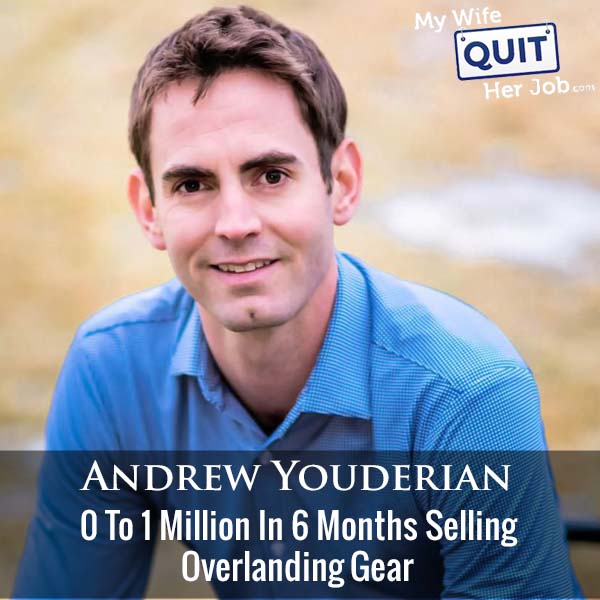
In this episode I brought Andrew Youderian back on the show. He runs the eCommerceFuel community and spent six months building Overlander.com from nothing.
Below is the whole build: how the partnership was structured, how they chose 2,000 SKUs, what to private label versus dropship, how the launch traffic actually worked, and what he would do differently.
Get My Free Mini Course On How To Start A Successful Ecommerce Store
If you are interested in starting an ecommerce business, I put together a comprehensive package of resources that will help you launch your own online store from complete scratch. Be sure to grab it before you leave!
Table of Contents
Key takeaways
- Three parties, three roles: audience and creative, logistics and fulfillment, and someone running point on the build.
- Curation was the value prop. Nothing on the site is junk, and the influencer’s proven gear surfaces first.
- Private label only universal products. Vehicle-specific parts explode into hundreds of SKUs.
- Email lists do not transfer between brands. They lost most of a large list to this.
- Order small and reorder. Prioritize data over the price break on a first order.
- Higher price points get easier dropship terms because carrying that inventory is unreasonable.
- Professional creative assets change everything. A decade of the influencer’s footage built instant authority.
- Launch earlier than feels comfortable. Most post-launch punch list items never get fixed.
How the partnership was structured
Three parties each brought something the others could not, which is what made a six-month timeline possible.
Expedition Overland brought the audience, the creative assets, the category expertise, and many vendor relationships. Clay and Rachelle Croft had spent roughly a decade building a well-known overlanding YouTube series.
AutoAnything, Drew Sanocki’s company, brought logistics, customer service, shipping, an existing email list in the hundreds of thousands, and existing relationships with roughly half the vendors.
Andrew ran point on the build: brand identity, catalog definition, private label product development, marketing strategy, and website development with Kurt Elster of Ether Cycle.
Both partners share the upside, which is what makes an influencer promote at full effort rather than treating it as a sponsorship.
The generalizable lesson is that this is a viable structure. Handle the ecommerce operations, give an established influencer equity, and let them bring the audience.
Andrew’s caution is that multi-party businesses require far more thought about incentives and compensation upfront than solo ventures do.
How they defined the value proposition
The positioning was becoming the Backcountry.com of overlanding: one destination for quality gear in a category where every vendor specialized narrowly.
The market problem was fragmentation. Some companies do storage well, others do bumpers, others do suspension, and no single place sold most of what someone needed.
The quality guarantee was the second half. Anything on the site meets a threshold, so buyers know nothing there is junk, which is a real filter given how many cheap poorly-designed brands exist in the category.
The tagline captures both: proven gear you can trust.
The mechanism that makes curation visible is an automated filter. Products Expedition Overland has personally used across long expeditions carry an approved badge and rise to the top of every category page automatically.
The third element is a 60-day trail-tested guarantee modeled on REI. Return it even if used.
The logic behind accepting those losses is lifetime value. Losing $500 on a returned air compressor is trivial against customers who spend $10,000 to $30,000 outfitting a vehicle over several years.
How they built a 2,000 SKU catalog quickly
Half the vendors came from AutoAnything’s existing relationships, and the rest from Expedition Overland’s connections plus direct outreach.
The catalog size was deliberate rather than accidental. Launching with 50 well-documented products would have been a better executed launch and would not have projected the breadth the positioning required.
Andrew is candid that this cost him. Listing quality at launch was below what he wanted, because producing rich media and detailed descriptions for 2,000 products in five months while building a brand from scratch was not possible.
The compromise was tiering. Products in the recommended tier got custom photography and video from the influencer partner, and the rest used manufacturer imagery.
What to private label versus dropship
Private label only products that are universal, non-technical, and used regularly.
The SKU math is what rules things out. Suspension for even 20 overlanding vehicles across 20 model years produces hundreds of variants, which is an enormous product development burden.
A rooftop tent is the opposite. It is essentially vehicle-agnostic with a few mounting bar configurations, which is why it is a viable private label target.
Technical complexity is the second filter. Competing on suspension requires R&D investment that will not rival established manufacturers without years of work.
Overlander had roughly ten private label products moving toward pre-production.
Why higher price points get better dropship terms
The higher the price and the wider the SKU range, the more likely a supplier is to permit dropshipping.
The reasoning is arithmetic. Expecting a dealer to stock 50 SKUs at $3,000 each means hundreds of thousands of dollars in inventory for one product line, which only national distributors can do.
The alternative for a retailer is specializing narrowly in one vehicle, which is a different business.
Some vendors simply refuse to dropship, which makes the decision for you.
How to decide first order quantities
Order small, accept worse pricing, and prioritize getting sales data over maximizing the price break.
Andrew’s guidance to their buyer was to err toward caution, plan on reordering in a month, and learn how products actually perform rather than committing to a large order on a guess.
Three inputs informed the initial guesses: personal category experience, Amazon review counts and sales rank as a proxy for popularity within a product line, and straightforward guessing.
The tradeoff he named explicitly is being wrong and stuck with a hundred units versus paying slightly more per unit and finding out.
How pricing works in a category with MAP
Price parity is table stakes when reselling existing products, and MAP pricing protects that.
Minimum advertised pricing on many products is a genuine advantage when you compete on quality, because it prevents a race to the bottom and lets service differentiate.
Trying to charge a premium for products available elsewhere is difficult regardless of your positioning.
How the launch traffic actually worked
The initial surge came from co-branded emails to AutoAnything’s existing list, which they could only do two or three times.
The mechanic was sending from the established brand’s address announcing the new one, targeted to owners of relevant vehicles.
The problem is that email lists do not transfer. Klaviyo will not permit moving addresses to a new brand, so most of that audience was lost after the initial sends.
Recovery required rebuilding. Clear opt-in links inside emails, re-opt-in requests, and a contest.
Andrew estimates email drove 30% to 40% of sales, which he correctly flags as an outlier caused by starting with a large borrowed list rather than a normal outcome.
The lesson is anticipating this before launch. Assuming access to hundreds of thousands of contacts and getting a few sends slowed growth considerably.
How the influencer partnership drove sales
Three channels: their email list, their social presence, and a contest built specifically for their audience.
The contest was the strongest piece. Rather than a discount, the prize was joining the Expedition Overland team for a day or two on a genuine overlanding trip in Montana, which is something money cannot ordinarily buy.
They ran it through Gleam.io with entry actions covering their YouTube channel, Instagram, email signup, and purchases.
Why other influencer outreach underperformed
Manual outreach to additional influencers took far longer than expected and largely did not convert.
One relationship worked. Another collapsed halfway through when the influencer’s existing sponsors objected.
Andrew’s conclusion is preferring three or four deep long-term relationships with genuinely on-point influencers over twenty people posting once for $400.
That reflects a broader shift. Both of our podcasts have sponsors we have worked with for years, which produces genuine loyalty rather than transactional promotion.
Why creative assets matter more than expected
Access to a decade of professional overlanding footage gave the brand instant depth and authority.
The assets covered category page imagery, product video, and photography, all built from real expeditions rather than staged shoots.
Andrew’s takeaway is that he would invest heavily in this upfront on any future brand, because nothing else produces that credibility as quickly.
The related surprise was that outsourcing good writing is possible. One writer had overlanded in Botswana, knew the category genuinely, and wove in historical references, which changed his prior assumption that outsourced writing always disappoints.
What went wrong at launch
Supply chain problems and incomplete inventory systems were the two significant issues.
Stock availability was the harder one. Building the Black Friday promotion required rejiggering the featured products multiple times because vendors could not supply items they wanted to sell, with MAP pricing limiting what could be discounted on the rest.
Inventory visibility was the other. Tying a new brand on a new platform into existing systems left them tracking stock manually for the first weeks, with a customer service lead personally contacting buyers whose orders were unavailable.
That got resolved within a couple of weeks by surfacing better pre-purchase information about lead times and backorders.
Why the price point made the number achievable
Selling $1,000 bumpers and $500 air compressors reaches a million dollar run rate far faster than selling $30 items.
The volume difference is enormous. Reaching $80,000 in titanium sporks requires moving a great deal of product.
The offsetting cost is expectation. A thousand dollar purchase carries a much higher threshold of buyer scrutiny than a thirty dollar one.
Why you should launch earlier than feels ready
Andrew’s strongest recommendation from seven or eight site launches and migrations is erring toward launching early.
The reasoning is compounding delay. Waiting until it feels ready pushes the date out by weeks or months, and everything you learn only starts once it is live.
His observation about the punch list is the convincing part. He maintains a list of post-launch fixes and frequently never returns to most of them, because once the site is running they turn out not to matter.
He describes himself as a perfectionist, which made a five-month timeline with twenty people involved genuinely uncomfortable and productive.
My own bias runs the other way. Coming from engineering, you expect to launch with bugs and fix them, which is why I wanted to launch a course with nothing and compromised on a couple of modules.
Why Andrew took the project
Growth and learning rather than money, since the arrangement carried no equity and a short contract.
He had never run something with a team this size and wanted to know how he would handle it.
The second reason was testing whether genuine passion for a category changes the work. His honest answer is that it helped considerably with the early learning curve and made almost no difference once the project got difficult.
That is worth hearing for anyone who believes passion is a prerequisite. It flattens the learning curve and does not change how hard the work is.
Frequently asked questions
How do you launch an ecommerce brand quickly?
Start with an audience rather than building one. Overlander.com partnered with an influencer who brought a decade of following and creative assets, plus an established operator handling logistics, which is what made a million dollar run rate in six months possible.
Should you give an influencer equity in your store?
It aligns incentives in a way sponsorship cannot, and it requires far more thought about compensation structure upfront. Both Overlander partners share the upside, which is why they promoted at full effort across email, social, and a purpose-built contest.
What products should you private label?
Universal, non-technical products used regularly. A rooftop tent works because it is essentially vehicle-agnostic. Suspension does not, because 20 vehicles across 20 model years produces hundreds of variants and requires serious R&D to compete.
How many units should you order first?
Fewer than the price break encourages. Err toward caution, plan to reorder in a month, and prioritize learning what actually sells over maximizing margin on a guess you have no data behind.
Can you transfer an email list to a new brand?
No. Email providers will not permit moving addresses to a different brand. Overlander sent two or three co-branded launch emails from the established brand, then had to rebuild through opt-in links, re-opt-in requests, and contests.
Why do expensive products get better dropship terms?
Because stocking them is unreasonable. Expecting a retailer to carry 50 SKUs at $3,000 each means hundreds of thousands in inventory for one product line, so suppliers of high-priced wide-range products are far more willing to dropship.
Should you launch before the site is finished?
Yes, in almost every case. Waiting until it feels ready pushes the timeline out by weeks and everything useful is learned after launch. Most items on a post-launch punch list turn out not to matter once the site is live.