

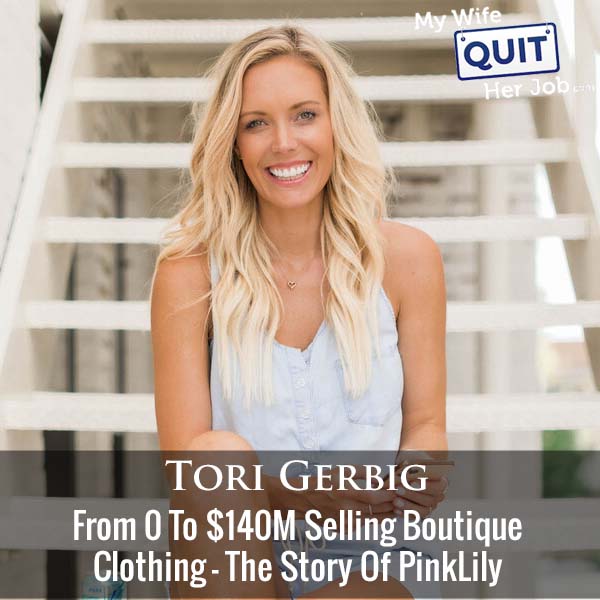
Podcast: Download (Duration: 47:44 — 54.9MB)
To start an online clothing boutique, build a Facebook group community before you build a website, source initial inventory from the LA Fashion District in small quantities, and reinvest every dollar of profit into more inventory. Tori Gerbig launched Pink Lily with $10,000 and roughly 25 styles, hit $4 million in year one, and grew it to over $100 million without ever taking outside funding.
In this episode I sat down with Tori Gerbig, founder of Pink Lily, who went from selling random items on eBay while working an insurance job in Kentucky to running a nine-figure clothing brand with 200+ employees and two warehouses.
Below is the whole playbook: the Facebook group that made the business, the $10,000 launch breakdown, LA Fashion District sourcing, why clothing sizing is the hardest problem in ecommerce, the influencer model, and what she would do differently starting today.
Get My Free Mini Course On How To Start A Successful Ecommerce Store
If you are interested in starting an ecommerce business, I put together a comprehensive package of resources that will help you launch your own online store from complete scratch. Be sure to grab it before you leave!
Table of Contents
Key takeaways
- Launched with $10,000 total. $500 for the website, the rest into roughly 25 styles at six units each.
- The Facebook group came first. 10,000 members before the website existed, built entirely word of mouth.
- Year one hit $4 million with seven employees. The first million shipped from her dining room table.
- Scrappy iPhone photos outperformed polished ones. Customers related to real photos more than professional model shots.
- Sizing is the number one cause of clothing returns. Multiple size models and fit videos are the current best fix.
- Reinvest 100% of profits. Every dollar went back into inventory for the first several years.
- Retention rate is 74%. Far above average, and they still require positive ROI on every influencer.
- Start with classic staples, not trends. Trends die faster than your inventory turns.
How to start an online clothing boutique with $10,000
Start an online clothing boutique with $10,000 by spending about $500 on the website and putting everything else into inventory: roughly 20 to 30 styles at six units per style. That is exactly how Pink Lily launched on January 1, 2014.
Six units per style sounds thin, and it is the right structure for a first launch because it spreads your bet across many styles rather than committing to a few. You find out what sells before you commit capital to depth.
The reinvestment discipline matters more than the starting amount. Every dollar of profit went back into inventory for years, which is how a $10,000 launch became $4 million in twelve months.
Why the Facebook group came before the website
Pink Lily’s Facebook group reached 10,000 women before pinklily.com existed, and that community was the entire initial customer base. The group started as local Kentucky women and grew purely by word of mouth, since Facebook did not allow paid promotion of groups.
The mechanics were completely manual at first. Tori posted photos of items, took orders in comments, sent PayPal invoices individually, and printed labels through Stamps.com, all at night after a full-time insurance job and after putting her son to bed.
That manual process is what forced the website. It was unsustainable, and the volume proved the demand was real before a dollar went into infrastructure.
How to grow a Facebook group for a clothing business
Grow a Facebook group by posting several times a day, answering every styling and sizing question personally, and letting members drive the content themselves.
The personal shopping element is what built loyalty. Members could ask “how would you style this” or “what size should I get” and get a real answer from the owner, which is an experience no large retailer offers.
The current Pink Lily group has around 120,000 women, and the highest-performing content is customer-posted photos. Members share what an item looks like on them, other members respond supportively and ask fit questions, and the community effectively runs itself.
Asking members what they want stocked is the other half. Buying decisions informed by the group consistently outperform buying decisions made in isolation.
Why scrappy photos outperform polished ones
Scrappy iPhone photos taken at home outperformed polished professional shots in Pink Lily’s early growth, because customers related to them. A real person wearing the item in a normal room is more persuasive than a Victoria’s Secret-style model shoot for this audience.
That said, clothing sells better on a model than as a flat lay, so Pink Lily used models from the beginning, recruited via Instagram DMs from a local college.
Tori did all photography herself for the first eight months, then hired a full-time photographer by August of year one. They now run three full-time photographers and roughly seven models on site most days.
Where to source inventory for a clothing boutique
Source clothing boutique inventory from the LA Fashion District, which has low minimum order quantities and lets you buy a single six-unit pack per style while you are testing. Pink Lily sourced entirely from there through 2016 and 2017.
The progression from there: as volume grows, the same vendors will negotiate on pricing, and eventually you move to working directly with manufacturers in LA, China, and Korea. Pink Lily started that transition around 2018 and still uses both channels.
Fashion District vendors will also sew your label into existing garments, which is the standard entry path before you are designing your own pieces.
How to pick which styles to buy with no fashion background
Pick styles by buying what you would personally wear plus whatever is currently trending, then double down hard on whatever sells out. There is no sophisticated strategy required at the start.
The concrete pattern: a Chevron maxi dress sold out immediately in 2014, so the next order was five more Chevron maxis. That simple feedback loop (sell out, buy more of that category) is what drove early inventory decisions.
The same logic scales. Once you know an animal print maxi sells out on every restock, you commission three more animal print designs rather than guessing at a new category.
Why sizing is the hardest problem in online clothing
Sizing is the number one cause of returns in online clothing and remains substantially unsolved. Customers cannot reliably determine their size from a size chart, and the mismatch drives most return volume.
The best current mitigations are showing the same garment on multiple models of different sizes, and producing fit videos that explicitly tell customers whether to size up, size down, or stick with their usual size.
Pink Lily implemented both in the last two years. It reduces the problem substantially and does not eliminate it, and Tori expects better solutions to emerge because the whole industry needs them.
Why you should sell staples instead of trends
Sell classic staples rather than fast-moving trends, because trends can die before your inventory turns and leave you holding unsellable stock. Pink Lily deliberately positions toward pieces that last years in a customer’s closet.
The cautionary example is tie dye in 2020. It was enormous, and then it was over, and anyone still holding inventory when the trend collapsed had to liquidate.
Their liquidation channels when it happens: a discounted clearance section on the site, and an annual in-person warehouse sale where customers can buy deeply discounted stock.
Trends are worth occasional testing. They should not be the foundation of the buying strategy.
How Pink Lily scaled from $4M to $100M
Pink Lily grew from $4 million to $12 million on organic social alone, plateaued there for two years, then scaled to $100 million through paid advertising, influencer partnerships, and hiring director-level leadership.
The plateau is instructive. From 2014 to 2016 the business ran on Facebook and Instagram organic reach, and it stalled at $12 million because the founders were still doing most of the work themselves and reinvesting only their own profits.
Three changes broke the plateau. Paid advertising started in 2016, and influencer partnerships launched in 2018.
In 2019 a minority investor came in specifically to fund director-level hires: ecommerce director, warehouse director, marketing director.
That leadership layer took them from $30 million to $100 million in two years. The capital mattered less than what the capital bought.
Why they run their own warehouse instead of a 3PL
Pink Lily fulfills everything in house rather than using a third-party logistics provider, because 3PLs work well for a limited SKU count with steady replenishment and struggle with fast fashion carrying 13,000 SKUs that turn four to five times a year.
The warehouse progression tells the growth story: 1,500 square feet in July 2014, 3,000 square feet by that November, a purpose-built 25,000 square foot facility in 2016, another 25,000 added in 2018, and a leased 160,000 square foot second warehouse in 2019.
They run two shifts covering roughly 20 hours a day, seven days a week, across both facilities. Full conveyor automation was quoted at $20 million and declined.
Being in Kentucky rather than California made this economically feasible in a way it would not have been on the coast.
The influencer strategy behind a 74% retention rate
Pink Lily requires positive ROI on every influencer partnership, tracked through coupon codes and post-campaign sales attribution, even with a 74% customer retention rate that would justify losing money on acquisition.
The mix: larger influencers drive more conversion and cost substantially more and are harder to book. Splitting the same budget across smaller creators reaches more new audiences and generally serves top-of-funnel better.
Typical deliverable is a single post, sometimes two posts plus two story sessions per month. Creators resist heavier commitments because they do not want their feed dominated by one brand.
The free-product era is largely over. In 2018 many creators would post for product alone. By 2022 nearly everyone considers themselves an influencer and expects payment.
What TikTok is actually good for in ecommerce
TikTok is good for lead generation and poor for conversion, because audiences do not engage with brands there the way they do on Instagram or in Facebook groups. Pink Lily has roughly 150,000 TikTok followers and treats the platform as a funnel entrance.
The working strategy is moving TikTok audiences elsewhere: TikTok ads that drive email newsletter signups, or content that pushes people toward Instagram where the community and conversion actually happen.
Facebook groups remain the strongest community platform. Tori’s assessment is that people genuinely get addicted to well-run groups, checking them daily and buying as a byproduct of belonging.
What Tori would do differently starting a clothing brand today
Starting a clothing brand today, Tori would look for a genuine gap in the market rather than competing in established categories, since Amazon Fashion and countless boutiques now occupy the space that was open in 2014.
Her example is Vuori, which found the athleisure and loungewear gap before everyone was home wearing loungewear. Sustainable clothing is the gap she sees currently open.
Bootstrapping with $10,000 is still viable. The marketing mix would shift toward TikTok and Instagram organic plus influencers rather than the Facebook-first approach that worked in 2014.
Knockoffs remain a permanent problem. Hand-drawn graphic tee designs show up on Etsy within a month of release, and there is no clean solution.
Frequently asked questions
How much money do you need to start an online clothing boutique?
Around $10,000 is workable. Pink Lily spent $500 on the website and put the rest into roughly 25 styles at six units each. The critical discipline is reinvesting 100% of profits into inventory rather than taking money out, which is how a $10,000 launch reached $4 million in year one.
Where do you source clothing for an online boutique?
The LA Fashion District has low minimum order quantities and lets you buy single six-unit packs while testing styles. Vendors there will also sew your label into existing garments. As volume grows, move to working directly with manufacturers in LA, China, and Korea.
How do you reduce returns on clothing sold online?
Show the same garment on multiple models of different sizes and produce fit videos that explicitly say whether to size up, size down, or stick with your usual size. Sizing is the number one return driver in online clothing and remains substantially unsolved industry-wide.
Should you sell trendy clothing or classic staples?
Classic staples. Trends can die before your inventory turns, leaving you with unsellable stock. Tie dye in 2020 is the cautionary example. Test trends occasionally, and build the core buying strategy around pieces that stay in a customer’s closet for years.
Is a Facebook group still good for selling clothing?
Yes, Facebook groups remain the strongest community platform for clothing. Pink Lily’s group has around 120,000 members and the highest-performing content is customer-posted photos of themselves in the products, which drives fit discussion and social proof without brand effort.
Does TikTok work for selling clothing?
TikTok generates leads well and converts poorly, because audiences do not engage with brands there the way they do elsewhere. The working approach is running TikTok ads that capture email signups, or driving followers to Instagram where community and conversion actually happen.
Should you use a 3PL or run your own warehouse for clothing?
Third-party logistics works well for a limited SKU count with steady replenishment. Fast fashion with thousands of SKUs turning several times a year is much harder for a 3PL to handle, which is why Pink Lily fulfills 13,000 SKUs in house across two warehouses.

