Podcast: Download (Duration: 51:41 — 59.4MB)
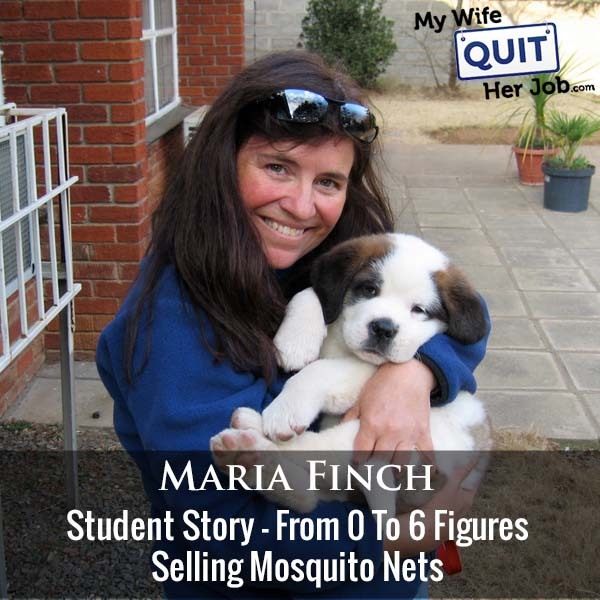
The reliable path to a profitable Amazon product is designing your own version rather than white labeling something that already exists, then pricing at a premium and competing on quality instead of cost. Maria Finch built a six-figure mosquito net business on just three SKUs by doing exactly that, and she still outranks the competitors who copied her.
In this episode I sat down with Maria Finch, a student in my Create A Profitable Online Store course, to walk through her whole journey: how she picked mosquito nets from a Jungle Scout search, how she designed her own product by email with a Chinese factory, the full container she ordered on her second purchase, and the supplier relationship that saved her thousands when an inspection failed.
Below is the full playbook: product research criteria, the ten-supplier outreach process, designing a product with no design background, why she priced above the market, how she handled Amazon disputes and piggybackers, and the mindset work behind pulling the trigger.
Get My Free Mini Course On How To Start A Successful Ecommerce Store
If you are interested in starting an ecommerce business, I put together a comprehensive package of resources that will help you launch your own online store from complete scratch. Be sure to grab it before you leave!
Table of Contents
Key takeaways
- Pick a product connected to your own experience. Maria had lived in countries where mosquito nets are a health necessity.
- Order 10 samples, never one. Roughly $150 including air shipping revealed what the market actually offered.
- Design your own version immediately. She wanted to be the sole seller on her listing from day one.
- You can design a product with drawings and email. Photos of hand sketches, iterated over about two months.
- Price above the market and compete on quality. Competitor nets she bought for comparison were garbage.
- Build real relationships with suppliers. Hers re-inspected and repaired thousands of units at their own cost.
- Three SKUs is enough for six figures. No need for constant product launches.
- Trademark and Brand Registry solve piggybacking. One email resolves what cease-and-desist letters take weeks to handle.
How to find a product to sell on Amazon
Find a product to sell on Amazon by running research tool filters on price and weight, then narrowing the results to products that connect to something you already know. Maria used Jungle Scout with standard parameters, then tracked a shortlist of candidates for a couple of weeks before deciding.
Mosquito nets stood out for two personal reasons. She had lived in Africa and Asia in places where mosquito nets are genuinely essential for health, and she had majored in biology, so the science of mosquito-borne disease was interesting to her rather than a chore.
That personal connection matters more than it sounds. Product research surfaces hundreds of viable options, and the one you will actually stick with through two years of supplier iteration is the one you find genuinely interesting.
The tracking discipline is the other half. Rather than deciding immediately, she followed a handful of candidates in Jungle Scout for a couple of weeks and kept returning to the same one.
How to contact and vet suppliers on Alibaba
Contact roughly ten suppliers on Alibaba filtered for gold-level verification, then evaluate the four or five who reply on English proficiency, response speed, and attention to detail rather than price alone.
Maria contacted ten and heard back from four or five. She picked the one whose written replies stood out, and that relationship is still running six years later.
The evaluation criteria are behavioral rather than commercial. Can they write clearly in English, and do they respond quickly?
The third test is whether they address every question you asked or only the convenient ones. Those signals predict how the relationship goes once real money and real deadlines are involved.
Why you should order 10 samples instead of one
Order at least ten samples rather than one, because a single sample tells you almost nothing about consistency or about the range of what the supplier can actually produce. Maria’s first order was ten samples plus air shipping for roughly $150 total.
That small spend gave her real products in hand to evaluate against her own experience using mosquito nets in the field. It also gave her inventory to list immediately, which is exactly what she did.
Those first ten samples sold as soon as she listed them on Amazon with no advertising at all, which validated demand before she committed real capital. Worth noting that this was six years ago and would be much harder today.
Why design your own product instead of white labeling
Design your own product instead of white labeling because it makes you the sole seller on your listing and it gives competitors something genuinely difficult to copy. Maria moved to a custom design immediately after her sample order specifically so nobody else could sell on her listing.
White labeling (putting your brand on an existing product unchanged) is a reasonable way to start, and the priority afterward should be figuring out how to make the product genuinely yours.
The competitive result speaks for itself. People have taken her ideas and produced their own versions, and she still ranks above them years later. Being first with a differentiated design creates a durable position that a price-matched clone does not erase.
How to design a product with no design background
Design a product with no design background by hand-drawing what you want, photographing the drawings, and emailing them to your manufacturer for iteration. Maria did exactly this, going back and forth on dimensions, rope thickness, and construction details over roughly two months.
The advantage she brought was not design skill. It was having personally used dozens of mosquito nets in the field, so she knew precisely what worked and what failed in real use.
She requested physical samples of the new design at least twice before approving production. If your name is going on a product, seeing and handling it before committing to a container is not optional.
Timeline from first supplier contact to product listed and selling: roughly two months.
Should you order a full container on your first real order?
Ordering a full container gets you better per-unit pricing and takes longer to sell through than most first-time sellers expect. Maria ordered a 20-foot container on her first real purchase after the samples sold out, and in hindsight would start smaller.
The pricing advantage is real. The risk is that nobody can tell you how long a container will take to move, and it took her longer than she anticipated.
The honest framing for anyone considering it: order a container only if you can afford to have that capital tied up indefinitely without it affecting anything else. Maria could. Most first-time sellers cannot.
Why premium pricing beats competing on cost
Price above the market and compete on quality, because the segment of buyers willing to pay more for something that actually works is large and underserved. Maria explicitly targeted that segment from the start.
Her validation method was buying competitor mosquito nets out of curiosity. They were garbage, which confirmed that a genuinely well-made product at a higher price had a real position.
She told her manufacturers explicitly that she was selling a premium brand and that quality was non-negotiable. That framing shapes how a factory treats your orders.
The buyer behavior supports this. Amazon is now flooded with cheap products where corners were cut, and for anything where function matters, buyers increasingly skip the cheapest option entirely.
How to build a supplier relationship that pays off
Build a supplier relationship by talking about things other than the order: family, weather, the challenges their business is facing. Maria’s background working across cultures told her this mattered to Chinese manufacturers, and it produced a concrete financial return.
The payoff came when a third-party inspection on a large order flagged a serious problem. She contacted the manufacturer, and they acknowledged it was entirely their fault, then opened and checked every single unit (thousands of them) and repaired every defective one at their own expense.
Her only cost was a second inspection. That outcome came from the relationship rather than from any contract clause.
Always use third-party inspection on large orders. The relationship determines what happens after a failed inspection, and the inspection is what surfaces the problem in the first place.
How to handle Amazon piggybackers and copycats
Handle piggybackers with a cease-and-desist letter before you have a trademark, and with a single email to Amazon Brand Registry after you do. The difference in effort is substantial.
Maria dealt with numerous piggybackers over the years. Pre-trademark, each required writing and sending a cease-and-desist, which usually worked and took time. Post-trademark and Brand Registry, resolving the same problem takes one email confirming the seller is not authorized.
Getting your brand trademarked once you have proof of concept is worth doing for this reason alone, separate from any broader IP strategy.
How to fight an incorrect Amazon fee charge
Fight an incorrect Amazon fee by escalating past Seller Central to the executive team. Maria’s first Amazon problem was an incorrect fee increase on her first product, and Seller Central took her in circles.
She eventually emailed Jeff Bezos directly, reached his executive escalations team, and got the error corrected plus full reimbursement of everything she had been overcharged.
The general principle: Amazon is an enormous machine and things go wrong inside it routinely. Seller Central handles the routine cases, and genuinely stuck problems often need escalation to move.
How much time does a steady-state Amazon business take?
A steady-state three-SKU Amazon business takes somewhere between 10 and 40 hours per week depending on what is happening, with most weeks toward the lower end once the products are established.
The early period is very different. Maria spent well over 40 hours a week initially, largely on learning: advertising, keywords, listing optimization, and website building.
She still devotes time weekly to learning, which she considers essential to staying successful rather than optional. The platform changes continuously.
Frequently asked questions
How do you find a product to sell on Amazon?
Filter a research tool like Jungle Scout on price and weight, then narrow to products connected to your own experience or expertise. Track a shortlist for a couple of weeks before deciding. The product you will stick with through supplier iteration is the one you find genuinely interesting.
How many samples should you order from a supplier?
At least ten, never one. A single sample tells you nothing about consistency. Ten samples plus air shipping typically costs around $150, and gives you real inventory to test-list while you evaluate quality against what the market offers.
Should you white label or design your own product?
Design your own. White labeling is a reasonable starting point, and a custom design makes you the sole seller on your listing and creates a position competitors cannot erase by matching price. Being first with a differentiated design produces durable ranking advantages.
Can you design a product without design experience?
Yes. Hand-draw what you want, photograph the drawings, and email them to your manufacturer for iteration on dimensions and construction details. What matters is knowing the product category from real use, not design credentials. Expect roughly two months of back and forth.
Should you order a full container on your first order?
Only if you can afford that capital being tied up indefinitely. Full containers get better per-unit pricing, and nobody can predict how long one takes to sell through. Most first-time sellers should start smaller, even at worse unit economics.
How do you stop people from piggybacking your Amazon listing?
Before you have a trademark, send a cease-and-desist letter, which usually works. Once you are trademarked and enrolled in Brand Registry, a single email to Amazon confirming the seller is unauthorized resolves it. Trademarking once you have proof of concept is worth it for this alone.
Should you price higher or lower than competitors on Amazon?
Higher, if your product is genuinely better. The segment willing to pay for quality is large and underserved, particularly in categories flooded with cheap products where corners were cut. Buy competitor products to verify the quality gap before committing to a premium position.