
Podcast: Download (Duration: 1:05:24 — 75.1MB)
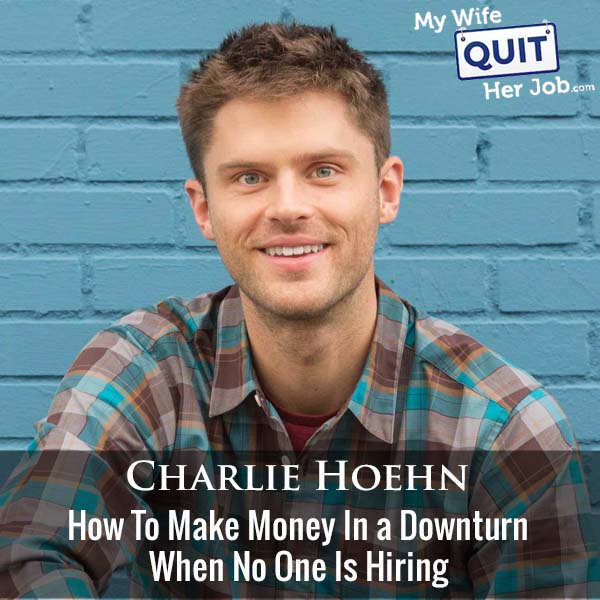
The way to land your dream job in a recession is to stop applying to job postings and instead pick one specific target, audit what they publicly need, and hand-deliver a free gift that shows you can already do the work. That is the TAG method (Target, Audit, Gift) that Charlie Hoehn used to land Tim Ferriss, Tucker Max, Seth Godin, and Ramit Sethi as clients when he graduated into the 2008 recession with zero connections and a hundred rejected job applications.
I sit down with Charlie in this episode to walk through the TAG method step by step, the philosophy behind his book Play for a Living (which Tony Robbins called “the cure to your stress”), and the frameworks he teaches authors to give their books the best shot at reaching a million readers. Charlie is the guy who first taught me how to use email marketing back in 2009 when he was helping Ramit launch Earn 1K, and email now drives 80 to 90 percent of my blog revenue.
Below is the full breakdown of how to use the TAG method, how to turn play into a paycheck, and how to write a book that actually sells.
Get My Free Mini Course On How To Start A Successful Ecommerce Store
If you are interested in starting an ecommerce business, I put together a comprehensive package of resources that will help you launch your own online store from complete scratch. Be sure to grab it before you leave!
Table of Contents
Key takeaways
- The TAG method (Target, Audit, Gift) lands dream jobs by delivering free, specific value to one named target instead of blasting applications into the void.
- Applying to 100 jobs got Charlie two responses (one pyramid scheme, one manual labor gig). One TAG-method gift got him Tim Ferriss.
- Play for a living: your play history (what you voluntarily did as a kid) is the fastest map to work that will not burn you out.
- The three levers of playful work: freedom (from pressure), mastery (of a game you enjoy leveling up in), and connection (with yourself and the people you serve).
- Book marketing rule number one: build the book so it markets itself. Chasing copy counts as an author is a losing headspace.
- The seven tests of a bestseller include a shareable message, a cultural moment, reader transformation, cult potential, gift-ability, media polarity, and distribution reach.
What is the TAG method for landing your dream job?
The TAG method is Charlie Hoehn’s three step framework for landing work you love without waiting for permission: Target one specific person or company, Audit their public presence for a real problem, and deliver a Gift that solves it before you ask for anything in return. He built the method out of desperation during the 2008 recession when the traditional application track produced two responses out of a hundred submissions, and one of them was a pyramid scheme.
The mindset shift is the hard part. Instead of applying and waiting, pretend you already have the dream job and act like it. Charlie set his target as Tim Ferriss because The 4-Hour Workweek had just come out and Tim was the most unique thinker in the space he wanted to work in.
Every action from that point served the story that he was already on Tim’s team. He was not begging for a role; he was earning one.
Step 1: Target one specific person or company for your dream job
Step one of the TAG method is picking one specific target instead of staying “open to anything.” Founders make the same mistake with their products (“it is for the masses”) and job seekers make it with their applications. Real opportunity comes from ruthless specificity.
Charlie was crystal clear: Tim Ferriss, because Tim’s writing had reshaped how Charlie thought about work. That clarity did two things. It gave him a single person to research deeply, and it kept him from spraying diluted effort across ten targets and delivering weak work to all of them.
Pick one person or one company you would drop everything to work for. Not a shortlist. One. You can add a second target after the first one works.
Step 2: Audit your target’s public presence like a doctor
Step two is auditing your target’s public presence the way a doctor searches for symptoms. Read their blog comments, watch their videos, look at their marketing, and note every friction or missed opportunity you can find. This is not fault-finding; it is opportunity mapping.
Charlie’s Ferriss audit surfaced a specific problem inside 4hourworkweek.com’s blog comments: readers were asking for the audio version of a video Tim had posted. A few people asked, then a few more.
That single observation became the seed of the gift.
Do the same for whoever you targeted. What are their readers, listeners, or customers publicly asking for? What is their site or funnel doing that a stronger operator would tighten in an afternoon?
Step 3: Deliver a free gift that solves the problem you found
Step three is delivering a real, finished gift that fixes the problem, with no ask attached. Charlie ripped the audio from Tim’s video, uploaded it to an embeddable player, and emailed Tim the embed code along with a screenshot of exactly where to paste it in the post. Zero expectations, zero pitch.
The word “gift” is doing a lot of work in TAG. The failure mode Charlie sees most often is people who read the book Recession Proof Graduate and think TAG means “email prospects and tell them their website has problems.” That is not a gift, that is a cold criticism. Nobody hires a stranger who opens with “you are doing this wrong.”
A gift shows you already have the skills, respects the target’s time, and takes zero effort on their part to accept. Charlie has seen the same tactic work at the highest level. He has documented on his Instagram the story of a candidate who bombed his Apple job interview, ran into Steve Jobs in the hall, showed him a magnifying-glass effect he had prototyped for macOS, and got hired on the spot.
Why does the TAG method beat submitting a resume?
TAG beats a resume because a resume is a claim and a gift is a proof. A hiring manager reads a resume as one more piece of paper in the pile. A finished, useful gift is a working sample of the exact skill they need, delivered by someone who is clearly self-directed enough to ship without being asked.
Charlie’s students back this up. A consultant named Michael Lim used the TAG method to land a six figure job running MrBeast’s philanthropy channel by creating a gift so specific to that channel MrBeast wanted to hire him immediately. An engineering student named Steven used it to try to build a scale model of SpaceX’s rocket landing, got interviewed multiple times by SpaceX (they thought he was too experienced for the intern role), and landed his dream aerospace job elsewhere off the strength of the same project.
The pattern repeats because most people are still stuck in the “wait to be assigned work” mode school trained them into. Anyone who breaks out of that pattern with a real gift stands out instantly.
How to build a career around play instead of pressure
You build a career around play by looking at your play history (the activities you repeatedly and voluntarily chose as a kid without being paid, forced, or graded) and finding a version of that activity people will value. Charlie’s play history included pulling pranks, playing catch, doing improv, making art, and building things with his hands. His current business helping company cultures adopt “play first” habits is a direct descendant of that list.
Intrinsic motivation from play beats every other form of motivation Charlie has tested. Purpose is second-best. Growth opportunities are weaker.
Salary is a poor motivator. Pressure from parents or teachers is one of the most harmful forms. The worst motivator of all is inertia: “I’ve done this for ten years, so I’ll do it for forty more.”
Practically, you incorporate one play activity into your weekly routine before you try to redesign your career around it. Charlie’s small starter move was proposing “catch meetings” instead of “coffee meetings.” From there he added improv classes, which turned out to be spiritually aligned with who he is, and everything downstream followed.
Why play is more sustainable than hustle for founders and freelancers
Play is more sustainable than hustle because hustle burns the operator out; play refuels them. Charlie ended up in a state of anxiety and burnout during the years he ran his career on pressure instead of on the play instinct that had launched it.
He points to a specific pattern in the founders and creators who reshape culture: Ray Dalio, Brian Cranston, Oprah, Bob Iger. They approach their work as a game they are playing, not as a debt they are paying. The Cal Newport phrase is “so good they can’t ignore you,” and the way you get so good is to keep playing until the market catches up.
If you are stuck in a job you dislike, the smallest useful move is not to quit. It is to reincorporate one play activity into your routine so your energy stops running on fumes.
Your body sends increasingly loud complaints when you ignore this: bad sleep, illness, injury, chronic anxiety. The complaints eventually get loud enough to force the change; the play habit lets you make the change on your terms first.
What are the three components of work that feels like play?
Work that feels like play has three components: freedom, mastery, and connection. Missing one and the “job” quickly stops feeling like play, no matter how well-designed the role is.
Freedom is the freedom from intense economic and emotional pressure, the freedom to do the work how you want, and the freedom to disconnect fully when you need to. Charlie thinks the Great Resignation happened because remote workers finally tasted this and refused to give it back.
Mastery is the game itself. Are you leveling up a skill you actually enjoy improving? If the answer is no, better titles will not save the role.
Connection is the tie that binds. Do you feel intrinsically rewarded by the work? Do your coworkers feel like playmates or backstabbing bureaucrats?
Do your customers feel like an extension of you, or people you cannot stand? If two of those three levers are broken, the job is unfixable.
How to make money doing what you love as a service provider
You make money doing what you love as a service provider by meeting the market where the demand already exists, then inserting your unique skill combo into the equation. Charlie’s Scott Adams-inspired rule: you will never be the best in the world at one skill, but you can be the best in a category of your own by stacking two or three skills nobody else stacks.
His starter services were video, editing, marketing, public speaking, and coaching. Not a huge list. But that stack, offered to founders who all had marketing problems, let him say “based on your specific problems and goals, here is where I fit in your equation.” That is a much easier sell than “hire me because I need work.”
If you want an even faster test, build an easy yes: a two-page PDF in Canva that lays out who you are, exactly how you will help this one person, and what you will save or create for them.
Charge five thousand dollars. Talk to enough people until one says yes. Then build the thing.
Play doesn’t have to mean content: the productized service alternative
Play does not have to mean content creation to pay the bills. Not everyone is a content creator, and not everyone should try to become one. Anyone can create a potent, specific experience for one client, put it in front of them on a one-page proposal, and close the deal before doing the work.
Our mutual friend Noah Kagan is the case study Charlie cites. Noah has ideas. His trap-avoidance move is to never build the thing until customers have paid upfront.
If he cannot get enough presale money for the idea, he does not build it, because it will not get easier to sell after it exists. That is the same discipline the productized service move enforces.
Combine that with the TAG method and you have a full playbook for turning your play into a paycheck without waiting for a giant audience or an ideal economy.
How to write a bestselling nonfiction book: the seven tests
Charlie has produced Scribe Book School (scribebookschool.com), which teaches book writing, publishing, and marketing for free and has taken 40,000 to 50,000 authors through the material. His condensed framework for whether a book has a shot at a million copies is a seven test filter.
Test one: will people talk about your book? Does it carry an amazing story or an unconventional message that readers share unprompted?
Does mentioning it elevate the reader’s status? Will influencers naturally endorse it?
Test two: is this the right book at the right time? Nearly every million-copy book strikes a cultural moment, challenges a widespread assumption, or offers an unconventional solution to a huge frustration.
Test three: does your book transform the reader? Change them, do not just inform them.
Test four: will your book create a cult following? David Goggins’s Can’t Hurt Me is Charlie’s canonical example.
Test five: is buying and gifting your book a no-brainer impulse purchase? If not, why not?
Test six: are you or your book polarizing enough for the media? A vocal minority ought to dislike it; otherwise you are not saying anything worth attention.
Test seven: can your book get massive distribution? Major platforms, international retailers, movie or training program adaptations.
Why your book should market itself and how to make it happen
Your book has to market itself because you as the author cannot outrun the copies-sold treadmill. Even a respectable 5,000 first-year copies will feel small next to fantasies of 100,000 or a million, and hunting the number will slowly break you. The healthy metric is whether people who read it are talking about it.
Charlie’s structural advice, borrowed from James Clear’s Atomic Habits, is to front-load the value. Hit readers with the best content immediately.
Do not spend chapters one and two setting up history and theory. Authors who make readers earn the payoff bleed engagement in the first fifty pages.
The other big lever is beta readers. Do multiple rounds. Recruit target readers or experienced authors, not friends and definitely not your mom.
Have them tell you the moment they get bored, confused, or want to roll their eyes. Iterate until early readers finish and rave about the experience. Treat the book like software: how far do readers make it into “level one,” and where do they drop off?
Book launch reality: plant the seed and let it grow
Once a book is out, the author’s job is less like marketing and more like planting a seed. Charlie shared advice he gave one author that changed how that author approached his next several books: a book is a seed, treat it accordingly. Plant it, water it well, and let it bear fruit for readers for years or decades after you are gone.
That mindset shift keeps authors from spiraling on launch-week rankings and from making bad decisions in the panic of “the launch failed.” If the book itself is strong and the launch is competent, the book will find readers long after the author has moved on to the next project.
If you want a bestseller list, chase it because you get one launch and might as well go all out, not because the label validates you. The stronger you can make the statement “this book is awesome and readers will love it,” the stronger the launch tends to be.
Frequently asked questions
What is the TAG method Charlie Hoehn uses to land dream jobs?
TAG stands for Target, Audit, Gift. Pick one specific person or company you want to work with, audit their public presence for a real problem, and hand-deliver a free finished gift that solves it. No ask attached. That is the exact sequence Charlie used to land Tim Ferriss, Tucker Max, Seth Godin, and Ramit Sethi.
How do you use the TAG method without coming across as a jerk?
The gift has to actually solve a problem the target already has, and it has to come with zero expectations. Emailing a stranger to list everything wrong with their website is not a gift, it is a cold criticism. The distinction is whether you finished a useful thing and delivered it, or just diagnosed a problem you have no plan to fix.
What is Charlie Hoehn’s book Play for a Living about?
Play for a Living is Charlie’s book on building a career around intrinsic play instead of external pressure. The core exercise is your play history: the activities you voluntarily chose as a kid without being paid, forced, or graded. Reincorporating one of them into your weekly routine is the smallest, most sustainable career-repair move most people can make.
How do you know if you are in the wrong career?
Your body will tell you before your mind will. Chronic anxiety, poor sleep, recurring illness, injury, and general dread that shows up around Sunday night are all signals. Ignore them long enough and something bigger breaks. The healthy move is to reincorporate play at a small scale first, then let that shift what you say yes and no to.
What is the best framework for writing a bestselling book?
Charlie’s seven tests: will people talk about it, is it the right book for the moment, does it transform the reader, can it create a cult following, is it a no-brainer gift, is it polarizing enough for the media, and can it get massive distribution. Use them to stress-test a concept before you write a single chapter.
Where can I find Charlie Hoehn’s free books and resources?
Charlie’s site is charliehoehn.com. If you sign up there, he gives away all of his books for free, including Recession Proof Graduate, Play It Away, and Play for a Living. He also offers workshops for company cultures that want to adopt a play-first model, and his firm has worked with clients like Microsoft and Scribe.