

Podcast: Download (Duration: 56:34 — 65.0MB)
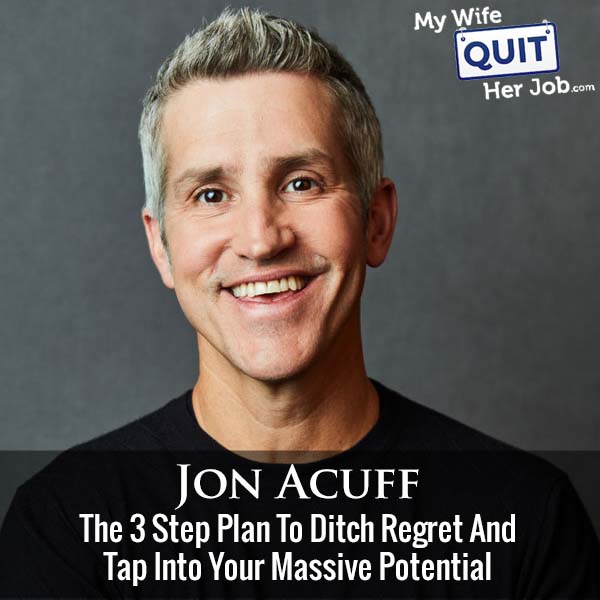
On this episode I sat down with New York Times bestselling author Jon Acuff, whose new book All It Takes Is a Goal came out September 12. Jon and I dug into what actually stops people from tapping into their full potential (spoiler: it is almost always mental, not tactical) and the specific techniques he uses with readers and I use with course students to get them unstuck. According to a 3,000-person survey Jon ran with a Nashville PhD, 96% of people said they were not living up to their potential and half said 50% of it was still untapped.
Jon has written nine books and speaks to hundreds of thousands of people a year for brands like Home Depot, Bose, and Staples. I have taught e-commerce for over a decade and every year I can predict within five minutes of a one-on-one call whether a student will succeed. The pattern behind both of those observations turns out to be the same one, and this post lays out the techniques that flip it.
Below: the interview-a-previous-win technique, the motivation portfolio, the ladder-with-more-rungs model, the three questions from Jon’s book Soundtracks, and Jon’s Venn diagram for deciding whether a new business or book idea is worth pursuing.
Get My Free Mini Course On How To Start A Successful Ecommerce Store
If you are interested in starting an ecommerce business, I put together a comprehensive package of resources that will help you launch your own online store from complete scratch. Be sure to grab it before you leave!
Table of Contents
Key takeaways
- 96% of people surveyed said they were not living up to their potential; 50% said half of it was still untapped. The gap is almost always mental, not skill-based.
- Interview a previous win. When someone is stuck on a new goal, ask them about a past goal they achieved and translate the specific tools (community, accountability, tracker, mentor) into the current one.
- Build a motivation portfolio, not a single “why.” Motivation dissipates on day two of any goal. Written-down reasons across 5-10 categories give you something to reach for on the bad days.
- Turn a two-rung ladder into a ladder with a rung every six inches. Most people set only two goals (“start” and “make $1M”), then jump. Add tiny intermediate rungs.
- Ask three questions about any recurring negative thought: Is it true? Is it helpful? Is it kind? If any answer is no, replace the thought with one that passes all three.
- Excellence is boring. The high-leverage work looks like thank-you notes, adding contacts to a CRM, and unglamorous repetition. Social media hides all the “during” and only shows befores and afters.
- Jon’s three-way Venn diagram for a new book or business: personal passion, real market need, and an available slot in the marketplace. Miss any one and it is a cake pop, a hobby, or a day job.
Who is Jon Acuff and why his advice matters here
Jon Acuff is a New York Times bestselling author of nine books, one of Inc’s Top 100 Leadership Speakers, and for the last 20 years has helped major brands like Home Depot, Bose, and Staples with copywriting and story. He got his start in corporate marketing at Auto Trader in Atlanta, then started a blog on a whim in the early 2000s, and eventually turned that into books, speaking, and the last decade of running his own business.
Jon’s writing focuses on how normal people actually turn potential into action. He has interviewed thousands of readers and clients about what works. That is the exact problem I see in my e-commerce course, so the conversation went deep into practical techniques rather than motivational abstractions.
His one regret from those early years: not building an email list. His advice to anyone starting now is to invest in email immediately and stop chasing the dopamine hits of social media likes and follows.
Why most people never live up to their potential (the 96% number)
96% of people are not living up to their potential, and half of them say 50% of it is still untapped. Jon and a PhD-holding Nashville professor surveyed 3,000 people and got that result, which is what motivated him to write All It Takes Is a Goal.
The gap is not information. Everyone has access to the same YouTube tutorials, courses, and books. The gap is mental: knowledge overload, not knowing which direction to move, and the discomfort of leaving what feels familiar.
I see the same pattern in my Create A Profitable Online Store course. The tactics are not rocket science. The people who succeed and the people who stall are separated almost entirely by mindset. That is why an interview-based book on potential written by a professional storyteller is worth the time to internalize.
How to interview a previous win to unstick a new goal
Interview a previous win by asking someone stuck on a new goal to describe a past goal they successfully achieved, then translate the specific tools they used into the new goal. Someone struggling to lose weight, for example, might have crushed a debt-payoff goal three years earlier.
Ask what actually worked in the past. Was it a small group that met weekly? An envelope system? A physical picture on the wall you cut into twelve pieces? A podcast? Then ask which of those tools they are currently using on the new goal. Usually the answer is none.
The move is to translate: if community and a visual tracker were the load-bearing pieces for debt payoff, the weight-loss version might be a personal trainer plus Orange Theory (community that works out at the same time) plus a habit-sticker system. The point is to start from a win you already own instead of starting from scratch.
Build a motivation portfolio, not a single “why”
Build a motivation portfolio, not a single “why,” because motivation is the flightiest resource you have and it leaves on day two of any real goal. Jon’s counter-example is the show Alone, where you can watch contestants prepare to quit by cycling through the same four or five stories (“my uncle back home needs me,” “I have to check on my kids”). The pattern is universal.
The move is to make a written list of the things that motivate you across many categories: family, health, curiosity, financial freedom, a specific purchase, a specific accountability partner, a specific song. On any given day, you might have to go 12 items deep on your list to find the one that works today.
Jon told a story about a woman whose big motivator for building her business was a Louis Vuitton purse. Every time she saw one on another woman’s arm in Paris, it was a reminder to keep pushing. That specific purse would do nothing for Jon or me. It did everything for her.
There is a Jocko Willink quote Jon likes: if you are going to procrastinate, procrastinate on quitting. Tell yourself you will quit tomorrow. By tomorrow you will have slept and eaten and you will keep going.
Turn a two-rung ladder into a ladder with a rung every six inches
Most people design their goals as a 12-foot ladder with only two rungs: “start my business” at the bottom and “make $1M” at the top. Then they wonder why they cannot jump 12 feet. The fix is to add a rung every six inches.
The rungs are the tiny actions that feel almost too small. Ramit Sethi once told me to just send one email a week when I was overwhelmed by his email marketing setup. That single rung is what unlocked my entire email operation, which now runs weekly and drives a large chunk of my blog revenue.
The people who tell you “just do the small thing” have condensed nine years into a 30-minute stage talk. Your job is to reverse that compression and put the intermediate steps back in. Do the tiny thing, get used to it, then add the next tiny thing.
The three questions to ask any recurring negative thought
Ask three questions about any negative thought that keeps looping in your head: Is it true? Is it helpful? Is it kind? Jon teaches these in his book Soundtracks and uses them on himself in real time.
His example: he caught himself saying he had plateaued on his speaking fee because he is not a celebrity, and Super Bowl-winning celebrities can charge 10x for a keynote. Is it true? Yes, celebrities do get paid more. Is it helpful to keep repeating it? No, because it functions as a permission slip to stop working hard.
The replacement thought he chose: “I am going to make my content and my customer service so great that I get around the celebrity obstacle.” Same reality, different soundtrack, different behavior.
There is a related idea from Gay Hendricks (The Big Leap): “I get to keep the limitations I fight for.” Every excuse you defend, you keep. I hear the same excuses in my student surveys: I am not tech-savvy, I am not good at video, I do not have a big network, I do not live in a big enough city. Fight for the excuse and it is yours to keep.
Excellence is boring (why social media hides the work)
Excellence is boring. The high-leverage work is writing thank-you notes, transferring business cards into a CRM after every flight, and the same five preparation steps before every event. None of it films well. All of it compounds.
Social media shows befores and afters and skips the during, because the during is not entertaining. Jon does not do much on YouTube for exactly this reason. What does two hours of writing look like? A guy typing, staring, deleting, retyping, muttering “this story feels fake.”
Steph Curry practiced roughly 29,000 hours from age six to 35 to deliver about 25 minutes of practice per week during the season and 90 minutes of court time on a three-game week. The 20-minute NBA shot is worth the 29,000 hours. That ratio is what most people never see and never accept.
How to actually leave your comfort zone (Jon’s answer to my problem)
Nobody willingly leaves their comfort zone, and they should not, because it is comfortable. You have to trick yourself out of it by finding something outside the comfort zone that you want more than you want the comfort. Desire, not discipline, drives the change.
When Jon started blogging in Atlanta, he did not wake up one day and decide to be disciplined. He started a small experiment, liked it, and wanted to do more of it. Doing more of it meant getting up earlier despite two kids under four, a wife, an Atlanta commute, a full-time job, and freelance clients. He got up earlier because he wanted to, not because he made himself.
The corollary for business: if you are grinding on a business you do not love, the discipline eventually runs out. If you find a business (or a topic, or a product) you nerd out on, you will happily leave the couch because everything else got boring by comparison. “Find something you love so much that Netflix gets boring” is the frame Jon uses with people.
How to know when you are overwhelmed and dial it back down
Overwhelm is not a switch you can flip off. It is a dial you have to actively turn back down. Jon credits therapist David Thomas for this frame. People jump from switch to switch (yoga, cold plunges, meditation apps, launching a new thing) hoping the next one will permanently silence the stress. It never does.
Jon’s personal warning signs that his dial is turned up: he is not writing anymore, he is short with his wife and kids, and he is not interruptible during work. He likes Bilbo Baggins’s line from Lord of the Rings: “too little butter spread over too much toast.”
The turn-down technique he uses most: make two lists. Things you do because they are important, and things you do because they make you feel important. “Talk to my COO” often lives on the second list. Cutting from the second list is how you claw the dial back down without shrinking your actual output.
Jon’s Venn diagram for whether a business or book is worth pursuing
Jon uses a three-circle Venn diagram to decide whether an idea (a book, a business, a product) is worth pursuing: personal passion, real market need, and an available slot in the marketplace. All three have to overlap.
- Passion plus need but the marketplace is oversaturated: that is a cake pop. You are late to Starbucks.
- Passion plus marketplace slot but no real need: that is a hobby. Great, keep loving ferrets. It is not a business.
- Need plus marketplace slot but no passion: that is a day job. You will burn out before it works.
For his new book All It Takes Is a Goal, the passion came from a moment on his oldest daughter’s college tour where he realized how much of college he had wasted. The need came from the 3,000-person survey (96% said they were not living up to their potential). The marketplace slot came from Amazon: most existing potential books were high-level and holistic, and nobody was answering “what do I actually do with this on a Tuesday?”
Why book sales are harder than course sales (and what that taught me)
Books are harder to sell than a $2,000 online course, which is counterintuitive because a book costs $19. What you are actually selling with a book is work: the reader has to sit and read. Most people would rather watch a video or listen to a podcast than open a book.
Jon’s data on this is striking. He sells 2.5x more audiobooks than ebooks now, a shift he attributes to the podcast boom teaching people that great content can be consumed via audio. He reads his own audiobooks and adds 10 bonus stories per book so audio has its own distinct value.
His current sales mix (roughly): 7 print, 3 audio, 1 ebook out of every 10. Corporate speaking gigs skew his numbers toward print because a client will bulk-buy a thousand hardcovers for an event audience. For independent authors without a speaking business, the print share is smaller and the audio share is larger.
Frequently asked questions
Who is Jon Acuff?
Jon Acuff is a New York Times bestselling author of nine books, including Finish, Soundtracks, and All It Takes Is a Goal. He is one of Inc’s Top 100 Leadership Speakers and has helped brands like Home Depot, Bose, and Staples with story and copywriting for over 20 years. He writes and speaks primarily about goals, mindset, and reaching your potential.
What is Jon Acuff’s book “All It Takes Is a Goal” about?
All It Takes Is a Goal is about the mindset shifts and small-step techniques that turn potential into results. Jon co-ran a 3,000-person survey with a Nashville PhD and found that 96% of respondents were not living up to their potential and 50% said half of it was untapped. The book breaks down how to close that gap on a day-to-day basis.
What is a “motivation portfolio”?
A motivation portfolio is a written-down list of many different reasons you are pursuing a goal, across categories like family, health, curiosity, a specific purchase, a specific mentor, or a favorite song. Motivation dissipates on day two of any real goal, so having 10+ reasons to reach for on bad days beats relying on a single “why.”
How do you interview a previous win?
Ask someone stuck on a new goal to describe a past goal they successfully achieved (getting out of debt, quitting smoking, finishing a degree). Then list the tools that made it work: community, accountability partner, visual tracker, coach, podcast. Then translate those tools into the current goal. The insight is that people already have proven personal success formulas and just are not applying them.
What are the three questions from Jon Acuff’s Soundtracks?
The three questions to ask any recurring negative thought are: Is it true? Is it helpful? Is it kind? If any answer is no, replace the thought with one that passes all three questions. Jon uses this to catch limiting stories in real time and swap them for productive ones.
How do you get out of your comfort zone?
You do not willingly leave the comfort zone. You have to find something outside it that you want more than you want the comfort, then desire (not discipline) does the work. The move is to identify the specific thing that would make leaving worth it, then take the smallest possible first step toward it.
What is Jon Acuff’s Venn diagram for a new business or book?
Three circles: personal passion, real market need, and an available slot in the marketplace. Passion plus need but no marketplace slot is a cake pop (you are late). Passion plus marketplace slot but no need is a hobby. Need plus marketplace slot but no passion is a day job that will burn you out. All three must overlap for the idea to be worth pursuing.
Do audiobooks sell more than ebooks now?
For Jon Acuff, yes: he currently sells about 2.5x more audiobooks than ebooks, a shift he credits to podcasts teaching people to consume long-form content via audio. Print is still #1 for him at roughly 70% of sales, but that is inflated by corporate bulk buys. For independent authors without a speaking business, the audio share is typically larger.

