
Podcast: Download (Duration: 46:42 — 53.7MB)
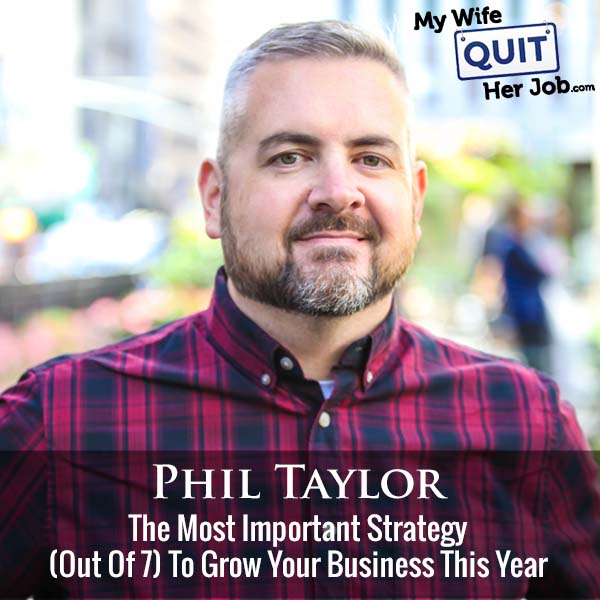
The seven ways to grow your business this year, according to FinCon founder Phil Taylor, are: make the core product better every cycle, innovate carefully with new product lines, create content and social media, foster a community around the business, charge more (and tier your pricing), hire a talented team that complements your gaps, and acquire other businesses. Phil used this exact playbook to take FinCon from 200 attendees and roughly $100,000 in top-line revenue in year one to a 3,000-person conference doing over $1M in seven years.
In this episode of the My Wife Quit Her Job podcast, Phil Taylor and I walk through each of the seven strategies with the specific FinCon example behind it. Phil is the founder of the conference that launched my speaking career, and he just made his first acquisition (Nomadic Matt’s TravelCon), so the playbook is fresh.
Here is the framework, in the order Phil applied it.
Get My Free Mini Course On How To Start A Successful Ecommerce Store
If you are interested in starting an ecommerce business, I put together a comprehensive package of resources that will help you launch your own online store from complete scratch. Be sure to grab it before you leave!
Table of Contents
Key takeaways
- FinCon started in 2011 with about 250 attendees as a side hustle. The event scaled to a 3,000-person peak in 2019 and is targeting 2,000 again this year in New Orleans.
- Revenue growth followed the same curve: roughly $100,000 in year one to over $1M in year seven, driven by these seven strategies in sequence.
- The single most important lever, per Phil, is continuous improvement of the core product driven by real customer feedback loops. Everything else compounds on top of that.
- Tiered pricing (three tickets, with a $1,000 brand pass anchoring a $600 pro pass and a sub-$300 basic pass) moved the middle option hard. The rule of three works.
- The first hire should complement the founder’s weakest area. Phil is a visionary and community builder, so he hired Jessica (now FinCon’s CEO) to run details.
- Acquisition is the fastest way to grow in events because organic growth is limited to one cycle per year. FinCon just acquired TravelCon to enter the travel-creator space.
How Phil Taylor grew FinCon from 200 to 3,000 attendees
Phil Taylor grew FinCon from about 250 attendees in 2011 to 3,000 at the 2019 peak by treating the event as a rolling seven-step growth loop instead of a one-time launch. Revenue moved from around $100,000 in year one to over $1M by year seven, and the same seven strategies apply to any bootstrapped content, service, or ecommerce business.
Phil wrote up the seven ways on PTMoney.com and I asked him to walk through each one on the podcast. What follows is the framework in order, with the specific FinCon example behind each step.
1. Make the core product better every year
The first and most important way to grow your business is to obsessively improve the core product, using real customer feedback as the source of ideas. Phil’s phrase for this is “the posture of continuous improvement,” and at FinCon it means post-conference surveys, pre-conference surveys, and constant listening to what attendees actually want more (or less) of.
The specific asks that shaped FinCon early: better speakers, cooler locations, a better hotel, better parties, more networking time, fewer overlapping sessions, and clearer communication in the run-up to the event. None of those came from Phil guessing. All of them came from the survey mechanism.
Phil quotes Sam Walton on this: there is only one boss in your business, and it is the customer. The insecurity most owners feel about asking for negative feedback is where the gold is buried.
“So many business owners I see are afraid to hear what their customers actually think of their product. There’s insecurity in that. And there’s so much gold in opening that conversation up with your customers.” (Phil Taylor)
A companion resource Phil recommends for structuring those conversations is Ryan Levesque’s book Ask.
2. Innovate with new products, but test small
Once the core product is dialed in, add new product lines using a lean-startup approach: small tests inside the existing business rather than big swings at a separate business. This gives a creative founder somewhere to channel new ideas without abandoning the bread and butter, and it kills the “shiny object” problem.
At FinCon, iteration happens inside the event umbrella. New sponsor packages, new party formats, a new mastermind element, meetup programs, tracks, and this year a video recording booth attendees can book time in.
The rule: launch the test small, do not marry yourself to it, and if one pops you have a new product line without having spun up a whole second company.
The Pro Pass: how tiered tickets became a second product line
The best FinCon example of “innovate with new products” is the Pro Pass. Phil resisted a premium ticket for years because he wanted the event to stay accessible at $99. When he finally layered a higher-value ticket on top (extra brand-matchmaking access, extra swag, a dedicated party), it became a huge revenue lever without alienating the base ticket.
I have been to almost every FinCon since the second year, and the Pro Pass is genuinely unique. Because attendees are creators trying to close brand deals on-site, the premium ticket buys them the outcome they actually came for.
3. Create content and social media (from what you already have)
The third growth strategy is a content and social media engine, and the trick for a busy founder is to use assets you already have rather than trying to create from scratch. FinCon started its blog by asking the attendee community for guest posts, turned those guest posts into a printed magazine handed out at the event, and then launched a podcast (the Financial Blogger Podcast) that interviewed speakers and sponsors in the six months before each conference.
The upgrade Phil is pushing now is video. FinCon has years of recorded session footage sitting behind a paywall (the virtual pass), and the plan is to publish those sessions on YouTube on a slow drip starting three months post-event, then chop them into short-form clips for the feeds.
This is the pattern the best creators use in 2026: long-form video or audio at the center, then blog posts derived from the transcript, then short-form clips distributed to Instagram, YouTube Shorts, and TikTok to pull viewers back to the long form.
Turn user data into content
Phil’s newest content idea is to mine FinCon registration data (niche, platforms, tenure) to create list content the same way Starter Story mines its interview database. That has already produced pieces like “top affiliate programs for personal finance creators” and “top personal finance journalists,” and the raw data set can drive dozens more.
4. Foster a community around the business
The fourth strategy is to build a real community and give it ownership of the product. At FinCon that means open speaker submissions (500+ applications every year), Facebook groups for the off-season, funded local meetups in cities around the US and abroad, and a general posture of open-sourcing the event itself.
Attendee ownership is the mechanism. When the community helps craft the event, they show up already invested and they bring more people with them next year.
Phil is currently evaluating a move off Facebook groups (roughly half the audience is no longer active there) and looking at Skool, Circle, and Mighty Networks as replacements. Skool is his likely pick, mostly because of the founder’s slow-growth, high-intentionality approach.
5. Charge more (with three tiers, not one)
Charge more, and structure the pricing as three tiers so the middle option looks like the obvious choice. FinCon’s ticket stack is: a sub-$300 basic creator ticket, a roughly $600 Pro Pass, and a $1,000 brand pass for industry buyers who are not sponsoring or exhibiting.
The brand pass is the anchor. Very few of them sell, but its presence at the top of the price sheet makes the $600 Pro Pass look like a bargain, and Phil saw ticket mix shift hard toward the middle option the day the three-tier structure went live.
Phil is a self-described frugal guy and admits he resisted raising prices for years. The lesson: your own price sensitivity is not your customer’s, and a well-anchored tier structure lets you raise ARPU without punishing the loyal base.
Graduated pricing creates urgency
Layered on top of tiers, FinCon graduates each tier’s price upward as the event approaches (starting around $225 for early birds, ending above $300 at the door). That creates a “prices go up next month” deadline every marketing cycle and rewards early buyers.
6. Grow through a talented team (hire your complement)
The sixth strategy is to hire people who fill in the specific gaps you have, especially your first hire. Phil is a visionary and community builder, so his first key hire was Jessica, a college buddy who had been his VA at another business, to run the operational details. She is now FinCon’s CEO.
For an event business Phil identifies four skill areas where a talented specialist is worth their salary many times over: organization, marketing, branding, and AV. His AV hire, Jessica’s brother Justin, started as a contractor, became an employee, then Phil deliberately spun him out to start his own AV company so FinCon could be his biggest customer. Justin now negotiates AV costs with hotels and vendors far more effectively than Phil ever could.
Libby, the third key hire, owns the look and feel of the event (booth design, signage, website, social visuals). Phil credits the professional visual upgrade with a step-change in how sponsors and attendees perceive FinCon.
7. Acquire other businesses
The fastest way to grow, especially in the event industry, is to acquire another business rather than wait a full year for your own next cycle. Large event conglomerates grow almost entirely through acquisition for exactly this reason.
FinCon just closed its first acquisition: TravelCon, the travel-creator conference Matt Kepnes (Nomadic Matt) built and ran for several years. Phil actually helped push Matt into launching it originally, and the deal moves FinCon into the travel-creator space with an already-established brand and audience.
Phil’s read on the current market: the event business is hard, a lot of independent event operators are looking for exits post-pandemic, and that creates a real acquisition window for founders who want to compress years of organic growth into a single deal.
What content is actually attracting sponsors in 2026?
Sponsor demand splits by content format. Affiliate-marketing sponsors (finance, hosting, software) still lean into blog content because it is evergreen and SEO-driven. Campaign sponsors (banks, brokerages, big brands) want video: sponsored YouTube integrations, pay-per-video, and podcast episode reads.
The bigger shift Phil is seeing is niche-down. Brands are getting more targeted about who they work with and prefer a micro-creator with a tight audience over a generalist with a bigger number. A military-finance show has a specific set of sponsors that will pay well regardless of subscriber count because the audience match is exact.
Frequently asked questions
What is the single most important thing you can do to grow your business this year?
The single most important thing you can do to grow your business this year is to relentlessly improve the core product using direct customer feedback. Phil Taylor’s phrase for it is “the posture of continuous improvement,” and every other growth lever compounds on top of a product that is getting measurably better each cycle.
How did FinCon grow from 200 to 3,000 attendees?
FinCon grew from about 250 attendees in 2011 to a 3,000-person peak in 2019 by applying a seven-step growth loop: improve the core product, add new product lines (like the Pro Pass), build a content engine, foster community ownership, tier the pricing, hire a complementary team, and finally acquire other events. Revenue climbed from roughly $100,000 in year one to over $1M by year seven.
How does tiered pricing increase revenue?
Tiered pricing increases revenue because a three-option price sheet anchors buyers toward the middle. When FinCon added a $1,000 brand pass above the $600 Pro Pass and the sub-$300 basic ticket, the Pro Pass sales jumped immediately even though very few brand passes were actually sold.
Who should be your first hire when growing a business?
Your first hire should complement your weakest skill area, not duplicate your strongest one. Phil Taylor is a visionary and community builder, so his first key hire was an operator (Jessica) who handled the details, and she now runs FinCon as its CEO.
Is buying another business a good way to grow?
Buying another business is often the fastest way to grow, particularly in industries with long organic-growth cycles like events, media properties, and SaaS. FinCon just acquired TravelCon to compress years of organic expansion into the travel-creator space into a single deal.
What kind of content are brand sponsors looking for right now?
Affiliate-marketing sponsors still favor evergreen blog content because it earns compounding SEO traffic, while campaign sponsors (banks, big brands) prefer video integrations, sponsored podcast reads, and pay-per-video deals. The shared trend is niche-down: brands are paying premium rates for micro-creators with tightly targeted audiences.
When and where is FinCon this year?
FinCon takes place in October in New Orleans, and full speaker and session details are posted at finconexpo.com. Ticket tiers currently run from a sub-$300 basic pass to a $600 Pro Pass to a $1,000 brand pass.