

Podcast: Download (Duration: 48:33 — 55.8MB)
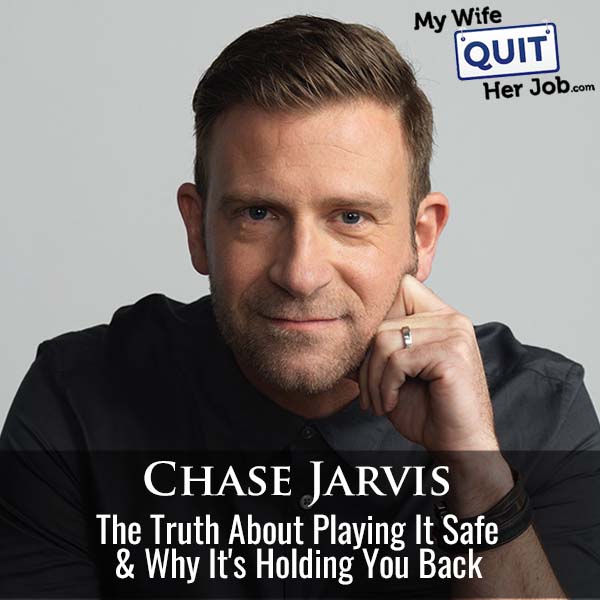
You stop playing it safe by choosing where your attention goes, then running tiny, low-risk experiments in the direction of your real interests instead of defaulting to the paths other people picked for you. That is the core of the framework Chase Jarvis lays out in his book Never Play It Safe, which he came on my podcast to walk through. Chase is an acclaimed photographer, director, and the founder of CreativeLive, and he argues that safety is really just the well-worn rut of career, relationship, and identity choices you have been conditioned to accept.
The good news is you do not have to blow up your life to get out of that rut. Chase describes seven levers, tools that already exist inside you, that let you redirect toward the work you actually want, one small correction at a time.
Below I break down the levers he covers on the show, how I have used them in my own business, and how to apply them if you are the classic case of a smart professional who followed the safe path and now hates it.
Get My Free Mini Course On How To Start A Successful Ecommerce Store
If you are interested in starting an ecommerce business, I put together a comprehensive package of resources that will help you launch your own online store from complete scratch. Be sure to grab it before you leave!
Table of Contents
Key takeaways
- Playing it safe means defaulting to the well-worn paths of others because you were conditioned to. It shows up in career, relationships, and self-awareness.
- You do not need to be perfect. Chase describes his own life as walking about one percent off course, correcting, then walking one percent smarter the next day.
- Attention is the first lever. Dr. Andrew Huberman calls the ability to direct attention the defining characteristic between success and failure in any endeavor.
- Time is the second lever. Life is long. There is enough time in your twenties, thirties, forties, or fifties to start a new career, and painter Carmen Herrera had her first Whitney retrospective at 99.
- Intuition is a muscle, not a magic gift. Most people confuse fear with a gut feeling because they have never practiced the difference.
- The right kind of failure is a fast, deliberate second attempt with one or two variables changed. Not “try, try again,” and not “fail fast” without a debrief.
- Framing something as a tiny experiment lowers the psychological cost of starting. Test in the next town before you go all in nationally.
- You can make a living from almost any niche interest if you go deep enough. A million-person niche is plenty when you only need to be in the top 1 percent.
What does it mean to play it safe?
Playing it safe means defaulting to the well-worn paths that other people, your family, your school system, or your peer group, have already walked, because that is what you were conditioned to do. Chase’s definition is deliberately broad. It covers career, relationships, your relationship with yourself, your discipline, and whether you are willing to listen to what your gut is actually telling you.
The trap is that these paths look responsible from the outside. Go to a good school, get a stable job, sit in an office in perpetuity as a doctor, lawyer, or engineer. I was the poster child for this growing up as an Asian American, and I know a lot of my friends never strayed from that script because every other path looked scary.
The point is not that the safe path is evil. The point is it is a default, and defaults were chosen by someone else for someone else. If you never audit whether that default fits you, you can walk a degree off your real direction for ten years and end up a thousand miles from where you actually wanted to be.
Do you have to blow up your life to stop playing it safe?
You do not have to blow up your life to stop playing it safe. Chase is explicit that his book is not a “quit your job, move to France, wear a beret” manifesto. This is an inside job, and the correction can happen without moving cities, changing marriages, or dropping your income to zero.
His mental model is one percent. He describes his own trajectory as returning to himself one percent better, one percent smarter, one percent faster than the day before. Over years, that compounds into a life that looks unrecognizable to the person who started, without any single dramatic leap.
That framing matters because most people who feel stuck also feel that any move has to be huge to count. It does not. The seven levers below are all low-cost, low-drama corrections you can start today.
The 7 levers from Chase Jarvis’s Never Play It Safe
The book is organized around seven levers, one per chapter, and each lever is a tool that already lives inside you. Chase’s argument is that if you learn to use even one of them intentionally, you get disproportionate leverage on the direction of your life. The ones he unpacked in most detail on the show are attention, time, intuition, and failure, which are the four I cover below with the most depth.
Lever 1: How to use attention to change your life
Attention is the first lever because everything else you do downstream depends on where you point your focus. Chase cites Dr. Andrew Huberman, who runs the Huberman Lab podcast out of Stanford and has surveyed the underlying research, and Huberman calls the ability to direct your attention the defining characteristic between success and failure in any endeavor.
What that means in practice is your day is a series of attention decisions. What you look at when you first wake up, whose opinions you weight, whether you open your inbox or open your project, whether you listen to the career counselor pushing you toward medicine or the small voice pulling you toward the thing you actually love.
Most of us leak attention to whichever notification, person, or worry is loudest. Redirect it once, and you have already changed the day. Do that consistently, and you change the trajectory.
Lever 2: How to think about time so you stop rushing
Chase’s second lever is time, and his reframe is that life is long, not short. The “seize the day, hair on fire” version of hustle has real value at the margin, but it tends to make people run around stuffing tasks into a calendar instead of choosing what to go deep on.
If you treat life as long, you can afford to spend a full decade mastering photography, then use what you learned about learning to build a company, then write books, then teach. That is Chase’s actual arc. It is also what makes it possible for a 50, 60, or 80 year old to start something new without feeling ridiculous.
The clearest example he gave was painter Carmen Herrera, who had her first Whitney retrospective at 99. I had a similar moment with a student who signed up for one of my classes at age 80 and asked if it was too late. It is not.
The other half of the time lever is flow. Clock time is the schedule you keep. Flow is the experience of an entire chapter of a book, or an entire loyalty program for your store, getting written in one sitting because you were so deep in the work you forgot to eat lunch. Chase’s point is that when time bends like that for you around a task, that is a signal about what you should be doing more of.
Lever 3: Is a gut feeling real, or is it fear?
A real gut feeling is a body signal, not a story your brain tells you, and most people mislabel fear as intuition because they have never practiced the difference. Chase calls intuition a muscle. If you have never trained it, of course your first attempts feel unreliable.
I asked him about the moment my wife told me she wanted to quit her six-figure job. My “gut” said she should keep working. Chase’s answer was that what I called gut was actually fear, a constricted feeling in the body that I had labeled as caution because that felt safer to admit than being scared.
His practical exercise is a body scan. When someone tells you what you should do, park the brain for a second and ask what your body is doing. Constricted or open. Excited or heavy. Then journal on it. He credits James Clear with the prompt “what do I really want?” and says asking it every day for seven days is transformational because your answer sharpens with each iteration.
Lever 4: The kind of failure you should actually be seeking
The right kind of failure is a fast, deliberate second attempt with one or two variables changed after a real debrief. That is what the failure science supports, and it is different from both “try, try again” and “fail fast, fail forward,” which are the two clichés most people default to.
The debrief is the load-bearing piece. After something does not work, name what did not work, pick a small number of variables to change, and re-run the attempt while the context is still fresh. If you wait too long between attempts, you lose the value of what you learned.
Chase’s example is a toddler learning to walk. When a child stumbles for the 139th time, no parent shrugs and says, well, this one is not a walker. The kid stabilizes on the couch arm, adapts, and tries again in seconds. That is the model.
The wrong version of this, and the one I see most often in my audience, is people who “tried something for two years” but were doing one specific thing wrong the entire time. Running ads on the wrong platform. Selling on the wrong marketplace. Not iterating on the actual variable that broke the thing.
The other trap is the opposite extreme. Very complex failures with a thousand inputs are hard to learn from because you cannot isolate what mattered. Chase points to how the military struggles to debrief real combat outcomes for exactly this reason. Aim for the middle: small experiments where the number of variables is low enough to isolate what actually moved the outcome.
How to run a tiny experiment instead of betting the business
A tiny experiment is a small, cheap, time-boxed test of one variable that gives you data without putting the whole project at risk. It is the practical form of the failure lever, and it is scattered throughout the book as an antidote to the “go all in” narrative.
Chase gave a great example on the show. I told him about a friend who runs a food critique site that succeeded only after he narrowed from all of California to one small town. Chase’s follow-up was, do not immediately try to scale it to a national brand. Try the same playbook in the next town over. Localize it 25 percent. See if it works. That is a tiny experiment. It costs almost nothing and it tells you whether the model travels.
The framing lowers the psychological cost. You are not “launching a business,” you are “running a test.” If it fails, you have data. If it works, you have a template.
Can you really make a living doing what you love?
Yes, you can make a living from almost any niche interest if you are willing to go deep enough to become an expert in it. Chase’s phrasing was direct. Give him any interest, papaya farmer, moon rover designer, food critic in a small town, and he can build a case for how to make an insane living doing that thing.
The math works because niches are bigger than they look. Any interest you have, there are at least a million other people on the internet who share it. You do not need all of them. You need to be in the top one percent, which is not as unreachable as it sounds because most people never actually try.
Smaller niches also let you charge more. Less competition, more pricing power, and a more loyal audience. My food critic friend covers a town of one to two million people and pulls in thousands of dollars a month from what is effectively his hobby.
The route to top-one-percent is depth. Get close to the thing. Volunteer, join a group, spend a month working in it, know somebody who does it. The moment you are inside it, you start seeing inefficiencies that the incumbents miss because they are the family farmers who inherited the operation, and you are the curious outsider looking with fresh eyes.
Why “life is long” is the most freeing part of this framework
“Life is long” is the reframe that unlocks most of the other levers because it removes the artificial pressure that says every decision has to be right the first time. If you have decades ahead, then a five-year detour into photography that teaches you how to learn is not a wasted five years, it is training for the next chapter.
This is the piece I would put in front of anyone stuck in a career they picked at 22 and now hate. Whatever you learned in the last relationship, the last job, the last failed launch, is portable into the next one. There is no wasted effort if you frame it constructively.
The 80-year-old who signed up for my audience-building class had more energy and rigor than most 30-year-olds because he was doing something aligned with who he actually was. That is what “life is long” looks like in practice.
How the Never Play It Safe framework applies to online business
The seven-lever framework maps almost one-to-one onto how I have built and run my ecommerce and online businesses. Attention is why I do not chase every trend. Time is why I let a good idea marinate before I productize it. Intuition is why I sometimes ignore the spreadsheet when it tells me a product line is fine but my body says the customer base is drifting.
Failure and tiny experiments are the biggest ones. Every product line I have launched went through a small-batch test before I committed inventory. Every course I have sold started as a workshop for a small group. Nothing was ever a “bet the company” launch, and that is not because I am risk averse. It is because tiny experiments give you real signal for a fraction of the cost.
If you are running an online store, a content site, or a course business, the leverage move is not to work harder inside the safe path. It is to pick the one lever above that you are weakest on and spend a month getting deliberate about it.
Frequently asked questions
What is the book Never Play It Safe by Chase Jarvis about?
Never Play It Safe is a practical guide to freedom, creativity, and a life you love, built around seven internal levers you can pull to stop defaulting to the well-worn paths other people picked for you. The levers include attention, time, intuition, and a specific type of deliberate failure, and each chapter walks through how to use one of them.
Who is Chase Jarvis?
Chase Jarvis is an acclaimed photographer, director, and entrepreneur who has shot campaigns for Apple, Nike, and Red Bull, and whose work has appeared in the New York Times and Wired. He founded the online education platform CreativeLive and hosts the Chase Jarvis Live show.
How do I know if I am playing it safe?
You are probably playing it safe if the path you are on was picked mainly to satisfy family expectations, school counselors, or peer approval rather than your own curiosity. Ask yourself what you would do this year if nobody would judge you for it, and how far that answer is from what you actually spend your days on.
How do I tell the difference between intuition and fear?
Do a body scan when the decision comes up. Fear tends to feel constricted, heavy, and story-driven, with the brain immediately narrating threats. Intuition is a quieter body signal that shows up before the story starts, and the muscle strengthens with practice through journaling and reflection.
What is a tiny experiment in this context?
A tiny experiment is a small, cheap, time-boxed test of one variable of a new business or life direction. Instead of quitting your job to become a food critic, you run a critique newsletter for one town for three months and see whether readers actually show up.
Can I really make money doing something I love?
Yes, if you are willing to go deep enough to become genuinely expert in it, because any interest with a million people passionate about it can support a full living from the top one percent of practitioners. Smaller niches often pay better because competition is lower and audiences are more loyal.
Is it too late to start over in my 40s, 50s, or later?
No. Life is long, and every skill and lesson from your prior chapters is portable into the next one. Painter Carmen Herrera had her first Whitney retrospective at 99, and Chase’s framing is that a new decade-long career is fully available in your fifties or sixties.
Where can I get Never Play It Safe by Chase Jarvis?
The book is available anywhere books are sold, and Chase offers a bonus bundle including a live launch event, a masterclass, and a companion workbook at chasejarvis.com. The offer at launch was around $705 in bonuses for buyers who registered their receipt on the site.