
Podcast: Download (Duration: 17:29 — 20.3MB)
To prepare your business for ChatGPT and AI disruption, lean into everything a language model cannot copy. That means real human relationships with your customers, a brand and community that only you can host, and owned channels (email, SMS, and your own audience) that survive a shift away from search.
Writers, coders, artists, and anyone whose main output is a commodity draft are the most exposed. Anyone with a real audience is the least.
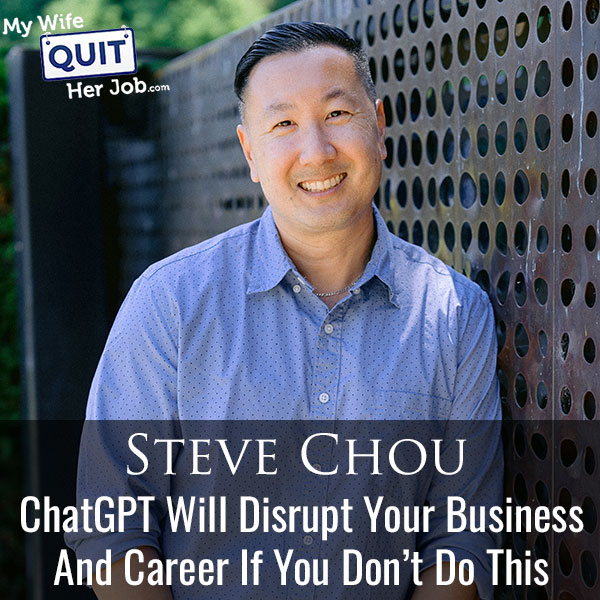
In this solo episode of the My Wife Quit Her Job podcast, I walked through why ChatGPT is as big a shift as the internet, Google, or the iPhone, what I have already used it for at Bumblebee Linens, and the concrete steps I am taking so my e-commerce store, blog, and YouTube channel do not go obsolete.
Below is the full playbook, including which jobs are most at risk, why brand and community are the durable moat, and the specific moves to make right now if you sell products or create content online.
Get My Free Mini Course On How To Start A Successful Ecommerce Store
If you are interested in starting an ecommerce business, I put together a comprehensive package of resources that will help you launch your own online store from complete scratch. Be sure to grab it before you leave!
Table of Contents
Key takeaways
- ChatGPT is a foundational shift on the scale of the internet, Google, or the iPhone, not another shiny tool.
- Writers, coders, artists, and commodity content creators face the most disruption. Anyone with a real audience faces the least.
- AI still gets facts wrong. A ChatGPT essay on Thomas Hobbes was well written but factually incorrect, which is why education is the scariest short-term battleground.
- The moat is human: real customer relationships, a recognizable brand, and a community you host.
- Own your customer data. Email and SMS lists survive a world where ChatGPT replaces Google and clicks stop happening.
- Amazon is short-term cash flow, not a long-term business. The same logic applies to any platform you do not control.
- Video is the highest-trust medium right now for building a following that AI cannot substitute for.
What ChatGPT actually is and why it disrupts everything
ChatGPT is an artificial intelligence chatbot developed by OpenAI that generates human-quality text on demand, including articles, emails, code, jokes, and scripts. After using it for a week, I would put it on the same list as the internet, Google, and the iPhone in terms of business impact. It is that big.
The reason it disrupts everything is that most knowledge work today is text output. If a machine can draft the email, write the code, produce the article, or generate the image at zero marginal cost, the pricing power of anyone paid to produce a commodity version of that same output collapses.
For a concrete example, I asked ChatGPT to draft a brand story for Bumblebee Linens, my wife’s online store that sells personalized handkerchiefs and linens. I told it my wife cries at everything, that we could not find quality hankies for our wedding, and that our value props are monograms, personal messages, the largest selection online, and in-house embroidery.
After a few rounds of coaching it to write in first person, to sound heartfelt, and to keep the tone casual, it produced a story in the voice of a founder named Jennifer that I would have paid a copywriter hundreds of dollars for. The final draft covered the wedding origin, the sourcing obsession, the embroidery techniques, the largest-selection value prop, and the fast turnaround, in usable prose.
It also writes working code. I pasted a compilation error into it and it told me the fix. Other developers have used it to write face-tracking code from scratch.
Which jobs and businesses ChatGPT actually disrupts
ChatGPT hits any role whose main output is a commodity draft that a customer only needs to be “good enough,” including freelance writers paid by the word, staff bloggers churning out roundups, junior copywriters, junior developers writing boilerplate, illustrators doing generic stock work, and Stack Overflow-style Q&A. Those are the exposed roles today.
Content and publishing is already visibly disrupted. Some operators are copying a New York Times article into ChatGPT, asking it to break the piece into bullet points, and having it regenerate a new authoritative-sounding article covering the same points. It works well enough to fool most readers.
Google has said outright that AI-generated content will be penalized in search. That policy alone will not stop the flood, but it clarifies where the arms race is going.
Art is next. An AI-generated image recently won an art contest against human entrants. The models are trained on human artists, so the “is it plagiarism” debate is genuinely unsettled.
Education is the scariest short-term battleground. A blogger at Strategery.com had ChatGPT write a term paper on Thomas Hobbes for his daughter. The essay was well written and confidently voiced, but factually wrong on multiple points.
If every kid drafts every essay with ChatGPT, we raise a generation that never learns to think through a problem end to end. That is a bigger long-term risk than any specific job loss.
Why humans still win: two stories from my own career
Humans still win because the parts of a job that require relationships, taste, and cross-team judgment do not compress into a text prompt. Two stories from my own career made this obvious to me.
Story one is the India outsourcing wave. In the early 2000s, my Silicon Valley employer moved most of its engineering hiring to Pune and Bangalore, where labor cost five to ten times less. Coworkers were terrified they would be next.
I was not. The engineers in India could write code, but I sat at headquarters, had the internal relationships, and could trade favors with peers to move projects forward far faster than anyone ten thousand miles away.
Story two is Bumblebee Linens. Chinese sellers routinely knock off our products and undercut us on price. A competitor called Hummingbird Linens copied our site outright.
I am not worried, because we have a loyal customer list, a real brand, and an email base that lets us stay a step ahead. My competitors do not.
The pattern in both cases is the same. Cheap and fast substitutes always show up. What they cannot replicate is the relationship-and-trust layer that sits on top of the work.
That is the layer ChatGPT is worst at and where you should invest.
How to compete with AI as an e-commerce store or content creator
To compete with AI as an e-commerce store or content creator, invest in the human layer that AI cannot fake. That means being visible as a real person, owning your customer data, and building community your audience cannot get from a chatbot. Here is the exact playbook I am running.
1. Establish real human connections with your audience
Get on the phone, answer customer emails personally, and show your face on video, TikTok, and blog posts. Of the three main content mediums, video is the strongest for building a genuine following because tone, expression, and personality all survive the medium.
2. Get out from behind the computer
Build community in physical or synchronous formats. I have been going through my phone contacts and randomly texting people to reconnect, taking Zoom calls with readers and customers, and hosting groups on Facebook, Discord, and forums where people can hang out. In-person events do the same job even better, which is why I run the Seller Summit every year.
3. Own your customer data
Focus your marketing on email and SMS lists you actually control. My SMS list at Bumblebee Linens is roughly one tenth the size of my email list and generates comparable revenue.
Owned channels survive a world where ChatGPT replaces Google, AI Overviews eat organic clicks, or any single platform changes its rules. Rented traffic does not.
4. Treat Amazon as cash flow, not a business
Selling on Amazon is fine as a cash-flow engine. It is not a long-term business, because Amazon owns the customer and can end your listing tomorrow.
The same logic applies to any platform where you do not own the relationship. Push customers off-platform onto your list every chance you get.
5. Assume ChatGPT could replace Google and plan accordingly
If people start asking ChatGPT their questions and getting the answer without ever clicking a search result, “I rank number one on Google” stops being a moat. Plan for that world now by diversifying into podcasts, YouTube, email, SMS, and community, so your business does not depend on a single traffic source.
What ChatGPT cannot copy about your business
ChatGPT cannot copy the community you have built, the trust your customers have in you personally, or the taste and judgment behind your brand. Those are the assets to compound.
A good stress test is my microphone example. When I recently shopped for wireless mics, I paid double for a Rode over a Chinese knockoff at half the price. I did that because the brand had earned it.
Brand is what makes a customer pay a premium in a world of infinite cheap substitutes.
The same applies to writing. My friend Jim Wang introduced me to the blog Strategery, and the voice on that site is unmistakable.
No AI will replicate that writer’s specific personality in a way readers cannot tell apart. Distinctive voice is the writer’s version of brand.
The bigger pattern: platforms disrupt, humans adapt
Every major platform shift disrupted the businesses that were built on the previous platform’s default assumptions. The internet gutted mail-order catalogs. Google gutted the Yellow Pages.
Amazon gutted a generation of brand-agnostic e-commerce stores. AI will do the same to businesses whose main output is a commodity text or image draft.
The businesses that survived every previous wave shared one trait. They owned the customer relationship and treated the platform as a channel, not a foundation. That is exactly the playbook to run for the AI wave too.
Steve’s summary line: leverage your strengths as a human, own your customer data, and adapt quickly. Since humans are still the ones training the models, humans stay a step ahead, but only if they keep moving.
Frequently asked questions
Will ChatGPT replace writers, coders, and artists?
ChatGPT will replace the commodity end of writing, coding, and art (roundup posts, boilerplate code, generic stock illustration) faster than most people expect. It will not replace writers, coders, or artists with distinctive voice, deep judgment, or real client relationships, because those are the parts of the work AI is worst at.
Is ChatGPT good enough to publish content without a human editor?
ChatGPT reads well but gets facts wrong often enough that publishing unedited AI output is a real risk. A well-known example is a ChatGPT-drafted term paper on Thomas Hobbes that was fluent but factually incorrect. Always fact-check, and always have a human add first-hand experience the model cannot invent.
Will Google penalize AI-generated content?
Google has publicly said it will penalize AI-generated content, and the “helpful content” system is aimed squarely at low-effort AI spam. In practice, AI-assisted content that adds original expertise, first-hand experience, and accurate facts is not the target. Pure regurgitation is.
Is Amazon still a good long-term business in the age of AI?
Amazon is fine as a short-term cash-flow channel, not a long-term business. Amazon owns the customer relationship, controls the platform rules, and can suspend a listing overnight, and AI does not change that. Build your own list, your own site, and your own brand, and treat Amazon as one channel among many.
What is the single best move to future-proof my business against AI?
Build a direct relationship with your customers that lives outside any platform. That means an email list, an SMS list, a YouTube or podcast audience, and ideally an in-person or community layer on top. Everything else, including SEO, ads, and marketplaces, is downstream of owning the audience.
Should I use ChatGPT in my business right now?
Yes, treat ChatGPT like a fast junior draft partner. Use it to draft emails, product descriptions, brand stories, code snippets, and outlines, then rewrite with your voice, verify every fact, and add first-hand experience the model does not have. That is where the leverage is.