
Podcast: Download (Duration: 45:16 — 52.1MB)
The biggest regret my friend Chad Vanags has after a stage 4 lung cancer diagnosis is that he spent nearly 15 years building businesses he did not care about, telling himself he was working toward a life he never actually started living. His clarifying framework now is simple: your identity, your stress, your immune system, and your diet are one interlocking chain, and if you break the identity link (by driving down what he calls the “wrong road”), the other three tend to snap with it. The exercise that changed his life late is one anyone can do this weekend: write out your ideal day, compare it to your actual day, and if the two are not overlapping at roughly 80/20, you are on the wrong road.
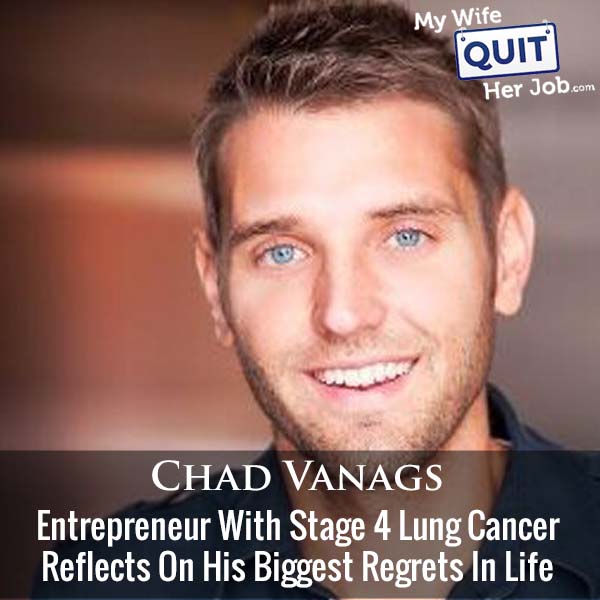
In this episode of the My Wife Quit Her Job podcast, I sat down with Chad Vanags, a friend of mine for seven years, the former co-host of the eCommerce Influence podcast, co-founder of RevFlow, and founder of the Tequila Farm and Uncharted Spirits. Chad, a lifelong non-smoker in strong physical shape, was recently diagnosed with stage 4 lung cancer with tumors in both lungs, his lymph nodes, his bones, and 30 lesions in his brain. This is the most meaningful conversation I have ever recorded.
Below is what he shared about the four pillars he now credits for real health, the trap most founders fall into, the ego problem behind the “chase,” and the exact question he now uses to sort what stays in his life from what goes.
Get My Free Mini Course On How To Start A Successful Ecommerce Store
If you are interested in starting an ecommerce business, I put together a comprehensive package of resources that will help you launch your own online store from complete scratch. Be sure to grab it before you leave!
Table of Contents
Key takeaways
- Chad’s biggest regret is spending nearly 15 years driving down “the wrong road,” working on things he never cared about (real estate, e-commerce agencies, payments) while telling himself the money would fund the life he actually wanted.
- His health framework, drawn from the book Cured by Dr. Jeffrey Rediger, has four interlocking pillars: diet, immune system, stress response, and identity. Weakness in any one opens the door for the others to collapse.
- Identity is the pillar most founders neglect. If your daily work is not authentically you, your body absorbs that mismatch and your immune system pays the bill.
- The “ideal day” exercise is his diagnostic. Write out what your ideal day looks like. Compare it to your actual day. If they are not overlapping at roughly 80/20, you are on the wrong road.
- Contemplate death daily. Chad now lies in bed each night and thinks about dying. The exercise strips away the ego that drives the “chase” and forces clarity about what actually matters.
- Diet: everything organic, single-ingredient foods (peanut butter should be “peanuts and salt”), sprouted-grain bread from the freezer section, and a daily Vitamix blend of vegetables. Cut processed foods, sugar (the average American now eats 156 pounds of sugar per year vs. 3 pounds 200 years ago), and processed cold cuts.
- The medicine is working. Chad’s brain tumors have reduced in size by 50 percent, and he credits the combination of medicine plus the four-pillar approach.
Who Chad Vanags is and what he was diagnosed with
Chad Vanags is a longtime e-commerce entrepreneur, former co-host of the eCommerce Influence podcast, the person who built Klaviyo’s partner program, and the founder of RevFlow, the Tequila Farm, and Uncharted Spirits. In late 2022, at age 40-something and as a lifelong non-smoker in strong physical shape, he was diagnosed with stage 4 lung cancer driven by a specific genetic mutation.
The scan results were severe: tumors in both lungs (the lung tumor is five times the average size), lymph nodes, bones, and 30 lesions in his brain. Chad’s insurance paperwork was signed with a prognosis of six to twelve months if treatment did not respond.
Treatment is responding. His brain lesions have shrunk 50 percent, and he credits the combination of targeted medicine plus the four-pillar lifestyle rebuild he is doing alongside it.
The four pillars framework Chad now uses to think about health
Chad’s four-pillar framework comes from Cured by Dr. Jeffrey Rediger, which studies documented cases of spontaneous remission from terminal diagnoses. The four levers Rediger identifies are diet, immune system, stress response, and identity.
Chad describes them as an interlocking chain. Weakness in any single link creates the opening for the other three to fail together.
| Pillar | What it means | The founder failure mode |
|---|---|---|
| Diet | What actually enters your body | Grabbing whatever is convenient between meetings; processed foods; sugar overload |
| Immune system | Your body’s ability to catch and fight mutating cells | Chronic sleep debt and inflammation; no space for the body to do repair work |
| Stress response | How your nervous system handles pressure over time | Late nights, early mornings, “hustle culture” as a permanent state |
| Identity | Whether your daily work matches who you actually are | Chasing revenue, titles, or ego wins while the real thing you want to build waits |
The pillar Chad wants founders to pay the most attention to is identity, because it is the one most people never examine.
The “wrong road” metaphor and why founders drive down it for years
The “wrong road” is Chad’s phrase for spending years chasing money, revenue, and ego wins in a business you do not actually care about, while telling yourself you are funding the life you really want. In his own case, he drove down the wrong road for close to 15 years, from real estate in 2005, through an e-commerce agency, through his CMO tenure at a payments company, all while the business he actually wanted to build (Uncharted Spirits, a world excursion company) stayed on the other side of the highway.
His metaphor: imagine driving 100 miles per hour in third gear while staring at the road on the other side of the divider. Sooner or later the engine blows, or the body pulls the parking brake. His body pulled it.
The identity failure is not laziness or lack of drive. It is the opposite. The founders most at risk are the ones grinding hardest on a business that does not represent them.
The ideal day exercise: how to know if you are on the wrong road
The ideal day exercise is Chad’s practical diagnostic: sit down, write out what your ideal day actually looks like from morning to night, and compare it honestly to your current day. If your ideal day and your actual day are not overlapping at roughly 80/20 (the 80 percent on the things you care about, the 20 percent on the necessary business you have to do), you are on the wrong road and something has to change.
Chad’s ideal day, when he sat down to write it: get up, write about things he cares about, work outside on his urban farm, learn to weld, train hard physically. His actual day for 15 years: whatever kept the current business moving.
If you cannot yet name what your ideal day looks like, Chad’s take is that you already know but have not let it surface. Sit with the question long enough and it comes out.
Why founders should contemplate death every day
Chad now lies in bed every night and deliberately contemplates his death, and he recommends the practice to every founder. His argument is simple: the reason most people trade their happiness for revenue, titles, or ego wins is that they secretly assume they have another 20 or 40 years to sort it out. Removing that assumption changes every business decision.
His direct line to founders making half a million to a million dollars a year in jobs they hate: “You’re going to die. Was it worth it?”
I felt the weight of that question in my own life on the recording. Since the interview, I have found myself asking it about small decisions too. Would the extra 20 percent revenue push matter if this were my last year?
The ego trap: chasing revenue when you already have enough
The ego trap is the pattern where a founder who already earns more than they need continues pushing for higher revenue purely for the status win, and the family and health costs are paid quietly in the background. Chad and I both admitted to falling into this trap. In my case, I once blasted emails and ran unprofitable ads to hit a $1M revenue milestone that meant nothing operationally, then immediately set the next year’s target 20 percent higher, until my wife (rightly) shut it down.
The clarifying question Chad uses now: “Will your Stanford buddies care about your hankies when you’re gone?” Nobody cares about your revenue plaque a decade after you are gone.
The 80/20 rule applies here too. It is entirely fine to run a business that occupies 20 percent of your life, if the 80 percent it enables is the family, the health, and the identity you actually want.
How Chad now optimizes each of the four pillars
Chad now runs a specific, concrete routine against each of the four pillars, and every founder can copy the framework whether or not they copy the exact tactics. Identity is where he started, because fixing it made everything downstream easier.
Identity: shutting down what is not authentically you
Chad is winding down RevFlow because payment processing is not the thing he cares about. He is putting his time into the Tequila Farm, Uncharted Spirits, and contract sales training work at Winning by Design (Dropbox, Calendly, and others) because those match who he actually is. The 20 percent of work he does not enjoy is fine as long as the other 80 percent is his.
Stress: dropping the drive that does not serve you
The stress pillar collapses naturally once the identity pillar is fixed. Chad’s stress dropped as soon as he stopped grinding on businesses he did not care about. If you are burned out, look at the identity link before you look at the stress link.
Immune system: high-intensity training and rest
Chad now trains at a CrossFit gym with a dedicated coach and describes himself as being in some of the best shape of his life. High-intensity training plus adequate rest is his framework for supporting the immune system’s ability to detect and fight cell mutations.
Diet: the “ZFG” green blend and single-ingredient foods
Chad’s diet is dictated by a cancer nutritionist and delivered through a meal service that follows her plan. His own daily addition is what he calls the “ZFG” (zero effs given) blend, a Vitamix mix of all the vegetables he needs to get in, drunk quickly with no concern for taste.
The single-ingredient rule matters. His peanut butter’s ingredient list is “peanuts and salt.” His bread comes from the freezer section (Ezekiel-style sprouted grains) because shelf-stable bread requires preservatives. If you are going to eat meat, make it grass-fed and skip processed cold cuts entirely.
The sugar stat that stopped me cold: 200 years ago, the average human consumed 3 pounds of sugar per year. Today the average American consumes 156 pounds per year.
What this episode changes for how I run my business
The takeaway I am carrying forward from this conversation is that the four pillars are not a wellness aesthetic, they are a chain, and identity is the load-bearing link. Fix identity first and the other three become dramatically easier to hold together. Try to fix diet or stress in isolation while ignoring identity and you are patching leaks in a boat with a hole in the hull.
Chad’s mission now is to install guardrails at the top of the cliff so other founders do not end up in the ambulance at the bottom. If this episode has moved you at all, sit down this weekend and write your ideal day.
You can follow Chad on LinkedIn at linkedin.com/in/chadvanags, where he now shares most of his writing on the four pillars and the mindset shifts he wishes he had made a decade earlier.
Frequently asked questions
What are the biggest regrets of an entrepreneur diagnosed with terminal cancer?
Chad Vanags’s biggest regret is spending nearly 15 years building businesses he did not care about (real estate, an e-commerce agency, payments) while postponing the world excursion company he actually wanted to build. His broader regret is not treating identity as a health pillar. He believes the identity mismatch weakened his immune system and opened the door to the mutation.
What is the “wrong road” metaphor Chad Vanags uses?
The “wrong road” is Chad’s phrase for a founder driving hard down one career path while constantly looking at the road on the other side of the divider (the business or life they actually want). The mismatch creates chronic stress and identity strain, which he believes eventually forces the body to pull the parking brake through burnout or illness.
What are the four pillars of health in Dr. Jeffrey Rediger’s book Cured?
The four pillars in Cured are diet, immune system, stress response, and identity. Rediger studied documented spontaneous remissions and found these four levers appeared consistently. Chad now treats them as an interlocking chain where identity is the most commonly neglected link.
What is the “ideal day” exercise?
The ideal day exercise is a written comparison of the day you would live if every day were ideal against the day you are actually living. If your actual day is not close to 80 percent overlap with your ideal day, Chad’s take is that you are on the wrong road and need to make a change before your body forces one.
How does Chad Vanags eat now?
Chad now eats an organic, single-ingredient diet planned by a cancer nutritionist and delivered by a meal service. His own daily add is a “ZFG” Vitamix vegetable blend. He avoids processed foods, sugar, and processed cold cuts, and prefers freezer-section sprouted-grain bread (like Ezekiel) over shelf-stable bread.
How much sugar does the average American eat compared to 200 years ago?
The average American now consumes roughly 156 pounds of sugar per year, versus about 3 pounds per year 200 years ago. Chad cites this as one of the strongest arguments for scrutinizing every ingredient label.
How can founders avoid burning out before something catastrophic happens?
Chad’s practical answer is three-part: accept that you will die and contemplate it daily, do the ideal day exercise honestly, and start on one of the four pillars (usually food) even if you can only make partial changes at first. The point is to force the identity conversation before your body forces it for you.