
Podcast: Download (Duration: 54:35 — 62.7MB)
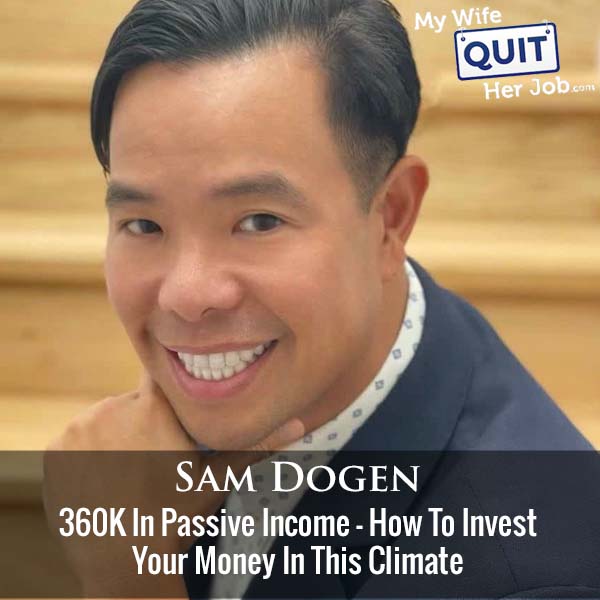
Sam Dogen of Financial Samurai generated roughly $380,000 in passive income in 2022, targeting $400,000, by shifting his tax-advantaged accounts into short-duration US Treasury bills yielding above 5%, keeping a base of rental real estate and stock dividends, and using his blog and book royalties as active supplementary income. His core message this cycle: “T-bill and chill” while the Fed is still raising rates, then aggressively bid on real estate as the market retrenches.
In this episode of the My Wife Quit Her Job podcast, I sat down with Sam, the longtime writer behind FinancialSamurai.com and author of the Wall Street Journal bestseller “Buy This, Not That.” Sam engineered his own layoff from Goldman Sachs / Credit Suisse in 2012 at age 34 with about $80,000 in passive income and a large severance, and has been managing the family portfolio ever since.
Below is Sam’s rate-cycle playbook, the 70/30 probability framework he uses for major life decisions, why he treats content brand equity as insurance against ChatGPT-style search disruption, and the passive income math that lets a Bay Area family of four cover the bills without a W-2.
Get My Free Mini Course On How To Start A Successful Ecommerce Store
If you are interested in starting an ecommerce business, I put together a comprehensive package of resources that will help you launch your own online store from complete scratch. Be sure to grab it before you leave!
Table of Contents
Key takeaways
- Passive income of ~$380K in 2022, target $400K. Composition: rental real estate, stock dividends, short-duration US Treasury bills, and interest-bearing CDs/money markets.
- “T-bill and chill” is Sam’s cycle call. 1-year Treasury bills were yielding ~5.125% at the time of recording, risk-free and exempt from state and local tax, so his tax-advantaged accounts are heavily rotated into 3-month to 1-year Treasuries.
- Stock allocation trimmed from 35% of net worth to 30% at end of 2022. A 50% market drawdown from that allocation would cost 15% of net worth, which he considers his comfort floor.
- Real estate is his aggressive 2023 play. Anyone listing a home while mortgage rates are near 6.75% is likely a motivated seller, so Sam recommends “spraying and praying” DocuSign offers 10-15% below 2022 peaks.
- The 70/30 framework says: if you believe you have a 70%+ probability of being right on a major life decision, act. Waiting for 90%+ certainty is how you miss the job, the relationship, and the business you should have started.
- The 2023 happiness-vs-income research updated Kahneman’s famous $75,000 ceiling. New number: happiness continues to rise through roughly $500,000 in household income, not $75K.
- Sam wrote “Buy This, Not That” during the 2020 pandemic after being rejected by 25 literary agents in 2011. His self-published “How to Engineer Your Layoff” e-book still generates $40K-$50K per year at ~97.5% margin.
How Sam Dogen built $380K in passive income
Sam built his passive income stack over 20+ years by saving aggressively while working in investment banking, then rotating into a mix of rental real estate, dividend stocks, Treasury bills, and CDs. In 2022 the stack produced approximately $380,000, and his target for 2023 was $400,000.
The composition matters. Real estate is the largest anchor, dividend stocks and index funds are the growth engine, and short-duration Treasuries are the current tactical overweight because the risk-free yield is finally above 5%.
Sam’s operating rule is that a base of passive income equal to comfortable middle-class expenses (he estimates $300,000-$350,000 for a Bay Area family of four in 2023) is enough. Beyond that, active work should be optional and joyful.
What does “T-bill and chill” mean and how does it work?
“T-bill and chill” means parking cash in short-duration US Treasury bills (3-month to 1-year maturities) that are yielding above 5% risk-free, and waiting out the current economic cycle instead of chasing equity or crypto returns. At the time of recording, 1-year T-bills were yielding roughly 5.125% and paid no state or local income tax.
Sam’s math: on $10 million, that is $520,000 in risk-free annual income; on $20 million, it clears $1 million. Even if your investable assets are $10K instead of $10M, the framework is the same. Any asset (stocks, real estate, crypto) must clear the risk-free rate for the risk to be worth taking, and right now that hurdle is high.
How to buy Treasury bills
You can buy Treasury bills two ways: directly at TreasuryDirect.gov, or through any major online brokerage account’s fixed-income tab (Fidelity, Schwab, Vanguard, and E-Trade all support this). Inside the brokerage flow, pick “Treasury” from the bond list, pick a maturity, and click buy. Minimum purchase is $1,000.
Why Treasuries beat a money market fund
A money market fund pays interest that is taxable at the federal, state, and local level. Treasury bond interest is exempt from state and local tax. If your marginal state income tax is 5% or higher, the tax-adjusted yield on Treasuries can beat a money market fund by 50-75 basis points at current rates.
Should you buy real estate in 2023-2024?
Sam’s answer is yes, aggressively, but only on discounted properties from motivated sellers. His logic: anyone who lists their home while mortgage rates are at 6.75% and demand has tailed off is more likely to be selling because of divorce, job loss, or relocation than because they think it is a good market for them, and desperate sellers accept lower offers.
He recommends a “spray and pray” DocuSign strategy: use your agent to submit offers 10-15% below 2022 peaks on any property you would happily own, and wait for one to hit. The window closes once the Fed pivots and mortgage rates come down, which he expected to happen in 2024.
Longer term, Sam is bullish on real estate as an inflation hedge and a demographic play, and treats it as the single best asset class for the average person over a multi-decade horizon.
Sam’s 70/30 probability framework for big life decisions
Sam’s 70/30 framework says that if you believe you have a 70% or greater probability of being right on a major decision (a job, a marriage, a startup, a big purchase), you should act instead of waiting for perfect certainty. Waiting for 90-100% is how most people miss the window.
The other 30% is not failure. It is the tuition you pay to learn, as long as the downside is not catastrophic. The book “Buy This, Not That” is built around applying this frame to public vs private school, kids or no kids, marry or not, join a startup or stay corporate, and start a business or stay employed.
The pre-mortem drill Sam runs with his son on the drive to school shows the frame in action. They start at a 90% probability of arriving on time, then adjust up or down as unknown variables appear (a downed tree, less Friday traffic), and reassess in real time.
How to apply the 70/30 framework to starting an ecommerce business
Applying the 70/30 framework to starting an ecommerce business means writing down four things before you commit: your current income stability and severance potential, your feasibility research (talked to 5+ operators in the space), your runway to fail (how many years before you concede), and your fallback (can you get your day job back).
Sam’s honest caveat: you will never actually hit exactly 70%. The number is a feeling backed by real due diligence, and the moment you feel you have crossed it, the correct move is action, not more research. Analysis paralysis is expensive.
The corollary: side-hustling on nights and weekends before quitting your day job massively raises your probability of success by extending your runway indefinitely. That is the setup Sam used with Financial Samurai from 2009-2012 before negotiating his severance.
Why engineers over-analyze and under-launch
In my (Steve Chou’s) 20+ years teaching an ecommerce class, engineers consistently underperform less-analytical students at launching businesses, because they are trained to look for certainty that does not exist in early-stage entrepreneurship. The students who succeed most often are the ones who say “screw it, we’re going to try” and iterate from live customer feedback.
Sam’s counter, and I agree with it, is that thinking and planning are free. Pre-mortem planning surfaces the checklist you will need when the car accident happens, and it costs nothing to do. The failure mode is not planning; it is planning as a substitute for launching.
The winning combination: do the pre-mortem thoroughly, then take the leap when you cross the 70% line, then iterate.
How Financial Samurai monetizes without generic AI-style content
Financial Samurai monetizes primarily through affiliate income from a small number of investment partners Sam actually uses (Empower / Personal Capital, Fundrise-style platforms, etc.), plus book royalties, plus a podcast. Sam deliberately writes every post himself in an opinionated, first-person voice, which is the opposite of the SEO-optimized freelance content strategy that dominates the personal finance niche.
His reasoning: hiring freelance writers to produce generic affiliate-heavy content is a business that ChatGPT can now replicate at zero cost, so its long-term moat is weakening. First-person, opinionated content grounded in Sam’s real portfolio decisions is something a language model cannot replicate, because the underlying life isn’t a language model’s to draw from.
He calls this a “free call option.” Because his site is built on his voice, he can add SEO freelance content on top later if he ever wants to; a generic-content site cannot bolt his voice on retroactively.
Will ChatGPT and AI search kill the affiliate business model?
Sam expects the affiliate model to get disrupted for marginal players (generic content sites with no brand), while established personal brands survive and increasingly monetize via “ambassadorship” deals instead of per-click affiliate splits. His analogy: a tennis player’s endorsement income scales with their brand equity (Roger Federer over Novak Djokovic), and the same dynamic will apply to content creators.
The predicted shift: Empower or a similar brand tells its top 10 affiliate creators, “We are done paying per referral; here is $1 million as a brand ambassador for the year.” That is a very different economic model than the click-attributed affiliate flow that runs the industry today.
Whether Bing Chat or ChatGPT actually dents Google’s ~90% search share is a separate question. Sam is skeptical, given how long Bing has spent stuck at 2-3% share, but agrees the click-through economics of blue-link search are under real pressure.
What “stealth wealth” means and why Sam practices it
Stealth wealth means quietly accumulating assets, financial independence, and optionality without signaling any of it externally. In practice that looks like modest cars, quiet social posts, and a lifestyle that stays below what your income could support, so your net worth stays private from neighbors, employers, and kids’ schools.
Sam’s motivation is a mix of privacy, personal safety, and social insulation. Wealthy people he knows in San Francisco, including friends with $500 million to $1 billion in net worth, deal with the same worries as everyone else, plus 5,000 employees, board dynamics, and privacy issues normal families never face.
For most people, stealth wealth is also the antidote to lifestyle inflation. If your neighbors do not know what you earn, you have no social pressure to spend to match.
The $500,000 happiness ceiling (updated Kahneman research)
A 2023 update to Daniel Kahneman’s famous 2010 study found that happiness continues to rise with income up to roughly $500,000 per household, not the $75,000 figure the 2010 paper reported. The old $75K number was suspicious, and it appears to have been influenced by benchmarking against median private-university salaries at the time.
The takeaway: more money does buy more happiness, but the returns compress as you go higher, and the marginal utility of a fifth million versus a fourth million is very different from the marginal utility of a $50K raise on a $75K salary. Ask yourself what the extra income actually buys before you sacrifice the time to earn it.
Frequently asked questions
How do you buy Treasury bills as an individual investor?
You can buy Treasury bills at TreasuryDirect.gov or through any major online brokerage account’s fixed-income tab (Fidelity, Schwab, Vanguard, E-Trade). Minimum purchase is $1,000. Choose the maturity (3-month, 6-month, 1-year), click buy, and the bond settles into your account.
Are Treasury bills better than a high-yield savings account?
At current rates, short-duration Treasury bills often beat high-yield savings and money market funds on a tax-adjusted basis, because Treasury interest is exempt from state and local income tax. In a 5%-plus state income tax bracket, that exemption is worth 25-50 basis points, so a 5.1% T-bill yield can beat a 4.5% money-market yield after tax.
What is the “70/30 framework” and how do you use it?
The 70/30 framework says that if you have done real due diligence and believe you have a 70% or greater probability of being right on a major life or investment decision, you should act. The other 30% is the acceptable margin of error, and its purpose is to keep you from waiting for a 100% certainty that never arrives.
How much passive income do you need to retire in the Bay Area?
Sam estimates that $300,000-$350,000 per year in passive income supports a comfortable middle-class lifestyle for a Bay Area family of four in 2023, adjusting for inflation. This budget assumes a paid-off or low-mortgage home; the ceiling scales with location, family size, and lifestyle.
Is real estate a good investment in 2023-2024?
Sam is bullish on buying selectively in 2023 and 2024, targeting sellers who list into a slow market (a signal of motivation), offering 10-15% below 2022 peaks, and holding for the long term. Long-term drivers (inflation, population growth) favor real estate as a wealth-building asset for average investors.
What is “T-bill and chill”?
“T-bill and chill” is a shorthand for parking cash in 3-month to 1-year US Treasury bills that yield above 5% risk-free, and waiting out an uncertain economic cycle instead of chasing equity or speculative returns. It is a tactical positioning call for a specific rate environment, not a permanent portfolio.
Does ChatGPT kill affiliate blogging?
ChatGPT is a real threat to generic, high-volume affiliate content sites that compete on speed and volume instead of voice. First-person, opinionated brands with real portfolio proof are much harder to replicate and are likely to survive and shift toward ambassadorship-style brand deals instead of per-click affiliate revenue.