
Podcast: Download (Duration: 47:11 — 54.3MB)
To build an 8-figure baby shoe brand, sell into an underserved mid-market price band, launch on Amazon with a few thousand units and grow into wholesale and DTC once product-market fit is proven, and moat the business with high SKU complexity (dozens of styles times six sizes) that a copycat cannot spin up on Alibaba over a weekend. That is the playbook Cole South used at Bird Rock Baby, and it is now 60% Amazon, 40% DTC and wholesale, with 500+ boutique retailers.
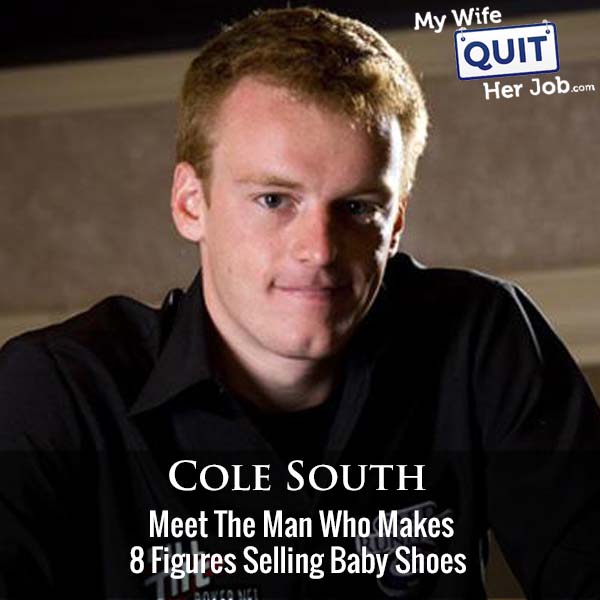
In this episode of the My Wife Quit Her Job podcast, I talked with Cole South, a former professional poker player who co-founded Bird Rock Baby (baby moccasins) and Gold BJJ (jiu-jitsu uniforms), and is now building an ecommerce software tool called Synchronize. Cole runs the whole operation out of a 5,500 sq ft San Diego warehouse with a team of five.
Below is the full playbook: how Cole spotted the mid-market gap, how he sources shoes in China, how he manages inventory across three sales channels in a Google Sheet, and how he built retail into a real distribution channel.
Get My Free Mini Course On How To Start A Successful Ecommerce Store
If you are interested in starting an ecommerce business, I put together a comprehensive package of resources that will help you launch your own online store from complete scratch. Be sure to grab it before you leave!
Table of Contents
Key takeaways
- The market gap that started Bird Rock Baby was a mid-price baby shoe. Existing options were either $65 luxury shoes (too expensive for kids who lose them at the playground) or $6 AliExpress drop-ships (unsafe). Bird Rock landed in the middle.
- Launch quantities were roughly 2,000 pairs total (four colors, four sizes) on the first order. Cole says over-ordering the first run is worth it because stock-outs wreck your forecasting for months.
- The first year was 99% Amazon, from a January 2016 launch. Two organic sales on day one convinced Cole and his partner they had product-market fit, and they quit poker to go full time.
- Bird Rock now moves through 500+ small boutique retailers, sourced via personalized outbound plus the Faire wholesale marketplace. Minimum wholesale order is $250 at a 50% discount off retail.
- Cole runs 60% Amazon / 40% DTC and wholesale out of a 5,500 sq ft warehouse with 5 people. He picked in-house over 3PL because Bird Rock has ~50 styles x 6 sizes and most 3PLs handle SKU complexity poorly.
- The return rate on baby shoes is 15-20%, roughly half of which is resellable. Plan margins around that: aim for at least 4x markup on cost of goods to have a healthy ecommerce business.
- A 3-6 month PR agency campaign is underrated. Bird Rock’s PR run drove high-authority backlinks (Motherly, pregnancy publications) that lifted the site’s Google rankings and gave collection pages like “baby moccasins” a #1 slot.
How did Cole South pick baby moccasins as a product?
Cole picked baby moccasins because his business partner had two young kids, his partner’s wife was frustrated with the two-tier baby shoe market, and Amazon keyword tools confirmed real search demand for “leather baby shoes” and “baby moccasins.” The gap was a mid-market, safety-tested, American-backed baby shoe between the $65 luxury tier and the $6 AliExpress tier.
That framing matters. Cole did not pick baby shoes because they were easy or because they had low competition. He picked them because he could see a specific customer complaint the existing market was not solving.
He also picked a product he and his partner would personally buy, which is a repeating pattern in every Bird Rock decision that came after.
What did it cost to start Bird Rock Baby?
Bird Rock Baby started with about $5,000 to $10,000 in initial capital between Cole and his business partner to open the LLC and place the first inventory order. As the business grew, Cole loaned it more money to finance additional inventory, and eventually the company qualified for financing from Amazon Lending and Chase.
The initial inventory order was roughly 2,000 pairs total, spread across four colors and four sizes (about 16 SKUs). That is far more than a “test order,” and Cole’s reasoning is worth internalizing: stock-outs on your first product destroy your sales-velocity data and make every subsequent order guesswork.
Over-order on run one, learn from the sell-through per SKU, then place tighter orders after that.
Where does Bird Rock Baby manufacture its shoes?
Bird Rock manufactures all of its baby shoes in China with a single factory it has worked with since day one, sourced originally through Alibaba. The company has also evaluated Mexican shoe factories as a China-alternative strategy given rising US-China tensions, but has kept its main relationship in China because of the depth of the partnership.
For sizing, Cole customized the factory’s off-the-shelf design in three ways so that Bird Rock’s sizing chart followed a standard US template instead of a Chinese chart. Standardized sizing lowered the return rate and improved the buying experience.
Minimum order quantities at that factory started around 500 units per SKU. Baby-shoe MOQs are relatively small compared to adult footwear, which is why the category is accessible to a bootstrapped brand.
How Cole ranked #1 on Amazon and Google for baby moccasins
Bird Rock ranks #1 in Google for “how to size baby shoes” and #1 for the collection query “baby moccasins,” through a combination of on-page SEO on the collection pages and a 6-month PR agency campaign that landed high-authority backlinks. Amazon ranking came from launching in 2016, riding the platform’s organic tailwinds, and building enough review volume in year one to defend the top slots.
The buying-guide content is deliberately close to purchase intent. “How to size baby shoes” is the question every new parent asks right before they buy. Content further from that decision (sleep tips, feeding tips) does not convert as well and is not part of the strategy.
The collection pages themselves are the highest converter, and PR-driven backlinks are what pushed those pages to the top of search.
Should you hire a PR agency for your ecommerce brand?
Cole recommends a 3-6 month PR agency campaign for an established ecommerce brand, framed as brand-awareness and asset building, not performance marketing. Judging PR by “did it drive $5,500 in sales this month to cover the $3,000 retainer” is the wrong scorecard and will make the channel look like a failure.
The correct scorecard is press features you can reuse forever as social proof (Motherly, pregnancy magazine, mom-focused outlets) and dofollow backlinks from high-authority sites that boost your SEO. A 3-6 month burst usually captures the best of an agency’s rolodex before diminishing returns set in.
Long-term retention of a PR agency is rarely worth it for a small business.
Bird Rock’s Amazon vs DTC vs wholesale channel mix
Bird Rock runs three sales channels roughly independently, each with its own owner and workflow, and the mix has shifted meaningfully over time.
| Channel | Share of revenue | Owner | Notes |
|---|---|---|---|
| Amazon | ~60% | Cole | Fulfilled via FBA. Ad spend has roughly doubled to 10-12% of Amazon revenue vs 6-7% three years ago. |
| DTC (Shopify) | ~30% (part of the 40% non-Amazon mix) | Cole | Facebook ads pulled back after iOS privacy changes wrecked profitability. Now leans on SEO, Google Ads, email, and word of mouth. |
| Wholesale | ~10% (500+ boutiques) | Cole’s wife | Personalized outbound + Faire marketplace. $250 min order, 50% off retail. |
Running each channel siloed means nobody feels responsible for everything, and it gives the business real diversification if one channel breaks (as Facebook effectively did in 2022).
How Bird Rock manages inventory in a Google Sheet across 3 sales channels
Bird Rock manages inventory in a single Google Sheet that acts as the master dashboard for FBA stock, San Diego warehouse stock, in-production units, and trailing sales velocity across Amazon, Shopify, and wholesale. The team tried multiple hosted inventory tools every six months for years, and every time they ended up back in the sheet.
The problem with off-the-shelf inventory tools is SKU-and-channel complexity. With 50+ styles, 6 sizes, 2 warehouses (FBA + San Diego), and 3 sales channels, most tools become 800 checkboxes and still miss the specific quirks of a real ecommerce business.
The manual step that broke the sheet workflow was daily exports. An employee pulled Amazon and Shopify reports every morning and pasted them into data tabs, and even careful people occasionally filtered the wrong date range or pasted into the wrong tab. Underordering a hot SKU by three weeks of sales is expensive.
Cole solved this by hiring a developer to build custom Google Sheets functions like `=Amazon_Inventory(“MySKU”)` and `=Shopify_Sold_Units(“MySKU”, 30)` that continuously refresh live data from a database his team hosts. That internal tool became the seed for his SaaS product, Synchronize.
Why Bird Rock chose a 5,500 sq ft warehouse over a 3PL
Bird Rock runs its own 5,500 sq ft warehouse in San Diego with a team of 5, because the SKU complexity (~50 styles x 6 sizes) makes the brand a bad customer for most 3PLs. In-house also gives the team full control over wholesale, which involves boxing custom multi-SKU orders that 3PLs handled poorly.
Cole’s staffing philosophy is a small squad of A-players. In his experience, the productivity gap between an A-player and a C-player in a warehouse is closer to 10x than 2x, and a C-player pulls the whole operation backwards.
Because Amazon is FBA-fulfilled and 60% of the business, the on-site team only fulfills the other 40%. That gives them meaningful bandwidth headroom, which prevents burnout and lets them absorb Black Friday volume without hiring temps who never get up to speed in time.
How Bird Rock protects its wholesale channel from getting undercut
Bird Rock protects its wholesale channel by only accepting physical brick-and-mortar retailers, requiring wholesalers to agree upfront that they will not sell on Amazon, and being loose on MAP (minimum advertised price) enforcement while strict on the two big rules.
The two hard rules for a Bird Rock wholesale partner: no selling on Amazon (they would piggyback the brand’s listings), and no bidding on branded Google Ads terms. Everything else is negotiable, because most boutique owners are not internet-savvy enough to be a real threat to the brand’s DTC pricing.
If a partner does try to list on Amazon, Bird Rock is brand registered and trademarked, and the ultimate lever is cutting off supply. That conversation almost never has to happen a second time.
Why Cole stopped launching new Amazon products and focused on one hero SKU
Cole stopped launching new Amazon products because his existing baby moccasin has such clear product-market fit that expanding line breadth would dilute focus and slow down the growth of the core product. Bird Rock’s market penetration in baby shoes is still small, so pushing the same ball faster is a better use of energy than launching a diaper backpack.
This runs against the standard Amazon growth advice of “launch more SKUs once you’ve cracked the formula.” Cole’s take: launching new products is the hardest way to grow. It is easier to lift the AOV, repeat rate, and channel mix on a product you already know converts.
That philosophy is exactly why Bird Rock’s ad spend, retail push, and SEO all point at the same hero product.
The moat: why SKU complexity beats “easy” ecommerce products
Bird Rock’s real moat is SKU complexity, which acts as a barrier to entry for lazy competitors. A copycat cannot open an Alibaba account, spend $10,000, and immediately match 50 styles across 6 sizes with standardized sizing and safety testing.
Contrast that with a garlic press or a phone stand. If any AliExpress hunter can source your product in a weekend, you will have hundreds of competitors before quarter end, and your margins collapse.
The Bird Rock parallel on the Gold BJJ side is embroidery. Custom-embroidering 150 jiu-jitsu uniforms with a school’s academy logo, turned around in a week, is something an overseas seller with no US footprint cannot easily replicate. Complexity is protection.
Frequently asked questions
How much does it cost to start a baby shoe business?
Bird Rock started with roughly $5,000 to $10,000 in initial capital for the LLC and first inventory order, and grew from there via founder loans and later Amazon Lending. A realistic first inventory order of about 2,000 pairs across 16 SKUs at Chinese factory MOQs of 500 units per SKU sits in that range.
Where does Bird Rock Baby manufacture its shoes?
Bird Rock manufactures all of its baby moccasins in China at a single factory it has worked with since 2016, sourced originally through Alibaba. It has also evaluated Mexican shoe factories as a diversification hedge but keeps its main relationship in China.
What is the return rate on baby shoes?
Cole says his return rate on baby moccasins is 15-20%, which is lower than adult apparel but still high enough to model into your margins. Roughly half of returned pairs are resellable.
What margin should you target on ecommerce products?
Cole targets at least a 4x markup on cost of goods as a bare minimum to run a healthy ecommerce business. On the wholesale side specifically, if retail is $30 and wholesale is $15, you still want a 50% margin on the wholesale price itself.
Should you use a 3PL or run your own warehouse for a multi-SKU ecommerce business?
Most 3PLs handle small-and-light single-SKU brands well but struggle with high SKU counts across many warehouses and channels. Bird Rock’s ~50 styles x 6 sizes across FBA plus its own warehouse across three sales channels made 3PLs a poor fit, so it runs its own 5,500 sq ft San Diego warehouse with 5 people.
Is Amazon still a good place to launch an ecommerce business in 2026?
Cole says Amazon was a great launch pad in 2016 and is much harder today, with ad costs roughly doubling and knockoff sellers a permanent fixture. Building a defensible brand on Amazon in the current climate requires either high SKU complexity, real product innovation, or an existing off-Amazon audience to seed reviews and rank.
Should you hire a PR agency for your ecommerce store?
Yes, but only for a 3-6 month burst and only if you judge it as brand-awareness and SEO backlinks, not direct-response revenue. Beyond six months, most agencies have burned through their best contacts for your niche and returns diminish.