
Podcast: Download (Duration: 46:25 — 53.4MB)
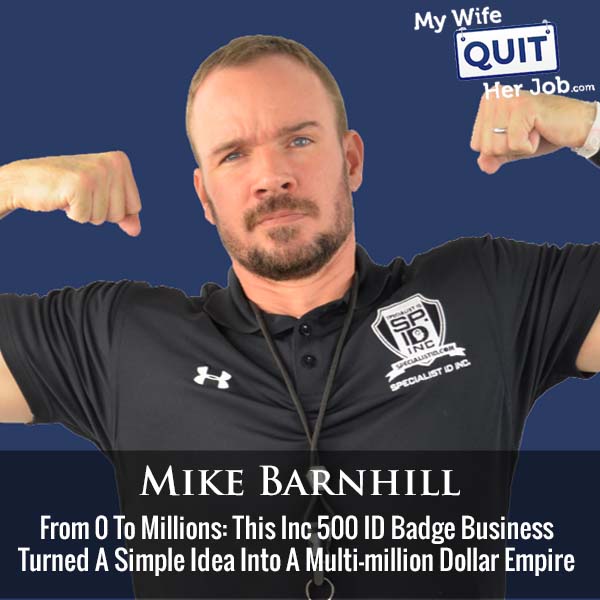
Mike Barnhill and his brother Patrick turned a “boring” ID badge business called Specialist ID into an Inc 500 multi-million dollar empire by picking a saturated commodity, deciding to be the best in the world at that one thing, and going wide on every marketplace that would list badges. Roughly 70% of Specialist ID’s revenue now comes from Amazon, the rest from their Shopify site, Etsy, eBay, and Walmart, with thousands of SKUs, in-house assembly of custom bundles, and a reorder rate roughly double the industry average.
On this episode of the My Wife Quit Her Job podcast, Mike walked me through how they went from a failed recording studio in a garage to a Florida warehouse full of auto-baggers and a full US-based customer service team. The playbook is a good template for anyone building an ecommerce brand in a category everyone else considers commoditized.
Here is exactly how Specialist ID got started, how they scaled to eight figures in a category no one else wanted to touch, and how they used a Good to Great mindset and a Blue Ocean playbook to keep innovating past their competition.
Get My Free Mini Course On How To Start A Successful Ecommerce Store
If you are interested in starting an ecommerce business, I put together a comprehensive package of resources that will help you launch your own online store from complete scratch. Be sure to grab it before you leave!
Table of Contents
Key takeaways
- Specialist ID picked ID badges because it was the one product they were already selling well on eBay and, after reading Good to Great, they realized it was the one product they could be best in the world at.
- Amazon is roughly 65 to 70% of Specialist ID’s revenue, with the remainder split across their Shopify site, Etsy, eBay, and Walmart at about 1 to 3% each. They deliberately built the brand to be ubiquitous.
- Their Amazon reorder rate is about double the office-supplies industry average, driven by white-glove customer service inspired by Tony Hsieh’s Delivering Happiness.
- They pivoted twice during the pandemic. First, they scraped Indeed and Monster to build hot-pink “badge buddies” for hospitals hiring travel nurses. Then they bought up every double-ended lanyard in the US and rebranded them as mask lanyards, which produced their two biggest months in company history.
- Etsy has been Specialist ID’s best source of high-value repeat customers, because crafters and nurse-side-hustlers use their blank badge reels as raw material and often graduate into big wholesale accounts.
How Specialist ID started selling ID badges on eBay
Specialist ID started because Mike and Patrick Barnhill needed to keep the lights on at a failed recording studio their estranged father had funded with a one-time $20,000 “dream fund.” When the studio did not draw paying artists, they turned to eBay and started selling pro-audio gear from a wholesaler’s catalog to cover the rent.
The breakout product came from a leftover supplier relationship of Patrick’s: retractable badge reels at 99 cents plus $2.99 shipping. The listings sold on repeat, week after week, at a scale nothing else in their catalog matched.
The turning point was reading Jim Collins’ Good to Great. The book’s “hedgehog” principle (be the best in the world at one thing) pushed them to drop the pro-audio experiment and go all-in on badge holders. That single decision is what turned an eBay side hustle into an Inc 500 company.
Why Specialist ID went all-in on a “boring” commodity product
Specialist ID went all-in on badge holders because it was a commodity nobody was trying to be the best at, and being the best in a boring category is a much easier fight than being the best in a hot one. Mike and Patrick decided they could not out-compete established brands in pro-audio, but they could absolutely become the Nike of badge holders.
That framing did two useful things. It gave them permission to obsess over a category that outsiders considered dull, and it gave them a clear yardstick for every product, packaging, and customer-service decision.
Later, at one of my Seller Summit events, an attendee handed Mike a copy of W. Chan Kim’s Blue Ocean Strategy. That book layered the second key idea on top: any market you win eventually gets saturated, so a durable brand has to keep innovating into product gaps customers are asking for.
That combination (best in the world at one thing, plus continuous product innovation) is the operating system Specialist ID still runs on.
Where Specialist ID actually sells: Amazon, Shopify, Etsy, eBay, and Walmart
Specialist ID sells across five channels, and the mix looks like this in order of revenue contribution:
- Amazon: 65 to 70% of revenue. Not planned, just where the opportunity kept showing up as they went into private label in 2014.
- Own website (Shopify, migrated from Volusion): the bulk of the remainder. Used for bulk orders, quotes, and Fortune 500 clients that Amazon cannot service well.
- Etsy: roughly 1 to 3%. Small share, but produces the highest-loyalty customers, including nurse-crafters who later become large wholesale accounts.
- eBay: roughly 1 to 3%. The original channel, still running as a low-cost feeder into other properties.
- Walmart: roughly 1 to 3%. A small pilot with about five products on Walmart Fulfillment Services (WFS), quietly experimenting rather than pushing hard.
The key insight from that mix is that the “boring” plays (Etsy, eBay, Walmart) each punch above their revenue weight because they source completely different customer types. Every channel is a different lead magnet into the brand, and the customer-service team already exists to handle them.
How Specialist ID scaled Amazon private label in 2014
Specialist ID scaled Amazon private label in 2014 by studying Scott Voelker’s ecommerce content and applying his playbook to badge holders. They took products that already had proven demand, then wrapped them in keyword-optimized listings, better photography, and bundle formats (5-packs, 10-packs, key-ring combos) that no one else was offering.
Mike’s specific edge is Amazon keyword hunting. He mines auto-complete phrases and long-tail searches to find queries with real demand and no relevant listing, then Specialist ID builds a product to fill that exact gap. That is how they layered a private-label catalog with thousands of SKUs on top of the original resale business.
The economics of private label also solved their biggest early pain: getting undercut on price when everyone else sold the same wholesale catalog on Amazon. Owning the SKU meant owning the buy box, the reviews, and the margin.
How Specialist ID grew during COVID with two fast pivots
Specialist ID grew during COVID with two fast pivots that landed them on the Inc 500 in 2021. The first pivot targeted travel nurses, and the second pivot invented the mask lanyard category. Both moves used existing supplier relationships and existing product inventory, so they cost almost nothing to test.
Pivot 1: Custom badge buddies for hospitals hiring travel nurses
Mike scraped Indeed and Monster for hospital job titles that were actively hiring during COVID. Every title (LPN, RN, respiratory therapist) got its own badge buddy listing, in every color hospitals color-code by role, with hot pink as a default best-seller. Those listings went up on Amazon and Etsy in bulk, and the sales came in immediately because travel nurses were buying their own badge gear before shifts.
Pivot 2: Mask lanyards from existing double-ended lanyards
Specialist ID had already designed a double-ended napkin holder for events, complete with photography. When masks became mandatory, Mike realized the same double-ended lanyard could hold a mask. They bought up every double-ended lanyard in US inventory, relaunched them as mask lanyards, and posted them on Amazon.
Day one: about 20 sets sold. Within weeks: their two biggest revenue months in company history.
They then extended the line with school-color variants, kid-safe breakaway versions, and MRI/metal-detector-friendly versions for hospital and airport workers. Every innovation shipped ahead of the copycats, then the copycats caught up, then Specialist ID innovated again.
How Specialist ID keeps customers coming back
Specialist ID keeps customers coming back with a Delivering Happiness style customer service culture that will happily lose money on a single order to keep a customer for life. Their Amazon reorder rate is about double the office-supplies industry average, driven by two US-based full-time customer service reps and a dedicated B2B sales rep who works the phone list of past buyers.
Their operating principle is simple: if a customer has a problem, do whatever it takes (even overnight shipping at a loss) to make them happy today, even if they were unhappy yesterday. The financial cost of that policy is small compared with what a lost lifetime relationship costs, and Mike said it also lets him actually sleep at night.
The reorder rate compounds because ID badges are true consumables. A broken reel means a nurse cannot work a shift, and buyers do not want to re-research the category every time. Once Specialist ID earns the first order and the first great support experience, they usually own the recurring line item.
What Specialist ID makes in-house vs. outsources
Specialist ID does a large share of packaging, bundling, and simple assembly in-house, using auto-baggers and a dedicated “packaging and branding” team at their Miami warehouse. In-house work covers custom bundles, key-ring assembly, branded barcodes, badge buddy printing, and any new product they want to test before committing to overseas tooling.
The manufacturing itself is outsourced globally to vetted “Nike-tier” factories in Taiwan, China, Vietnam, and the US. If a factory does not meet their standard on quality or ethics, they pass, no matter the price advantage.
That split (make it in the warehouse until you know it sells, then place the overseas PO) is what lets them keep innovating without blowing capital on speculative inventory. It is also what let them move so fast during COVID.
How Specialist ID sources product ideas from customers
Specialist ID sources many of its best product ideas directly from customers, particularly Etsy buyers who message the store with specific vendor tips. Mike described one recurring pattern: a nurse-crafter will say she knows the vendor who makes a specialty item, does not want to place a 10,000-unit minimum order herself, and offers to buy the first 500 units if Specialist ID commits to the initial 10,000.
That kind of tip does three useful things at once. It surfaces a validated product idea from someone who already knows the market, it de-risks the first inventory buy with a guaranteed anchor order, and it turns a small B2C customer into a real product partner.
Very few ecommerce brands build a listening loop that specific. Most treat customer messages as support tickets to close, not as R&D. Specialist ID treats them as free product research from the people who use the product every day.
Comparison: Specialist ID’s marketplaces by role in the business
- Amazon. The engine. 65 to 70% of revenue. Best for one-off B2C and small B2B orders where keyword optimization does the selling.
- Own website (Shopify). The margin play. Best for bulk quotes, Fortune 500 accounts, and custom color mixes Amazon cannot handle.
- Etsy. The loyalty channel. Best for finding crafter and side-hustler buyers who convert into long-term wholesale relationships.
- eBay. The feeder. Best for volume-testing new SKUs at low risk and pulling residual demand into the website.
- Walmart. The experiment. Best for products that get crushed on Amazon by cheap-and-cheerful competition; Walmart is less saturated on many mid-priced SKUs.
What a new ecommerce seller can copy from Specialist ID
A new ecommerce seller can copy four specific things from Specialist ID: pick one boring commodity you can be the best at, be present on every marketplace your buyer might check, treat customer service as a marketing budget (not an expense line), and mine keyword and job-market data for product ideas nobody else is building for. None of that requires a novel product. All of it requires focus.
The bigger lesson is that “saturated” is often just code for “nobody is trying hard.” Badge holders had thousands of listings by the time Mike and Patrick got serious, and they still built an Inc 500 business by out-caring, out-listing, and out-innovating every other seller in the category.
Frequently asked questions
What does Specialist ID sell?
Specialist ID sells ID badge holders, retractable badge reels, lanyards, badge buddies (color-coded hospital role identifiers), custom-printed badge accessories, and related credential products. Their catalog runs into the thousands of SKUs across Amazon, their Shopify site, Etsy, eBay, and Walmart.
How much of Specialist ID’s revenue comes from Amazon?
About 65 to 70% of Specialist ID’s revenue comes from Amazon, consistently across the last several years. It was not planned. Amazon private label just kept out-scaling the other channels as they layered on more listings starting in 2014.
How do you compete in a saturated ecommerce category?
To compete in a saturated ecommerce category, be the best in the world at one narrow slice of it (Good to Great “hedgehog” principle), keep innovating into product gaps competitors have not filled yet (Blue Ocean Strategy), sell on every marketplace your buyer might check, and use white-glove customer service to earn a reorder rate above the category average.
Is Etsy worth it for ecommerce sellers who are not handmade?
Etsy is worth it for ecommerce sellers who are not handmade if you sell supplies to Etsy’s crafter and maker community. Etsy officially allows suppliers to sell to resellers, and Specialist ID says some of their best long-term wholesale customers first found them on Etsy as small crafters years earlier.
How did Specialist ID grow during COVID?
Specialist ID grew during COVID with two fast pivots. First, they scraped Indeed and Monster for hospital job titles and built role-specific “badge buddies” for travel nurses in every color hospitals code by. Second, they bought up every double-ended lanyard in US inventory and rebranded them as mask lanyards, which produced the two biggest revenue months in company history.
Should you list the same product on Amazon, Etsy, eBay, and Walmart?
You should list the same product on Amazon, Etsy, eBay, and Walmart if you have a customer service team already handling volume. Each channel reaches different buyer types, keyword tweaks per platform are cheap, and Specialist ID reports that products that flop on Amazon often sell well on Walmart because Walmart is less saturated in many mid-priced categories.