
Podcast: Download (Duration: 15:24 — 17.9MB)
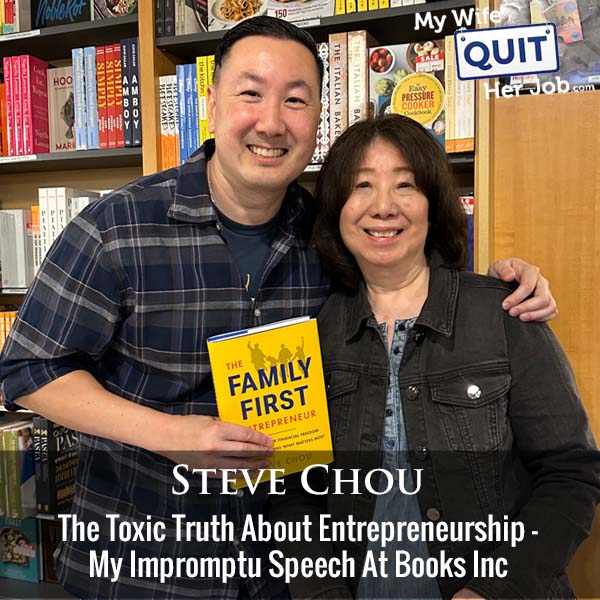
The toxic truth about entrepreneurship is that most business books teach you to work 80 hours a week for an exit that usually never comes, and by the time you figure out the trade, your family has already paid the bill. This is a Family First Friday episode of the My Wife Quit Her Job podcast, taken from the impromptu 15-minute speech I gave at my very first book signing at Books Inc in Palo Alto for The Family First Entrepreneur.
The alternative is the framework I built the book around: a side hustle you actually care about, a small business run on systems and automation instead of hustle, and a clear ranking of the four life burners (work, friends, family, health) so you know which ones to turn down when a trade-off shows up.
Below is the through-line of that talk, plus the four burners theory explained in full and the FAQ people ask me most about family first entrepreneurship.
Get My Free Mini Course On How To Start A Successful Ecommerce Store
If you are interested in starting an ecommerce business, I put together a comprehensive package of resources that will help you launch your own online store from complete scratch. Be sure to grab it before you leave!
Table of Contents
Key takeaways
- Most business books assume you have no family and no other responsibilities. Family First Entrepreneurship rejects the 80-hour-week playbook and targets “enough” instead.
- Our two businesses generate seven figures on roughly 20 hours per week combined, because we invested in systems and automation once the income was stable.
- The four burners theory says life has four burners (work, friends, family, health) and you can only run two well. Pick your two on purpose.
- Some balls you juggle are glass and some are rubber. Family is glass. Know which is which before you drop something.
- Everyone should have a side hustle in a topic they already care about. Layoffs at Facebook and Google right now show why relying on a single paycheck is fragile.
- The moving-goalposts trap kills more entrepreneurs than failure does. If the number keeps growing but nothing in your life gets better, the goal is the problem.
Why I wrote The Family First Entrepreneur
I wrote The Family First Entrepreneur because every business book I read assumed I had no kids, no spouse, and no interest in seeing either of them. Living in Silicon Valley makes it worse. The default template here is venture-backed, going public, and treating 80-hour weeks as the price of admission.
The math on that template is ugly once you stop and look at it. You sacrifice years of family time chasing an exit that, more often than not, never happens.
And even when it does happen, the entrepreneurs I interview on this podcast tell me privately that the payoff was smaller than the price.
What Family First Entrepreneurship actually means
Family First Entrepreneurship means building a business that funds the life you want on the fewest hours possible, then reinvesting that time in the people you love. It targets “enough money to be free” instead of a nine-figure exit.
For us, “enough” is two businesses that clear seven figures on around 20 hours a week of work between me and my wife Jen. That took years of building systems, but it is very much achievable for a small business.
You do not need a family to use this framework. If the phrase “family first” bothers you, read it as “life first.” The book is fundamentally about how to work less and make more.
The moving-goalposts trap that almost broke our business
The single biggest mistake I made as an entrepreneur was moving the goalposts every time we hit a number. When our handkerchief store cleared six figures in year one against a $60,000 target, my ego took over and I set a new target. When we hit that, I set another one.
We were making far more than we could spend. I am famously cheap. I do not like cars, I do not have expensive hobbies, and I do not travel lavishly.
One night Jen came to me in tears (the unhappy kind) and asked why we were still doing this. The whole reason we started the business was so she could quit her job and be around me and the kids. Somewhere along the way I had traded that away for a bigger revenue number.
That conversation is when we killed all revenue goals and rebuilt the business around processes, automation, and getting both of us out of the day to day. Money turns out to be a terrible measure of anything that matters.
Why successful entrepreneurs are often quietly miserable
After 460+ podcast interviews with seven, eight, and nine-figure entrepreneurs, I can tell you that the real conversation usually starts the second I hit the stop button. On air, everything is congratulations and growth curves. Off air, a lot of them are quietly falling apart.
One founder hit $2 million in six months. On the recording, we celebrated. Off air he told me it was the most stressful, miserable stretch of his life, because fast growth is not fun to live through even when it looks great on a chart.
I once interviewed a billionaire and asked, off record, if he had any regrets. He said yes: he lost his family, went through a divorce, and rarely sees his kids. He would trade the private jets and everything else to get them back.
Why the media version of an entrepreneur is fake
Anytime you see a family entrepreneur profile in the media, assume the camera-ready version is staged. Our family was recently on CNBC, and there is a scene where the kids run into the kitchen and cheerfully ask about breakfast options while I calmly pour milk.
Real mornings in our house are “get out of bed, put on your clothes, eat, out the door.” The videographer needed a warm shot, so we performed a warm shot.
The point is not that CNBC lied. The point is that a 90-second segment cannot show reality, so anything you are comparing yourself to on TV or Instagram is a highlight reel, not a benchmark.
Why everyone needs a side hustle right now
Everyone should have a side hustle even if they love their day job, because a side hustle is optionality and the tech industry just spent 12 months proving how fragile a single paycheck is. Facebook has now announced its second round of layoffs, and Google has cut roles again.
Friends of mine hate their situation but cannot walk away, because they never built anything on the side.
A side hustle also has real upside. Our handkerchief store started as a weekend project my wife and I ran on the side and turned into a seven-figure business.
MyWifeQuitHerJob.com started as a blog with zero readers because I got inspired by Steve Pavlina’s post “How to Make Money From Your Blog.” It took three years to make six figures, then it took off.
Same story with my YouTube channel. One video a week for three years, and now the ad revenue alone covers our family’s bills.
How to pick a side hustle you will actually stick with
Pick a side hustle in a topic you are already into, because consistency is the only thing that separates the side hustles that grow from the ones that die. If you already care about the topic, showing up every week is easy. If you do not, you will quit by week six.
One of my friends buys a new piece of electronics every single week. As his friend, I already want to know what he thinks of everything he buys. If he just documented that in a YouTube channel or blog, I would watch every video, and there are millions of people like me.
Your version of that is whatever you already do for free on weekends. Start documenting it and see what happens over 18 months.
What the second half of the book covers: automation and systems
The second half of The Family First Entrepreneur is about sustaining a business without becoming enslaved to it, because the trap most owners fall into is that the more money they make, the harder they work. That is backwards. If revenue is growing and your calendar is getting worse, you are running the wrong playbook.
The fix is systems, processes, and (increasingly) AI-powered automation. I have used human writers to help with the blog for years, and I am probably not going to keep using them because ChatGPT and the other tools have gotten that good.
If you have not experimented with ChatGPT, Midjourney, or any of the AI tools yet, do it this week. This is the biggest small-business productivity shift in a decade.
The four burners theory explained
The four burners theory says your life is a stove with four burners (work, friends, family, health) and to do one thing well you have to turn off at least one burner. To do something exceptionally well, you have to turn off two. Elon Musk has three burners off and his work burner cranked to max.
It is a priorities framework, not a lifestyle prescription. You cannot run a serious business, maintain great health, be a present spouse, be a present parent, and hold up an active social life all at the same time. Something gives.
My chosen two burners have always been family and work, in that order. Yours might be different. The point is to choose on purpose so you are not surprised by which burner burned down while you were focused on another one.
Glass balls vs rubber balls: knowing which trade-offs matter
You are always juggling multiple balls in the air, and some are glass while others are rubber. The rubber ones bounce when you drop them. The glass ones shatter.
Family is a glass ball. If you drop it, it does not bounce back. A missed revenue target is a rubber ball; you can chase it down next quarter.
Before you say yes to another late night, another launch, another client, ask which ball you are about to drop and whether it is glass or rubber. Almost every regret I hear from successful entrepreneurs is the story of dropping a glass ball while chasing a rubber one.
Frequently asked questions
What is a family first entrepreneur?
A family first entrepreneur is someone who builds a business designed around their family life instead of the other way around, targeting “enough” income to be free rather than a maximum exit. The goal is small business ownership with systems and automation that let you stop trading hours for dollars.
What is the four burners theory of work-life balance?
The four burners theory says your life has four burners (work, friends, family, health) and to succeed at any one, you have to turn off at least one other. To succeed at a very high level, you have to turn off two. It is a priorities framework popularized by James Clear.
How many hours a week does Steve Chou work?
Steve and Jen Chou run two seven-figure businesses (Bumblebee Linens and MyWifeQuitHerJob.com) on roughly 20 hours per week combined. That number is only possible because they invested years into building systems, automation, and hiring so both owners could step out of the daily operation.
Do you have to have kids to read The Family First Entrepreneur?
No. The Family First Entrepreneur is really a book about working less and making more, so the framework works for anyone who wants to build a small business without an 80-hour week. If you do not have a family, read “family first” as “life first” and the advice still applies.
Is it possible to start a side hustle when you already work full time?
Yes. Side hustles are how MyWifeQuitHerJob.com, Bumblebee Linens, and the podcast all started, each while Steve was still working a full-time engineering job. The key is picking a topic you already care about and blocking a set part of every week to work on it consistently.
What should my first side hustle be?
Your first side hustle should be in a topic you are already into for free, because consistency is what separates a side hustle that grows from one that dies. If you already read about, buy, or think about a topic on weekends, start documenting it publicly on a blog, YouTube channel, or podcast and see what audience shows up.
Where can I get The Family First Entrepreneur?
The Family First Entrepreneur is published by HarperCollins and available at major retailers including Amazon, Barnes & Noble, and Books Inc, as well as at thefamilyfirstentrepreneur.com. The site also lists upcoming book-signing events.