
Podcast: Download (Duration: 49:20 — 56.7MB)
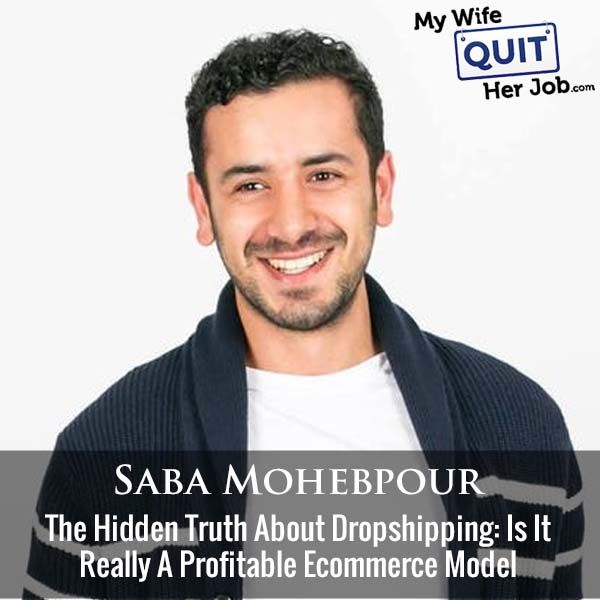
Dropshipping is profitable when you run a tight niche store (typically 1 to 10 focused products, not 500), source from vetted US or EU suppliers with 25 to 50 percent baked-in margin, and have either paid-acquisition skill or an existing audience to drive traffic. In this episode of the My Wife Quit Her Job podcast, Spocket founder Saba Mohebpour walks through what the data across his 150,000+ merchants actually shows about dropshipping viability, and where AliExpress-based stores tend to die within six to eight months.
Saba built Spocket after 10 to 11 failed apps, self-taught himself to code from a $14.99 Udemy course, and launched on the Shopify App Store in 2017. Spocket is now a marketplace of over 3,000 vetted suppliers and 1.5 million products, and about 68 to 70 percent of Spocket orders route through US and EU suppliers rather than AliExpress.
I am not a huge dropshipping fan as a long-term model, which made this a useful conversation. Here is the honest breakdown of what works, what does not, and how the successful merchants graduate off pure dropshipping.
Get My Free Mini Course On How To Start A Successful Ecommerce Store
If you are interested in starting an ecommerce business, I put together a comprehensive package of resources that will help you launch your own online store from complete scratch. Be sure to grab it before you leave!
Table of Contents
Key takeaways
- Successful Spocket dropshippers run niche stores with 1 to 10 focused products, not general Amazon-style catalogs. Spocket caps its top tier at 10,000 pushable products because more than that wastes merchant time, per Spocket’s own data.
- Vetted US and EU suppliers on Spocket must offer 25 to 50 percent off retail as a condition of joining, which is what gives dropshippers baked-in margin before they pay for any marketing.
- 68 to 70 percent of Spocket orders route through US/EU suppliers rather than AliExpress. AliExpress-based dropshipping can spike to seven figures in three months and then die inside six to eight when competition arrives.
- The two proven traffic engines for dropshippers on Spocket: paid-acquisition specialists with a positive ROI who reinvest every dollar, and creators with existing Instagram audiences (10K to millions) who launch stores to their followers at zero acquisition cost.
- The all-in cost to start testing a dropshipping store is under $100 per month (Shopify at $25-40, Spocket at $30). Saba’s point: that is less than one dinner out, and the lesson-per-dollar ratio on a failed store is high.
- Spocket’s customer-support KPIs: under 2-minute response time, 95 percent+ CSAT/NPS weekly average, with 35 people staffing 24/7 support that Saba himself still reads 10 to 15 tickets from daily.
- The natural graduation path is dropship to test, then move winners to white-label via Spocket’s Jubilee partnership (0 to 12,000 merchants in four months), then eventually to private label with your own inventory.
Is dropshipping actually profitable in 2026?
Dropshipping is profitable when the store is niched, the supplier margin is real (25 to 50 percent off retail before marketing costs), and traffic comes from either skilled paid acquisition or an existing audience. Across Spocket’s 150,000+ active merchants the winners consistently share those three traits; general-catalog stores trying to be smaller Amazons consistently do not.
The failure mode is the opposite pattern: a broad catalog of hundreds or thousands of imported products, no niche focus, unvetted AliExpress suppliers with four-to-eight-week shipping, and no acquisition channel beyond hoping people find the store. That combination is why dropshipping has such a bad reputation, and it is what most beginners default to.
Dropshipping is best treated as a low-cost testing lab. The cost to run the test is around $100 per month, and the merchants who eventually build real businesses use the drop-ship stage to find winning products before they graduate to white-label or private label.
Who is Saba Mohebpour and how did Spocket start?
Saba Mohebpour is the founder and CEO of Spocket, a dropshipping marketplace with over 150,000 active merchants across Shopify, Wix, BigCommerce, Ecwid, Square, Squarespace, WooCommerce, and (as of the recording) eBay, with an Amazon integration launching within four weeks. Spocket has over 3,000 vetted suppliers and about 1.5 million products, roughly 90 percent based in the US and Europe.
Saba’s path in is unusual. He moved to Canada in 2012 for pre-med at UBC, saw a 2015 YouTube interview about a 17-year-old whose app Summly sold to Yahoo for $30 million, and decided to teach himself to code that night. He bought a $14.99 Udemy course, downloaded Apple’s Swift book, and coded 16 to 17 hours a day through the rest of his degree.
He built and killed 10 to 11 apps before Spocket, which launched on the Shopify App Store in June 2017. Spocket raised a Canadian seed round eight months in, went through Techstars, and has not raised since. Every failed app taught a compounding skill: coding first, then Facebook ads, then hiring, then grants, then how to run a company.
Why niche stores beat general catalogs in dropshipping
Niche stores beat general catalogs in dropshipping because customers who want a generic product go to Amazon or eBay first. A dropshipping store’s only advantage is specificity: 1 to 10 curated products for one audience, presented better than a marketplace can, marketed to a targeted community.
Spocket’s own product decisions reinforce this. The top Unicorn tier caps pushable products at 10,000 even though raising the cap would take about 30 minutes of engineering, because the data shows that even 10,000 is more than optimal. Their pattern-matching on successful stores is unambiguous.
The rule of thumb: if a customer could find the same product on Amazon in one search, you need something Amazon does not have (a narrower audience, better content, an exclusive angle, or the trust of an existing community) or you will lose the price comparison.
The 3 traffic engines that make dropshippers successful
There are three traffic engines Spocket sees repeatedly in its winning merchants. Each requires a distinct skill or asset before you launch, and mismatching them to your situation is where most beginner dropshippers stall.
Traffic engine 1: skilled paid acquisition with a positive ROI loop
Some of Spocket’s top merchants are essentially agencies-that-also-dropship. They launch a store as a side project, run paid ads with disciplined ROI tracking, and pour every extra dollar back into ad spend to scale. One merchant Saba described was doing millions in sales this way, and eventually built a brand on top of the store.
Traffic engine 2: an existing social audience
Creators with 10,000 to millions of Instagram followers spin up dropshipping stores as monetization for an audience they already have. Because acquisition cost is effectively zero, cash flow is positive from day one. Saba described a Spocket case study of a merchant who scaled from one store to four, doing $2 to $2.5 million per year, very profitably.
Traffic engine 3: SEO and content that funnels to product pages
The third engine is the classic content-first approach: rank in search, or build an owned audience via blog/YouTube/newsletter, then funnel that traffic to product pages. This overlaps with what I recommend to my own students who do not already have an ad-buying skill or a social following.
Spocket’s supplier vetting: what the 25 to 50 percent margin rule means
Every supplier on Spocket must offer 25 to 50 percent off retail as a condition of joining, so merchants automatically start with margin. That is one of about 10 requirements on the onboarding checklist, and Spocket’s vetting process runs multi-week to multi-month per supplier from first contact to live.
Supplier types on the platform range from pure warehousing-and-shipping wholesalers, to Etsy-style handmade limited editions, to aggregators who pull from multiple small suppliers. About 90 percent of the 3,000+ supplier base is US or Europe, which is what enables the fast shipping that separates Spocket from AliExpress-based platforms.
Suppliers can still sell direct on their own site, and rarely compete meaningfully with dropshippers because most suppliers are strong manufacturers and weak marketers. Spocket’s pitch to them is: focus on producing, warehousing, and shipping, and let hundreds of merchants handle marketing and selling.
US/EU dropshipping vs AliExpress dropshipping: what the data shows
| Dimension | US/EU dropshipping (Spocket vetted) | AliExpress dropshipping |
|---|---|---|
| Share of Spocket orders | ~68 to 70 percent | ~30 to 32 percent |
| Shipping time | Days | 4 to 8 weeks historically; better today but still slower |
| Supplier vetting | Vetted by Spocket (~10-item checklist, multi-week onboarding) | Not vetted; merchant reviews ratings themselves |
| Guaranteed margin | 25 to 50 percent off retail baked in | Variable; merchant negotiates |
| Dispute resolution | Spocket mediates and processes refunds if warranted | Not covered by Spocket support |
| Typical revenue lifespan of winning products | Sustainable long-term | Often 6 to 8 months before competition kills margins |
| Best fit for | Long-term brand-building merchants | Fast paid-acquisition operators willing to churn products |
Saba’s honest take on AliExpress: some merchants make several million dollars in two to three months on a winning product, then the competition arrives, margins collapse, and the store dies. That is a valid short-cycle model if you are a paid-acquisition specialist, but it is not a business that compounds.
What does a dropshipping test store actually cost to run?
A dropshipping test store costs under $100 per month all-in: Shopify at roughly $25 to $40 depending on the plan you pick, Spocket at $29 to $30 for the starter, and no inventory to buy upfront. Compared to the cost of two dinners out or eight to nine coffees, the lesson-per-dollar ratio on a failed store is much better than most people give it credit for.
Saba’s argument to friends who balk at the monthly fee: they will happily spend $100 on cocktails but perceive a $30 SaaS bill as expensive, when the SaaS is the cheapest way to learn Shopify setup, taxes, theme configuration, sourcing automation, and Facebook ads all at once. If the first store fails, the second one starts with real skills.
The starter Spocket plan at $29 includes access to the 1.5M+ product marketplace, AliExpress and Alibaba integrations, white-label via Jubilee, NFT-store creation, winning-products data, image search, real-time inventory sync, and 24/7 customer support with a sub-2-minute response SLA.
The graduation path: from dropshipping to white-label to private label
The natural progression for successful Spocket dropshippers mirrors what Shopify saw with Shopify Plus. Merchants dropship to test, find winners, then need a way to keep growing without staying stuck on generic supplier products. Spocket’s answer is a partnership with Jubilee (focused today on cosmetics, expanding to fashion) that lets merchants slap their logo on manufacturer-produced product and treat it as a private-label brand.
Jubilee scaled from essentially zero to over 12,000 active merchants in the four months since the partnership launched, which points to real demand for the graduation path. It is $19 per month plus a small per-order cut on top of Spocket’s own fees.
The final step is true private label with your own inventory purchase. Spocket suppliers will typically offer up to 50 percent off retail on bulk orders, which is the wholesale price. That is what lets you self-warehouse, customize packaging, and control the unboxing experience.
Frequently asked questions
Is dropshipping still profitable in 2026?
Dropshipping is still profitable in 2026 when you run a niche store of 1 to 10 focused products, source from vetted suppliers with 25 to 50 percent baked-in margin, and drive traffic through paid acquisition, an existing audience, or SEO/content. General catalogs of hundreds of imported products competing with Amazon on price are the pattern that consistently fails.
How many products should a dropshipping store have?
A dropshipping store should typically have 1 to 10 focused products in one narrow niche, per the data Spocket sees across its successful merchants. Spocket caps even its top-tier plan at 10,000 pushable products because more than that consistently wastes merchant time without improving store performance.
How much does it cost to start dropshipping?
The all-in cost to start dropshipping is under $100 per month with no inventory: roughly $25 to $40 for Shopify, $29 to $30 for a supplier marketplace like Spocket, and no upfront product buys. The bigger real cost is testing budget for paid ads if that is your traffic channel.
Is AliExpress dropshipping still viable?
AliExpress dropshipping can work in short bursts (some Spocket merchants hit several million dollars in two to three months on a winning product), but competition typically kills the margin within six to eight months. It is a valid model for skilled paid-acquisition operators willing to churn products, and a poor fit for anyone building a long-term brand.
What margin do vetted dropshipping suppliers offer?
Vetted dropshipping suppliers on Spocket must offer 25 to 50 percent off retail as a condition of joining the marketplace, so merchants start with margin before any marketing spend. Bulk-order pricing on the same supplier products can reach the full 50 percent discount, which is the wholesale price for merchants ready to hold inventory.
Where do successful dropshippers get their traffic?
Successful dropshippers on Spocket get traffic from one of three engines: skilled paid acquisition with a positive-ROI reinvestment loop, an existing social audience (typically Instagram followings of 10,000 to millions), or SEO/content that funnels to product pages. Merchants who match one of these engines to their own strengths before launch outperform generic-store operators by a wide margin.
Should you dropship first and then move to private label?
Yes. Dropshipping is the lowest-cost way to test which products actually sell, and the standard graduation path is dropship to find winners, move winners to white-label (via a partner like Spocket’s Jubilee integration), then to full private label with your own inventory. Jubilee grew from zero to 12,000 active merchants in four months, so the demand for that graduation is real.
Do you own the customer relationship in dropshipping?
Yes, the customer is yours and their data lives in your store, not the supplier’s. The supplier handles fulfillment; you handle acquisition, email, SMS, retargeting, and lifetime value. That is what makes dropshipping a valid first step toward a real ecommerce brand even when the individual product margins are thin.