Podcast: Download (Duration: 1:00:54 — 70.0MB)
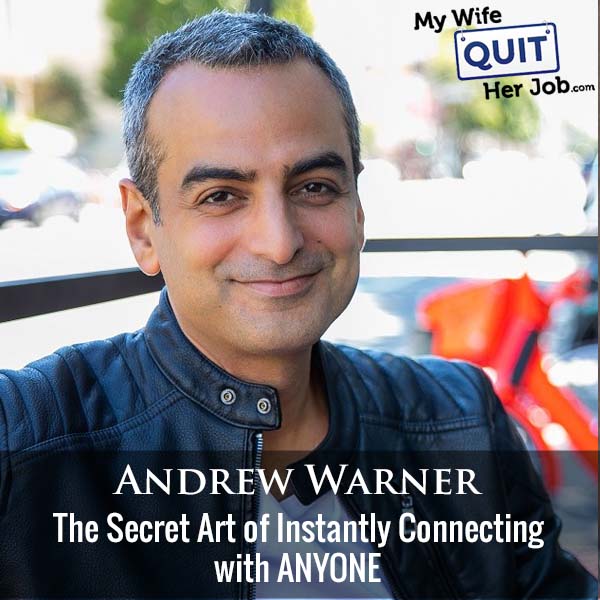
The fastest way to connect with anyone, even someone far above you in status, is to walk in as a student instead of an expert, name the audience your conversation is really serving, and remove the pressure to perform by asking the other person, up front, what a win looks like for them. That is the entire on-ramp Andrew Warner of Mixergy has used across more than 2,000 interviews with founders like Barbara Corcoran, Gary Vaynerchuk, and Paul Graham, and it is what he lays out in his book Stop Asking Questions.
In this episode of the My Wife Quit Her Job podcast, I sat down with Andrew, one of the original interview-podcast pioneers, to unpack the exact people-skills moves he uses to make guests open up, defuse over-rehearsed answers, and turn cold pitches into real relationships. I read his book cover to cover and pulled him on the show because my own business did not start compounding until I started building real relationships with other founders, and Andrew is a master at it.
Below is the full framework, the scripts he uses when a big name will not stop pitching, and the tactic that finally got him to finish a book he had been trying to write for years.
Get My Free Mini Course On How To Start A Successful Ecommerce Store
If you are interested in starting an ecommerce business, I put together a comprehensive package of resources that will help you launch your own online store from complete scratch. Be sure to grab it before you leave!
Table of Contents
Key takeaways
- Show up as a student, not an expert, and explicitly tell the other person you are trying to learn from them.
- Ask “what would make this a win for you?” before the conversation starts so you can align on their goal.
- When a guest keeps pitching, warn them with a short story about a past guest who bombed by promoting too hard.
- Call out over-rehearsed answers with appreciation, then follow with a small piece of vulnerability to go deeper.
- Big-name guests are usually too media-trained to be interesting; the “motivated moment” is when they will show up for free.
- Use podcasting itself as your learning vehicle. If a topic fascinates you, launching a show is the fastest way to talk to the smartest people in it.
- A published book is a physical trust object. Keep copies around because people bring them up and pass them on.
How to connect with anyone above your status
The trick to connecting with someone above your status is to remove the pressure of being “good enough” by openly framing yourself as a student who is trying to figure something out on behalf of a real audience. Andrew’s guiding move for the last two decades has been to walk in and say, in plain words, “I do not know this topic, that is why I asked you here, will you help me?”
The reason this works is that it flips the anxiety in the room. A high-status person is usually worried about two things when they say yes to a conversation: are they wasting time with a novice, and will they be used as a mouthpiece.
Naming your own inexperience out loud kills both worries. You are not pretending. You are asking them to teach, which is a role most experts enjoy.
How to make a big-name guest take you seriously when you have no audience
To get a big-name guest to take you seriously when you have no audience, name the specific audience that will still hear this conversation, even if that audience is just one person driving to a job interview at their company. In Andrew’s early days he told founders that his interviews would be the source someone driving to a meeting with them would listen to on the way, or the piece a future grandkid would use to understand family history.
He gave one example on the show. In the earliest Mixergy days he interviewed the founder of JibJab, who showed up in a baseball cap and clearly saw the interview as a favor.
Before hitting record, Andrew told him he was recording something the founder’s grandkids would one day play back to learn how their grandpa got successful. Years later that founder emailed asking for a clean master copy of the interview for his family. The framing worked because it was true, and because it made the conversation feel meaningful in a way that had nothing to do with audience size.
How to get an over-rehearsed guest to open up
To get an over-rehearsed guest to open up, call out the rehearsed answer with genuine appreciation, then follow with a small piece of your own vulnerability so they feel safe going one layer deeper. Andrew’s exact framing is close to, “I have heard you tell that story on other podcasts, I love it, and I want to go a little deeper. The thing I am wrestling with right now is.”
Andrew’s take on the mechanic is that the biggest names in business are basically Mark Cuban tier at repetition. They have told the same story at cocktail parties, on late-night shows, and on 50 previous podcasts.
They are not being dishonest. They are being efficient. Naming that pattern with warmth signals that you did your homework and you are not going to reward the canned answer, which is often enough to pull them off script.
How to stop a guest from turning your interview into an infomercial
To stop a guest from turning your interview into an infomercial, warn them beforehand with a short story about a previous guest who lost the audience by over-promoting. Direct rules like “please do not pitch” do not stick. Stories do.
Andrew’s version sounds something like, “I had a guest on recently, I will not say his name, and he was a promotion machine. My audience hated it, I got hate mail, and it hurt him more than it helped.” Then he offers to handle the promotion himself in the tee-up so the guest does not feel pressure to force it.
He also frontloads alignment by asking the guest before the recording, “What would make this a win for you?” That question makes the guest feel like you are on the same side, which lowers their defensiveness and their urge to grab airtime for their agenda.
Why big-name podcast guests do not automatically move the needle
Big-name podcast guests do not automatically move the needle because they are over-interviewed, over-rehearsed, and their stories have already been told everywhere else your listeners might go. Andrew is direct about this. Most of his best-performing episodes did not come from household names.
Two reasons. First, the audience wants you to do the hard work of surfacing interesting people they cannot find on their own. Second, the same media training that makes a big name safe to book also makes them boring to listen to.
That said, big names still matter for a different job. They put a face on your brand, they buy you association credibility, and, as Andrew explained about wild-posting magazine ads in Manhattan, media has a unique legal right to feature famous people to sell itself.
How to book big-name guests using “motivated moments”
The most reliable way to book a big-name guest for free is to catch them in a “motivated moment,” which is a stretch of time when they want access to your world and would happily show up for exposure alone. Andrew coined the term in Stop Asking Questions to describe exactly this window.
The classic example he gave on the show is Mark Cuban and Blog World back in the early blogging era. Cuban wanted a way into the blogging scene, so he agreed to speak at the conference without a fee, because being on that stage gave him the credibility he was looking for.
Rappers wanting to invest in tech, actors with a new project, authors right before a book launch, and executives entering a new category are all in motivated moments. The playbook is to figure out what someone is trying to break into and offer them a legitimate on-ramp to it.
Why launching a podcast is the fastest way to learn a new field
Launching a podcast is the fastest way to learn a new field because it converts your curiosity into a formal, repeatable reason to spend an hour with the smartest people in that world. Andrew described this exactly with how he learned about DAOs (decentralized autonomous organizations) through his friend Ben Huh at Orange DAO.
He did not read a book about DAOs. He interviewed Ben about the DAO he had built with Y Combinator founders, then interviewed the founder of VC3, and used every conversation to actually understand how member tokens, portfolio access, and pooled capital work.
The podcast is also the ethical excuse to keep asking. In casual conversation it is impolite to keep digging for 45 minutes. In an interview it is expected.
Steve applied the same logic when starting the My Wife Quit Her Job podcast, treating early episodes as a way to meet e-commerce founders he otherwise had no reason to approach.
Andrew’s pre-interview vetting process
Andrew still does a pre-interview with almost every guest, and the single filter he uses is whether he is genuinely curious enough to want to use what the person is doing. Not just “is this guest impressive on paper.” Curiosity that could lead to action.
He is comfortable being the person who says no after a pre-interview, even when it is uncomfortable, because the pain of an off-topic episode is worse than the pain of a polite rejection. He often writes the rejection as: “My audience is expecting this specific thing, your story does not fit that right now, if we force it in they will feel cheated and be angry at both of us, so let us come back when the story fits.”
The most common reason he passes is that a founder has inflated their exit or their metrics on social media and the numbers do not survive a real conversation. He calls the small, LinkedIn-only exit a “gentleman’s exit” and says booking a guest whose story you know you will have to challenge on air is a bad deal for everyone.
How Andrew finally finished his book
Andrew finally finished Stop Asking Questions by paying for accountability in two forms: a weekly editor check-in and a Focusmate co-working partner watching him write on webcam for $5 a month. He had tried and abandoned book projects for years because he over-respected the format and would not start.
The unlock was borrowing a system from his friend Robby who used an editor as a weekly commitment device. Andrew hired the same editor’s colleague, wrote alongside her on shared screen sessions, and paired that with a random Focusmate stranger for extra reps.
The other unlock was that he already had the raw material. Over years of doing Mixergy interviews he had built a Google Doc of every technique he had used to get guests to open up, complete with transcript snippets showing each one in action. That doc became the spine of the book.
Why a physical book is a trust object worth keeping around
A physical book acts as a portable trust object, and that is why authors who build businesses keep stacks of their book around and hand them out in person. Andrew was initially skeptical about this, then watched multiple author friends do it well and changed his mind.
He gave three concrete examples. Hal Elrod donated his own books to a school fundraiser and it worked. Chandler Bolt keeps 10-plus copies on his dining room table when he entertains, and guests take them home.
Nick Gray of the Two-Hour Cocktail Party laid out three copies at his parties and asked guests to take a photo of the book if they enjoyed the night.
Steve now applies the same idea to The Family First Entrepreneur, which debuted as a Wall Street Journal business bestseller. A book gives a stranger something tangible to associate you with, and unlike a website URL or a podcast link, it lives on someone’s shelf for years.
The launch playbook Steve used to make The Family First Entrepreneur a WSJ bestseller
Steve’s playbook for hitting the Wall Street Journal bestseller list was to spend years building distribution first, then stack bulk buys, favor-based promotion, and bonuses on launch week. He was open with Andrew about the exact levers.
He grew a YouTube channel to roughly 200,000 subscribers in preparation for the launch, ramped up his Twitter presence, and joined TikTok, all so that on launch day he had multiple owned channels to blast at once. Then he cashed in favors with sponsors and friends for bulk orders, guest appearances, and email blasts to their lists.
The other lever was bonuses. Steve gave away $690 in bonuses (a three-day print-on-demand workshop, a two-day passive-income workshop, invitations to book parties around the US, and access to a six-week live challenge) because, as he put it, people do not buy books, they buy the transformation the book unlocks.
The Family First rule Andrew regrets breaking
Andrew told Steve his one work-life regret is having enjoyed his kids so much in the middle years that he coasted on his existing systems and stopped pushing himself in new directions. He is not advocating for aggressive workaholism, but he also is not advocating for pure balance.
His current stance sits closer to what he calls an “aggressive fear of failure.” He believes his kids need to see him working hard because the work ethic they build for themselves comes largely from watching their parent live it out.
Steve’s answer to the same tension is to run one focused project per year (book, YouTube, Twitter, TikTok) and cap spending at what he actually needs, so there is no financial reason to grind. That gives his ego something to obsess over without letting revenue goals steal his family time.
Frequently asked questions
Who is Andrew Warner and what is Mixergy?
Andrew Warner is the founder and host of Mixergy, one of the original founder-interview podcasts on the internet, with more than 2,000 interviews with entrepreneurs including Barbara Corcoran, Gary Vaynerchuk, and Paul Graham. He is also the author of the book Stop Asking Questions, published in 2021 by Damn Gravity.
What is Andrew Warner’s book Stop Asking Questions about?
Stop Asking Questions is a practical playbook for leading high-impact interviews and getting anyone to open up, drawn from Andrew’s two decades of interviews on Mixergy. It teaches specific conversational moves like the “motivated moment,” how to call out rehearsed answers, and how to align on what a “win” looks like for the other person before you record.
What is a “motivated moment” in an interview?
A motivated moment is a window of time when a high-status person actively wants access to your world and will show up for free because being associated with your audience helps them. Book launches, category pivots, and executives moving into a new industry are all common motivated moments.
How do you get an over-rehearsed guest to open up?
Acknowledge the rehearsed answer with appreciation, tell them you have heard the story elsewhere, and then share a small piece of your own vulnerability to invite them one layer deeper. This signals that you did your homework and are not going to reward the canned reply.
How do you stop a podcast guest from over-promoting during an interview?
Before recording, tell a short story about a past guest who lost the audience by pitching too hard, and offer to handle the promotion yourself in the tee-up so the guest does not feel pressure to jam it in. Ask the guest what a win looks like for them so their agenda is already respected.
What is a DAO in simple terms?
A DAO, or decentralized autonomous organization, is a group of people who pool capital and effort together and use a token-based points system to reward members who contribute more. Orange DAO, run by Y Combinator alumni, invests as a group and lets any member help portfolio companies for token credit.
Why does Andrew keep a physical copy of his book on his desk?
Because a physical book is a tangible trust object that people bring up in conversation, take home, and remember. Chandler Bolt taught Andrew to keep copies around when hosting because guests will take them, and it conveys authority in a way a website or podcast link cannot.