
Podcast: Download (Duration: 47:15 — 54.4MB)
The 19 million dollar business ideas below are the full list Nick Loper of Side Hustle Nation and I brainstormed in this episode, ranging from a Core Web Vitals productized service to a Shopify shopping-cart round-up plugin. Every one is a real gap either of us has run into as a customer, which is the single best place to find a business idea worth chasing.
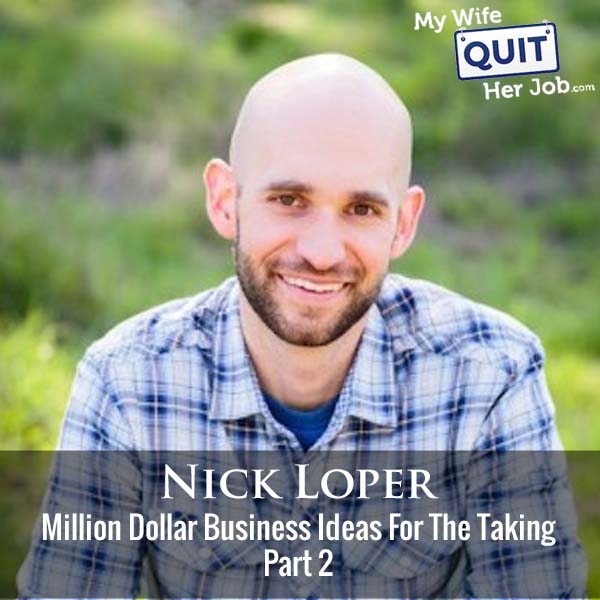
This is Part 2 of a recurring segment on the My Wife Quit Her Job podcast where Nick and I riff on side hustles for 2023 that you can start with little or no money. Part 1 was episode 429, and it was our most-downloaded idea episode, so we brought Nick back to run it again.
Below you will find every idea, why the pain point exists, and how to think about turning it into a paid service or product.
Get My Free Mini Course On How To Start A Successful Ecommerce Store
If you are interested in starting an ecommerce business, I put together a comprehensive package of resources that will help you launch your own online store from complete scratch. Be sure to grab it before you leave!
Table of Contents
Key takeaways from Nick Loper’s million dollar business ideas
- Every one of the 19 ideas came from a real, first-hand pain point Nick or I had recently lived through. That is the whole methodology, and it is the fastest way to spot a side hustle worth building.
- Productized services (a fixed scope for a fixed fee) show up over and over on the list, because they are the lowest-friction way to package a skill you already have.
- AI is the enabling technology behind at least four of the ideas (SteveBot, podcast repurposing, group travel planner, Lego repurposing), and most can be built by one person using off-the-shelf tools.
- Two ideas, Pod Reacher (podcast repurposing) and the same-old-line-dudes (paid line waiters), already exist as validated businesses generating six figures, which proves the format works.
- Nick’s idea-generation trick: search Exploding Topics for a fast-rising query, then ask “what productized service would I sell against that trend?” That is how the Core Web Vitals idea surfaced.
- You do not need any of these exact ideas. Use them as a template and repeat the exercise on your own life.
Where to brainstorm million dollar business ideas
Most of these ideas came from two sources: personal pain points we ran into that week, and trend-mining tools like Exploding Topics. Nick opened the episode with an Exploding Topics search that surfaced “Core Web Vitals” as a rapidly rising query, which he then turned into a productized-service idea.
Exploding Topics is basically a curated version of Google Trends. It surfaces queries that are climbing before they peak, which is exactly when a service business around that query has the least competition.
The pain-point method is even more reliable. Almost every idea on this list started with either Nick or me saying “I wish someone would just do this for me” during a normal week. If you keep a running note of those moments for 30 days, you will have your own list of 19.
Idea 1: Core Web Vitals optimization service
The first million dollar business idea is a productized service that fixes a site’s Core Web Vitals score for a flat fee. Core Web Vitals are Google’s page-experience metrics (Largest Contentful Paint, Interaction to Next Paint, Cumulative Layout Shift), and they directly affect search rankings.
Nick’s pitch: start on Fiverr with a “I will fix your Core Web Vitals score for $100” listing, learn on real client sites, then graduate into a monthly retainer where you keep the score healthy as Google’s thresholds shift.
I speak from experience here. I fixed my own Core Web Vitals by hand, and it was miserable.
Google’s diagnostic tool spits out technical jargon and generic “recommended actions” that are useless if you are not a developer. I would have paid a real human to do it in a heartbeat.
Idea 2: Accountability text-message service
The second idea is a paid accountability service that pings your customer once a week to ask if they hit the goals they set the week before. The entire product is that weekly text message. A dashboard, a course library, and a community are all optional (and probably a distraction).
I have taught my Profitable Online Store course for over a decade, and the single biggest reason students stall is not intelligence or lack of information. They stall because nobody is asking them “did you actually do the thing this week?”
A membership does not need a huge content library to work. Sometimes the whole value proposition is a human (or a well-designed text prompt) looking over your shoulder.
Idea 3: AR health gamification app
The third idea is a health-gamification layer for augmented reality glasses that overlays the true cost of each food choice in your field of vision. Think “this steak is minus 14 minutes of life expectancy, this salad is plus 15 minutes,” delivered as an AR overlay while you are ordering.
Nick’s inspiration was his first-grader’s Eager Reader program at school, which turned reading into a measured contest and had the kid reading two to three hours a day. Gamification changes behavior when a passive good habit becomes a quantified competition.
The consumer proof point is Fitbit. My wife does not work out, and she once hit 35,000 steps in a single day (roughly 10 to 12 miles) just to beat our friend group on the weekly leaderboard.
Idea 4: Rent-a-garden service
The fourth idea is a rent-a-garden service that gives customers a maintained plot of good soil in exchange for a monthly fee. You handle sunlight, water, and soil conditions; the customer plants their own seeds and harvests their own crops.
The pain point is real. My wife and I keep trying to grow vegetables in our backyard and they keep dying because our conditions are wrong. We would gladly pay someone else to guarantee the plants live.
Community-garden precedent already exists (Nick’s HOA runs one), so the market is validated. The upsell is a full-service tier where the operator also tends the plot for busy customers.
Idea 5: Kids’ summer camp aggregator site
The fifth idea is a local aggregator site that pulls together every summer camp and kids’ program in a metro area, with registration dates, price, age range, and a calendar visualization so parents can block out the whole 10-week summer at a glance.
Right now this planning is completely fragmented. Some camps open registration in March, some in late April, some sell out in 48 hours. Parents end up printing physical calendars to figure out which weeks are covered.
The premium tier writes itself: an AI agent that just registers your kids for the three camps you picked, based on your criteria. Summer camp is one of the highest-stress logistics problems parents face every year.
Idea 6: Ethnic foods monthly subscription box
The sixth idea is a monthly subscription box that ships snacks and packaged foods from a specific country you cannot easily buy in the United States. I came up with this literally the night before recording, after getting back from Japan and realizing I could not source most of the snacks I wanted to bring home.
Start with one country to keep sourcing and customs simple. The natural expansion is to rotate countries monthly, which conveniently gives the founder a business reason to travel.
Validation exists in adjacent niches: a listener of ours ran a Hawaii subscription box during 2020 when tourism collapsed, and there are Canadian subscription boxes serving expats in the US. Curation and marketing are the real levers.
Idea 7: Laugh reminder app for longevity
The seventh idea is a “Laugh Reminder” app that pings you once a day with a funny video, a funny story, or a clip of a family member laughing. Positioned as a longevity and gratitude practice, not a comedy app.
Nick pointed to a multi-year National Institutes of Health study of participants in Japan that found people who reported laughing more frequently lived longer and had significantly fewer cardiovascular events than those who did not. That is real, publishable research you can cite in your marketing.
The killer feature is user-uploaded clips of your own family, so the app pings you with your five-year-old’s giggle instead of a stranger’s. That personalization is what turns a novelty into a daily habit.
Idea 8: SteveBot, an AI clone of your own content
The eighth idea is what I have been calling “SteveBot” internally. You take every transcript from your podcast, YouTube channel, and course library, feed it into a fine-tuned bot on the ChatGPT API, and let your audience pay to ask the bot questions.
For me, it is a natural add-on to my Profitable Online Store course. Students who have a quick question get an instant answer trained on my exact material, and I do not have to answer the same question for the ten-thousandth time.
I am actively building this. If you have hundreds of hours of your own content sitting on YouTube or Apple Podcasts, you are one weekend of transcription and a $20/month OpenAI account away from having your own version.
Idea 9: Podcast repurposing service (validated at $420K in revenue)
The ninth idea is a done-for-you podcast repurposing service that turns each episode into Twitter threads, short-clip videos, LinkedIn posts, and other social assets. Nick pointed to Pod Reacher by Jacquelyn Scivicque, which reported $420,000 in revenue by mid-2022 (per her Starter Story interview), as proof the model works.
This is the “catching a rising tide” framework in action. Podcasting keeps growing, discovery keeps being hard, and every podcaster wants more mileage from content they have already recorded.
Version one was human-powered. In 2023 an AI-heavy version with a human editor on top is probably the right build. Same value, better margins.
Idea 10: Easter egg party service
The tenth idea is a seasonal party-throwing service that stuffs candy-, cash-, and prize-filled Easter eggs and hides them on the client’s property. My friend recently threw a party with 2,500 stuffed eggs, and a local mega-church near Nick’s house ran an event with 60,000. Stuffing that many eggs is genuinely tedious.
The seasonal weakness is the same as every holiday business, so the smart play is to stack complementary holidays: Easter, Fourth of July scavenger hunts, Halloween setup, Christmas light installs. A luxury-picnic operator we profiled a few years back runs on the same model.
Local, seasonal, high-margin, and repeatable every spring.
Idea 11: AI group and rewards travel planner
The eleventh idea is an AI travel planner built specifically for group travel and credit-card rewards optimization. Feed it four families’ points balances (Ultimate Rewards, Amex, Capital One, United, and so on), the dates that work, and a rough destination, and let it return the actual optimal booking.
Nick tries to plan an annual friendsgiving with the same group of 15+ years, and the flight-and-hotel logistics eat entire evenings. The manual work of comparing four departure cities, points programs, and layover hacks (like the free-connecting-flight trick out of certain hubs) is exactly what an AI agent should do.
I ended up defaulting to cruises with my friend group because the logistics of planning any other kind of trip across four families’ schedules was too painful. A working version of this tool would have kept us on land.
Idea 12: Hands-free backpack umbrella
The twelfth idea is a physical product: a backpack or harness attachment that holds an umbrella over your head so both hands stay free. I saw a guy in Shibuya, Tokyo who had rigged one from tape and a stick, and I have never seen it as a real product.
The target customer is obvious: urban commuters in cities like Seattle, London, or Tokyo where it rains most of the year and you need a phone and a Google Maps hand while walking. Dog walkers checking the mail are a second segment.
This is a classic private-label physical product setup. Prototype it with a factory, test it on Amazon, and see if the umbrella-hat crowd from decades ago will upgrade to a modern version.
Idea 13: Friend proximity travel notifications
The thirteenth idea is an opt-in app that quietly notifies you when a friend from your network happens to be in the same city or country as you at the same time. It does not share continuous location, just the fact of overlap.
Nick’s pain is one every frequent traveler has: you get home from Florida and a friend texts “dude, you were just in my city, why didn’t you tell me?” The chance encounters those apps enable are disproportionately valuable, especially when you are traveling internationally.
Facebook used to surface a “friends in [city]” list when you posted a travel update, and Nick reconnected with a college classmate that way. That feature has largely gone away, which leaves a real opening for a privacy-respecting standalone.
Idea 14: Create-a-crowd social proof service
The fourteenth idea is a service that pays real people to hang out in front of a new restaurant, product launch, or physical store to manufacture social proof. Walking into a restaurant in Kyoto, our decision rule was “get in the longest line,” because Yelp did not work there and a line is the most trusted signal humans have.
A friend of mine just opened a restaurant and told me his biggest fear was an empty opening night. Paying a service to seed 30 minutes of foot traffic with a free snack giveaway would solve that.
Precedent exists. There is a business called Same Ole Line Dudes (SOLD) that gets paid to wait in line for iPhone launches, Nike drops, and Broadway tickets. The evolution is to send those same people to a client’s storefront to create buzz on cue.
Idea 15: A better UI for TreasuryDirect I-bonds
The fifteenth idea is a modern front-end layered on top of TreasuryDirect.gov, the federal site for buying US Series I savings bonds. I bonds paid a peak yield of 9.62% in 2022, so demand spiked, but the interface is famously awful: virtual keyboards for passwords, IP-flagged spouse accounts, and paperwork that has to be notarized at a bank.
The model already works elsewhere. Trademarkia layered a modern search UI on top of the USPTO trademark database, which is another government site with a bad interface. Same pattern here.
The technical challenge is that TreasuryDirect has no public API, so you would need to work carefully within their terms of service or partner with a broker. But the pain is unambiguous and the audience is large.
Idea 16: Lego separator, organizer, and repurposing service
The sixteenth idea is a mail-in service that separates and reorganizes your family’s mixed-up Lego collection, then ships back a series of new build kits (with printed instructions) assembled entirely from the pieces you already own.
The pain point is my house. We bought Lego sets every week when the kids were young, and now we have giant tubs of mingled bricks and half-broken kits that no one will ever rebuild. My wife literally asked me if this service existed.
The AI upgrade is obvious. Ingest a photo or an inventory of the customer’s bricks, and generate custom build instructions for something new (a Saturn V, a T-rex, a spaceship) using only pieces they already have. A community Lego-inventory site already exists that estimates retail value, so the plumbing is not exotic.
Idea 17: Centralized affiliate program database and payout aggregator
The seventeenth idea is actually two closely related businesses. The first is a searchable database of every brand’s affiliate program that tells you which network(s) it runs on (Impact, PartnerStack, CJ, ShareASale, in-house, and so on) and what the current commission rate is.
The second, and the one I would personally pay for, is a payout aggregator. I currently run affiliate accounts with 20 to 30 different companies across a half-dozen networks. I want one dashboard, one payout, and one 1099 at the end of the year.
The closest existing tool is Affluent.io, owned by Impact, which pulls reporting from 15+ networks into one dashboard and emails you a daily summary. It handles reporting only, not payment consolidation, so the payout-aggregation piece is still wide open.
Idea 18: Pet discouragement (or pet-practice) service
The eighteenth idea is a “pet discouragement” service that walks kids through the full, unglamorous reality of pet ownership (cleanup, feeding schedule, vet costs, daily walks) so they can make an informed decision before nagging their parents into a puppy.
My kids ask for a dog, a pig, and every other animal on rotation, and none of them understand the actual daily burden. A structured 90-minute intro session with real animals would answer the question for most families in one afternoon.
The positive-framing version already exists: friends of Nick’s volunteer as puppy-raisers for a guide-dog program, which lets families experience a dog for a few weeks. Package that same structure as a paid consumer experience and you have a business.
Idea 19: Shopify shopping-cart round-up plugin
The nineteenth idea is a Shopify plugin that lets any store offer a shopping-cart round-up at checkout: “Round up your $18 order to $20 and we will donate the difference to [charity].” Grocery stores like Safeway have used the paper version of this at the register for years.
Nick’s inspiration was buying $18 of Girl Scout cookies through a QR-code checkout page that did not offer the round-up. He would have happily bumped to $20 for a good cause, but the plugin was not there.
GoDaddy runs a similar prompt at their checkout. On Shopify, a version that supports registered nonprofits (with the auto-generated donation receipt to close the loop) is a clean, defensible SaaS play. The addressable market is every Shopify store that ever runs a cause-marketing campaign.
How to actually turn one of these million dollar business ideas into a business
The ideas above are free for the taking, which also means they are worth nothing until someone builds one. Nick and I ran the same episode format in episode 429 (Part 1), and to my knowledge only a handful of listeners have actually shipped a business from either list.
The pattern that separates the shippers from the collectors is embarrassingly simple: pick one idea today, and by the end of this week have either a landing page collecting emails, a Fiverr gig live, or a $10 Facebook ad running against the pain point. Real customer signal in seven days beats another month of thinking.
If you want to steal the pain-point methodology Nick and I used for this episode, keep a running note on your phone for 30 days. Every time you say “I wish someone would just do this,” write it down. At the end of the month, cross out anything that only affects you, and the survivors are your list.
Frequently asked questions about million dollar business ideas
Are these million dollar business ideas actually free to use?
Yes. Nick Loper and I brainstormed and shared all 19 ideas publicly on the My Wife Quit Her Job podcast, and neither of us has plans to build them ourselves. Anyone can take an idea, validate it, and build a business around it without owing us anything.
Which of these business ideas is the easiest to start with no money?
The productized services (Core Web Vitals optimization, accountability text service, podcast repurposing) are the easiest to start with under $100. You can list a Fiverr gig today, take on your first three clients this week, and be earning revenue before you have a website or a brand.
What is a productized service?
A productized service is a specific scope of work sold for a fixed fee with a fixed deliverable, like a physical product. “I will fix your Core Web Vitals score for $299” is productized, while “web performance consulting, billed hourly” is not. Productized services are easier to sell, price, and scale because the buyer knows exactly what they get.
Who is Nick Loper of Side Hustle Nation?
Nick Loper is the founder and host of Side Hustle Nation, a top-ranked podcast focused on part-time business ideas and case studies of real side hustlers. He has been a guest on the My Wife Quit Her Job podcast three times, and this is his second million-dollar-ideas episode with me (episode 429 was Part 1).
Where do good business ideas come from?
The most reliable source is your own recent frustrations. Nearly every idea on this list started with either Nick or me saying “I wish someone would just do this for me” during a normal week. A second reliable source is trend-mining tools like Exploding Topics, which surface rising queries before they get competitive.
What tools did Nick mention for finding trending business ideas?
Nick specifically called out Exploding Topics for surfacing rising search queries early, and Starter Story for reading revenue-verified case studies of real founders (that is where he found the $420K revenue figure for Pod Reacher). Both are free to browse.
Has anyone actually built a business from Nick’s previous ideas episodes?
At least one listener has. Dr. David Powers of RuggedDadLives.com reached out after Nick pitched a “zombie apocalypse consultant” idea in Part 1, because he is a Marine Corps veteran board-certified in emergency crisis response and effectively already runs that business.