
Podcast: Download (Duration: 48:32 — 55.8MB)
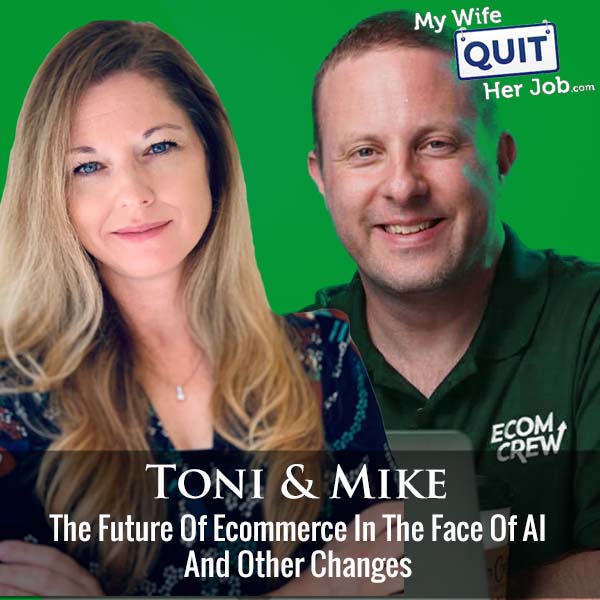
In this episode of the My Wife Quit Her Job podcast, I sit down at the Alibaba Co-Create Conference with Mike Jackness (EcomCrew, Terran, Colorit) and my business partner Toni Herrbach to argue about where ecommerce is actually headed. Between AI-driven shopping, tariffs on Chinese imports, and Amazon’s continued market-share grab, both DTC and Amazon sellers are being forced to pick a defensible moat now or get commoditized.
The short version: Amazon still owns 50 percent of US ecommerce and its logistics moat is nearly impossible to catch, but the future for individual sellers is the opposite of a race to the bottom. It is niche products with real moats: intellectual property, US-based last-mile assembly or customization, or a real brand story that only works in a DTC funnel.
Here is the full conversation, restructured: how sourcing is changing (Alibaba vs sourcing agents vs your own team in China), why Mike is going to India next, why tariffs became a small-business tax, which products belong on Amazon vs DTC, and Mike’s next play (a warehouse in Nevada, light machinery, IP-backed products).
Get My Free Mini Course On How To Start A Successful Ecommerce Store
If you are interested in starting an ecommerce business, I put together a comprehensive package of resources that will help you launch your own online store from complete scratch. Be sure to grab it before you leave!
Table of Contents
Key takeaways
- Amazon has ~50 percent of US ecommerce, Walmart is next at 6.3 percent. Amazon’s Prime + Whole Foods + delivery infrastructure moat is going to be very hard for anyone (including Walmart) to catch.
- Sourcing tiers: Alibaba for beginners and small orders, a sourcing agent (typically ~8 percent) once you graduate, your own full-time China-based team at scale. Alibaba is not replacing sourcing agents; they solve different problems.
- Section 301 China tariffs (25 to 35 percent extra on many categories) landed as a small-business tax. Almost no one has been able to pass the tariff on to consumers, so the margin hit gets absorbed.
- Amazon works for pain-point, high-intent, low-brand-consideration commodity products (paper clips, light bulbs, ice packs after a wisdom-tooth extraction). DTC works for emotional-trigger, brand-story, or niche products discovered on TikTok and Facebook.
- Mike is preparing to launch a new business built for defensibility: US warehouse, some light machinery for final assembly, intellectual property, silly margins. The whole point is a moat that Alibaba clones cannot copy in a week.
- Beginners can still get started for around $600 to $1,000 if they pick a niche product and treat the first launch as paid education, not the final business.
Where the future of ecommerce is heading (DTC vs Amazon in an AI world)
The future of ecommerce splits along a widening line: Amazon owns pain-point, high-intent, commodity purchases; DTC owns emotional-trigger and brand-story purchases; and AI-driven shopping is about to change how the results pages themselves look on both sides. The winning play is to pick one lane and build a moat inside it.
Amazon keeps grabbing market share and now has ~50 percent of US ecommerce. Walmart is a distant second at 6.3 percent. Amazon’s logistics footprint (warehouses, own delivery vans, next-day shipping, ~100 million Prime members with a card on file) is a moat no one has been able to catch, even with billions in capital.
DTC is bouncing back for a different reason: TikTok and Instagram make it easier than ever for a niche brand to go viral on a story. Mike expects both sides to grow, with the same seller often finding that a product that crushes on Amazon flops in a DTC funnel, and vice versa.
Which products work best on Amazon vs DTC
Amazon works best for pain-point, high-intent, commodity purchases where speed and price beat brand: light bulbs, paper clips, ice packs after a wisdom-tooth extraction. The customer types a generic keyword, does not research, and takes the top-ranked prime option.
DTC works best for emotional-trigger, brand-story, or niche products the customer had not been thinking about 10 seconds before they saw the ad. Mike’s coloring-book company Colorit is the textbook example: no one wakes up planning to buy coloring books, but the right Facebook or TikTok creative in front of the right audience pulls out the credit card at $10 to $30.
Amazon-friendly product signals
An Amazon-friendly product has high branded and unbranded search volume on the marketplace, sits in a category where shoppers do not care about brand, and has a fast pain-point or convenience trigger.
Examples from the episode: ice packs, paper clips, light bulbs, rubber bands, replacement parts. The Amazon customer is impatient, wants Prime shipping, and will pick the cheapest option that looks fine.
The risk for an Amazon-only seller is that low brand loyalty invites cloning. Type any successful ice pack into Helium 10 and you will find 70 Alibaba manufacturers willing to make an indistinguishable version. That is the “hamster wheel” Mike is trying to get off of.
DTC-friendly product signals
A DTC-friendly product has a real story (eco-friendly, single-source, values-driven, personalized), triggers an emotional or aspirational response, or fits a niche audience that ad platforms can target precisely.
Examples: personalized handkerchiefs (Bumblebee Linens), single-source coffee, adult coloring books, values-driven consumables. These same products often flop on Amazon because the higher price and the missing story make them lose to generic competition.
The DTC moat is your funnel, your brand, and your repeat-purchase engine, not the product itself. That is what makes it defensible.
Amazon vs DTC at a glance
| Attribute | Amazon | DTC |
|---|---|---|
| Purchase trigger | Search: “I need X now” | Ad: “I did not know I wanted this” |
| Brand importance | Low for most categories | High |
| Best product types | Commodities, pain-point items, replacements | Niche, personalized, story-driven, values-driven |
| Main moat | Best listing, reviews, PPC, buy box | Brand, funnel, repeat purchase, community |
| Biggest risk | Being cloned by 70 Alibaba sellers overnight | Rising ad costs eating margin |
| Change velocity | Constant (rules, listing format, algo) | Slower on brand, fast on ad platforms |
How AI is going to change the ecommerce shopping experience
AI is going to change the ecommerce shopping experience by collapsing the traditional 20-blue-links results page into a small number of personalized recommendations, on both Google and Amazon. The competition for those few slots will be significantly harder than today.
Think about Netflix. Every household member sees a completely different home screen based on watch history. Amazon is heading the same way: fewer generic search results, more personalized carousels tuned to your specific purchase and browse history.
That means keyword-first Amazon SEO gets less powerful and shopper-history-first personalization gets more powerful. On the DTC side, AI shopping assistants (ChatGPT, Perplexity, Google’s AI Overviews) will surface a handful of recommended brands per query, which makes off-Amazon brand mentions and citations a growing moat.
Sourcing from China in 2024: Alibaba, sourcing agents, or your own team
Sourcing from China in 2024 breaks into three tiers based on order size: Alibaba for beginners and small orders, a sourcing agent (typically about 8 percent) once you graduate to multiple 6- and 7-figure suppliers, and your own full-time China-based team at scale.
Alibaba is not replacing sourcing agents. It solves discovery and vetting for early-stage sellers, but does not solve the on-the-ground advocacy that a good sourcing agent provides.
What a sourcing agent actually does for you
A sourcing agent is a paid representative on the ground in China who negotiates on your behalf, physically inspects your orders, understands the local pricing and quality game, and pushes back on the small quality drift that suppliers will otherwise sneak in over time.
At Bumblebee Linens we have our agent do piece-by-piece inspections against a defect document we have built over years. A one-off inspection firm would not know our specific quality thresholds and could not enforce them the way an ongoing agent does.
Mike’s take: China is the most difficult culture he has navigated across 57 countries, even with a Mandarin-speaking wife. That cultural gap alone justifies the ~8 percent an agent takes.
Do you still need to fly to China?
You do not need to fly to China to source anymore. Alibaba plus a sourcing agent covers the mechanics. But relationships still matter, and once a year of in-person time with your top suppliers pays off in priority, fewer quality issues, and easier hard conversations.
Mike is meeting his biggest supplier in Hong Kong during the Canton Fair (four years after his last in-person meeting) and adding India to the itinerary. The old-school Chinese business dinner (baijiu, lazy Susan, ganbei toasts) is still culturally expected by the older generation of suppliers.
Why India is worth looking at as an alternative to China
India is worth looking at as a sourcing alternative to China because it currently has no Section 301 tariffs, less geopolitical tension, and, importantly, is far less saturated with Western ecommerce sellers than China. That is where the puck is going.
Mike is joining a sourcing trip to India led by Meghla Bhardwaj to scout options. The thesis: China’s advantage in manufacturing scale is enormous, but the crowding of Western sellers into the same Alibaba suppliers has eroded the opportunity for niche differentiation, and India in 2024 looks a lot like China did 8 years ago.
How the China tariffs became a small-business tax
The Section 301 China tariffs (typically 25 to 35 percent on many ecommerce SKUs) landed as a tax on US small businesses rather than a tax on China, because almost no seller has been able to pass the added cost through to consumers.
Nobody wants to raise their retail price, so the margin hit gets absorbed. Mike says the ice-packs business he co-owns took the full 25-to-35 percent extra cost with essentially no ability to reprice. Very few product categories were exempt.
The strategic response is either to sit inside a category with real pricing power (branded DTC, personalization, IP), or to diversify sourcing to non-tariffed countries. Both take real time. Neither is optional if tariffs stay or expand.
How to build a defensible ecommerce business (Mike Jackness’s playbook)
To build a defensible ecommerce business, stack multiple moats on top of the product: intellectual property (patents, unique designs), a physical last-mile step in the US (assembly, personalization, embroidery), repeat business, and a brand real customers care about. Each moat by itself is easy to copy. Stacked together, they are not.
Mike’s next business (not yet named on the show) leans on all of the above: a Nevada warehouse he is preparing to open, some light machinery for US-based final assembly, IP-protected products, silly margins by design. The barrier to entry is meant to be the moat: most competitors will not go rent a warehouse and buy machinery.
Bumblebee Linens is the model. The blank handkerchiefs cost pennies, but what makes it defensible is the embroidery machinery, the warehouse, the SEO position, and the repeat-buyer engine, none of which a random Alibaba drop-shipper can replicate.
The $600 startup cost turned into a seven-figure, recession-resistant business precisely because the moats accumulate.
Why “silly margins” matter more than revenue
Silly margins matter more than revenue because they buy you room to spend on paid acquisition, pay for the moat (US warehouse, machinery, staff), and survive the constant change on both Amazon and DTC ad platforms. A tight-margin business gets whipsawed every algorithm update.
The IP layer is what unlocks the margins. A patented or design-protected product commands a premium and cannot be legally cloned overnight. Combine that with US-based final assembly and you have a product that most competitors will not attempt to copy at all.
Where should a beginner start ecommerce today?
A beginner should start an ecommerce business today for $600 to $1,000 in a small, boring niche, and treat the first product as paid education rather than the final business. The goal of the first launch is to learn the ropes (Amazon Seller Central, Shopify, ads, trademarks, listing images, shipping labels), not to hit a home run.
Analysis paralysis is the biggest killer. Pick anything reasonable and go. Even if the first product fails, you will have built the entire operating stack (LLC, trademark, payment processing, ad accounts, supplier relationship, ship plan) that transfers directly to attempt two.
Mike’s advice for beginners who cannot afford the warehouse-and-machinery moat: chase the same defensibility signals at smaller scale. A niche product (“the riches are in the niches”), a real brand, some form of personalization or last-mile touch, and a repeat-buyer motion. Bumblebee Linens started at $600 and it is the same playbook.
Frequently asked questions
Is Amazon or DTC better for a new ecommerce business?
Amazon is better for pain-point, high-intent, commodity products where brand does not matter (paper clips, replacement parts, ice packs). DTC is better for emotional-trigger or niche products with a real brand story. Very few products win on both.
Is Alibaba replacing sourcing agents?
Alibaba is not replacing sourcing agents. Alibaba solves supplier discovery and light vetting; a sourcing agent physically inspects orders, negotiates locally, and enforces quality over time. Use Alibaba when you are starting or placing small orders, and add a sourcing agent (roughly 8 percent) once you have real recurring volume.
Do I still need to fly to China to source products in 2024?
You do not need to fly to China to source products in 2024, because Alibaba plus a sourcing agent covers the mechanics. Face-to-face time still matters for your top suppliers, so plan an annual or biannual trip if you are running meaningful volume. Hong Kong during the Canton Fair is a common workaround if you want to meet suppliers without traveling into mainland China.
How did the China tariffs affect small ecommerce businesses?
The Section 301 China tariffs landed as a 25 to 35 percent added cost on many ecommerce SKUs, and almost no seller has been able to raise retail prices to pass it on. In practice the tariff has functioned as a tax on US small businesses rather than a tax on Chinese exporters.
Is India a viable alternative to China for ecommerce sourcing?
India is a viable alternative to China for ecommerce sourcing because it currently has no Section 301 tariffs, less geopolitical risk, and far fewer Western sellers competing for the same suppliers. Manufacturing scale is still smaller than China’s, so India is best for categories where flexibility and differentiation matter more than absolute lowest price.
How much money do you need to start an ecommerce business today?
You can start an ecommerce business today for about $600 to $1,000 if you pick a small niche product. Bumblebee Linens started at $600. Treat the first product as paid education for learning Amazon Seller Central, Shopify, ads, trademarks, and shipping; the moat comes later once you know the operating stack.
What products should I sell on Amazon vs my own Shopify store?
Sell commodity, high-intent, pain-point products on Amazon (people are searching for what you sell and brand does not matter to them). Sell niche, story-driven, personalized, or values-based products on your own Shopify store, where you can build a funnel and a brand. A handful of products will succeed on both, but they are the exception.