Podcast: Download (Duration: 44:12 — 50.9MB)
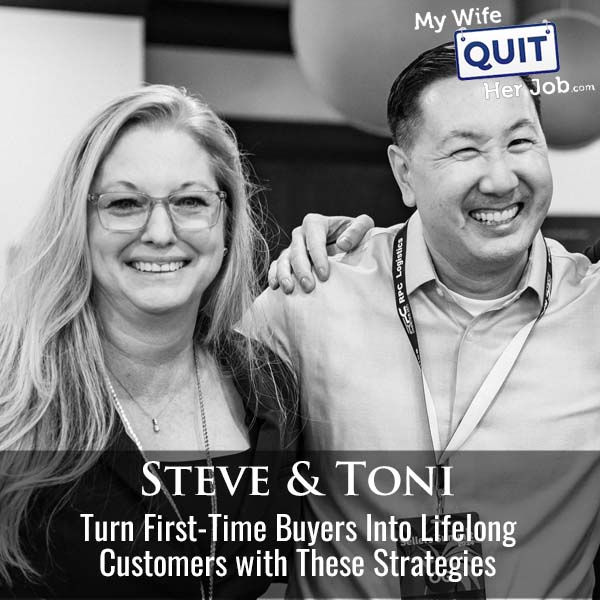
You turn first-time ecommerce buyers into repeat customers by running a loyalty program that behaves like a 1% discount but feels like a 20% reward, layered with a post-purchase email flow that reintroduces the program two weeks after the first order. In this episode of the My Wife Quit Her Job podcast, Toni Herrbach and I break down the exact loyalty structure we run in our stores (Bumblebee Linens for me, The Happy Homeschool for Toni), including point values, VIP tiers, redemption thresholds, and the Klaviyo flows that turn point balances into a second, third, and fourth purchase.
Repeat customers already drive between 36% and 50% of our revenue. That number climbs when a loyalty program gives us another reason to email without discounting the sticker price a first-time visitor sees.
Below is the full playbook: how many points to award for which actions, when to trigger a “you have $5 to spend” flow, how to run a triple-points event so it lifts your entire email account, and when in your business it actually makes sense to sign up.
Get My Free Mini Course On How To Start A Successful Ecommerce Store
If you are interested in starting an ecommerce business, I put together a comprehensive package of resources that will help you launch your own online store from complete scratch. Be sure to grab it before you leave!
Table of Contents
Key takeaways
- A loyalty program is functionally a 1% to 3% discount, but psychologically it feels far bigger and drives repeat purchases without touching the sticker price.
- Award 3 points per $1 spent, 250 points for a product review, 500 points for a birthday, and 200 points for signup. Reward the actions you want more of.
- Redemption rates run 7% to 10% on average. Unclaimed points are pure margin, like unredeemed gift cards.
- Trigger a “congratulations, you have $5” Klaviyo flow the moment a customer hits 500 points. That flow can hit 70% open rate and 11% click-through.
- Introduce the program in a post-purchase email two weeks after delivery. New-member versions of this email hit ~10% click-through.
- Run triple-points events two to three times a year. Even when they do not spike revenue, they lift open and click rates across your entire email program.
- Sign up for a paid plan (Smile.io, Yotpo, etc.) once you hit roughly 1,000 monthly orders, or sooner if paid ads are your primary acquisition channel.
Why a loyalty program is the best way to earn repeat customers
A loyalty program earns repeat customers because it behaves like a 1% to 3% discount, but psychologically feels like a much bigger reward, and every point balance becomes another reason to email. Redemption rates run between 7% and 10% at most stores, which means most of the points you award are never redeemed. That gap is pure margin.
The two levers that consistently drive repeat purchases without cutting price are loyalty points and free-with-purchase gifts. Both let you feel generous to the customer without giving up gross profit like a 20% off sale would.
Airline miles, hotel points, and coffee-shop apps prove the psychology. A 1% cash-back rate at Starbird chicken changes where I choose to eat lunch, even though the actual dollar value is tiny.
How much does a loyalty program cost for an ecommerce store?
Most stores on Shopify or BigCommerce will use a third-party app, and the practical price range is $49 to $1,000 per month depending on tier and features. Smile.io starts at $49/month for the base plan, jumps to about $200/month for the mid-tier where the interesting features live, and $1,000/month for the Plus plan.
Start on the $49 tier if your store is doing anywhere from six figures to low seven figures a year. Every store I know that runs even the base tier makes back the $49 many times over from the extra emails alone.
Do not start on the $1,000 Plus plan just because it has cool features. Those features only pay for themselves once you are running weekly loyalty campaigns to an engaged list, which is not where you are on day one.
What actions should a loyalty program award points for?
Award points for every action you want customers to take more often, weighted by how much you value each one. Here is the point structure I recommend based on what we run at The Happy Homeschool.
- 3 points per $1 spent (translates to roughly a 3% cash-back rate at 100 points = $1 redemption)
- 200 points for signup (turns email opt-in into a low-friction “you already have $2 waiting” hook)
- 250 points for a product review (high value because reviews compound over years)
- 500 points for a birthday (customer gives you a segmentable date; you get another annual email trigger)
- 50 points per social share (Facebook, Instagram)
- 500+ points for user-generated video content (the highest-value asset most brands are starved for)
The point-per-dollar rate is the only number you have to get right for your margin. Everything else is a knob you can turn based on what you need more of this quarter.
How to structure loyalty program VIP tiers
Add a VIP tier that unlocks after the second purchase, because statistics consistently show a customer who has bought twice is likely to become a long-term repeat buyer. That single threshold does more work than a five-tier system does at most small brands.
The tier-two benefit should be a real bump: 2x reward points on every subsequent order. That is a benefit worth chasing without costing you meaningful margin (2x of a 3% cash-back rate is still just 6%).
Setting the tier requirement at “two purchases” rather than “500 points” prevents customers from creating throwaway accounts to farm signup and review bonuses. Marriott, Hyatt, and every airline prove the point: status tiers change where people book.
How to introduce the loyalty program in your post-purchase email flow
Introduce the loyalty program in a dedicated post-purchase email that lands roughly two weeks after delivery, split into two versions (one for members with zero points, one for members who already have some). The 14-day timing matters because the customer has the product in hand, has probably used it, and has forgotten about you.
The zero-points version explains the program from scratch: how to earn, what points are worth, what actions get the biggest boost. This version hits about a 10% click-through rate at The Happy Homeschool because most recipients are learning about the program for the first time.
The existing-member version reminds them of their current balance and nudges the next action (“Only 100 points from your next $5 reward”). It runs about a 50% open rate and near-4% click-through.
How to trigger a “you have $5 to spend” reward flow in Klaviyo
Trigger a celebratory Klaviyo flow the exact moment a customer’s point balance hits your lowest redemption threshold (500 points = $5 at our standard rate). Toni borrowed this pattern from Chubbies, the men’s swimwear brand, and it consistently outperforms almost every other automated flow in her account.
Email 1 (immediate): Fireworks, confetti, “Congratulations, you have $5 to spend.” 70% open rate. 11% click-through. 0.6% order rate.
Email 2 (7 days later): A share-with-a-friend nudge ($5 for you, $5 for them). Lower engagement, higher revenue per person.
Email 3 (14 days later): Subject line “Have you checked your balance lately?” 60% open rate. 10% click-through.
The whole flow triggers when the Klaviyo profile property “points balance” hits 500. Set it once and it runs forever.
How to run a triple-points event for maximum email engagement
Run a triple-points earning event for a 24-hour window two to three times a year, and send it only to segments that already have points (a signal of engagement). This does two things at once: it drives repeat purchases from existing customers, and it lifts your open and click rates across your entire email program.
At The Happy Homeschool, one of Toni’s triple-points events during the summer back-to-school sale sent only to point-holders. It hit strong per-recipient revenue despite going to under 20,000 people.
The real win was the follow-up email 24 hours later, sent only to the roughly 500 people who purchased during the triple-points window. Subject line: “You just earned all these points, spend them while things are still on sale.” Result: 71% open rate. 20% click-through rate.
That single email dragged the sending domain’s engagement metrics up for the rest of the campaign. Even the revenue-per-send was modest ($481 from 500 recipients), the deliverability lift compounded across every other email that week.
How to stack a loyalty reward with a sitewide sale and a free gift
Stack three things in one email to point-holding customers during a big sale: the sitewide discount, triple loyalty points, and a free-with-purchase gift. This is Toni’s highest-converting sale-email template.
The psychology matches how humans actually shop. Give a busy customer one offer and they weigh it against their to-do list. Give them three offers, and they feel the compounding value (“I would be leaving money on the table if I did not buy”).
The free-with-purchase item should be something you need to liquidate from the warehouse (perceived value $25 to $35, actual cost to you $1 to $3). Toni cleared an entire slow-moving SKU with this exact stack in a single week.
What redemption threshold moves the most customers?
The $5-off redemption is consistently the most-used reward, followed closely by $10 off, at stores that offer both. At The Happy Homeschool, the $5 coupon is the top redemption; $10 is second (customers wait to build up); the free digital product (a $10-perceived-value Bible study) is a distant third.
The lesson: keep your lowest threshold reachable after the first or second order. A 500-point threshold at 3 points per $1 hits after roughly $167 in spend, which is well within most customers’ second purchase.
Do not let the first order redeem the signup bonus alone. Require the second order for the first redemption, so the reward system reinforces the behavior you actually want (repeat purchases), not just email signups.
How to use a loyalty program to collect user-generated content
Award outsized point bonuses (500 to 1,000 points) for customer video testimonials and photos, because user-generated content is one of the highest-leverage assets in ecommerce and it is chronically undersupplied at most brands. Short-form video especially compounds across TikTok, Instagram Reels, YouTube Shorts, and your own product pages.
Set explicit hooks in the loyalty page: “Upload a photo of you holding the product: 500 points. Upload a video review: 1,000 points.” The point value should feel absurdly generous, because most customers will never take the action, and the ones who do are giving you a permanent marketing asset.
Product reviews often do not need extra incentive because they arrive organically. Reserve the biggest point bonuses for the assets you cannot generate any other way.
When should you sign up for a paid loyalty program?
Sign up for a paid loyalty app once you hit roughly 1,000 monthly orders, or sooner if paid ads are your primary customer acquisition channel. The order threshold matters more than the revenue threshold because 1,000 orders means you have around 800 to 1,000 distinct customers to enroll in a given month.
If you are spending $10 or more to acquire each customer through Meta or Google ads, sign up sooner. Every dollar you spend making a customer come back is a dollar you do not have to spend acquiring a new one.
The one non-negotiable: have your email templates and campaign calendar ready to go before you enable the paid plan. Loyalty programs die when brands sign up, dump the widget on the site, and never mention it in another email.
How to display point balances in every email you send
Drop the Klaviyo merge tag for point balance at the very top of every marketing email you send, right below the header. When a customer opens a Black Friday email and sees “You have 780 points” (worth $7.80 off), it materially raises purchase probability without changing the offer.
Segment your list into “has points” and “has zero points” and send a different top-of-email block to each. The zero-points version is a short paragraph explaining how to earn (avoids showing an ugly “null” balance and turns the empty spot into an acquisition moment).
Every major loyalty app (Smile.io, Yotpo, LoyaltyLion) exposes point balance as a Klaviyo profile property. Set the merge tag once in your header block and it flows through every campaign automatically.
Frequently asked questions
What is the average redemption rate for ecommerce loyalty programs?
Ecommerce loyalty programs typically see 7% to 10% redemption rates on earned points. That means 90% of the points you award are never redeemed, which is why the effective cost of a loyalty program is far lower than the headline point-back rate suggests.
How much does a loyalty program cost per month?
Most third-party loyalty apps start at about $49/month for the base plan and scale to $200/month for mid-tier features and $1,000/month for enterprise tiers. Smile.io is the most widely-used option on Shopify; Yotpo and LoyaltyLion sit in similar price ranges.
What is a good point-per-dollar rate for a loyalty program?
Three points per $1 spent, with 100 points equaling $1 in rewards, is a solid default (roughly a 3% cash-back rate). Higher-margin categories can offer up to 10% back; lower-margin categories should stay closer to 1%.
Should loyalty points expire?
Expiring points create urgency but risk alienating customers who feel punished for not redeeming fast enough. Most successful programs (including The Happy Homeschool) keep points permanent and use expiring bonus points for time-limited campaigns instead.
Can you allow customers to redeem points on their first order?
You can, but requiring the second order for the first redemption reinforces the repeat-purchase behavior you actually want. If you already give a signup bonus (say 200 points = $2), gating that first redemption to order two makes the program a repeat-purchase driver, not an acquisition discount.
How do you get customers to redeem loyalty points?
Trigger an automated Klaviyo flow the moment a customer hits your lowest redemption threshold, then follow up 7 and 14 days later. That three-email sequence at The Happy Homeschool consistently produces 60%+ open rates and 10%+ click-through rates.
Do loyalty programs work for stores that do not get repeat purchases?
Loyalty programs still add value even in one-and-done categories (wedding, mattress, hot tub) because point balances make every marketing email more engaging and unlock referral mechanics. Adjust the point structure to reward shares, reviews, and referrals rather than repeat purchases.
How many revenue points come from repeat customers vs new customers?
Existing customers typically drive 30% to 50% of total ecommerce revenue at healthy stores. At Bumblebee Linens (wedding, mostly one-and-done) repeat customers are about 36%; at The Happy Homeschool (homeschool curriculum, high LTV) they are about 50%.