

Podcast: Download (Duration: 42:21 — 48.7MB)
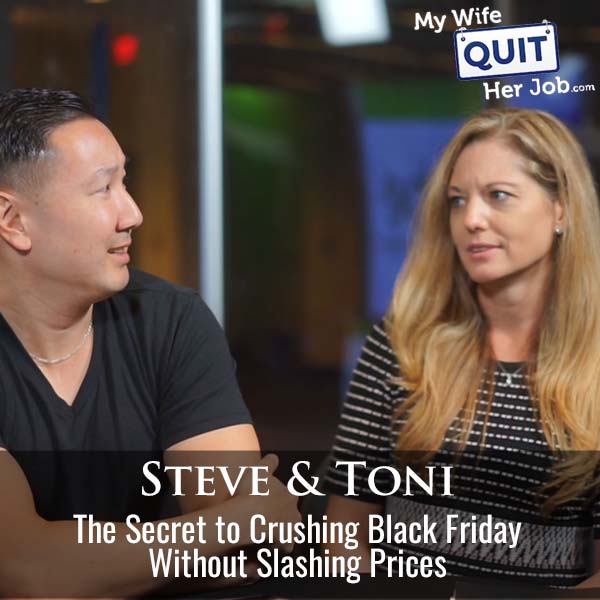
You can grow Black Friday and Cyber Monday sales without slashing your prices by stacking a waitlist launch, a loyalty-point event, bundles, free-with-purchase gifts, and daily flash sales with real scarcity. In this episode of the My Wife Quit Her Job podcast, Toni Herrbach and I walk through the exact BFCM playbook we run in our own stores (Bumblebee Linens for me, The Happy Homeschool for Toni) so you protect your margins instead of racing competitors to the bottom.
The math is brutal on discounting. If you sell at 50% margin, a 20% off sale means you have to sell roughly twice as many units just to break even on gross profit. So we keep our biggest discount at 15% and lean on offers that feel bigger to customers than they actually cost us.
Below is the full framework: how long your promotion should run, how to warm the list up, how to structure the waitlist, and the specific daily emails we send from mid-November through Cyber Monday.
Get My Free Mini Course On How To Start A Successful Ecommerce Store
If you are interested in starting an ecommerce business, I put together a comprehensive package of resources that will help you launch your own online store from complete scratch. Be sure to grab it before you leave!
Table of Contents
Key takeaways
- Never discount more than you have to. A 20% off sale at 50% margin forces you to double unit sales just to hold your gross profit flat.
- Run the promotion 12 to 14 days, not two weeks of teasers. Teasing too early trains customers to pause spending until the sale starts.
- Launch a new product or run a challenge in the first week of November so people who need to buy that month still have a reason.
- A one-day waitlist coupon (stacked on top of the sitewide discount) is our single biggest revenue day of the year.
- Use a loyalty program as a “1% discount that feels like 20%”: bonus-point days, half-price rewards, and outright point bonuses.
- Free-with-purchase and bundles boost AOV and let you liquidate slow-moving SKUs without touching the sticker price.
- Dial down Facebook ads in October and November of election years. CPMs commonly run 2x to 4x normal on top-of-funnel campaigns.
Why deep Black Friday discounts destroy profit
Deep Black Friday discounts destroy profit because a small percentage off the price is a huge percentage off your gross margin. If your product costs $10 and sells for $20 (a 50% margin), a 20% off promotion drops your revenue per unit from $20 to $16 and your gross margin from $10 to $6. You now need to sell roughly 1.67 units for every one unit you used to sell just to keep gross profit flat.
At 30% off, that break-even multiplier jumps to about 2.5 units. This is why we cap our biggest promotion at 15% at Bumblebee Linens and lean on offer structures that feel bigger than they cost.
How long should your Black Friday promotion run?
Twelve to fourteen days is the sweet spot for most stores, running from the Wednesday or Thursday before Thanksgiving through the Saturday after Cyber Monday. Big-box retailers now stretch “Black Friday” through the entire month of November, and Walmart drops its holiday catalog before Halloween, but small brands do not need to match that.
A shorter, more concentrated window keeps the sale from cannibalizing full-price sales in early November. Two weeks is long enough to hit every segment of your list with multiple emails without the message going stale.
I am not a fan of teasing the sale two weeks before it begins. When you announce “big Black Friday deals coming in 14 days,” you train your customers to hold off on every purchase they were about to make at full price, and pre-sale revenue tanks.
What to sell in the first two weeks of November
Give people who need to buy in early November a reason to buy from you at full or near-full price, so you do not lose those sales while waiting for Black Friday. There are three plays that work well.
1. Launch a new product the first week of November. We have done this for two years in a row. Launch pricing gets set at whatever the Black Friday discount will be, and we tell customers directly, “This is the best price this product will ever be. You will not see it lower on Black Friday.”
2. Run a five-day themed challenge. Pick a topic customers care about, send five daily emails on that topic, go live on Facebook, and put related products on a small discount during the challenge window. This works when you do not have a new product to launch.
3. Sell a genuinely limited-edition November-only product. Size the run based on the last three years of November order volume, so you can actually sell out and market the scarcity honestly. A holiday-themed tote bag or seasonal design works for almost any category.
Why a loyalty program beats a sitewide discount
A loyalty program is functionally about a 1% discount, but it feels to customers like a much bigger reward. That is why loyalty is the core of my BFCM strategy at Bumblebee Linens instead of deep sitewide markdowns.
The specific levers I run during Black Friday week are double-points days, half-price rewards (customers redeem their points for twice the usual value), and outright bonus-point drops for existing members. Every one of those becomes an excuse to send another email.
Each email adds another chance to make a sale without touching the price a first-time visitor sees. New shoppers still get the sitewide 15% off; loyalty members feel like they are getting something extra.
How to run a Black Friday waitlist that stacks on top of your sale
The waitlist is our single biggest revenue day of the entire year, and it works by giving list members one 24-hour window with an extra discount on top of the regular Black Friday sale. If sitewide is 20% off, waitlist members get an additional 10% off on the first day only.
Toni has been running this for three years at The Happy Homeschool and increases the stacked discount by five percentage points each year. Here is the exact five-email sequence.
Email 1 (three weeks out): “Black Friday is coming. We are doing something we have never done before. Get on the waitlist to know exactly when the one-day discount starts.” Use a click-to-tag in Klaviyo so subscribers do not have to opt in again.
Email 2 (five to six days later): Sent only to people not yet on the waitlist. Add a free-with-purchase gift that day only (something you already need to liquidate from the warehouse).
Email 3 (resend to unopens): Same content as email one or two, new subject line, sent to the segment that never opened the previous email.
Email 4 (48 hours before the sale, text-only): A short two-sentence personal-style email. “Hey Steve, tomorrow you get 35% off. You are not on the waitlist and you will not get the coupon. Click here and I will email it to you.” Even this two-sentence email consistently makes real money.
Email 5 (waitlist day, 6am): “Here is your coupon. Live until midnight.” Follow at 2pm with a reminder to unopens who have not purchased.
How to use free-with-purchase to raise AOV without discounting
Free-with-purchase moves the needle because a $3 gift feels bigger to the customer than a 10% discount, and it costs you less than the equivalent markdown. If your average order is $100, a 10% discount costs you $10 in margin; a $3 free gift costs you $3.
Set a purchase threshold that pushes AOV up ($50 or $100, depending on your price point). Make the free item something that only exists during this window, so it has “collect it or miss it” pull.
Beauty brands like Clinique run this play with limited-edition makeup bags every holiday season and it works because the bag itself is never available for sale. Any brand can do the same thing with a seasonal tote, holiday-themed accessory, or overstock SKU.
How to bundle products to boost average order value
Bundles let you raise the ticket size and quietly move slow-moving inventory at the same time. We create gift packs during BFCM that are only offered during the sale, price them higher than any single item, and stuff them with SKUs we want out of the warehouse.
Customers feel like they are getting more product for their money. In reality, the perceived value is high and our unit-level margin on the bundle is often better than the individual items would be at their sale price. Think of the pre-made stockings at drugstores in December: cheap toys in a stocking with a “Look at everything you get for $19.99” label.
How to refresh product photography for the holiday season
Reshoot your best sellers in holiday settings so customers who did not think they needed the product suddenly picture it in their home. A napkin ring on a bare table is a commodity; the same napkin ring on a fully-set Christmas table with evergreen, red plates, and glassware is a gift.
You can do a lot of this with AI now. Upload a real product photo to Midjourney or a similar tool and prompt it to set a Christmas table or stage the product in a seasonal scene.
For anything you sell (glassware, barware, table runners, home goods), the holiday-reframed shot becomes the hero image on the product page and the header of every BFCM email. That single change often lifts click-through without any price movement.
How to run daily flash sales with scarcity-based coupon codes
Flash sales keep sales alive on the “dead” days in the middle of BFCM (Monday through Wednesday before Thanksgiving, when families are traveling), using coupon codes with hard, limited-quantity caps. This is Toni’s signature Cyber Week play at The Happy Homeschool.
The email lists five coupons, each with a cap:
- Free shipping (first 10 orders)
- $10 off your order (first 25 orders)
- $5 off your order (first 25 orders)
- Buy one, get one free (first 30 orders)
- 10% off your order (first 25 orders)
Customers click through and race to try codes until they find one that still has quantity left. It creates urgency without touching the sitewide price, and it teaches you (via the back end) which offer type moves your specific audience the most.
For The Happy Homeschool the winner is consistently free shipping and dollar-off coupons; buy-one-get-one barely moves the needle. For Bumblebee Linens, small dollar-off coupons attract low-margin customers and percentage-off coupons attract the AOV we actually want.
How to segment the flash-sale email for maximum lift
Send the limited-coupon email to three distinct segments and treat them as separate campaigns. The revenue-per-recipient numbers tell you where the offer is really working.
Segment 1: Everyone who has not purchased yet this Black Friday. This produces the biggest raw revenue number because it is the largest audience.
Segment 2: One-time buyers who have not purchased in six months. This is the highest-performing segment on a per-recipient basis. It reactivates lapsed customers with a low-friction reason to click.
Segment 3: Subscribers who have never purchased. This email consistently converts more never-buyers than any other campaign we run.
Should you dial down Facebook ads on Black Friday?
Yes, dial down Facebook ad spend in November of an election year, and consider dialing it down every November regardless. CPMs and CPCs on Meta commonly run 2x to 4x their normal level in October and November of election years because political advertisers flood the auction.
Ads that break even in a normal month can bleed cash in an election-year November. Google search ads are usually less affected because search intent is stable; Meta and other social platforms take the biggest hit.
We start dialing Meta spend down in September of election years and shift budget toward email (which has near-zero incremental cost) and toward retargeting only the warmest segments.
How to use live video to sell during Black Friday
Going live on Facebook or your own site during BFCM does three things at once: it becomes another excuse to send an email, it legitimizes your business to shoppers who have never bought from you, and (when you run ads to the live) it produces cheaper impressions than a standard video ad.
If you do not want to be on camera, film the warehouse. Show orders being packed, bundles being assembled, and the shipping team working. That is the same social-proof pattern that makes TikTok Shop convert so well: real people, real physical product, real fulfillment.
Pair the live with a ManyChat flow that watches for a keyword in the comments. When someone comments “hanky,” the bot DMs them a product link and a coupon code. That turns passive viewers into a segmented list you can email again.
Frequently asked questions
What is the highest Black Friday discount you should offer?
Cap your biggest sitewide discount at 15% to 20% if you sell at typical 50% gross margins. Anything deeper forces you to sell dramatically more units just to hold gross profit flat, and it trains customers to wait for the sale next year.
How long should a Black Friday sale run?
Twelve to fourteen days is the sweet spot for most ecommerce stores, starting the Wednesday or Thursday before Thanksgiving and ending the Saturday after Cyber Monday. That is enough time to email every segment without the message going stale and without teasing customers so early that pre-sale revenue collapses.
Do Black Friday waitlists actually work?
Yes. A one-day waitlist coupon stacked on top of the sitewide sale is consistently the highest single-day revenue driver of our year. The key is giving list members a real reason to sign up (an extra 10% off on top of the sale) and delivering the coupon in a short, text-only email at 6am on the promised day.
How much can a loyalty program replace discounting on Black Friday?
A well-run loyalty program (double-points days, half-price rewards, bonus-point drops) functions as roughly a 1% discount that feels like a 20% reward to members. It cannot fully replace a sitewide sale because new visitors do not have any points, but it can shift a large share of holiday revenue from discount-driven to reward-driven.
What should I sell in November before Black Friday starts?
Launch a new product the first week of November at what will become the Black Friday price, run a themed five-day challenge, or drop a genuinely limited-edition November-only SKU. Any of the three gives early-November shoppers a reason to buy from you at full price rather than wait.
Does free-with-purchase work better than a discount?
Free-with-purchase almost always beats an equivalent-cost discount because a $3 gift with a $30 perceived value feels bigger than a 10% coupon. It also lets you liquidate overstock and creates a “collect it while it lasts” seasonal hook that percentage-off coupons cannot match.
Should I run Facebook ads during Black Friday in an election year?
Dial Meta spend down starting in September of an election year because CPMs commonly hit 2x to 4x normal. Keep Google search ads running (search intent is stable), and shift the freed budget into email, SMS, and retargeting your warmest audiences.
What is the biggest Black Friday mistake ecommerce sellers make?
Racing competitors to the deepest discount and destroying gross profit for the whole holiday quarter. The stores that win Black Friday are the ones that grow revenue through offer structure (waitlists, bundles, free gifts, loyalty rewards, flash-sale scarcity) rather than through a bigger percent-off number.

