
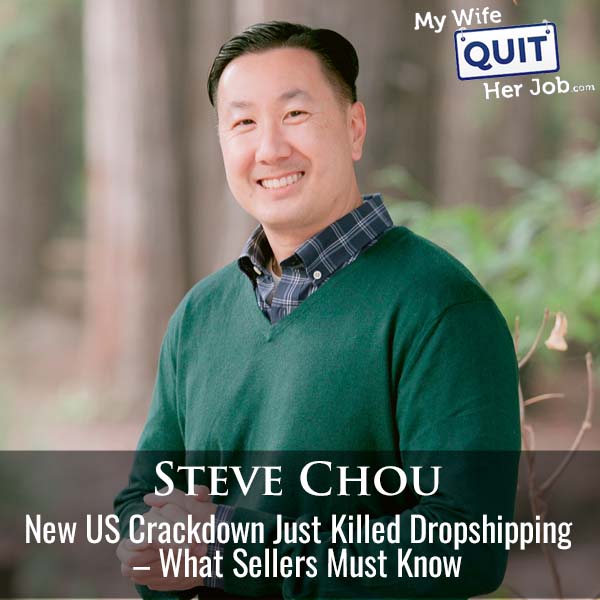
Podcast: Download (Duration: 13:03 — 15.2MB)
The new US crackdown on the de minimis rule effectively kills China dropshipping within about 18 months. Three changes matter: every China-origin package now owes customs duties and Section 301, 232, or 201 tariffs regardless of value; the seller must now collect the buyer’s Social Security number to claim the de minimis exemption on that buyer’s behalf; and every shipment must file an electronic certificate of compliance with US safety regulations at time of entry. None of those requirements survive contact with a real dropshipping customer buying a $10 mouth guard.
I break the whole thing down in this solo episode. If you are already running a Shopify or WooCommerce store fulfilled by AliExpress, DSers, CJ Dropshipping, or AutoDS, this post explains exactly what changed, why the economics no longer work, and what to do instead. If you are just thinking about starting a dropshipping business, reconsider.
Below is the full explainer plus what still works, what does not, and the path forward.
Get My Free Mini Course On How To Start A Successful Ecommerce Store
If you are interested in starting an ecommerce business, I put together a comprehensive package of resources that will help you launch your own online store from complete scratch. Be sure to grab it before you leave!
Table of Contents
Key takeaways
- The de minimis rule (packages under $800 entering the US duty-free) is being narrowed to exclude Chinese e-commerce shipments. That was the entire cost advantage of AliExpress dropshipping.
- All China dropshipping shipments will now owe Section 301, 232, or 201 tariffs plus normal customs duties, no matter the package value. Section 301 alone covers roughly 40% of Chinese imports.
- Sellers must now collect the buyer’s Social Security number to file the de minimis exemption on the buyer’s behalf. Almost no US customer will hand that over for a cheap online order.
- Every consumer-goods import must file an electronic certificate of compliance with US safety regulations at entry. The buyer becomes the importer of record and legally responsible for that filing.
- Timing is roughly 18 months for full enforcement based on industry consensus. The rules do not switch on overnight because of the paperwork volume.
- Domestic US dropshipping and AliExpress fulfillment from US warehouses are not affected. Only cross-border shipments from China to US buyers are.
- The long-term move for anyone starting an online business is to build a real brand with your own products, not to resell $2 junk from China.
What is China dropshipping and why did it work
China dropshipping is a business model where a seller lists products from AliExpress or a similar Chinese supplier on their own Shopify or WooCommerce store, and when a US customer orders, the Chinese supplier ships the item directly to that customer. The seller never touches the product and never holds inventory. The model worked because three economic advantages stacked on top of each other.
The first advantage was raw price arbitrage. That snoring mouth guard I mentioned in the episode sells for $39.99 on Amazon and costs $1.72 on AliExpress, a 23x markup. Almost any consumer good sourced from a Chinese factory carries similar spreads.
The second advantage was cheap shipping. The ePacket program, launched in 2011 to promote US-China ecommerce, priced a 1-pound parcel from China to the US at roughly $1 to $1.50. Domestic US shipping for the same weight costs several times that.
The third advantage was the de minimis exemption. Any package entering the US worth $800 or less passed through customs duty-free and tariff-free. Stack cheap product, cheap shipping, and zero import taxes together, and you have the economics that made AliExpress dropshipping a viral side hustle for a decade.
What is the de minimis rule and why did the US change it
The de minimis rule is a US customs provision that lets any package worth $800 or less enter the country without paying customs duties or tariffs. It was designed to save Customs and Border Protection from processing paperwork on low-value personal shipments like a $30 toy from another country. The current administration is changing it because Chinese e-commerce platforms have used it to ship billions of dollars a year in commercial merchandise into the US duty-free.
Temu and Shein are the two biggest examples. Temu launched in 2022 and by 2024 had expanded to 79 countries and captured roughly a third of Amazon’s US web traffic. Amazon’s apparel sales fell about 30% year over year as Temu and Shein took share, with virtually every Temu and Shein order arriving in the US duty-free under de minimis.
Customs and Border Protection processed more than a billion de minimis shipments in fiscal 2023, up from roughly 140 million a decade earlier. The rule was written for a smaller trade era and is now the single biggest loophole in US import law.
What are the three de minimis rule changes killing China dropshipping
There are three changes to the de minimis rule that together kill the China dropshipping model. Each one on its own would hurt margins. Stacked together, they make the business unworkable.
Change 1: All China shipments now owe tariffs and duties
The first change requires every package containing goods covered by Section 301, 232, or 201 of US trade law to pay full tariffs and customs duties, regardless of the shipment’s value. In practice that means the de minimis exemption no longer applies to most Chinese-made consumer goods entering the US.
Section 301 targets electronics, textiles, and machinery, and covers roughly 40% of all Chinese imports. Section 232 covers steel, aluminum, and related materials. Section 201 covers products like solar panels and washing machines.
Most dropshipped consumer goods fall under Section 301, so if you sell phone accessories, apparel, home goods, or gadgets from a Chinese supplier, expect your landed cost to jump. Doubling the cost still leaves headroom on a 23x-markup product, but the next two changes are where the model actually breaks.
Change 2: You must collect the buyer’s Social Security number
The second change requires the seller to collect and submit the buyer’s identifying information, including the buyer’s Social Security number, to claim the de minimis exemption on that buyer’s behalf. Commercial importers use an Employer Identification Number for entry filings. Individuals importing for personal use are identified by their SSN.
Because dropshipping treats each customer as the individual importer of record, that means asking your Shopify customer for a Social Security number at checkout to complete a $12 order. Nobody is going to hand over their SSN to buy a phone case from an unfamiliar store, especially one that is obviously fulfilling from China. Identity theft is already at historic levels in the US, and consumers are hyper-aware of Chinese data collection.
This change alone would end the model, and the third one seals it.
Change 3: Certificates of compliance are required at entry
The third change requires every consumer-goods shipment to file an electronic certificate of compliance with US safety regulations at time of entry. The certificate confirms the product meets applicable Consumer Product Safety Commission, FDA, or other regulatory standards for its category.
The reason this rule exists is that a huge share of what ships out of AliExpress and Temu fails US safety standards. AliExpress phone chargers are almost universally not UL certified, which is why lithium-battery fires linked to cheap Chinese electronics have been a recurring story since the hoverboard recalls. Temu has been repeatedly flagged for children’s toys containing unsafe levels of lead and phthalates. Shein has faced regulatory action for clothing containing formaldehyde and azo dyes, and for cosmetics containing mercury.
Under the new rules, the buyer becomes the importer of record and is legally responsible for filing the compliance certificate. No US consumer is going to accept legal liability for the safety compliance of a $10 phone case from a random Shopify store.
When do the new de minimis rules take effect
Full enforcement of the new de minimis rules is expected in roughly 18 months based on industry consensus. The changes cannot switch on overnight because Customs and Border Protection has to build the electronic filing infrastructure, and enforcing immediately would back up US ports of entry for years.
The direction of travel is not in question. Enforcement will phase in as the paperwork systems come online, and by the time it is fully live, the AliExpress and CJ Dropshipping model will not clear economically.
If you are running a China dropshipping store today, treat 18 months as the runway to migrate off the model. If you are still in the planning stage, do not start one.
Which dropshipping models still work under the new rules
The dropshipping models that still work under the new US rules are domestic US dropshipping, AliExpress or CJ Dropshipping orders fulfilled from US warehouses, and print on demand with US-based print partners. Anything that ships cross-border from China to a US customer under the de minimis exemption is what the new rules target.
| Model | Still viable | Why |
|—|—|—|
| Direct China-to-US dropshipping (AliExpress, CJ, DSers direct) | No | Loses de minimis, requires SSN and compliance filing |
| AliExpress or CJ with US-warehouse fulfillment | Yes | Enters US as commercial import, seller is importer of record |
| Print on demand (Printful, Printify, US printers) | Yes | Printed and shipped domestically |
| Domestic dropshipping from US suppliers | Yes | Never crossed a border in the first place |
| Private-label ecommerce (import in bulk, hold inventory) | Yes | Standard commercial import; you own the brand |
The private-label model is the one I recommend for anyone building a real online business. You import product in bulk, pay tariffs and duties upfront, hold inventory, and sell under your own brand. The margins are lower per unit than fake-margin dropshipping, but the business is durable and worth something when you sell it.
What sellers should do right now
Right now, sellers with an active China dropshipping business should start migrating suppliers to US warehouses, testing private-label alternatives, and preserving cash for the transition. Do not wait for enforcement to hit before making the move. Below is the practical sequence.
- Audit your current SKUs. Identify which products fall under Section 301, 232, or 201 tariffs and estimate the landed-cost jump when duties apply. Kill anything that will no longer clear a reasonable margin.
- Ask suppliers about US warehousing. Many AliExpress and CJ Dropshipping suppliers now stock inventory in US 3PL warehouses. Fulfilling from there sidesteps the border entirely.
- Test print on demand for graphic-driven categories. Apparel, mugs, and posters can move to Printful or Printify without touching your product catalog structure.
- Start sourcing for private label. Pick your two best-selling categories and negotiate bulk orders from the same Chinese factories that were fulfilling your dropshipping orders. You pay tariffs once on the bulk import, then sell under your own brand.
- Build an email list and a real brand. Cheap-junk dropshipping stores have no repeat customers. Owning the customer relationship is what makes the pivot worth it.
Dropshipping was always a tough long-term business because you had no control over product quality, shipping speed, or brand. Every serious ecommerce operator I have interviewed on this podcast who started with dropshipping eventually moved on. Even the CEO of Spocket admitted as much when he came on the show.
Frequently asked questions
What is the de minimis rule for US imports?
The de minimis rule allows any single shipment entering the United States worth $800 or less to enter duty-free and tariff-free. It was created to spare Customs from processing low-value personal packages. Chinese e-commerce platforms have used it to ship billions of dollars a year of commercial goods into the US duty-free.
Is China dropshipping dead in 2025?
China dropshipping is on a roughly 18-month runway to becoming economically unviable under the new de minimis rule changes. Duties and tariffs will apply to virtually all shipments, sellers must collect buyer Social Security numbers to claim any exemption, and every shipment needs a filed certificate of compliance. If you dropship from China direct to US customers, migrate now.
Does the de minimis change affect all dropshipping?
No. The de minimis change targets cross-border shipments from China to US customers. Domestic US dropshipping, AliExpress or CJ Dropshipping orders fulfilled from US warehouses, and print on demand with US printers are unaffected.
Will Temu and Shein still work in the US?
Temu and Shein will keep operating but their prices will rise as they lose the de minimis exemption on direct-from-China shipments. Both are already building US warehouses to fulfill domestically, which lets them keep some price advantage but forfeits the duty-free entry that made them viral. Their headline price gap versus Amazon will narrow.
What can I sell instead of China dropshipping?
The most durable alternative is a private-label ecommerce business, where you import your own product in bulk from a factory, pay the tariffs and duties once, and sell under your own brand at higher margin with real repeat customers. Print on demand and domestic dropshipping also work as lower-margin starting points.
What is a certificate of compliance in customs?
A certificate of compliance is an electronic filing that confirms an imported consumer product meets applicable US safety regulations from the Consumer Product Safety Commission, FDA, or other regulators. Under the new de minimis rules, every consumer-goods shipment must include one at time of entry, and the importer of record is legally responsible for its accuracy.
How long do I have before the new rules take effect?
Industry consensus is roughly 18 months for full enforcement, though phased implementation may hit certain categories sooner. Customs needs to build the electronic filing systems and phase in the paperwork volume. Treat the runway as short and plan the migration off China-direct dropshipping now.