

Podcast: Download (Duration: 41:43 — 48.0MB)
DeepSeek is a free, open-source AI model out of China that benchmarks competitively with paid tools like ChatGPT and Claude while reportedly using a fraction of the compute to train, which is why Nvidia’s stock dropped roughly 16 percent the day the news broke. The catch is data: everything you type into the hosted DeepSeek app is subject to Chinese terms of service, which allow much broader collection than OpenAI’s default settings.
If you download the open-source model and run it on your own PC (roughly a $3,000 hardware setup), no data leaves your machine. If you use their app or web interface, treat every prompt as public.
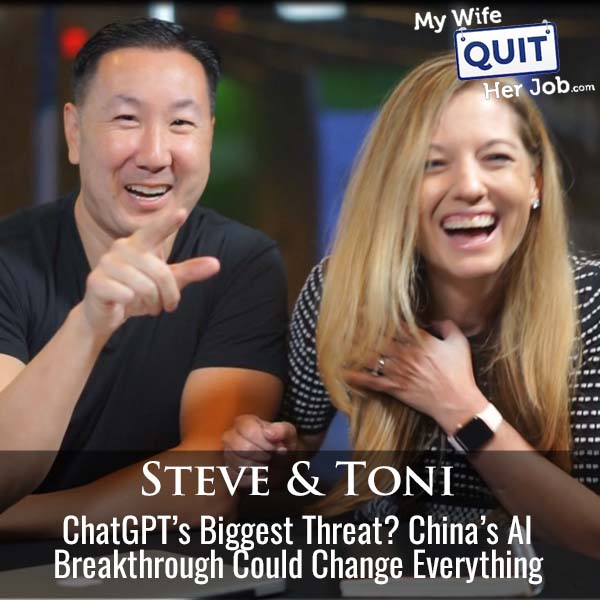
In this episode, my co-host Toni Herrbach and I unpack DeepSeek, Alibaba’s new Qwen release, and the wider “free Chinese AI vs paid US AI” split. We also cover what each major model is actually best for in real work: ChatGPT as the reliable general Google-replacement, Claude for creative writing and coding, Gemini for free image work, Llama for embedded use, and Grok as the outlier most people can skip.
Below we cover what DeepSeek actually is, the privacy tradeoff nobody wants to hear about, whether DeepSeek will get banned like TikTok, the model comparison for real use cases, and how AI companies will eventually monetize the free tier.
Get My Free Mini Course On How To Start A Successful Ecommerce Store
If you are interested in starting an ecommerce business, I put together a comprehensive package of resources that will help you launch your own online store from complete scratch. Be sure to grab it before you leave!
Table of Contents
Key takeaways
- DeepSeek is a free, open-source Chinese AI model that reportedly beats ChatGPT on benchmarks and triggered a roughly 16 percent Nvidia stock drop the day it launched.
- Using DeepSeek’s hosted app sends every prompt through Chinese servers under Chinese terms of service. Running the open-source model locally sends nothing.
- Alibaba released a competitive AI model (Qwen) roughly a week later. Both are free. Expect more of the same from Chinese firms.
- DeepSeek reportedly censors sensitive Chinese political topics (like Tiananmen Square), a warning sign for anyone worried about tailored answers.
- ChatGPT is best for general questions, math, and formula help. Claude is best for creative writing, scripts, and coding. Gemini is a solid free image tool. Llama (Meta) is embedded in Facebook and WhatsApp for free.
- The real risk is not individual data; it is aggregate data. When 50 million users’ prompts feed one collector, patterns become intelligence.
- The free AI monetization endgame is almost certainly ads inside answers plus paid brand placement, just like Google did.
What is DeepSeek and why did Nvidia stock crash?
DeepSeek is a Chinese open-source AI model that scored better than or equal to OpenAI’s ChatGPT on several benchmarks while reportedly using roughly 1/10th to 1/20th the compute to train. Nvidia’s stock fell about 16 percent on the news because investors read “less compute needed” as “fewer chip sales ahead.” The model is free to use in DeepSeek’s app or web interface, and the underlying weights are fully open source, so anyone with the right hardware can download the model and run it privately.
The “less compute” claim is contested. Multiple people in the industry think DeepSeek trained on top of OpenAI outputs, or has an undisclosed stockpile of Nvidia GPUs, or tuned the model specifically to pass the benchmarks used in the announcement.
Benchmark-gaming has a long history in hardware and software (Nvidia and AMD have both been caught tuning drivers for known benchmark names). None of this is confirmed, and the “trained on a shoestring” narrative should be treated as unverified.
The DeepSeek privacy question (why using the app is different from downloading the model)
Using DeepSeek’s hosted app or website means Chinese servers see every prompt you send, and their terms of service permit broad collection and use of that data. Downloading the open-source model and running it locally on your own PC means nothing leaves your machine. Those are two completely different products with the same name.
The hosted version asks for name, email, and other account info. Once you are in, everything you type is stored server-side under Chinese terms.
The self-hosted version requires roughly $3,000 in hardware (a solid GPU plus supporting components) and enough technical willingness to run a local model. Realistically, almost nobody in the general public will do this, which is exactly the point.
Why aggregate AI data matters more than individual data
Aggregate AI data matters more than individual data because any single user’s queries are usually unremarkable, but 50 million users’ queries reveal genuine intelligence: what people are worried about, what they are buying, what they are curious about, and where the country’s soft spots are. The national security concern with DeepSeek is not that Chinese authorities care what I ask about my hankerchief inventory. It is what all US prompts, aggregated, tell them.
The same logic applies to the tailored-answer risk. Once a foreign model has hundreds of millions of users, its owners can subtly shape answers on politically sensitive topics.
When a user typed Tiananmen Square into DeepSeek early on, the model reportedly returned nothing. That is a warning signal (well short of proof) and it is worth taking seriously.
Will DeepSeek get banned in the US like TikTok?
DeepSeek will probably face government scrutiny similar to TikTok, and there is a reasonable chance the hosted app gets restricted for federal employees, contractors, and possibly the general public if the current administration continues its stance on Chinese tech. The open-source model is much harder to ban because the weights are already downloaded and mirrored globally. Anyone who wants to run it locally already can.
The awkward truth is that Chinese AI models are arguably more invasive than TikTok because users voluntarily type their most personal questions (medical results, financial situations, private worries) into them. TikTok collected behavioral data. AI models collect the internal monologue.
DeepSeek vs ChatGPT vs Claude vs Gemini: what to use for what
DeepSeek vs ChatGPT vs Claude vs Gemini comes down to what you are trying to do, not which one “won” the benchmark race. Benchmarks measure narrow tasks that are easy to game.
Real work requires picking the tool that handles your job best. Here is where each tool actually earns its subscription.
Comparison table: which AI model to use for which job
| Model | Best for | Pricing | Privacy notes |
|---|---|---|---|
| ChatGPT (OpenAI) | General questions, math, formulas, everyday Google replacement | Free tier + $20/mo Plus | US terms of service; opt-out toggle for training |
| Claude (Anthropic) | Creative writing, scripts, coding (Canvas), contracts, hooks, headlines | Free tier + $20/mo Pro | US terms; strong stated privacy defaults |
| Gemini (Google) | Free image generation, integrated with Google Workspace | Free tier + paid Advanced | Google terms; extensive data collection across products |
| Llama (Meta) | In-app AI inside Facebook, WhatsApp, Instagram; free local hosting | Free (open source) | Meta terms if used inside their apps |
| DeepSeek | Free general use, image generation without US-model censorship (self-hosted) | Free | Chinese terms if hosted; no data leaves PC if self-hosted |
| Alibaba Qwen | General ChatGPT-style use, benchmarks competitive with DeepSeek | Free | Chinese terms; hosted by Alibaba |
| Grok (xAI) | Users deep in the X/Twitter ecosystem; less common as primary tool | Bundled with X Premium | xAI terms |
Which one I actually pay for
I pay for ChatGPT ($20/month) because it is my daily general-use tool: “how do I write this Google Sheets formula,” “give me the tax math on this scenario,” “help me set up this AWS user permission.” It is reliable and rarely sends me down a rabbit hole. I also use Claude, and I am about to switch my paid subscription over now that I am doing more scripting for video, because Claude produces scripts that stay closer to the source content and its Canvas coding view is genuinely useful.
I recently cancelled Midjourney because free Gemini image generation is now good enough for the YouTube thumbnails I need. As long as I do not need hands, it works.
What Claude and ChatGPT are actually good at (from real use)
Claude beats ChatGPT for creative writing, script generation, and coding tasks that need a live preview. ChatGPT is faster and clearer for math, formula help, and quick factual lookups where “reliable and slightly boring” wins.
Toni uses Claude for a video-editor contract and a launch-doc consolidation that would have taken her hours to draft manually. Her mother uses ChatGPT to draft scientific papers because it makes strong grammar patterns easy to apply.
Both tools respond very differently based on prompt style. Toni finds ChatGPT more sensational on titles; I find Claude more sensational.
That is largely because I prompt with “conversational tone” and she does not. Prompt style matters as much as model choice.
The killer everyday use case: pre-doctor visit
The killer everyday AI use case Toni’s brother uses is pasting medical test results into ChatGPT or Claude to generate context and questions before a doctor visit. The AI can flag which values are actually concerning for your age and history, and it produces a strong list of educated questions for a 15-minute appointment. This is one of the highest-leverage personal use cases for AI right now, and it costs nothing.
The privacy tradeoff on medical data is real. Weigh it before pasting sensitive records into any model.
Should you use DeepSeek or stick with paid US models?
Use DeepSeek only if you are running the model locally on your own hardware and the privacy question actually matters to your workflow. Otherwise, the $20-per-month cost of ChatGPT or Claude is trivial for most professional users compared to the data exposure risk of the hosted DeepSeek app.
For an average shopper, employee, or student, the pull of “free and as good as ChatGPT” is enormous. Expect DeepSeek and Alibaba’s Qwen to pick up massive US user counts in the next few months regardless of the privacy questions.
How free AI tools will eventually make money (and what you give up)
Free AI tools will eventually monetize the same way Google did: ads inside answers, sponsored brand placements, and API sales to third-party apps. There is no such thing as a durable “free forever” AI at scale because the compute cost is enormous.
Someone has to pay. Either the users pay in cash or they pay in data plus ads.
For merchants, that is actually a big opportunity. If tomorrow’s AI answer knows a user is planning a wedding, buying a car, or researching a supplement, brands will bid to appear inside that answer the way they bid on Google keywords today.
Klaviyo already shows what rich behavioral data enables for ecommerce. AI-scale data is that on steroids.
What to do this week if you are new to AI
If you are new to AI, start with the free version of ChatGPT, ask it three questions you would normally Google, then ask it one thing you have been putting off (a formula, a summary, a first draft of an email you dread). Pay attention to what feels faster or higher quality than your old workflow.
Add Claude for creative or script work when the ChatGPT output feels too generic. Consider Gemini for free image generation.
Skip the free Chinese models until the privacy picture is clearer, unless you are willing to self-host and know exactly what that means.
Frequently asked questions
Is DeepSeek safe to use?
DeepSeek is safe to use if you run the open-source model locally on your own hardware, because no prompts leave your machine. Using DeepSeek’s hosted app or website sends every prompt through Chinese servers under Chinese terms of service, which allow broad collection and use of that data. For sensitive queries (medical, financial, business), use a US-based model with a clear privacy policy.
Is DeepSeek really better than ChatGPT?
DeepSeek scores comparably to or better than ChatGPT on several public benchmarks but benchmarks are easy to tune for and do not always match real-world use. Multiple industry insiders believe DeepSeek was trained on top of OpenAI outputs and specifically optimized to pass the benchmark tests it announced. For a typical user’s day-to-day work (writing, coding, questions), ChatGPT and Claude remain highly competitive.
Will DeepSeek get banned in the US?
DeepSeek’s hosted app could face restrictions similar to TikTok, particularly for government employees, contractors, and possibly wider consumer use if regulators view its data practices as a national security issue. The open-source model itself is essentially impossible to ban because the weights have already been downloaded and mirrored globally by researchers and developers.
What is the best free AI tool right now?
The best free AI tools right now are ChatGPT’s free tier for general use, Claude’s free tier for creative writing and coding (with tighter usage limits), Gemini’s free tier for image generation and Google Workspace integration, and Meta’s Llama built into Facebook and WhatsApp. DeepSeek and Alibaba Qwen are also free but carry the Chinese-terms-of-service tradeoff.
What is the difference between hosted DeepSeek and self-hosted DeepSeek?
Hosted DeepSeek runs on DeepSeek’s servers in China and stores every prompt you send under Chinese terms of service. Self-hosted DeepSeek runs on your own PC or server, requires roughly $3,000 in hardware (mainly a strong GPU), and sends no data anywhere. Same model, completely different privacy profile.
Which AI tool should I pay for if I can only pick one?
If you can only pay for one AI tool, pick ChatGPT ($20/month) for general use or Claude ($20/month) for heavy writing, scripting, or coding work. Both are considerably better than the free tiers for high-volume users and both have clearer privacy protections than the free Chinese options.
What is Alibaba Qwen and how does it compare to DeepSeek?
Alibaba Qwen is Alibaba’s competitive AI model, released roughly a week after DeepSeek made global news, that reportedly benchmarks on par with or better than DeepSeek and OpenAI models. It is Chinese-owned and hosted, with the same data-privacy considerations as DeepSeek’s hosted app. It is not as clearly open-source as DeepSeek.