
Podcast: Download (Duration: 39:39 — 45.7MB)
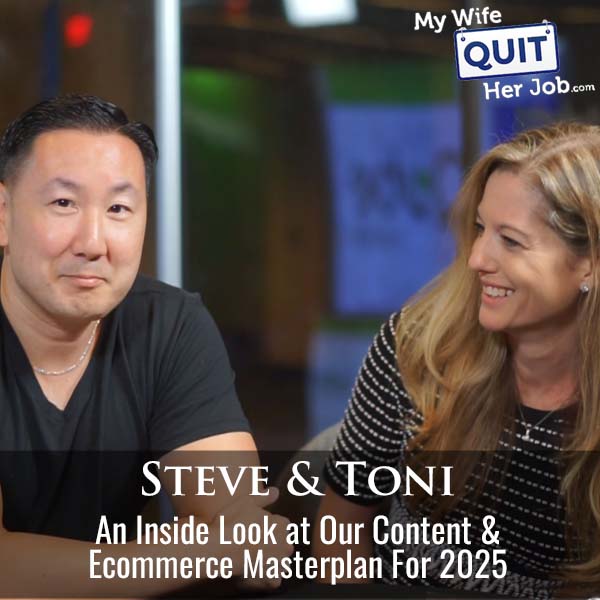
Our 2025 content and ecommerce masterplan is built on three moves: shift the primary content platform from written blog posts to short-form video (TikTok, YouTube Shorts, Instagram Reels) built around a pillar overview format, protect the ecommerce business from tariffs and knockoffs by going deeper into personalized and printed goods that are structurally hard to copy, and treat blogs as feed material for AI answer engines rather than as standalone Google plays. In this episode my co-host Toni Herrbach and I walk through what we are changing in both my business (Bumblebee Linens plus the My Wife Quit Her Job media brand) and Toni’s (The Happy Housewife plus her ecommerce coaching work).
The uncertainty going into 2025 is real: a new US administration promising broad tariffs, China preparing counter-moves, Google losing search share to AI, and Amazon copying Temu with the new Amazon Haul marketplace. But the response is not to panic. It is to lean into brand, content, and product moats that no algorithm change can wipe out overnight.
Below we cover the state of blogging in an AI-first search world, the pillar video strategy that is replacing pillar blog posts, our specific ecommerce moves (Bumblebee Linens’ shift into digital printing and handwriting embroidery), the tariff math that is less scary than the headlines suggest, and why Amazon sellers are the most exposed group in 2025.
Get My Free Mini Course On How To Start A Successful Ecommerce Store
If you are interested in starting an ecommerce business, I put together a comprehensive package of resources that will help you launch your own online store from complete scratch. Be sure to grab it before you leave!
Table of Contents
Key takeaways
- Traditional Google search is losing share, but well-ranked blog content still feeds AI answer engines like ChatGPT, Perplexity, and Google’s AI results. Do not sell your blog.
- Local business search on Google is one of the last strongholds. If you have a physical location or stock in retail stores, blogging plus a basic site still wins.
- Short-form video is the new pillar-and-cluster. Make one overview video (a full Thanksgiving dinner, a room remodel), then split each sub-step into its own TikTok, Reel, or Short.
- Tariffs are less scary than the headlines. On a $1 landed cost / $4 retail item, a 25 percent tariff raises your COGS by $0.25, not $1.
- Amazon private-label sellers are the most exposed to tariffs because Amazon margins already run 10 to 15 percent, and Amazon’s price wars leave no room to pass costs through.
- The Bumblebee Linens 2025 strategy: digital printing plus handwriting embroidery so every occasion (weddings, memorials, holidays) is personalized and structurally hard to knock off.
- Amazon Haul (Amazon’s Temu clone) is undercutting Amazon’s own core. A $7 Amazon jump rope is $3 on Haul and $2.50 on Temu.
Why the 2025 ecommerce and content plan has to change from 2024
The 2025 ecommerce and content plan has to change from 2024 because three forces hit at once: AI search stole a chunk of Google’s traffic, ad platforms (Google Ads and Meta) grew more expensive and less effective, and China’s flood of same-SKU low-price competitors expanded from Amazon to every marketplace including Amazon’s own new Haul storefront. If your plan for 2025 is a repeat of 2024, you will underperform on both traffic and margin.
The response is not more of the same. It is a structural shift toward content formats and product types that survive when algorithms change.
Is blogging dead in 2025?
Blogging is still alive in 2025, though its role has shifted from “primary traffic engine” to “feedstock for AI answer engines and local search.” I would not start a blog today purely as a Google-traffic business. If you already have one, do not sell it because your content is what ChatGPT, Perplexity, and Google’s AI Overviews cite when they generate answers.
Many of my longtime blogger friends are burnt out and selling. Some are shutting down entirely. I understand the exhaustion (Google updates, ad revenue drops, affiliate cuts, all of it), but the asset itself still has real forward value.
Local and travel queries are still Google-first
Local and travel queries are still Google-first because searchers need current, verifiable facts (business hours, phone numbers, whether the reindeer ride is still open). When Toni searched for “where can I go on a reindeer ride” for her upcoming trip, almost every top result was a blog or a destination site, with almost no AI Overview and no Reddit thread in sight. If you run a local business or you cover local topics, this window is still open.
What the AI search shift means for existing blogs
The AI search shift means existing blogs should optimize for citation, not just clicks. That means clean structured data, question-shaped headings, standalone paragraphs that answer questions in the first two sentences, and comparison tables or numbered lists that AI answer engines can lift directly. Traditional traffic will decline for many topics, but the well-optimized posts will keep earning brand mentions inside AI answers.
Pillar video is replacing pillar blog posts for 2025
The 2025 content strategy is to build a pillar overview video, then break each sub-step into its own short-form video. This is the old pillar-and-cluster SEO model applied to TikTok, YouTube Shorts, and Instagram Reels. Toni’s example is Thanksgiving dinner: one full “here is my Thanksgiving menu” overview video, plus one video each for the turkey, the mac and cheese, the scalloped potatoes, and every other dish.
That format is exploding on TikTok because it lets viewers save, share, and text specific recipes to specific people. Toni watched a scalloped potato TikTok because her daughter texted it to her from a family thread that had been going all morning.
How to make pillar videos when you are not a professional editor
Professional editing is optional for pillar videos, though good sound, clear framing, and a willingness to be visible on camera are all required. Toni watched a recipe TikTok where the creator tried an overhead mount, admitted on camera that she did not like the angle, and moved the camera back.
That video hit over a million views. Being real beats being polished.
If you have editing talent (or can hire an overseas editor), snappy edits do help. Toni pointed to “Lady in the Bathroom” as a case where the edits themselves are the growth driver.
The Bumblebee Linens video plan for 2025
The Bumblebee Linens video plan for 2025 is three TikToks a week (ramping to five) filmed at the office, mixing behind-the-scenes clips with employee-shot footage MJ compiles into short videos. My best format is going to be “pack a box with me” where I pack a real customer order, call out the customer’s first name, and drop a small personalized surprise. That combination is cheap (a few dollars per surprise), viral-friendly (people tag friends named Anna), and directly ties the video to a purchase moment.
How to think about tariffs on ecommerce in 2025
Tariffs on ecommerce in 2025 are less scary than the headlines because a 25 percent tariff hits your landed cost, not your retail price. A product that costs you $1 to source and retails for $4 sees a $0.25 tariff. Passing that entirely through takes retail from $4.00 to $4.25, roughly a 6 percent price increase, not a 25 percent one.
We have been here before. Trump’s 2016 term announced 45 percent tariffs across the board and most staples ended up in the 7.5 to 25 percent range. We did not raise Bumblebee Linens prices meaningfully to absorb it.
Who should actually worry about tariffs
The people who should worry about tariffs are Amazon private-label sellers because Amazon margins are already thin (often 10 to 15 percent) and Amazon’s constant price war leaves no room to pass costs through to customers. A quarter added to your COGS on a $10 item is a real dent when your net was already $1.50.
If you sell on your own Shopify or BigCommerce store, you have more pricing flexibility, more brand loyalty, and more room to absorb or pass costs through cleanly.
Chinese factories are also already moving to Vietnam and Mexico (often owned by the same operators) to sidestep tariffs. That will blunt some of the effect for sourcing.
The Amazon Haul problem (Amazon’s own Temu clone)
Amazon Haul is Amazon’s Temu clone and it is undercutting Amazon’s own core marketplace on identical SKUs. The example that stuck with me is a jump rope: $7 on Amazon, $3 on Amazon Haul, $2.50 on Temu.
All three are the exact same product from the exact same factory. Amazon is in a rock-and-a-hard-place because if Haul succeeds it eats their main business, and if it fails, Temu and Shein keep winning the low-end shopper anyway.
For sellers, this reinforces the “brand or be commoditized” split. Anything a shopper can find identical on Haul or Temu will lose the price war.
Why brand is the only durable ecommerce moat in 2025
Brand is the only durable ecommerce moat in 2025 because it is the one thing Chinese sellers cannot instantly clone. Uggs are wildly expensive and the knockoffs (Toni’s daughter has both) feel identical on your foot.
My wife Jen still wanted the real Uggs. That is the brand tax at work, and it is what saves margin when the same SKU shows up for a third of the price on Haul.
Small brands can create the same effect at their own scale. Chili’s grew profits by roughly 40 percent after a TikTok blew up their three-for-$10.99 deal.
GoDaddy’s Super Bowl commercial in the 2000s was a big-money brand moment. Today the equivalent moment costs zero if a single video lands.
The Bumblebee Linens digital printing plus handwriting embroidery move
Bumblebee Linens is going deep into digital printing and handwriting embroidery in 2025 because both create structurally hard-to-copy products with low inventory risk. Digital printing lets us produce any special-occasion design on the same blank substrate: Mother’s Day, Valentine’s Day, weddings, memorials. We do not need to warehouse variations because everything is printed on demand.
Handwriting embroidery takes an actual signed handwritten note (from a wedding vow, a grandmother, a lost loved one) and embroiders it onto a handkerchief or napkin. Nobody offshore can replicate that at the price point, because the customer’s own handwriting is the product.
The barrier for a would-be competitor is real: a DTF printer alone runs into the thousands, breaks down constantly, and requires monthly maintenance and troubleshooting. My printer clogged repeatedly for months before I figured out the cleaning routine. That mess is the moat.
The 2025 formula in one sentence
The 2025 formula for ecommerce and content is a product that is hard to knock off plus a content engine built on short-form video plus a blog that keeps feeding AI answer engines. Everything else (ads, Amazon, marketplace roulette) is secondary. Ad platforms keep getting more expensive and less effective, so free organic distribution on TikTok, YouTube, and Instagram is where the leverage is.
Layered on top: affiliate and influencer marketing on TikTok Shop still works well for interesting products, especially when the price point is impulse-buy friendly and the creator can demo the product on camera.
Frequently asked questions
Is it worth starting a blog in 2025?
Starting a blog in 2025 as a standalone traffic play is a weak play for most people. A blog attached to a real business (ecommerce store, local service, coaching practice) is still worth building because it feeds AI answer engines that increasingly influence buying decisions, helps with local search where AI has not taken over yet, and creates on-site content the business owns forever.
Should I switch my content strategy from blog to video in 2025?
Keep your blog going as feed material for AI search, and shift your primary content investment in 2025 into short-form video on TikTok, YouTube Shorts, and Instagram Reels. Blogs feed AI answer engines and long-tail SEO. Short-form video drives new audience discovery, brand awareness, and cheap distribution that ad platforms no longer provide affordably.
How will Trump’s tariffs affect a small ecommerce business?
Trump-era tariffs on Chinese goods raise the landed cost of imported products by a percentage of that landed cost, not a percentage of retail. A 25 percent tariff on a $1 landed-cost product adds $0.25 to your COGS. For most private-label brands with 3x to 5x markup, the impact on retail price is single-digit percent, not scary. Amazon-only sellers with thin margins feel it more than DTC brands.
Are Amazon sellers in trouble in 2025?
Amazon sellers are more exposed in 2025 because Amazon Haul (Amazon’s Temu clone) is undercutting the same SKUs at 40 to 50 percent lower prices, Chinese sellers are flooding listings with alphabet-soup brand names, and margins were already thin. The path forward for Amazon sellers is either build a real brand outside Amazon or move upmarket into products that cannot be commoditized.
What ecommerce products are hardest to knock off?
The ecommerce products hardest to knock off are personalized or made-to-order goods, products that require specialized equipment (like DTF or embroidery), and branded products with strong recognition. Bumblebee Linens is leaning into digital printing and handwriting embroidery because the customer’s own handwriting cannot be replicated overseas at scale.
Does TikTok Shop actually work for ecommerce brands?
TikTok Shop works for ecommerce brands with interesting, visually demonstrable products under about $50. Free organic reach through affiliates and micro-influencers is where the leverage sits. Brands with commodity products or products that require lots of explanation see weaker results.
How do I do the pillar video strategy for my niche?
To do the pillar video strategy for your niche, make one overview video covering the full topic (a full Thanksgiving dinner, a full room remodel, a full morning routine), then split each sub-step into its own standalone short-form video. Link the shorts back to the pillar in captions and descriptions. Every short doubles as a shareable “here is exactly how to do this step” clip, and the pillar remains the discoverable overview.