

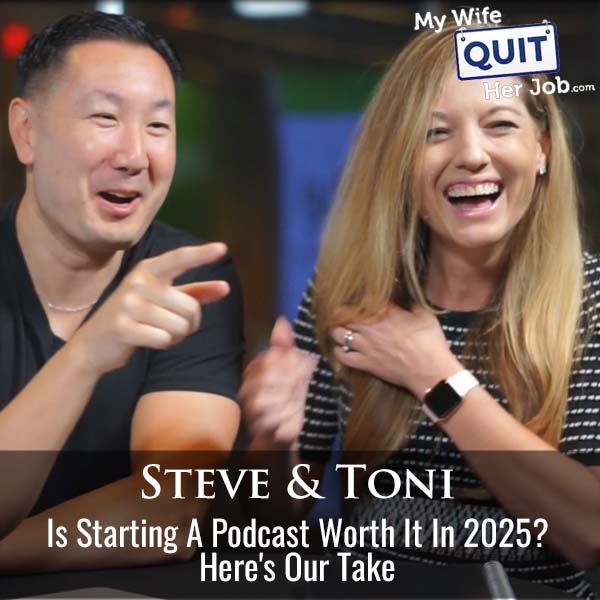
Podcast: Download (Duration: 40:09 — 46.2MB)
Starting a podcast is still worth it in 2025 if your goal is deep audience loyalty, high-trust access to people you cannot otherwise meet, or a warm channel for driving conversions on high-ticket offers. It is probably not worth it if your primary goal is fast growth or short-term reach, in which case YouTube almost always wins on effort-to-audience ratio. After running this podcast for 10 years, my honest take (with co-host Toni Herrbach) is that podcasting rewards patience and consistency in a way that no other medium quite matches, but the discovery mechanics have collapsed and you now have to piggyback on YouTube or TikTok to grow.
If you are staring at your calendar wondering whether to launch a podcast, a YouTube channel, or both, this post walks through the actual tradeoffs, the discovery reality on Apple Podcasts and Spotify, the effort of clipping episodes for social, and the specific business results a podcast can deliver that a YouTube channel cannot.
Below we cover why podcasts are still low barrier to entry, why iTunes and Spotify search are essentially broken, the YouTube and TikTok clip strategy that has become the real growth engine, when to pick YouTube first, and the loyalty and access wins podcasts still create better than any other medium.
Get My Free Mini Course On How To Start A Successful Ecommerce Store
If you are interested in starting an ecommerce business, I put together a comprehensive package of resources that will help you launch your own online store from complete scratch. Be sure to grab it before you leave!
Table of Contents
Key takeaways
- Podcasting has a low technical barrier to entry. You can launch one without a website, hire nobody, and get published on Apple Podcasts in a day.
- Discovery on Apple Podcasts and Spotify is largely broken. Search returns almost nothing useful. Growth today comes from clipping episodes onto YouTube and TikTok.
- To be in the top 10 percent of podcasts you only need a few hundred downloads per episode. Category rankings are easier to crack than the overall charts.
- YouTube usually beats podcasting for pure reach and speed of growth. Toni and I both agree if you can only pick one and your goal is audience size, pick YouTube.
- Podcasts win on listener loyalty. Listeners who spend 30 to 40 minutes with you weekly convert far better on high-ticket offers (courses, events, coaching) than YouTube viewers.
- Podcasts open doors: interviews are the fastest way to build relationships with people who would ignore a cold email. Steve’s original reason for starting was to meet people, and it still works.
- Editing a podcast for YouTube takes real work. Long-form audio-to-video needs someone who can find the clip-worthy moments, which AI tools like Opus have not solved well yet.
Is starting a podcast worth it in 2025?
Starting a podcast in 2025 is worth it if you value long-term relationship-building, loyal audience, and access to guests over fast reach. It is not the best pick if you are optimizing for pure audience size, in which case YouTube is a stronger first move.
The medium itself is not the problem. Podcast listenership keeps growing every year, and what has changed is discovery.
Apple Podcasts and Spotify search are borderline useless for finding new shows, so growing a podcast without an existing audience or a distribution partner (YouTube, TikTok, or a niche community) is significantly harder than it was five years ago.
The right way to frame the decision is not “podcast or nothing.” It is “podcast plus a video distribution channel,” or a YouTube-first strategy that eventually adds a podcast as a second surface for the same content.
How saturated is the podcast market in 2025?
The podcast market is highly saturated at the top and shallow at the bottom, which is actually good news for a serious new creator. There are millions of active podcasts, but most publish infrequently or abandon the show within 10 episodes. To crack the top 10 percent of podcasts by download volume, you typically need only a few hundred downloads per episode.
Category rankings are more accessible than overall rankings. A podcast focused on a specific niche (cottage food business, Pinterest ads, TikTok Shop selling, homeschool curriculum) has a much better shot at ranking well in its category than at cracking the overall charts, because the competition inside a defined vertical is thin.
The Joe Rogan effect is real but distorts the discussion. Rogan podcasts run three hours, break every mainstream rule about attention span, and still dominate.
That does not mean your podcast has to look like his. It means the audience appetite for long-form conversational content is far bigger than the “15-second attention span” narrative suggests.
What is the technical barrier to starting a podcast?
The technical barrier to starting a podcast is very low. You do not need a website, and you do not need to know WordPress.
Modern hosts like Buzzsprout, Podbean, and Anchor handle recording, editing, hosting, and distribution to Apple Podcasts and Spotify in a single dashboard, and most offer usable free tiers.
Compare this to starting a WordPress blog. Most first-time bloggers spend weeks fighting themes, plugins, and design decisions before they ever publish a post, and the site they end up with usually looks worse than what they envisioned. Podcasting skips almost all of that.
The equipment cost is also low. A USB microphone under $150 (Shure MV7 or Rode Podcaster), a quiet room, and free recording software (Audacity, GarageBand) get you to production-quality audio for a first season.
Why podcast discovery on Apple Podcasts and Spotify is broken
Podcast discovery on Apple Podcasts and Spotify is functionally broken in 2025. Their search engines routinely fail to surface obviously relevant episodes. Toni searched Apple Podcasts for “email marketing Black Friday” a couple of months ago and got only two results back, missing well-known shows that had recently published episodes on exactly that topic (including Chase and Jimmy’s Send It podcast).
The failure repeats across niches. A search for “Pinterest ads” returns almost nothing useful, even though multiple established podcasts publish on that topic. If you launch a new podcast and rely on search discovery inside these apps, effectively no one will find you.
The upshot is that “publish and hope” is dead as a growth strategy. Every successful new podcast in 2025 has an external distribution engine: an email list, an existing YouTube channel, a social following, or a partnership with someone who has one.
How to grow a podcast in 2025: YouTube and TikTok clips
The current best way to grow a podcast in 2025 is to distribute clips of episodes on YouTube and TikTok, using either a full-length video upload of the podcast or short-form clips with strong hooks. YouTube has quietly become the largest podcast player in the world, and TikTok’s algorithm surfaces podcast clips to viewers who show topical interest.
The clip strategy works because algorithmic feeds do not care whether a video is from a podcast; they care whether it stops the scroll. If you already run a podcast on the NBA, the Warriors, cottage food businesses, buying an ecommerce business, or any other niche with an active TikTok audience, a well-hooked 60-second clip can pull an entirely new listener base into your feed.
Toni discovered multiple podcasts during Golden Bachelorette season purely from TikTok serving her clips. She had never heard of the shows, never searched for them, and never would have found them through Apple Podcasts search. The clips did the work.
How to clip a podcast for YouTube and TikTok without burning out
The easiest way to clip a podcast for YouTube and TikTok is to keep a notepad next to you during recording and jot down the timestamp any time something quotable happens. That single habit collapses the hardest part of the workflow (finding the clip-worthy moments in a 40-minute recording) into three seconds of writing during the episode itself.
The alternative is paying an editor to find clips for you, which is expensive and hit-or-miss. Most editors are good at cutting, not at spotting the moments an algorithm will amplify.
AI tools like Opus have not solved this yet, either. Testing Opus on our own episodes returned clips that were not the ones a human would have picked.
If you want to publish the full podcast to YouTube (not just clips), the editing bar is higher because you cannot leave two talking heads on camera for 40 minutes. You need B-roll, cutaways, captions, or split-screen. That takes a video editor who does long-form well, which is a different skill from short-form clip editing.
Podcast vs YouTube in 2025: which one to start first
If you can only pick one and your goal is fastest growth, start a YouTube channel. If your goal is deepest listener loyalty and warm conversions on higher-ticket offers, start a podcast. Ideally, do both: record video for YouTube and strip the audio for the podcast feed, so a single production session produces both assets.
Here is how the two channels compare on the axes that actually matter:
| Attribute | Podcast | YouTube |
|---|---|---|
| Technical barrier | Very low | Medium (thumbnails, editing, retention) |
| Discovery mechanism | Weak (broken search on Apple/Spotify) | Strong (algorithm actively distributes) |
| Speed of audience growth | Slow | Fast (once you find a winning topic) |
| Listener/viewer loyalty | Very high (30-40 min per week per listener) | Medium (per-video engagement) |
| Conversion rate on your offers | High (deep trust) | Medium to high (depends on channel) |
| Ad monetization potential | Medium (sponsors, direct reads) | High (AdSense + sponsors + affiliate) |
| Effort per episode | Low to medium (audio only) | Medium to high (video + thumbnail + hook) |
| Best for meeting new people | Excellent (interview format) | Good (but less intimate) |
| Recognition at industry events | Strong (“I know your voice”) | Very strong (“I know your face”) |
Steve’s honest recommendation: if you were starting from scratch in 2025 with no existing audience, start the YouTube channel first, build a following, then launch the podcast once you have an audience to seed the first 500 downloads.
Why podcast listeners are more loyal than YouTube viewers
Podcast listeners are dramatically more loyal than YouTube viewers because they spend 30 to 40 minutes with a single episode, often in a passive-but-focused context (driving, walking, working out) where they are not multitasking or scrolling. That sustained attention builds parasocial trust faster than any other medium.
The commercial upside is real. When I do a workshop, roughly 9 out of 10 attendees discover me through YouTube, and the remaining 1 out of 10 comes from the podcast.
Those podcast listeners convert on higher-ticket offers (Sellers Summit tickets, courses, coaching) at a much higher rate per person than YouTube viewers do.
At Sellers Summit last year, several attendees told me they bought a ticket because they heard me on someone else’s podcast (Andrew Youderian’s Ecommerce Fuel, primarily). That is a $800 to $1,500 ticket, plus travel and hotel, purchased sight unseen because a trusted podcast host made an endorsement. YouTube almost never drives that kind of conversion because the trust relationship is thinner.
Why running a podcast opens doors nothing else does
Running a podcast opens professional doors that email, DMs, and cold outreach cannot, because “come on my podcast” is one of the few asks a busy expert is happy to say yes to. Steve started this podcast in 2014 specifically to meet interesting people in ecommerce, and after 10 years it is still the single best door-opener he owns.
Our student David Crabill runs a niche podcast on the cottage food business (fewer than 100,000 total addressable listeners) and it has generated speaking invitations, other podcast appearances, and introductions to people he never would have reached otherwise. Downloads are not the point. Access is.
If you are trying to build relationships in an industry, “will you come on my show” is the highest-yield outreach line available. Even a small podcast (a few hundred downloads per episode) is enough leverage for the ask, because the guest values the recorded conversation and the trust signal, not the raw audience size.
Solo podcast vs interview podcast: which is easier?
For most first-time podcasters an interview podcast is easier than a solo podcast, because doing background prep on one guest and asking follow-up questions requires less structure than talking to a camera alone for 40 minutes. The mental hurdle of a solo episode (script, teleprompter, staying on track) stops most people before they publish.
The counterview is real, though. Andrew Youderian of Ecommerce Fuel says interviews are more work for him because he does heavy pre-interview research on every guest to avoid asking the same questions everyone else has asked. Steve did the same before interviewing Robert Cialdini, listening to a large chunk of Cialdini’s prior interviews to find angles nobody had covered.
Solo podcasters like Shalene Johnson can record 40 minutes off an outline while walking or riding in an Uber, but that comes from years of practice and a specific gift for conversational structure. Most creators are not there on day one.
Frequently asked questions
How many downloads do you need to be in the top 10 percent of podcasts?
You need only a few hundred downloads per episode to be in the top 10 percent of podcasts globally. Rankings within a specific category are usually even easier to crack, because most active shows publish infrequently or abandon within the first year.
What equipment do you need to start a podcast in 2025?
A USB microphone under $150 (Shure MV7, Rode Podcaster, or similar), a quiet room, free recording software (Audacity, GarageBand, or Zoom for interviews), and a podcast host like Buzzsprout, Podbean, or Anchor. Total startup cost can be under $200, and you can publish to Apple Podcasts and Spotify from your host’s dashboard.
Do I need a website to launch a podcast?
No. Modern podcast hosts create a landing page for your show, submit your feed to Apple Podcasts and Spotify, and handle distribution. A dedicated website becomes useful later for SEO, show notes, and email capture, but it is not required to launch.
Should I start a podcast or a YouTube channel first?
If your goal is fastest audience growth, start a YouTube channel first. If your goal is deep listener loyalty and warm conversions on higher-ticket offers (courses, coaching, events), a podcast wins per-listener. Ideally, record video for YouTube and strip the audio for the podcast feed so one production session yields both.
How do you grow a podcast when Apple Podcasts search is broken?
Grow a podcast in 2025 by clipping episodes onto YouTube and TikTok, publishing full-length video versions on YouTube, guesting on other podcasts in your niche, and building an email list you can announce new episodes to. Publishing and waiting for iTunes search to find you does not work anymore.
Is it easier to do a solo podcast or an interview podcast?
An interview podcast is usually easier for first-timers because the guest carries a share of the conversation and you only need to prep questions plus background research. Solo podcasts require holding a 30 to 40 minute monologue on your own, which is a skill most creators develop over dozens of episodes.
Can AI tools like Opus find good podcast clips for me?
AI clipping tools like Opus can extract clips, but in practice they miss the moments a human would pick as the best clip. As of 2025, the reliable workflow is still to jot down timestamps during recording whenever something clip-worthy happens and pull those exact clips after the episode.

